Crypto Glossary: 140+ Crypto Terms Explained, From Bitcoin And Altcoins To DeFi, Layer 2 And On-Chain Data


The crypto market is no longer a simple game of a few ideas like Bitcoin and altcoins. Futures trading, DeFi, Layer 2 networks, AI-linked tokens and new reward models have all expanded the vocabulary, and each one brings terms that newcomers meet every day. Misreading those terms can lead you to misjudge how the market works, take positions without control and lose your edge from the start.
This crypto glossary gathers more than 140 terms in one place, written to be short and easy to follow. It runs from the basics every beginner needs to the advanced vocabulary used by traders and on-chain analysts, grouped by topic so you can jump to the section you need. Each section opens with quick definitions of related terms, then explains the core terms under their own headings, with two reference tables for on-chain metrics and airdrop stages. Backcom.io put it together to help readers approach crypto more methodically, avoid unnecessary risk and build better trading habits over time.
Crypto Terms For Beginners: The Basics
These are the foundation terms you need before you take part in the crypto market. Knowing them well helps you avoid most beginner mistakes when you read news, join communities or start trading. Start with these quick definitions:
- Crypto (cryptocurrency): a digital asset built on blockchain technology and not controlled by any central bank or single organisation. People use it to store value, make transfers, invest or interact with decentralised applications, and our beginner guide to crypto explains how it works in more depth.
- Circulating supply and total supply: circulating supply is the number of tokens currently trading in the market, while total supply is the number created so far, before any that may be minted later. Both figures affect a token's value and how much future dilution holders may face.
- Whitepaper: a project's official document describing its technology, goals, tokenomics and roadmap. Read it before you consider holding any token for the long term.
- CEX and DEX: a centralised exchange (CEX), such as Binance or OKX, is run by one company that holds your funds while you trade. A decentralised exchange (DEX) lets you trade directly from your own wallet without an intermediary. The trade-offs are covered in centralised vs decentralised exchanges.
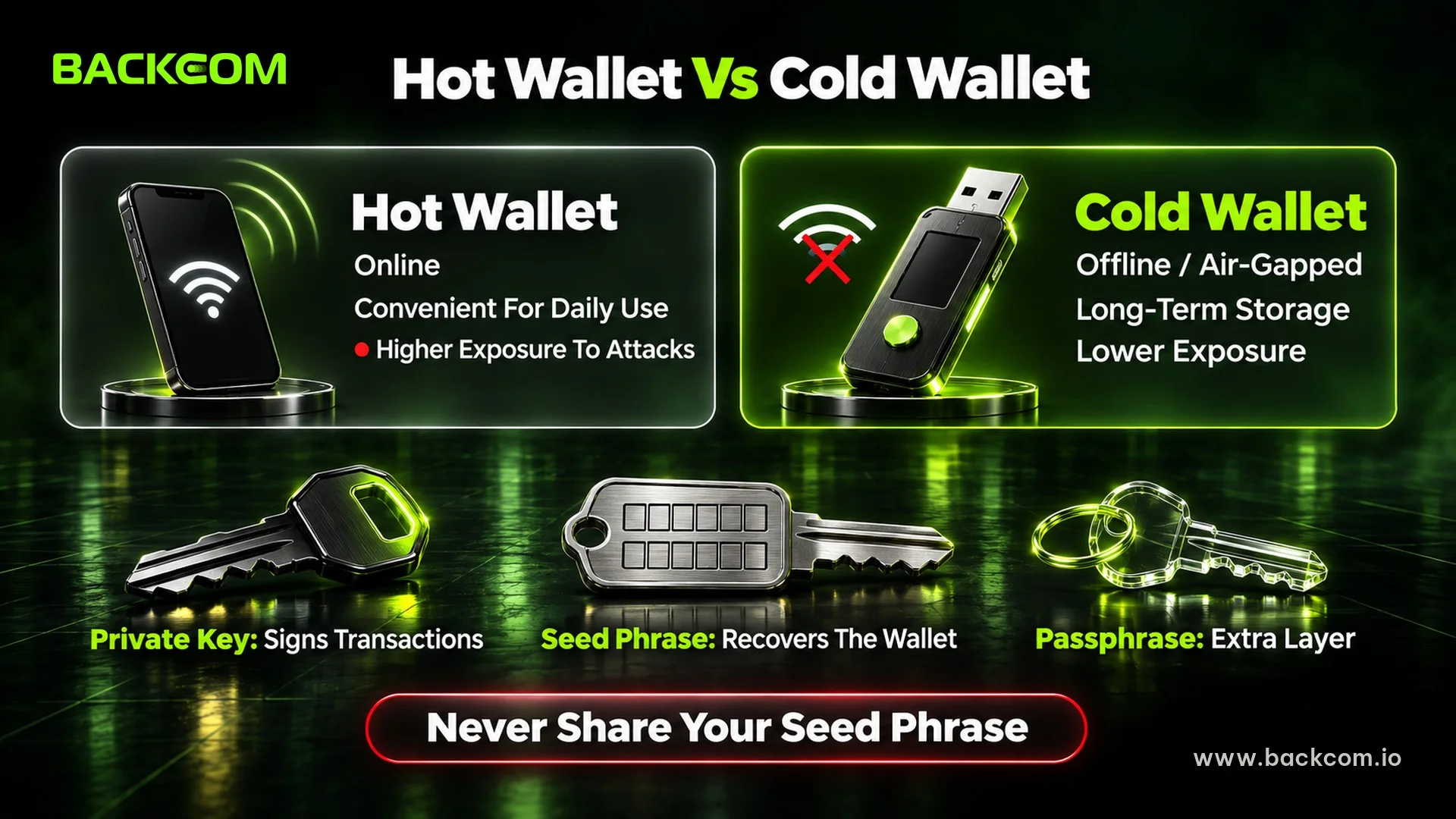
- Crypto wallet: where you store and manage your crypto assets. A hot wallet is connected to the internet and convenient for frequent transactions, while a cold wallet is kept offline and is more secure for long-term storage.
- ATH and ATL: the all-time high is the highest price an asset has ever reached, and the all-time low is the lowest price ever recorded. Traders use both levels to judge where an asset sits in its cycle and how sentiment has shifted.
- FOMO and FUD: FOMO (fear of missing out) is the urge to buy because others seem to be profiting, which often leads to buying the top. FUD (fear, uncertainty and doubt) is negative news that spreads panic and often leads to selling the bottom. These two emotions shape beginner decisions more than anything else.
Blockchain
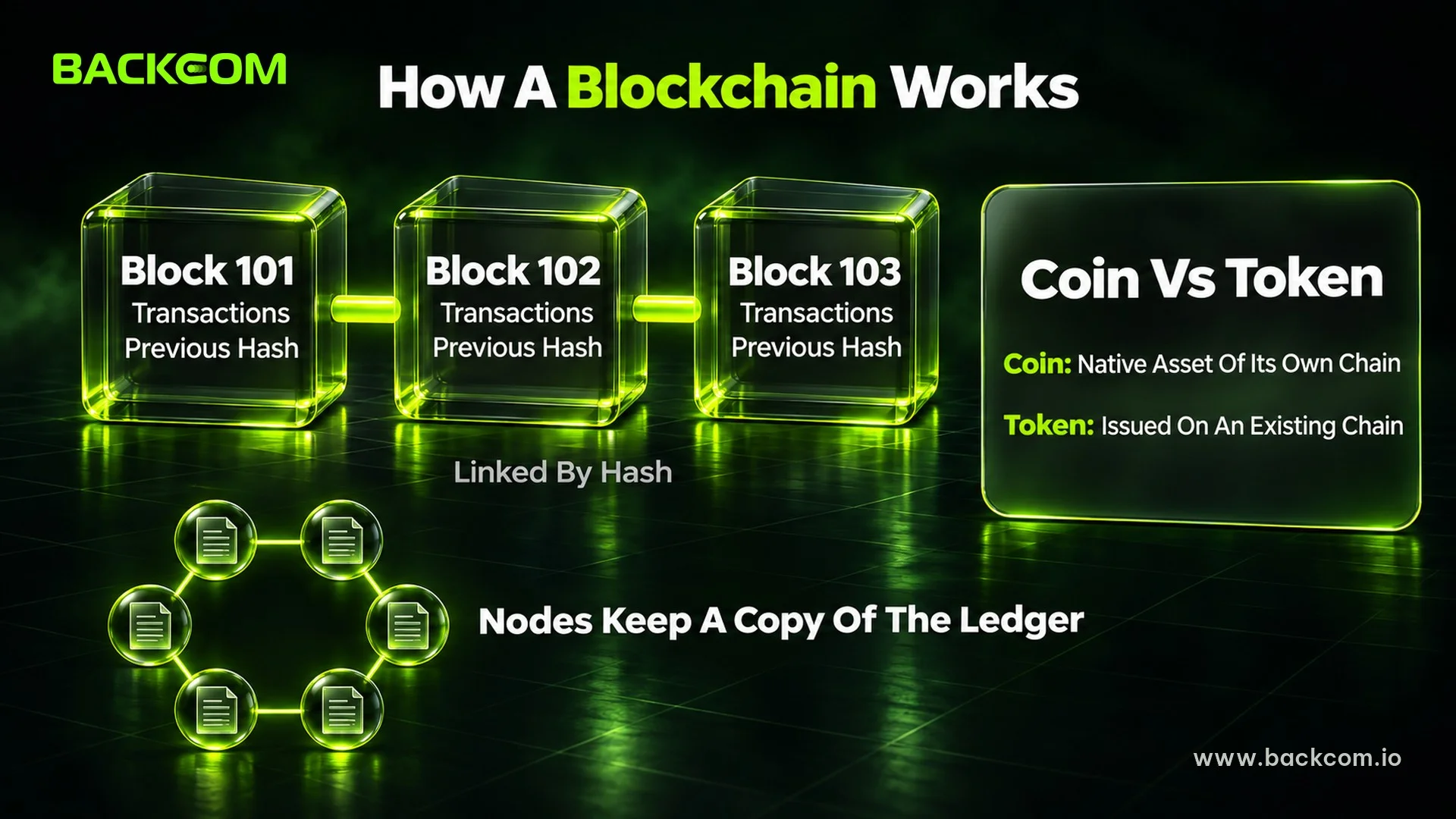
A blockchain is a distributed ledger where every transaction is recorded publicly, transparently and in a way that is practically impossible to edit. Each block holds transaction data and links to the previous block, forming a chain.
Bitcoin (BTC)
Bitcoin is the first cryptocurrency and the largest by market value, often seen as the backbone of crypto. According to the Bitcoin FAQ, only 21 million bitcoins will ever be created. In practice, Bitcoin's direction often sets the tone for the rest of the market.
Altcoin
An altcoin is any cryptocurrency other than Bitcoin. Altcoins usually swing more than BTC, which brings higher risk along with sharper moves in both directions.
Coin Vs Token
- Coin: the native asset of its own blockchain, such as BTC, ETH or SOL.
- Token: an asset issued on an existing blockchain (ERC-20, BEP-20 and others), often used for DeFi, gaming, governance or utility.
Stablecoin
A stablecoin is a cryptocurrency pegged to a stable asset such as the US dollar, with USDT and USDC as the best-known examples. Traders use stablecoins to reduce volatility, lock in profit and move capital quickly. See what is a stablecoin for the different types and their risks.
Market Cap
Market cap = current price × circulating supply. It shows the size and influence of a project far better than the price of a single coin on its own.
Tokenomics
Tokenomics describes how a token is allocated, issued and used: total supply, unlock schedule and the shares for the team, investors and community. Weak tokenomics is a common reason a token's price falls sharply.
Private Key And Seed Phrase
- Private key: the secret key that controls the assets in a wallet.
- Seed phrase: the list of words used to recover a wallet.
Losing your private key or seed phrase means losing access to the assets for good, with no way to recover them.
Gas Fee
A gas fee is the transaction fee paid to miners or validators for processing a transaction on a blockchain. When the network is congested, gas fees can rise sharply, and exchanges add their own charges on top, as explained in crypto withdrawal fees.
A solid grasp of these basic terms lets you read the market, avoid misunderstandings and limit risk from day one. It is the foundation you need before moving on to spot and futures trading or more advanced strategies.
Bitcoin And Market-Wide Terms
Bitcoin and the wider market steer the whole crypto ecosystem. Understanding the terms below helps you follow market cycles, money flows and investor psychology, and explains why prices rise and fall, instead of reading charts on gut feeling alone. The supporting terms come first, in brief:
- Market cycle: the crypto market usually runs through four phases: accumulation, growth, distribution and decline. Knowing where you are in the cycle helps you avoid buying the top and selling the bottom.
- Smart money: capital from institutions, funds and professional investors. Its behaviour often shows up before a major trend becomes obvious to everyone else.
- Liquidity: how easily an asset can be bought or sold without moving its price much. High liquidity keeps the market stable, while thin liquidity makes sharp swings more likely, as our guide to liquidity in crypto shows through slippage and fees.
- Volatility: how much a price moves over a given period. Crypto is highly volatile, which creates large opportunities but comes with equally large risk.
- Supply and demand: supply is the amount of Bitcoin that holders are ready to sell, and demand is the buying pressure coming from the market. The price rises when demand exceeds supply and falls when supply exceeds demand.
- Market sentiment: the general mood of investors, from greed to fear to neutral. It is often measured with the Fear and Greed Index explained below.
- Risk-on and risk-off: in risk-on phases investors accept risk and favour volatile assets such as crypto. In risk-off phases they avoid risk and prefer cash or safer assets.
- Correlation: how crypto, and Bitcoin in particular, moves together with traditional markets such as stocks, interest rates and the US dollar. It helps you judge how macro events may affect the price of BTC.
- Capitulation: a wave of panic selling, usually near the bottom of a cycle. It is a high-risk moment, but it can also hide long-term opportunity for patient investors.
Bitcoin Dominance (BTC.D)
Bitcoin dominance is Bitcoin's share of the total crypto market value.
- Rising BTC.D: money is favouring Bitcoin, and altcoins usually look weak.
- Falling BTC.D: capital is starting to move into altcoins, which can open the way to altseason.
Bull And Bear Market
A bull market is a long period of rising prices, optimism and steady inflows. In a bull market, Bitcoin usually leads and the move then spreads to altcoins.
A bear market is a long period of falling or sideways prices in which pessimism dominates. It is the phase that clears out weak projects and when patient investors accumulate for the next cycle.
Halving
Halving is the event that cuts the Bitcoin mining reward in half, roughly every four years. It reduces the supply of new BTC and has often been followed by a long growth phase, although past cycles do not guarantee future ones.
Whale
A whale is an individual or organisation holding a very large amount of Bitcoin or another asset. Whales can move prices sharply through large trades.
Fear And Greed Index
The Fear and Greed Index measures how fearful or greedy the crypto market is, and you can follow it on our Fear & Greed Index tool.
- Extreme fear: the market is pessimistic and often closer to a bottom.
- Extreme greed: the market is euphoric and more prone to forming a top.
The Bitcoin and market-wide terms help you read cycles, money flows and sentiment, so your decisions rest on evidence rather than emotion or rumours.
Crypto Trading And Futures Terms
Many newcomers move from buying coins to trading derivatives, where leverage multiplies both gains and losses. Each term below links to a full guide, so the definitions stay short:
- Spot vs futures: spot means buying the asset itself, while futures are contracts on its price. See spot vs futures trading.
- Perpetual futures: futures with no expiry date, kept close to the spot price through funding payments. See what are perpetual futures.
- Leverage: borrowed exposure that lets a small margin control a larger position. See leverage in crypto trading.
- Margin call: a warning that your margin is close to the maintenance level. See crypto margin call explained.
- Funding rate: the periodic payment between longs and shorts on perpetual contracts. See what is the funding rate.
- Open interest: the total value of futures positions still open. See open interest in crypto futures.
- Liquidation price: the price at which the exchange closes a leveraged position. See how to calculate liquidation price.
- Liquidation cascade: forced closures that trigger more forced closures. See what is a liquidation cascade.
- Short squeeze: a fast rally that forces short sellers to buy back. See what is a short squeeze.
- Insurance fund: the reserve an exchange uses to cover losses beyond a trader's margin. See the insurance fund in crypto futures.
- Maker and taker fees: makers add orders to the book, takers remove them, and each pays a different fee. See maker vs taker fees.
- Slippage: the gap between the expected price and the fill price. See slippage in crypto.
- Order types and stop loss: limit, market and trigger orders, plus the stop that caps a loss. See crypto order types and crypto stop loss.
Altcoin Terms And Market Narratives
Altcoins are where crypto produces its sharpest moves, especially when money leaves Bitcoin to look for new opportunities. The terms below explain how altcoins behave, how money rotates and which narratives have shaped the 2025–2026 cycle, so you avoid confusion and blind trend-chasing. Related terms in brief:
- Sector: a group of altcoins working in the same field, such as DeFi, AI, Layer 2 or gaming. Money often rotates by sector rather than token by token.
- AI coin: an altcoin linked to artificial intelligence, from computing infrastructure and data to AI models and AI applications on blockchain. It has been one of the major narratives of the 2024–2026 period.
- RWA (real-world assets): the trend of tokenising real-world assets such as property, bonds, shares and commodities. It is seen as a bridge between traditional finance and crypto.
- DePIN (decentralised physical infrastructure network): a model that uses blockchain and tokens to decentralise physical infrastructure such as internet access, storage and energy.
- Layer 2 altcoin: the token of a project that builds scaling solutions for a base blockchain, lowering fees and speeding up transactions. This group tends to benefit when blockchain usage grows strongly.
- Low cap and mid cap: low-cap altcoins have a small market value, large upside swings and high risk. Mid-cap altcoins have a medium market value and a more balanced mix of risk and potential.
- VC-backed: altcoins funded by venture capital firms. These projects usually have strong resources but carry the risk of heavy selling when investor tokens unlock.
- Pump and dump: pushing a price up quickly through hype or manipulation, then selling hard so the price collapses. It is a common risk in the altcoin market and a classic red flag of the schemes described in how to avoid crypto exchange scams.
- Bag holder: an investor who bought an altcoin near the top, failed to exit in time and is left holding it after a deep fall.
Altseason
Altseason is a period when a broad group of altcoins outperforms Bitcoin, often with sharp moves that can reverse just as fast. It usually appears once money has settled in Bitcoin and starts hunting for higher returns.
Narrative And Rotation
A narrative is the theme or story that steers money in a given period. Altcoins rarely rise on technology alone, and they rally when they fit the narrative the market is paying attention to.
Rotation is the way money keeps moving from one group of altcoins to another. Understanding rotation helps traders avoid holding an asset whose move is over, or buying just as money is about to leave.
Meme Coin
A meme coin is an altcoin driven by community, social media and speculation rather than technology. Meme coins can rise very quickly but also collapse when the money flows out.
Token Unlock
A token unlock releases tokens to the team, early investors or funds. It can create heavy selling pressure if supply rises suddenly.
Fully Diluted Valuation (FDV)
FDV is the theoretical market value if every token were already in circulation. An FDV far above the current market cap can signal future dilution.
Understanding altcoin terms and the current narratives helps you read where money is heading and judge risk before you take part, rather than chasing whichever coin is trending on social media.
DeFi Terms In The New Cycle
In this cycle, DeFi is no longer just "yield farming". It now covers decentralised financial infrastructure, on-chain governance and capital efficiency. These DeFi terms explain how the sector works at its core, so you are not confused when you meet new protocols. The supporting vocabulary, in short:
- Protocol: the set of rules and smart contracts behind a DeFi application. When you use DeFi, you are not just using an app but interacting directly with the protocol.
- Liquidity mining: rewarding users with tokens for providing liquidity or joining a protocol early. It is the main tool DeFi projects use to attract users in their early stages.
- Oracle: a service that feeds data from outside the blockchain, such as asset prices or interest rates, into smart contracts. A faulty oracle can put an entire protocol at serious risk.
- Collateral: an asset locked to secure a loan or a DeFi position. Its value determines how safe the position is.
- Overcollateralisation: requiring collateral worth more than the loan, to protect the protocol from sharp price swings. It is a standard feature of DeFi lending platforms.
- DAO (decentralised autonomous organisation): an organisation that makes decisions through on-chain voting with governance tokens instead of a traditional board.
- Governance token: a token that lets holders vote on key changes such as fees, budget allocation and protocol upgrades. It represents governance power, not only speculative value.
- Permissionless: anyone can use a DeFi protocol without registering, verifying their identity or asking for permission.
- Trustless: this does not mean "trust no one". It means you do not need to trust people, only the code and the rules of the smart contract.
- Bridge: a tool that moves assets between different blockchains. It is key infrastructure for multi-chain DeFi but also one of the biggest security weak points.
- Restaking: reusing assets that are already staked to help secure additional protocols. It is a newer trend aimed at making staked capital work harder.
DeFi (Decentralised Finance)
DeFi is a decentralised financial ecosystem where users can borrow, lend, trade and manage assets without banks or intermediaries. Every action runs automatically through code on a blockchain.
Smart Contract
A smart contract is an agreement written in code that executes automatically and usually cannot be changed after deployment. It is the core building block that lets DeFi run transparently without trusting people.
TVL (Total Value Locked)
TVL is the total value of assets locked in a DeFi protocol. A higher TVL usually reflects:
- the level of trust users place in the protocol;
- the amount of liquidity and how much the protocol is actually used.
Impermanent Loss
Impermanent loss is the temporary loss that occurs when the prices of assets in a liquidity pool move sharply compared with when you deposited them. Newcomers often underestimate it, so real returns end up lower than expected.
Flash Loan
A flash loan is a loan with no collateral that must be repaid within the same block. Flash loans are used for arbitrage, restructuring positions and, unfortunately, for exploiting protocol bugs.
MEV (Maximal Extractable Value)
MEV is the value that validators or bots can extract by reordering transactions. It directly affects costs, execution prices and fairness in DeFi.
These DeFi terms help you spot hidden risks, judge the quality of a protocol and avoid the trap of illusory yields. In the new cycle, DeFi rewards people who understand its structure and real money flows, not those chasing the highest advertised return.
Layer 2 And Blockchain Infrastructure Terms
As blockchain usage grows, congestion, high fees and slow confirmations become major barriers. Layer 2 networks and new infrastructure aim to solve scaling, performance and user experience. The terms below help you understand how blockchains work behind the scenes, rather than only watching token prices. Quick definitions first:
- Scalability: a blockchain's ability to handle more transactions without raising costs or confirmation times. It is essential if a network is to serve millions of users.
- Throughput: the number of transactions a blockchain can process per unit of time. High throughput keeps the network running smoothly even when demand surges.
- Finality: the point at which a transaction is considered complete and cannot be reversed. Fast finality gives users confidence that a transfer is truly confirmed.
- Consensus mechanism: how network nodes agree on the state of the blockchain. It directly affects security, speed and how decentralised the network is.
- Validator: a node that verifies transactions and protects the network. Validators are central to modern blockchains and earn rewards when they behave correctly.
- Data availability: the ability for anyone to access transaction data so they can verify it. Without it, a system can lose its transparency.
- Settlement layer: the layer that gives final confirmation and resolves disputes. In multi-layer designs, Layer 1 usually plays this role.
- Execution layer: where transactions run, smart contracts execute and state is updated. Layer 2 networks often take on this role to improve performance.
- Interoperability: the ability of different blockchains to communicate and work together. It is the foundation for a healthy multi-chain ecosystem.
- Decentralisation: how widely control of a network is spread, so that no single entity holds it. It directly affects security and resistance to censorship.
Layer 1 And Layer 2
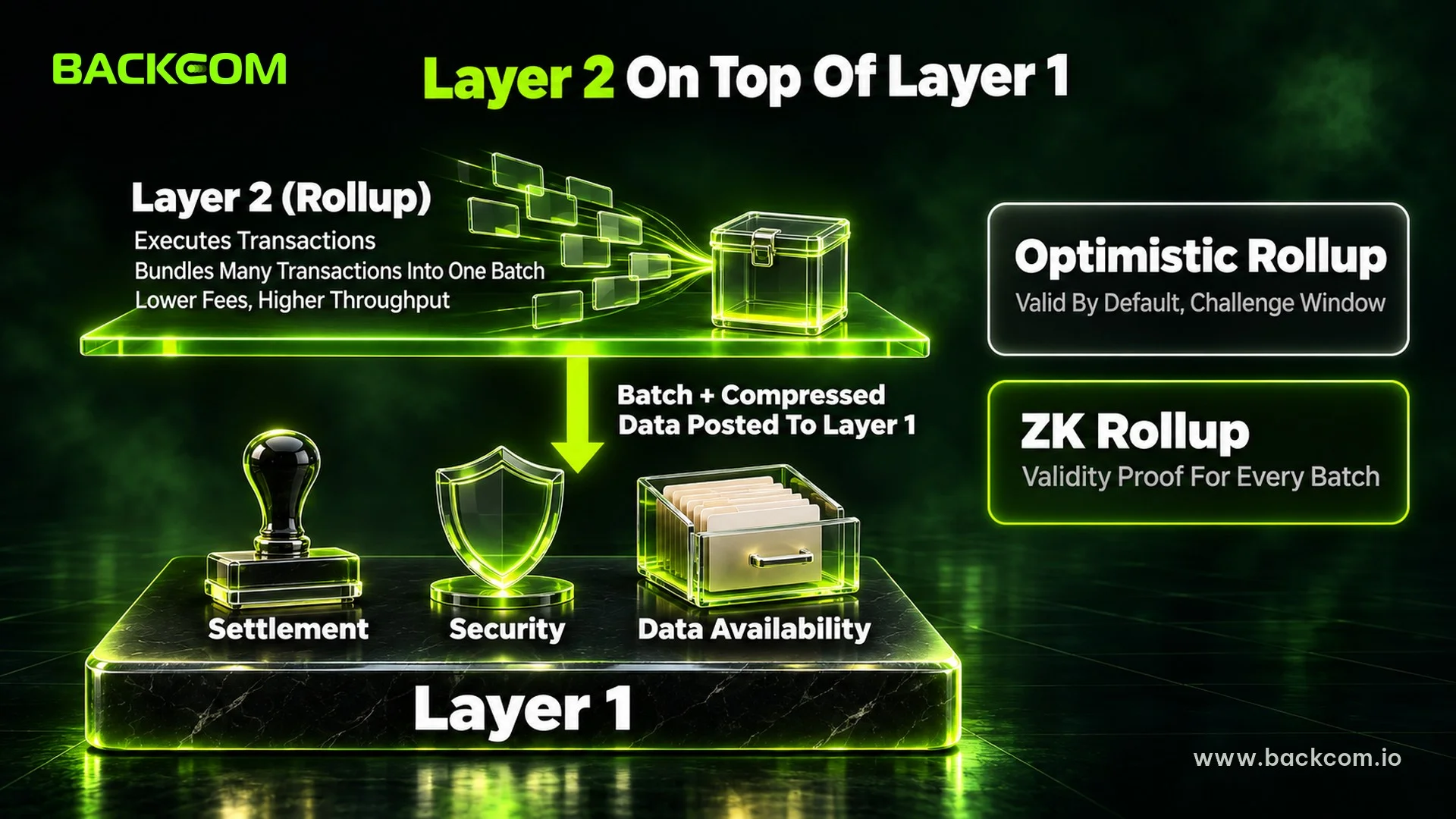
Layer 1 is the base blockchain, where transactions are processed and confirmed directly. Everything in the ecosystem starts on Layer 1, but an L1 often hits limits on speed and cost as usage grows.
A Layer 2 is a scaling solution built on top of a Layer 1. It processes transactions off the main chain and sends the results back to the L1 for confirmation, cutting fees and raising speed while inheriting the L1's security.
Rollup
A rollup is a Layer 2 design that bundles many transactions into one batch and posts compressed data to Layer 1. This significantly reduces cost and load on the base chain.
Optimistic Vs ZK Rollup
- Optimistic rollup: assumes transactions are valid by default and checks them only if someone raises a challenge. This lowers costs but requires a waiting period for safety.
- Zero-knowledge rollup (ZK rollup): uses cryptographic proofs to confirm that transactions are valid without publishing all of the underlying data. It is highly regarded for speed and security.
Modular Blockchain
A modular blockchain separates functions such as transaction execution, data storage and security into different layers. This makes the ecosystem more flexible and easier to scale than a monolithic chain.
Understanding Layer 2 and infrastructure terms helps you judge the real technical value of a project and tell lasting scaling solutions apart from short-lived narratives.
Airdrop And Incentive Programme Terms

In recent cycles, airdrops and user incentive programmes have become a common way for projects to build communities, distribute tokens and create early liquidity. Knowing these terms helps you take part properly and avoid wasting time on campaigns that lead nowhere. A few related terms first:
- Incentive programme: a scheme that rewards users with points, tokens or special benefits to encourage them to use a product in its early stage.
- Early user: someone who joined a project at a very early stage and is often prioritised in token distribution and long-term benefits.
- Anti-Sybil: measures that prevent cheating, for example by requiring transaction history, genuine activity or indirect identity checks so that distribution stays fair.
- Airdrop farming: the systematic use of a project to maximise the chance of an airdrop. Done badly, it costs fees and effort and brings no reward.
Airdrop
An airdrop distributes free tokens to users who meet criteria set by the project. Its main goal is to grow the community and spread token ownership. Most campaigns use the same vocabulary from the first interaction to the final unlock:
| Term | What it means | Why it matters |
|---|---|---|
| Points system | Tracks user activity such as trading, providing liquidity or regular interaction | Points may later convert into tokens, but projects rarely guarantee it |
| Testnet reward | Goes to users who test a network before its mainnet launches | A common source of airdrops for infrastructure projects |
| Eligibility | The criteria a wallet must meet, such as transaction count, length of use, value of activity or specific actions | Wallets that miss the criteria do not receive the airdrop |
| Whitelist | A list of wallets given priority for an airdrop, a testnet or an early token sale | Not being on it often means you do not qualify or receive less |
| Claim | Collecting airdropped tokens into your wallet once the project opens distribution | If you miss the deadline, the reward can be lost permanently |
| Vesting | Releasing tokens in stages instead of all at once | Limits selling pressure right after an airdrop |
| Lock-up | A period when tokens cannot be traded or transferred | Usually applies to large rewards or early users |
Retroactive Airdrop
A retroactive airdrop rewards users who used a project before any token was announced. Early participants usually receive larger rewards.
Snapshot
A snapshot is the moment a project records on-chain data to decide which wallets qualify. Anything you do after the snapshot no longer affects the result.
Sybil Attack
A Sybil attack is the use of many fake wallets to game airdrop rewards. Projects now use a range of methods to detect and remove this behaviour.
These airdrop terms help you judge the real value of a campaign, avoid chasing illusory rewards and spend your time and fees wisely.
On-Chain Analysis And Data Terms
On-chain data reflects what market participants actually do, unaffected by news, influencers or crowd emotion. The terms below help you read money flows, holding periods and buying or selling pressure through data recorded directly on the blockchain. For practical research tools, see our tools hub. Three basic terms first:
- On-chain: all data recorded directly on a blockchain, including transactions, holding times, coin status and asset movements. Unlike technical analysis, on-chain data shows real actions, not price expectations.
- Address: a blockchain wallet location used to send and receive assets. Studying the number and behaviour of addresses shows how much a network is really used.
- On-chain divergence: price and on-chain data moving in opposite directions. For example, a rising price with weakening on-chain activity often signals that the trend is not sustainable.
On-Chain Analysis
On-chain analysis studies blockchain data such as transactions, wallets, holding periods and profit or loss status to judge investor behaviour and market health. These are the activity and holder metrics analysts check most often:
| Metric | What it measures | How traders read it |
|---|---|---|
| Active addresses | The number of addresses that transacted within a given period | Reflects real use of a blockchain rather than price speculation alone |
| Transaction count | The number of transactions on a blockchain over a period | Shows real usage and does not depend on price |
| Transaction volume | The total value of assets transferred on a blockchain | Rising volume shows large money at work, which matters most during accumulation or distribution |
| Dormancy | The average age of coins at the moment they are spent | Rising dormancy shows older coins are being sold, which often happens near cycle tops |
| Mean coin age | The average age of all coins on the network | A rising figure is a sign of accumulation, while a falling one means coins are starting to circulate quickly |
| Spent volume | The amount of coins spent at a given price level | Shows where holders are willing to sell, which helps map on-chain support and resistance |
| Miner revenue | Income miners earn from block rewards and transaction fees | Miner selling tends to rise when revenue drops sharply, which can affect short-term supply |
| Network growth | How fast new users join a blockchain | A key indicator of organic expansion that does not depend on speculation |
SOPR (Spent Output Profit Ratio)
SOPR measures whether coins are sold at a profit or a loss at the moment they are spent.
- SOPR above 1: investors are taking profit.
- SOPR below 1: investors are selling at a loss.
Realized Price And Realized Cap
Realized cap values each coin at the price it last moved on-chain, rather than at today's price. It estimates the value the market has actually paid and filters out short-term price noise.
Realized price is the average price at which all coins on the network last moved, based on on-chain data. Comparing market price with realized price helps you judge:
- whether the market as a whole is in profit or at a loss;
- whether prices look cheap or expensive relative to the cycle.
UTXO (Unspent Transaction Output)
A UTXO is an amount of coin not yet spent since its last transaction, and every bitcoin exists as UTXOs. Analysing UTXOs shows:
- whether coins are sitting still or circulating;
- whether the market is accumulating or distributing.
Coin Days Destroyed (CDD)
CDD measures the total "holding days" reset when coins are spent.
- High CDD: long-held coins are moving, a possible sign of distribution.
- Low CDD: long-term holders keep holding.
Mastering on-chain analysis terms helps you read real market behaviour, recognise accumulation and distribution, and avoid emotional decisions during volatile phases.
Crypto Wallet And Security Terms
Asset security is a matter of survival in crypto. Most losses come not from price swings but from poor key management, mistakes or psychological attacks. The terms below focus on protecting assets at both the technical and the behavioural level. The supporting terms at a glance:
- Keypair: a public key and a private key created together and linked mathematically. The public key is used to receive assets, the private key signs transactions, and whoever controls the private key controls all of the assets.
- Signing: proving ownership of assets with a private key. Every crypto transaction must be validly signed, or the network rejects it.
- Hardware signing device: a physical device that stores the private key apart from the internet. Transactions are signed inside the device, which reduces the risk of keys being stolen by malware.
- Air-gapped: a device that never connects to the internet. It is considered one of the most secure ways to store high-value assets.
- Passphrase: an extra security layer that works like a second password. Even if the seed phrase leaks, an attacker cannot access the assets without it.
- Backup strategy: your plan for backing up keys, covering the number of copies, where each copy is stored and how to recover if something goes wrong. Poor backups are a common reason assets are lost forever.
- Dusting attack: sending very small amounts to many addresses to track how they transact, which breaks privacy or prepares a follow-up attack.
- Social engineering: a psychological attack that exploits a lack of knowledge or haste. It is the most common form of attack and hard to avoid without awareness.
- Operational security (OpSec): a set of security habits, such as not revealing how much you hold, not using unfamiliar devices to sign transactions and separating wallets by purpose.
Multisignature (Multi-Sig)
Multisignature requires several valid signatures before a transaction goes through, for example two of three. Multi-sig reduces the risk of:
- one person losing a key;
- a single point of failure.
MPC (Multi-Party Computation)
MPC splits a private key into several parts so that no single party holds the whole key. A transaction is signed only when enough parties take part, which suits organisations and large funds.
Smart Contract Approval And Revoke
An approval is the permission you give a smart contract to spend your tokens. Many users lose funds because they forget to revoke approvals given to malicious or hacked contracts.
To revoke is to withdraw a permission previously granted to a smart contract. It is a routine security task, especially for people who use DeFi often.
Phishing
Phishing steals information through fake websites, fake links, emails or impersonation messages. In crypto, signing one wrong transaction can be enough to lose everything, so the warning signs in how to avoid crypto exchange scams are worth learning.
Address Poisoning
Address poisoning sends tiny transactions from an address that looks almost identical to one you use, so you copy the wrong address and send funds to the attacker next time.
Cold Storage Strategy
A cold storage strategy keeps long-term assets offline and limits on-chain interaction to a minimum. It suits assets you do not trade often.
Understanding these security terms helps you keep your money before you think about making more. Profit can come later, but one security mistake is enough to lose everything, and nobody will refund you if you make it.
Frequently Asked Questions (FAQ) About Crypto Terms
Which Crypto Terms Should Beginners Learn First?
Start with the basics in the first section: blockchain, Bitcoin, altcoin, coin vs token, stablecoin, wallet, private key and seed phrase. Then learn market cap, tokenomics and the CEX and DEX difference. Those terms cover most of what you will read in news and exchange interfaces, and they make the more advanced DeFi and on-chain sections much easier to follow.
What Is The Difference Between Market Cap And FDV?
Market cap multiplies the current price by the circulating supply, so it reflects the tokens trading today. FDV multiplies the same price by the full supply, as if every locked token were already circulating. A large gap between the two signals future dilution, because more tokens will reach the market as they unlock.
What Is The Difference Between A Hot Wallet And A Cold Wallet?
A hot wallet stays connected to the internet, which makes trading and transfers convenient but exposes keys to online attacks. A cold wallet keeps keys offline, often on a hardware device, so it is safer for long-term holdings. Many people use a small hot wallet for daily activity and keep larger balances in cold storage.
Why Do Token Unlocks Matter To Traders?
A token unlock adds new supply from the team, investors or funds to the market. If demand does not rise at the same time, that extra supply can weigh on the price. Check a project's tokenomics and unlock calendar before holding a token, especially when FDV is far above market cap.
Conclusion: Use This Crypto Glossary As Your Foundation
The crypto market is no longer a game of luck or rumours. It rewards knowledge, a correct understanding of how things work and sound risk management. The vocabulary keeps growing, from Bitcoin and altcoins to futures, DeFi, Layer 2, on-chain data and wallet security, and not knowing the terms means entering the market half blind.
This crypto glossary brings together the terms any investor or trader will meet in the crypto market. Once you know them, you can read news, analysis and on-chain data more confidently, and avoid many of the common mistakes that cause beginners to lose money.
In a market as volatile as crypto, understanding the terms will not make you rich quickly, but it helps you stay in the market long enough to have a real chance. That is the main advantage of people who approach crypto with method and discipline.
Disclaimer: This content is compiled by Backcom.io for information only and is not investment advice. Crypto assets and leveraged products are highly volatile and can lead to the loss of your capital.
Was this article helpful?
Join The Backcom.io Community
Get the latest on trading rebates, trading tips, and broker deals — and connect with thousands of traders worldwide.

Backcom App
Track Your Rebates Every Day
Every rebate is visible by broker and by day. Manage your wallet and withdrawals in one place.
Open Backcom App