What Is An Insurance Fund In Crypto Futures And How Does It Work

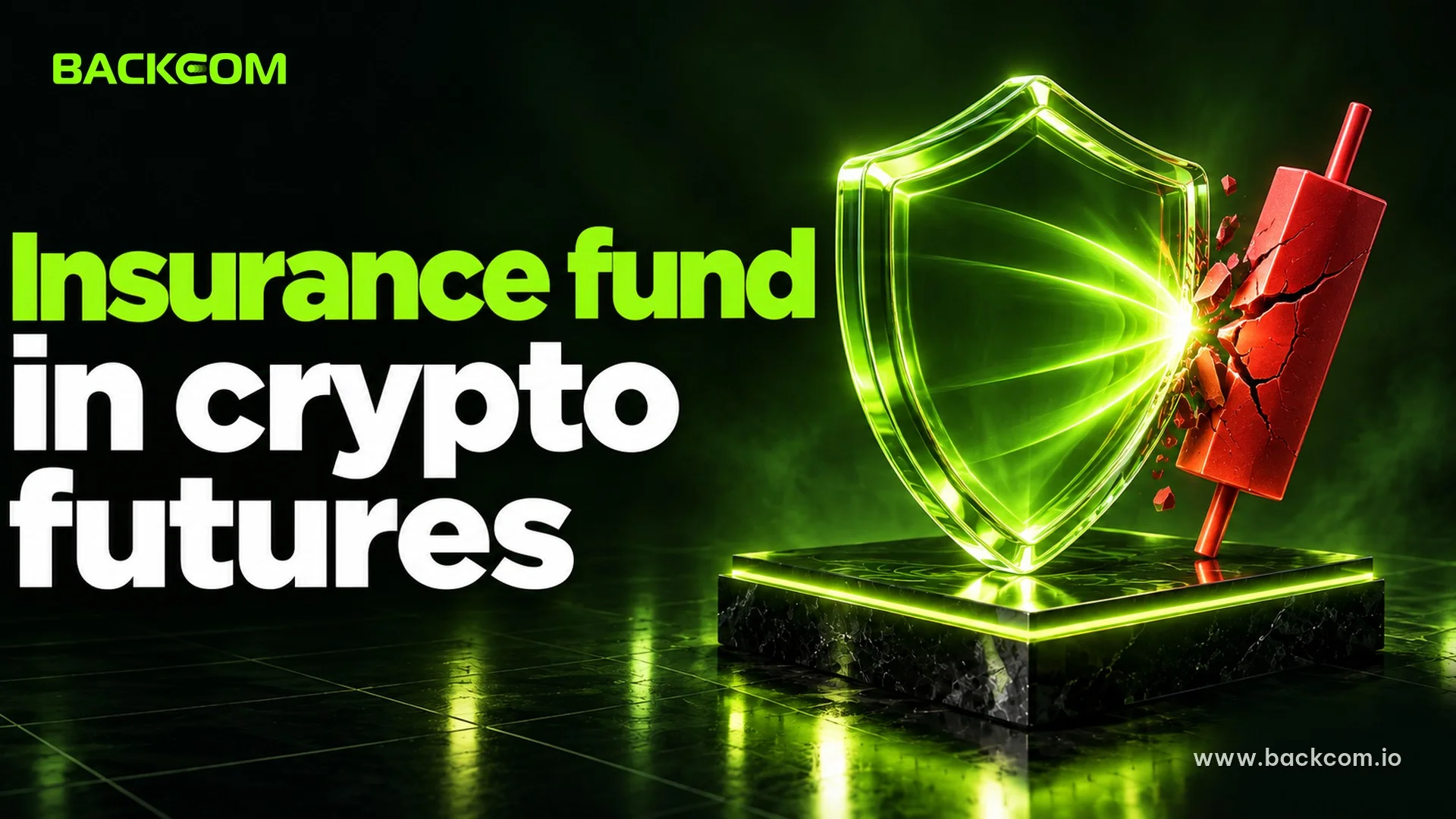
What is an insurance fund in crypto futures? It is a reserve of money that an exchange keeps to absorb the losses of liquidated positions that could not be closed in time. It matters because it decides whether a violent price move stays a problem for the trader who was liquidated, or spreads to profitable traders on the other side. This guide explains where the fund gets its money, what it pays for and what happens when it is not enough. In this article, Backcom.io keeps every number illustrative, because rules and fund sizes differ by exchange.
What Is An Insurance Fund In Crypto Futures?
An insurance fund is a pool of collateral held by a derivatives exchange to cover the shortfall when a liquidated position closes at a worse price than the trader's remaining margin can pay for. It is a safety net for the platform's matching system, not a product you can buy or claim against.
Binance describes its version as a safety net that limits the impact of liquidations, and states that traders will not get any of their losses back from a Futures Insurance Fund. It also says the funds are not insurance products and that Binance is not an insurer. Other large venues use the same idea under the same name.
Three points clear up most of the confusion:
- It protects the system, not you. It pays the gap that opens when a position goes bankrupt, so winners on the other side still get paid.
- It is not a refund. If your position is liquidated, the fund does not give your margin back.
- It is not a guarantee. It has a finite balance, and a large enough move can exhaust it.
If you are new to futures, read the guide to perpetual futures in crypto first, because the fund only makes sense once you know how margin and liquidation work.
Why Do Crypto Futures Exchanges Need An Insurance Fund?
A futures exchange needs an insurance fund because every profit on one side of a contract is a loss on the other side, so a loss that nobody pays becomes a problem for somebody else. With leverage, a trader can lose more than their margin if the market moves faster than the liquidation engine can close the position.
Think about the sequence. You open a leveraged long. The price falls and your margin shrinks. At some point the exchange starts closing your position. If it closes at a price better than the point where your margin hits zero, a small amount of money is left over. If price gaps through that point first, there is a hole. Someone has to fill it, or the traders who are holding the winning short positions are not paid in full.
The insurance fund is the first thing used to fill the hole. Without it, an exchange would have to reach for the profits of other users much more often. That is why the Binance Futures blog on liquidation and insurance funds says the main purpose of the fund is to limit how often auto-deleveraging happens.
How Does Liquidation Use The Bankruptcy Price?
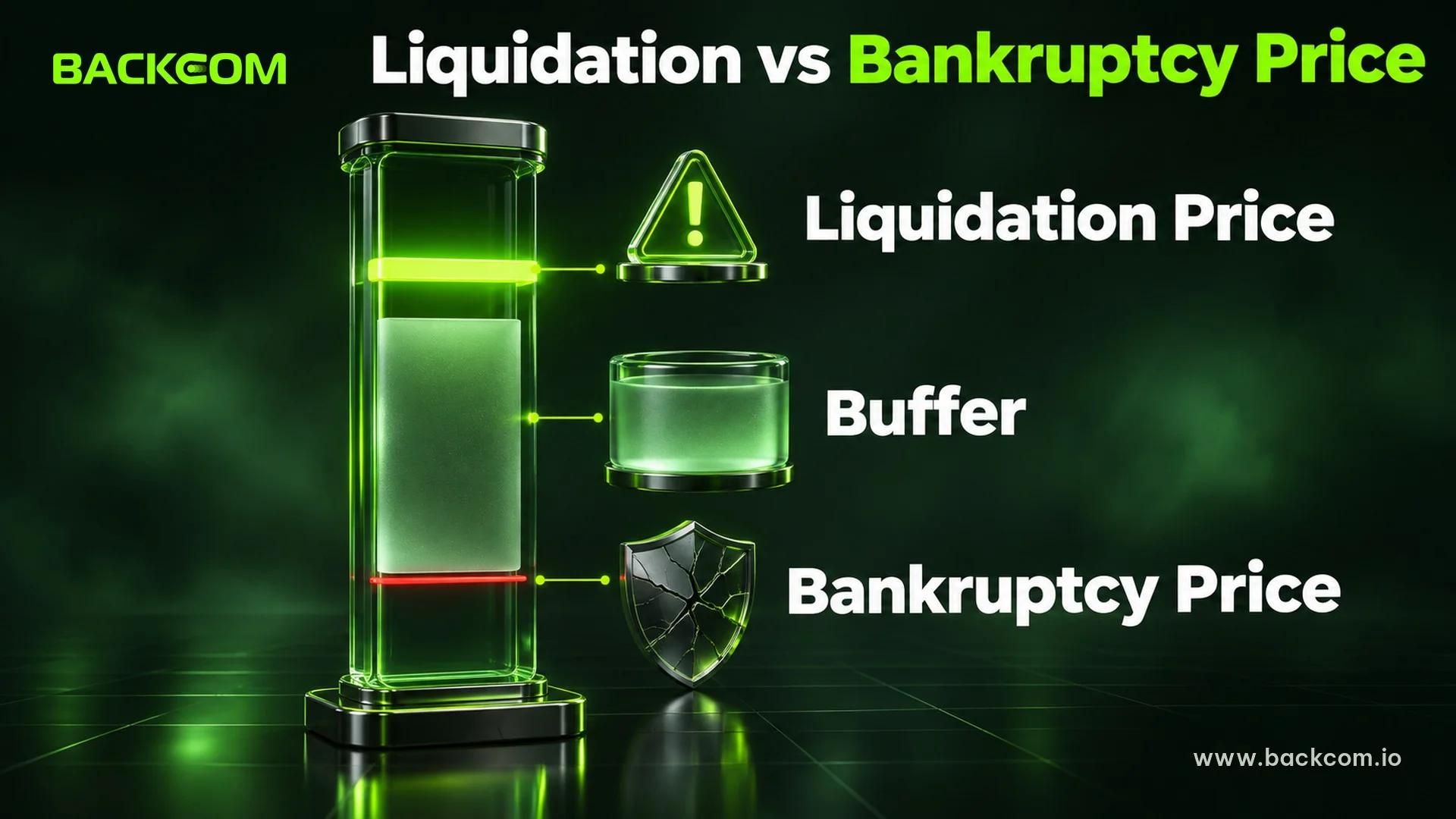
The bankruptcy price is the price at which a position's margin falls to zero, and the liquidation engine tries to close the position at a better price than that. These are two different numbers, and the gap between them is what feeds the insurance fund.
The Binance article defines it simply: the price at which margin drops to zero is the bankruptcy price, while the liquidation price is set earlier so that the position is closed while some margin remains. If you want the formula for your own trade, the guide to how to calculate liquidation price walks through it.
Here is the order of events on a typical futures exchange:
- Margin ratio rises. Your losses eat into your margin until it reaches the maintenance level.
- The liquidation engine takes over. The exchange sends an order to close your position near the liquidation price.
- Result A: it closes better than the bankruptcy price. Some of your margin is left. That surplus normally goes to the insurance fund.
- Result B: it closes worse than the bankruptcy price. Your margin is not enough to pay the loss. The fund pays the difference.
Because of step 3 and step 4, the fund grows in calm liquidations and shrinks in violent ones. The exact settlement rules, such as how the fund share is split, differ between platforms and product types, so read the help center of the venue you use.
A Worked Example With Illustrative Numbers
All figures below are assumptions for the sake of the example. They are not real fund balances, real fees or advice, and they ignore trading fees to keep the arithmetic clear.
You buy 1 BTC of a perpetual contract at 100,000 USDT with 10x leverage. Your initial margin is 10,000 USDT. Assume a maintenance margin of 0.5% of the entry position value, which is 500 USDT.
Bankruptcy price ≈ Entry Price × (1 − 1 ÷ Leverage) = 100,000 × 0.9 = 90,000 USDT
The liquidation price sits slightly above that. With the 0.5% maintenance assumption it is near 90,500 USDT. The 500 USDT gap per BTC is the safety buffer.
| Case | Closing price | Your loss | Margin left | What the fund does |
|---|---|---|---|---|
| A: orderly close | 90,300 | 9,700 | 300 | Receives about 300 USDT |
| B: price gaps through | 89,500 | 10,500 | 0 (500 short) | Pays about 500 USDT |
| C: very fast crash, fund too small | 88,000 | 12,000 | 0 (2,000 short) | Pays what it can, then ADL starts |
Illustrative figures only. Real liquidations also include fees, funding and exchange-specific rules, so check the contract specification before relying on any number.
In Case A you lose almost your whole margin, but the leftover 300 USDT goes to the fund rather than back to you, as Binance's article describes. In Case B the exchange absorbs a 500 USDT loss that you could not pay. In Case C the fund may not be large enough, which brings us to auto-deleveraging.
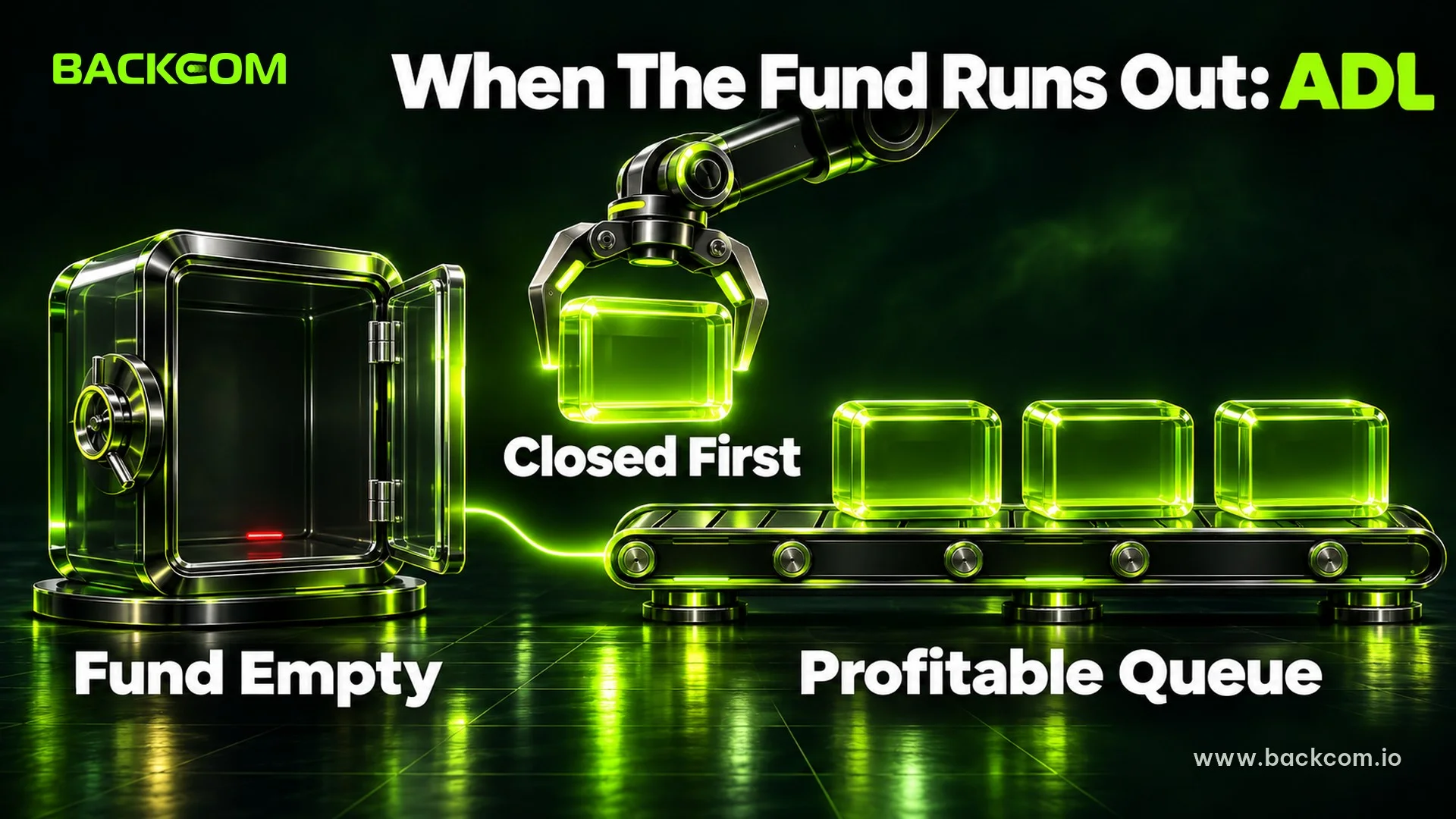
Auto-deleveraging (ADL) is the last step in the liquidation process: when the insurance fund cannot absorb a bankrupt position, the exchange closes profitable positions on the opposite side to cover the loss. On Binance it is a backstop used only when the fund cannot take over the position, and other exchanges set their own triggers.
Binance states in its ADL explanation that ADL is the final step in liquidation and applies only when the Futures Insurance Fund cannot take over a bankrupt position. Its own fund page adds that when losses exceed the available balance for a contract type, the liquidation engine can no longer trade that contract and the ADL mechanism is engaged. Bybit uses a different trigger: its help center describes ADL rules that can also depend on how far the insurance fund has fallen over a set period, so ADL there does not always wait for the fund to reach zero. Rules like this change, so read the current article on your own exchange.
For the person who gets auto-deleveraged, the result is unusual. You are not losing money in the normal sense. A profitable position is closed, usually at the bankrupt trader's bankruptcy price, even though you did nothing wrong and your own margin was healthy.
How Does The ADL Queue Decide Who Is Closed First?
Exchanges rank profitable positions and close the highest-ranked ones first. Binance publishes the formula for its ranking:
If PNL Percentage ≥ 0, ranking = PNL Percentage × Effective Leverage
Compare two winning traders with the same profit:
- Trader X: +40% profit at 20x effective leverage, ranking score 8.0.
- Trader Y: +40% profit at 5x effective leverage, ranking score 2.0.
Trader X is placed ahead of Trader Y in the queue. The pattern is simple: more profit and more leverage mean a higher ADL risk. Binance also shows an indicator on each futures position that signals how likely it is to be selected, so you can see the risk in advance. Other exchanges use their own formulas, such as a ranking based on leveraged return.
What Makes A Futures Insurance Fund Grow Or Shrink?
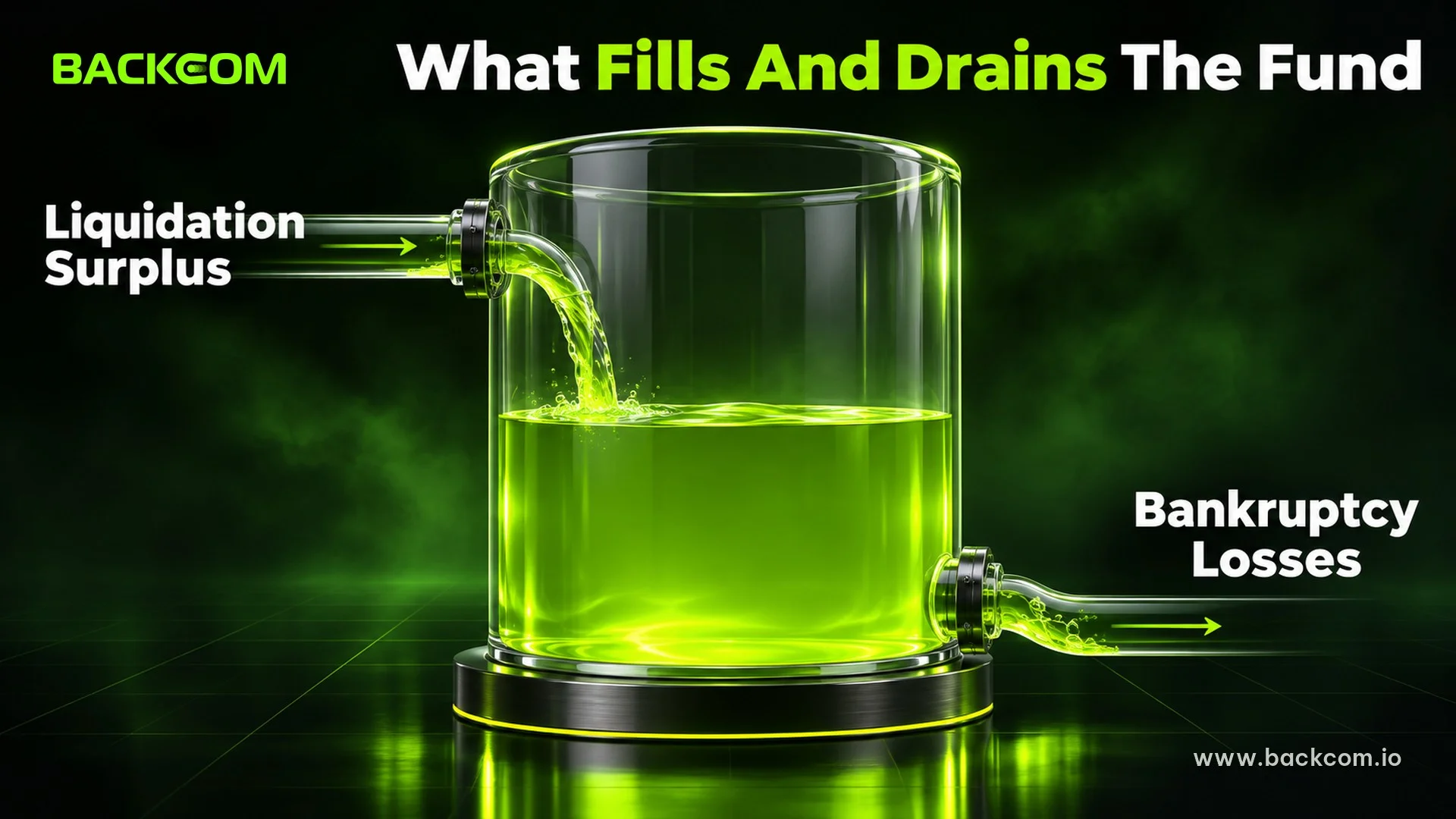
An insurance fund grows from liquidation surpluses and exchange contributions, and it shrinks when it pays for bankrupt positions. The balance is not static, and it moves with market stress.
Based on Binance's description, the main flows are:
- Inflows: part of the liquidation fees from liquidated positions that were not bankrupt may be allocated to the fund, and profits on positions the fund takes over are credited to it.
- Outflows: any loss from a bankrupt position is paid by the relevant fund.
- Top-ups: Binance says it will add assets if a fund falls below its required minimum, which it sets with stress scenarios and reviews each quarter.
- Take-over limit: each fund has a maximum take-over capacity, defined as a multiple of its balance. Binance's example is a 1 million fund with a 3x multiple, giving 3 million of capacity.
Binance adds a useful warning. It says that its minimum-size calibration does not mean that ADL will be avoided in 99.9% of liquidation scenarios. In other words, a large fund lowers the chance of ADL but does not remove it.
Funds are also split. Coin-margined contracts that use the same asset as collateral often share one smaller fund, so Binance's ADL FAQ notes they are more likely to face ADL than USD-margined contracts.
Where Can You Check The Insurance Fund Balance?
Most large exchanges publish the balance. On Binance Futures, you can find it under Data, then Futures Data, then Insurance Fund History. Other exchanges show it in their own data or help pages. Menu names and update rates change, so look for "Insurance Fund" in the data or help section of your exchange.
A few habits make the number useful rather than confusing:
- Compare it with open interest. A fund that looks large next to a small market can look small next to a very large one. Our guide to open interest in crypto futures explains how to read that number.
- Watch the trend, not one day. A falling balance across a week of volatility says more than a single snapshot.
- Check the contract type. A fund for one contract type may not cover another.
How Can Traders Reduce The Risk Of Being Liquidated Or Auto-Deleveraged?
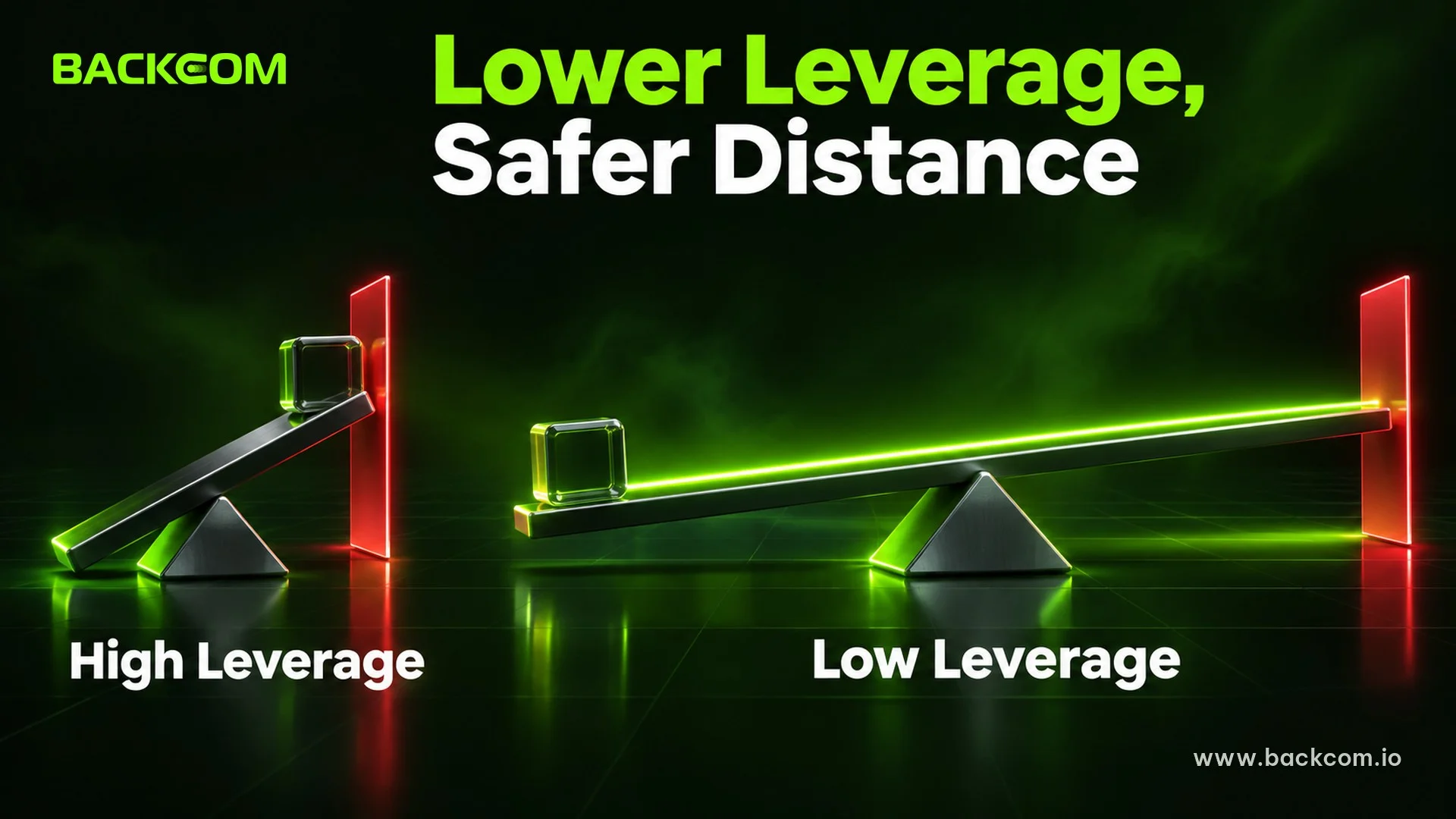
You cannot change how an exchange's fund works, but you can change how exposed you are to it. Most of the useful steps are ordinary risk management.
- Use lower leverage. Lower leverage moves your liquidation price further away and, on formulas like Binance's, lowers your ADL ranking. See what leverage means in crypto trading.
- Pick the margin mode on purpose. Isolated margin limits the damage to one position, while cross margin shares the whole balance. The comparison in cross margin vs isolated margin shows when each one fits.
- Size the position first. Risking a small fixed share of your account per trade keeps a bad liquidation survivable. The crypto position size calculator guide shows the method.
- Watch the ADL indicator on profitable trades. If the exchange shows a high risk, think about taking part of the profit.
- Understand the warning stage. A liquidation does not appear from nowhere. Read crypto margin call explained to recognise the signs earlier.
- Expect slippage in fast markets. Stops can fill far from the trigger, which is how a position ends up past the bankruptcy price. See what slippage is in crypto trading.
Frequently Asked Questions (FAQ) About The Insurance Fund In Crypto Futures
Does The Insurance Fund Pay Me Back If I Am Liquidated?
No. The fund does not reimburse the trader who is liquidated. Binance says that traders will not get losses back from a Futures Insurance Fund. It exists to cover the gap between the bankruptcy price and the actual closing price, so the counterparties are paid.
Is The Insurance Fund The Same As Deposit Insurance For My Account?
No. It is not a government or third-party insurance scheme, and it does not protect your balance if an exchange fails, is hacked or is shut down. Binance states that its funds are not insurance products. Treat it as an internal risk buffer, not a safety guarantee for customers.
What Happens When The Insurance Fund Runs Out?
On Binance, the exchange moves to auto-deleveraging. Profitable positions on the opposite side are ranked by profit and leverage, and the highest-ranked ones are closed to cover the shortfall. Some platforms also top the fund up from their own assets, but the details depend on the exchange.
Can I Avoid ADL Completely?
Not with certainty. You can lower the chance by using less leverage, taking profit on very large winning trades and keeping an eye on the ADL indicator. Some exchanges also state that they try to avoid ADL, but none can promise that it will never happen.
How Do I Know How Big The Fund Is?
Look in the data or help section of your exchange. Binance shows an Insurance Fund History page in its Futures Data menu, and other exchanges publish balances on their platform or API. Remember that the number changes over time and differs by contract type.
Conclusion: Treat The Fund As A Buffer, Not A Promise
The insurance fund in crypto futures is the first line of defence when a liquidation closes at a price that your margin cannot cover. It keeps winning traders paid, and when it runs short, auto-deleveraging takes over. For you, the practical rules are the same as always: keep leverage modest, size positions by risk, know your margin mode and watch the warning signs before liquidation. Always read the contract rules of the exchange you use, because the details of funds and ADL change.
Disclaimer: This content is compiled by Backcom.io for information only and is not investment advice. Crypto trading, especially with leverage, carries a high risk of loss. Examples use illustrative numbers, and fund rules, fees and ADL methods differ by exchange, so check the rules of your platform before trading.
Was this article helpful?
Join The Backcom.io Community
Get the latest on trading rebates, trading tips, and broker deals — and connect with thousands of traders worldwide.

Backcom App
Track Your Rebates Every Day
Every rebate is visible by broker and by day. Manage your wallet and withdrawals in one place.
Open Backcom App