Overtrading In Forex: 5 Signs And How To Set A Daily Trade Limit


Many traders do not lose because their analysis is wrong. They lose because they open far more trades in a day than their plan ever allowed. Overtrading in forex is what happens when the number of trades, the position size or the trading frequency goes beyond the rules a trader set in advance. Each single trade can look reasonable on its own, but added together the fees, the mistakes and the fatigue all grow.
This guide covers the signs of overtrading, the psychology behind it and how trading costs stack up as the trade count rises. In this article, Backcom.io will walk through three things:
- Spotting overtrading through 5 measurable signs instead of gut feeling.
- Calculating the real cost of taking too many trades with a worked example.
- Setting a daily trade limit with a formula and a clear stop routine.
1. What Is Overtrading In Forex And How Many Trades A Day Is Too Many?
Overtrading means trading with more frequency, volume or trade count than the trading plan and the risk budget allow. The key point is that overtrading is measured against each trader's own plan. No single number fits everyone.
A scalper whose plan calls for 15 trades a day is not necessarily overtrading. A swing trader whose plan calls for 2 trades a week but who opens 6 in one morning has gone far past the plan. So the right question is not "how many trades is a lot" but "does this trade belong to the list of setups I wrote down beforehand".
There are three common forms of overtrading:
- Too many trades: the number of trades opened in a day exceeds the set cap.
- Too much size: lot size rises after a loss or after a winning streak, beyond the planned risk per trade.
- Too many hours at the screen: sitting through the whole session, even when no setup meets the criteria.
The first form is the easiest to count, so this guide focuses on it. It also helps to separate overtrading from pyramiding, which means adding to an open position in the same direction. Pyramiding can be part of a plan. Overtrading always breaks the plan.
2. What Are The Signs Of Overtrading And How Can You Spot Them Early?
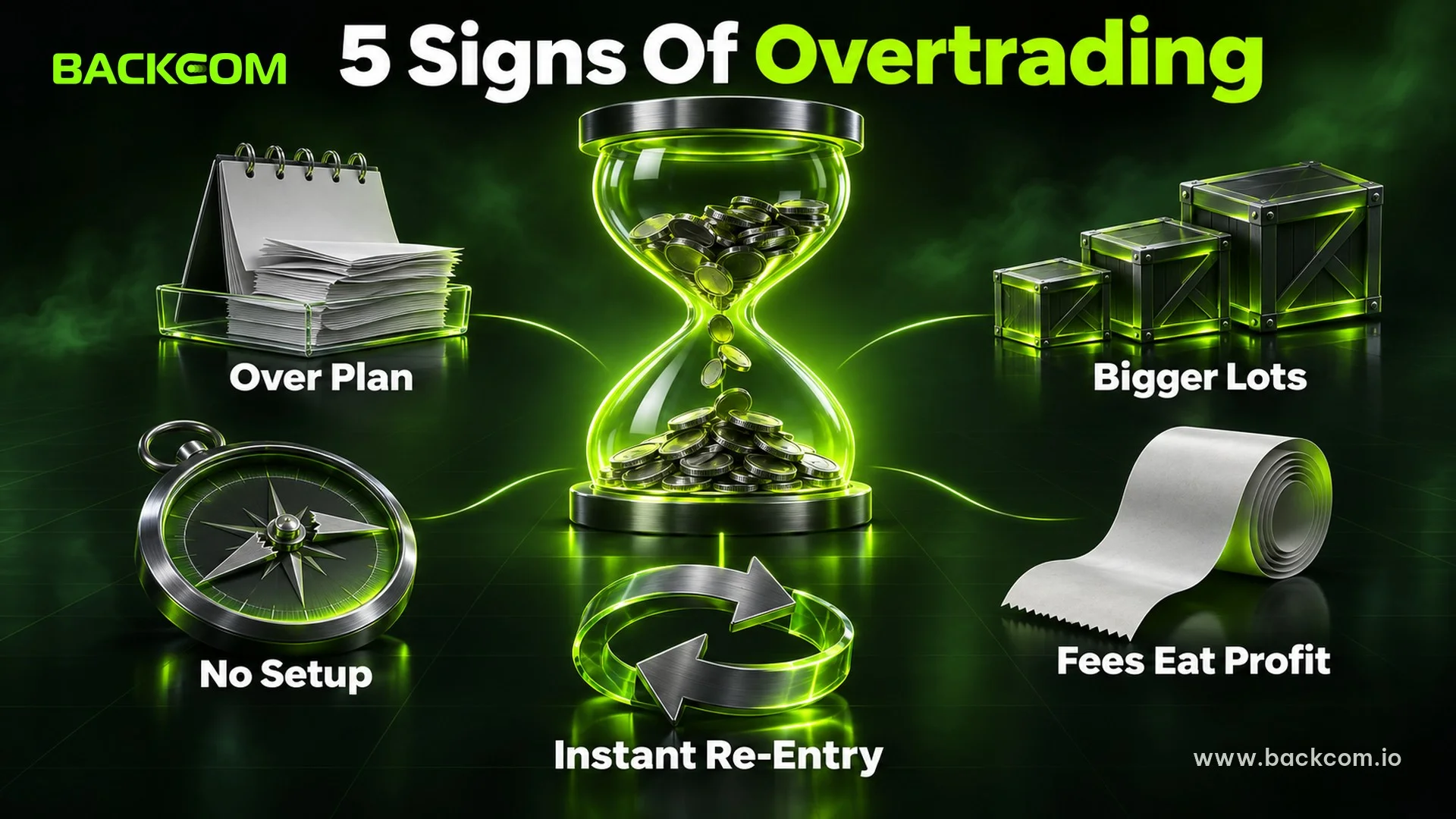
Traders rarely notice that they are overtrading, because in the moment it feels like being "active". The five signs of overtrading below can all be measured with a trading journal, so no self-assessment is needed.
1. The daily trade count is at least double the plan
This is the clearest sign. If the plan says 3 trades and the journal shows 8 by the end of the day, the other 5 were unplanned. If this repeats on three days in one week, overtrading has become a habit.
2. Entries that match no setup in the playbook
Asked "which setup is this trade", the trader can only answer "price was moving, so I got in". Trades like this are usually opened out of fear of missing out, not because a signal met its conditions.
3. A new trade right after closing the last one, even a winner
The gap between trades shrinks to a few minutes. Feeling "hot" or needing to "win back what I just lost" makes traders skip the wait for the next signal.
4. Raising lot size after a losing or a winning streak
Increasing size to recover a loss is the familiar form. Increasing it after a winning streak out of confidence is also overtrading in volume, and it often lets one losing trade erase a whole week of profit.
5. Fees and spread in the statement that rival the net profit
At the end of the week, total trading costs take most of the gross profit, or gross profit is positive but net profit is negative after costs. This sign is often missed because costs sit quietly inside every trade and never appear as a separate loss.
Whether a trader shows all five signs or only one, it is worth checking against the last 20 trades in the journal. A simple journal with date, setup, lot size, cost and result per trade is enough to start.
3. Why Do Traders Fall Into Overtrading?
Overtrading rarely comes from a lack of knowledge. It usually comes from four psychological drivers that repeat across many traders.
- Overconfidence after a few wins: the trader believes they can "read the market" and loosens the entry rules.
- Fear of missing out: every strong candle looks like an opportunity, so the trader enters late or with no clear stop.
- Wanting to recover a loss fast: after a loss the trader opens a new trade immediately, which is where revenge trading and overtrading overlap.
- Boredom in a sideways market: with no setup but a wish to be busy, the trader lowers the standard to create one.
Academic research on individual investors shows this is not only a forex problem. Brad Barber and Terrance Odean studied 66,465 households with accounts at a large US discount broker between 1991 and 1996. The households that traded most earned 11.4% a year, while the market returned 17.9%. The authors argue that overconfidence can explain the high level of trading and the poor results of individual investors.
For a direct look, see the abstract of the Barber and Odean paper in the Journal of Finance and the working paper from UC Berkeley.
Read the figure within its scope. The sample was US stocks in the 1990s, not forex, and the returns are after trading costs. Backcom.io cites the study to show the link between trading frequency, costs and results, not to claim that every active trader loses.
For CFDs, the European regulator ESMA has required providers since 2018 to show a standardised risk warning that includes the share of retail accounts losing money with that provider. See the ESMA announcement of 1 June 2018.
4. How Do Overtrading And Trading Costs Add Up?

Overtrading and trading costs are linked because every trade carries a fixed cost before price goes right or wrong: the spread, plus commission if the account charges it separately. As the trade count rises, cost rises almost in a straight line, while profit does not.
The basic formula for one trade:
Cost per trade = Spread (pips) × Pip value for the lot size + Commission for the lot size
To see the effect, take a hypothetical example. A trader trades EURUSD at 0.1 lot (1 pip is worth USD 1), with a 1.2 pip spread and a commission of USD 7 per round-turn lot, or USD 0.7 for 0.1 lot. The cost per trade is 1.2 + 0.7 = USD 1.90. Assume an account of USD 5,000 and 22 trading days in a month.
| Trading style | Trades per day | Trades per month | Cost per month | Cost vs. account |
|---|---|---|---|---|
| With a trade cap | 3 | 66 | USD 125.40 | 2.5% |
| No cap | 15 | 330 | USD 627 | 12.5% |
Hypothetical example as at 16 November 2026. Real spreads and commissions differ by broker, account type and time, so check them again before calculating for your own account.
With the same strategy, a trader opening 15 trades a day pays 5 times the costs, or 12.5% of the account per month, before counting the profit or loss of the trades themselves. To end the month in profit, those 330 trades must produce gross profit above USD 627, while each extra trade is usually of lower quality than the one before.
Spread is also not constant through the day: it widens around news releases and in thin liquidity, which is exactly when many traders overtrade. You can see how spread is formed in what is forex spread and compare real cost per lot in Raw Spread vs. Standard account.
For scalpers and other high-frequency traders working to a plan, forex rebates are one way to reduce the net cost of each trade. A rebate only offsets part of the cost already paid, though. It does not turn a losing trade into a winner and is not a reason to take extra trades.
5. How Do You Set A Daily Trade Limit?
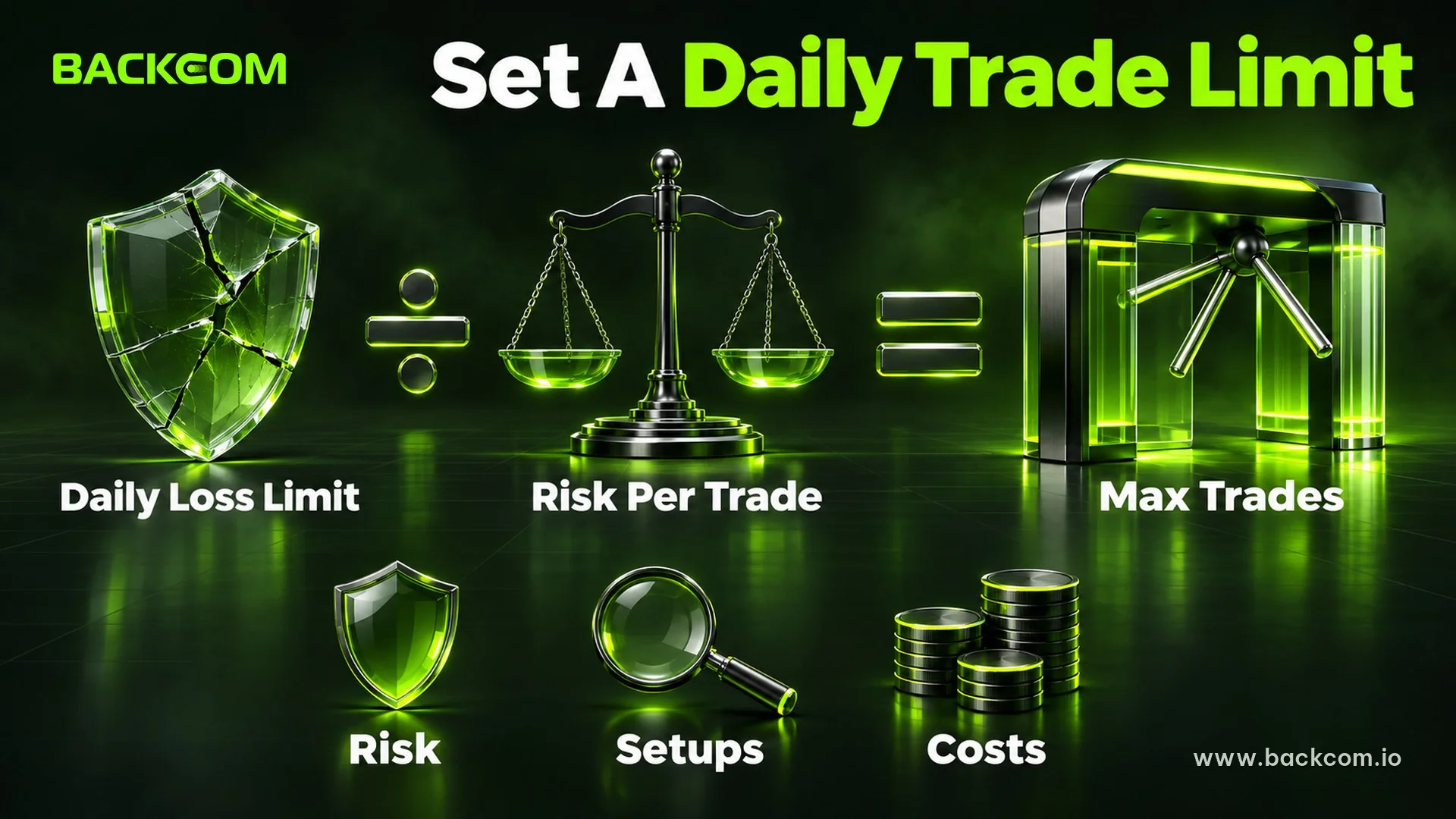
A daily trade limit is the maximum number of trades a trader allows themselves in a day, written down before the market opens and not changed during the day. A number picked by feel is easy to break, so it needs three grounds.
Ground 1: the daily risk budget. The trader sets a maximum daily loss, for example 2% of the account, and divides it by the risk per trade:
Maximum losing trades per day = Daily loss limit ÷ Risk per trade
With a 2% daily loss limit and 0.5% risk per trade, the trader can take at most 4 losing trades before stopping. How to size positions from risk per trade is covered in forex money management and the 1% rule, and lot size for a 0.5% risk can be worked out quickly with the position size calculator.
Ground 2: the number of setups the plan really produces. If the strategy offers only 2 to 3 quality entries per session, a cap of 10 trades means nothing. The cap should sit close to the number of setups the trader actually found over the last 20 to 30 days of journal entries, plus a little room.
Ground 3: the cost level you can accept. Using the formula in section 4, calculate total costs for the chosen cap and compare them with the account. If monthly costs exceed what the trader accepts, the cap must be lower.
The final number is the lowest of the three grounds. If risk allows 4 losing trades, the plan produces 3 setups a day and costs allow 6 trades, the cap is 3 trades.
Once the number is set, four companion rules make the cap work:
- Write the cap at the top of the journal or beside the screen before opening the platform.
- Count pending orders and partial closes too, because they are also trading decisions.
- Stop after two losing trades in a row, even if the cap has not been reached.
- Do not change the cap during the day. To change it, write the reason in the journal and apply it from the next day.
A trade cap does not replace a stop loss, so every trade still needs its own exit point. See how to set a stop loss.
6. How Do You Avoid Overtrading Once It Has Become A Habit?
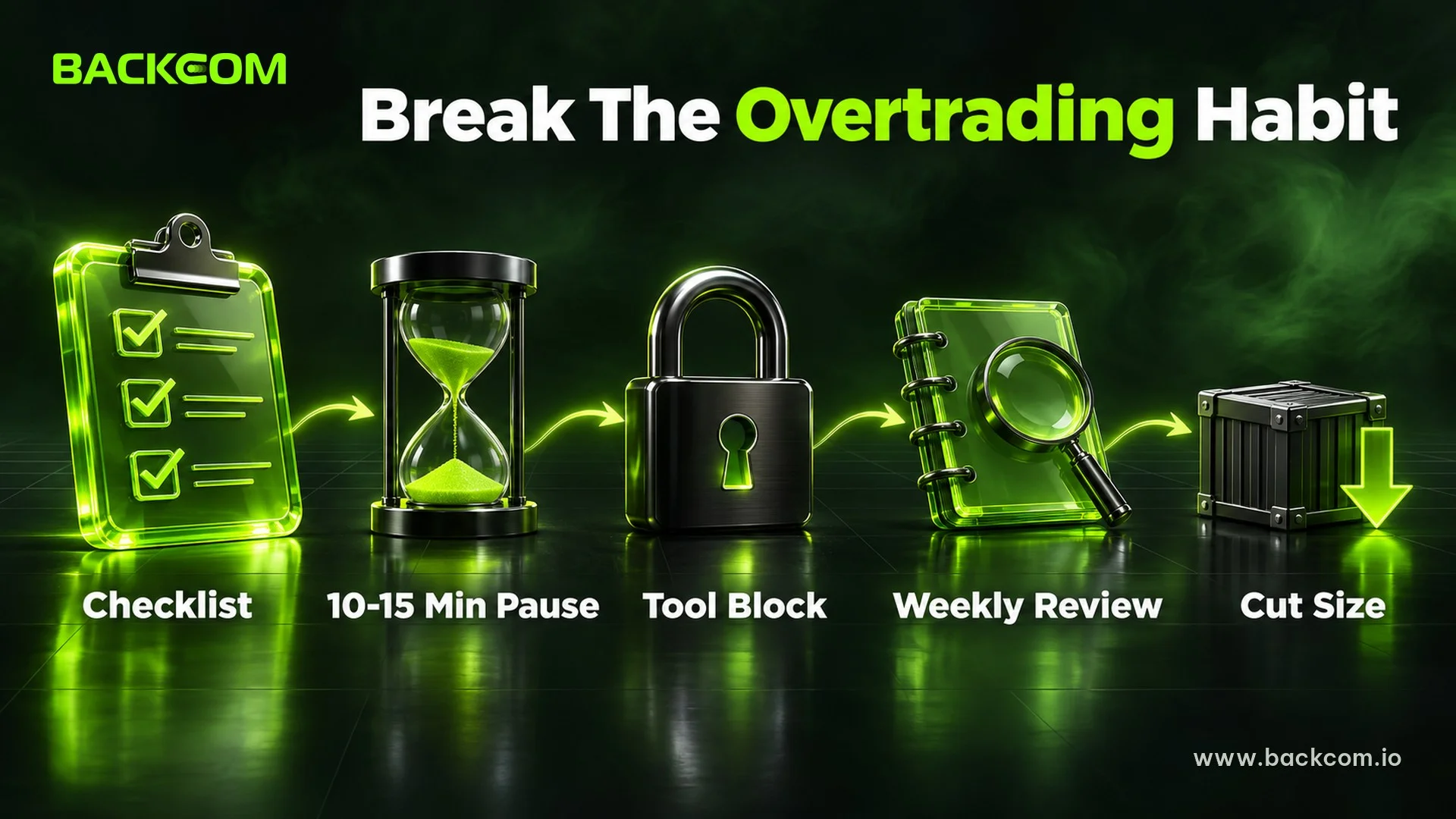
Knowing the cap is one thing. Keeping it while losing or winning is another. The most effective way to avoid overtrading is to add barriers outside willpower, because willpower is weakest exactly when it is needed.
Step 1: Turn entry conditions into a checklist
Each setup has 3 to 5 required conditions. The trader ticks each one before pressing the button, and if one is missing, there is no trade.
Step 2: Set a mandatory pause between trades
After each closed trade, the trader waits at least 10 to 15 minutes or until the next candle closes. The pause breaks the reaction chain right after a win or loss, where most unplanned trades appear.
Step 3: Block with tools, not only with resolve
The trader can set an alarm or shut the platform as soon as the cap is reached. For those who open impulsive trades, cutting the number of watched pairs also reduces false opportunities.
Step 4: Review the journal every weekend
The trader counts trades inside and outside the plan and compares the results of the two groups. The numbers from your own account are more convincing than any reminder.
Step 5: Reduce size during a long losing streak
The safe response is to lower risk per trade and monitor drawdown, not to raise the trade count to shorten recovery time. When the daily loss limit is hit, close the platform and rest until the next session, because stopping early costs less than a day spent chasing.
Frequently Asked Questions (FAQ) About Overtrading
What Is Overtrading And Does A High Trade Count Always Mean It?
No. Overtrading means going beyond the plan, not simply taking many trades. A scalper whose plan calls for 20 trades a day and who keeps to exactly 20 is not necessarily overtrading. A trader should treat it as overtrading when a trade falls outside the setup list, exceeds the trade cap or uses a lot size above the set risk.
How Many Trades A Day Should A Daily Trade Limit Be?
There is no universal number. A trader should take the lowest of three values: the maximum losing trades allowed by the daily risk budget, the setups actually found in the journal and the number of trades whose total costs are still acceptable. In the example in section 5, the three grounds give a cap of 3 trades a day, and each trader's own number depends on the strategy and the timeframe.
Does Overtrading Raise Trading Costs?
Yes. Every trade pays the spread and may carry commission, so total cost rises almost in proportion to the trade count. In the hypothetical example in section 4, 330 trades a month cost about USD 627, five times the cost of 66 trades. Rebates lower the net cost but do not offset losing trades.
How Long Should A Trader Stop After Overtrading?
A trader can stop for the rest of the day once the cap is hit, and rest the next day as well if the daily loss limit is hit twice in one week. The goal of the pause is to break the emotional reaction chain, not to punish. Returning with a smaller size is usually safer than returning at once with the old size.
Conclusion: Keep A Trade Cap To Protect Capital And Costs
Overtrading does not begin at the tenth trade. It begins at the first trade that is not in the plan. Traders need to look at three factors together: the signs in the journal, the costs that build with the trade count and a cap calculated from the risk budget rather than from feeling.
Three things are worth doing this week:
- Write the daily loss limit, the risk per trade and the trade cap on one page.
- Check that page against the last 20 trades in the journal.
- Apply the pause between trades and review the numbers every weekend.
To build a fuller risk framework, start with forex money management and lot size.
Disclaimer: This content is compiled by Backcom.io for information and reference only and is not investment advice, a trading recommendation or financial advice. The numerical examples are hypothetical and for illustration. Trading forex and CFDs carries a high level of risk, and traders can lose all of their capital and should assess their own risk tolerance.
Was this article helpful?
Join The Backcom.io Community
Get the latest on trading rebates, trading tips, and broker deals — and connect with thousands of traders worldwide.

Backcom App
Track Your Rebates Every Day
Every rebate is visible by broker and by day. Manage your wallet and withdrawals in one place.
Open Backcom App