Raw Spread Vs Standard Account: Which Costs Less Per Lot After Rebates?

Many traders hear that a raw spread account is "cheaper" because the spread is close to zero, then switch from Standard without adding the commission that comes with it. The question of raw spread vs standard account only has an answer once both accounts sit on the same yardstick: the total money lost per lot after the rebate.
The comparison is hard because the two accounts charge in different ways, and their rebates are not equal either. In this article, Backcom.io walks through:
- What a raw spread account is, and where a Standard account hides its fee.
- The net cost formula per lot for both account types.
- A commission table for Exness, IC Markets, Vantage and HFM, with the date checked.
- The break-even standard spread, with three worked examples that point in opposite directions.
- 5 steps for choosing an account from your own measurements.
What Is A Raw Spread Account? Raw Spread Plus Commission Vs Spread-Only Pricing
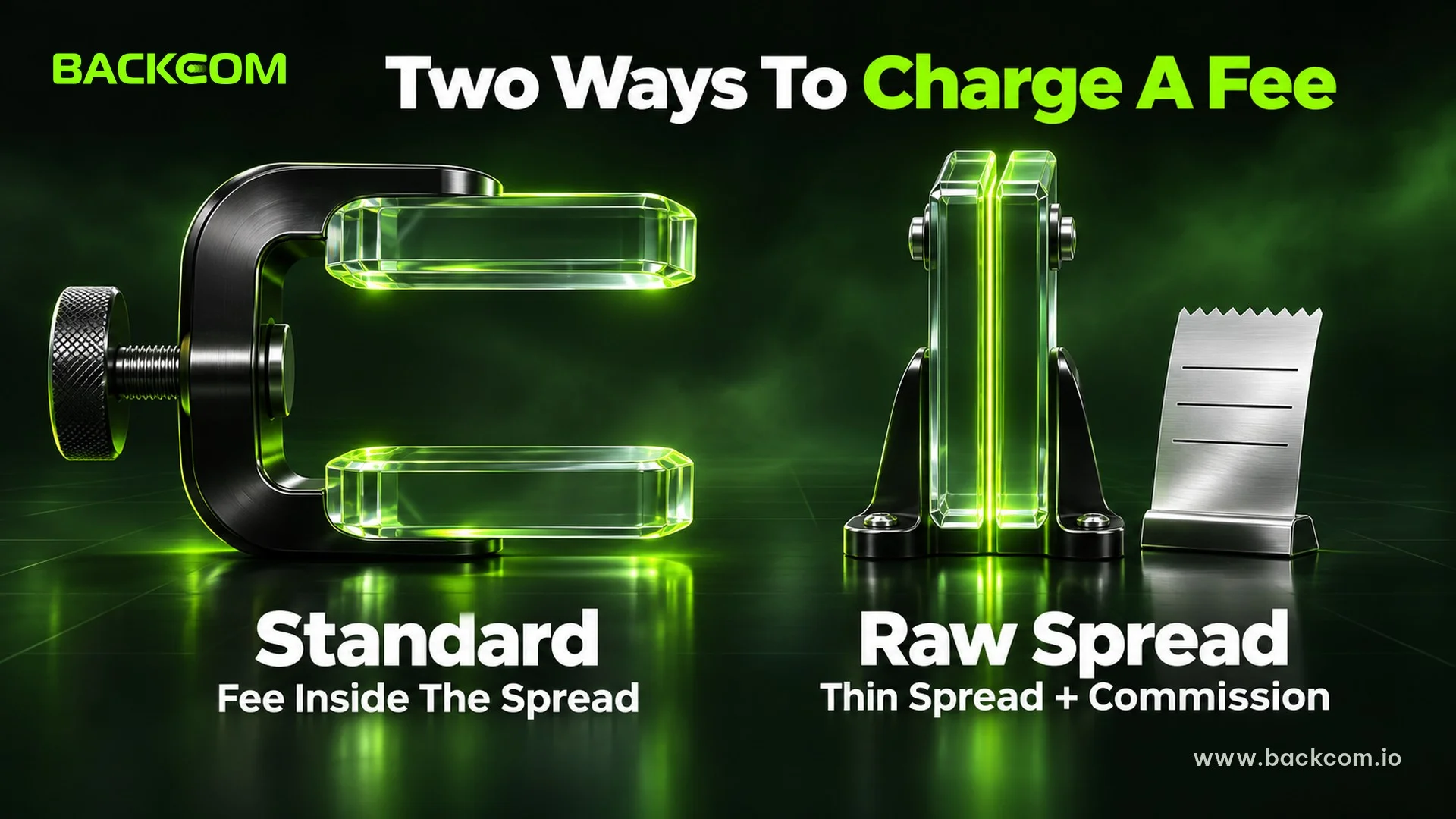
A raw spread account gives traders prices close to the interbank rate, with spreads from 0.0 pips, and the broker earns through a fixed commission on every lot. A Standard account works the other way: there is no commission, and the broker's whole fee sits inside a wider spread.
Both models produce the same kind of cost, only in different places. On Standard, the cost shows up in the spread column of the price list. On Raw, part of the cost is split out as a commission line in the trade history, so the price list alone makes it look cheaper than it is.
The guide What Is An ECN Account already explains the ECN, STP and market maker models, so this article skips that part. It compares only how each account charges:
- Standard: cost per lot = spread × pip value, with no commission.
- Raw spread: cost per lot = raw spread × pip value + round-turn commission.
- Rebate: subtracted from both, but the rebate on each account type is often different.
Units cause confusion too. Commission is usually quoted per side, meaning once on opening and once on closing, so a round turn has to be doubled. Read whether the broker says "per side" or "round turn" before adding anything up. If converting pips to money is new to you, What Is A Pip In Forex has pip values by currency pair and lot size.
Standard Vs Raw Spread Cost: The Net Cost Formula After Rebates
The net cost of a Standard lot is the spread cost minus the rebate the account earns. Because Standard has no commission, the formula has only two terms.
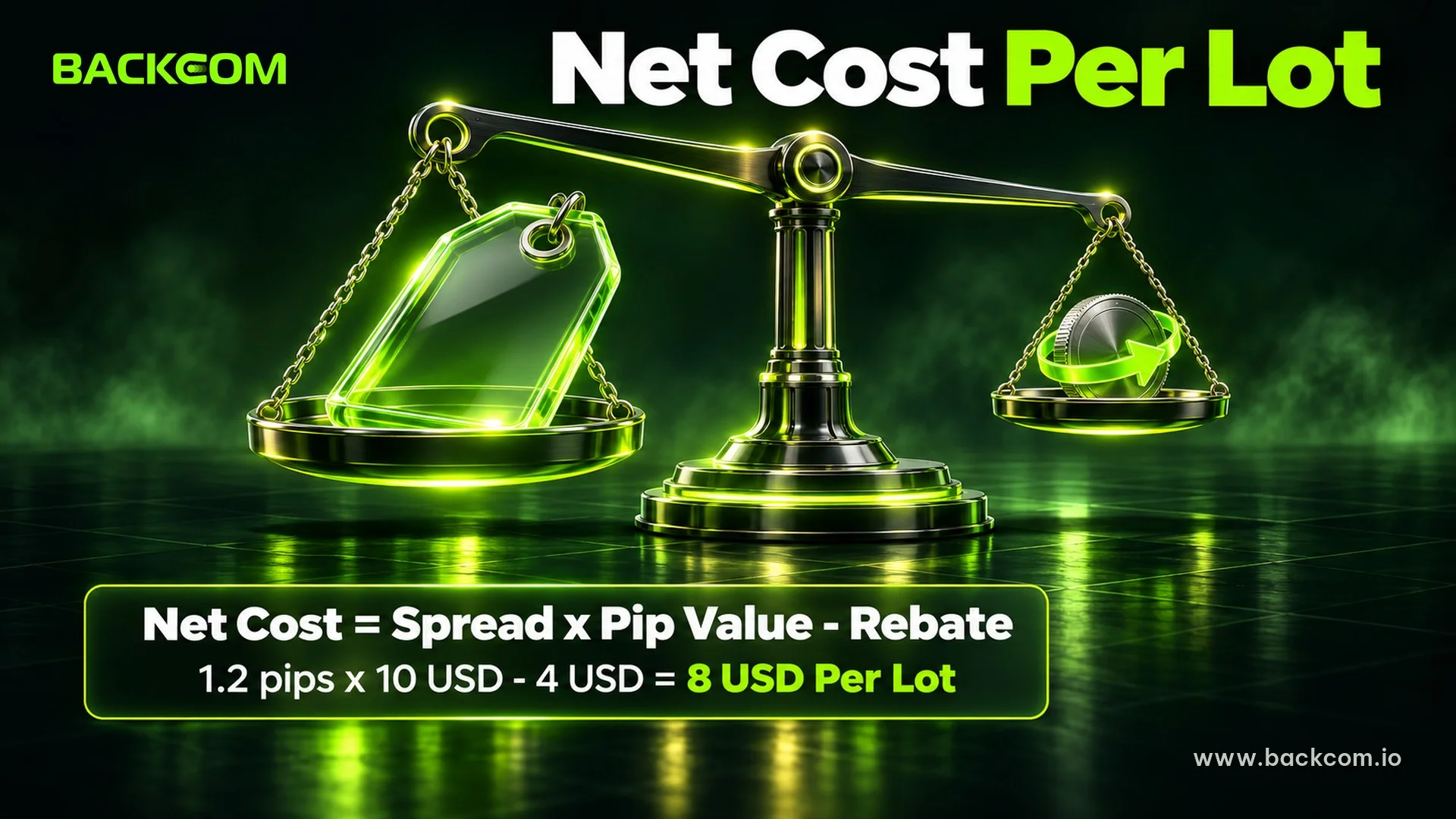
Standard net cost = Spread × Pip value − Rebate per lot
On EURUSD, one standard lot is worth 10 USD per pip. With a 1.2 pip spread and a 4 USD rebate, the net cost is 1.2 × 10 − 4 = 8 USD per lot. The method follows What Is Forex Spread, with the rebate term added.
On a Raw account the formula has one more term:
Raw net cost = Raw spread × Pip value + Round-turn commission − Rebate per lot
Setting the two equal gives the break-even point, the standard spread at which Raw starts to win. Set the two net costs equal and simplify:
Break-even standard spread = Raw spread + (Commission − Raw rebate + Standard rebate) ÷ Pip value
If your real Standard spread is above this point, Raw is cheaper. If it is below, Standard is cheaper. Note that the Standard rebate is added to the numerator. Standard accounts usually earn a larger rebate than Raw, so the rebate pushes the break-even point up and makes Raw harder to win than a comparison without rebates suggests.
The rebate is calculated on closed lots, whether a trade wins or loses. What Is Forex Rebate explains how it is formed and why it lowers cost without creating profit.
Raw Spread Account Commission Per Lot: Exness, IC Markets, Vantage And HFM
Raw spread account commission per lot differs by broker, platform and sometimes by product. The table below collects the figures published in the fee guides and broker pages on this site, converted to USD per lot, round turn.
| Broker and account | Published spread | Round-turn commission | Note |
|---|---|---|---|
| IC Markets Standard | from 0.8 pips | 0 | fee sits in the spread |
| IC Markets Raw Spread (MT4/MT5) | from 0.0 pips | 7 USD | 3.5 USD per side |
| IC Markets Raw Pro | from 0.0 pips | 3 USD | 1.5 USD per side, 5,000 USD minimum deposit |
| Exness Standard | by product | 0 | fee sits in the spread |
| Exness Raw Spread | from 0.0 pips | up to about 7 USD | up to 3.5 USD per side |
| Vantage Standard STP | from 1.0 to about 1.4 pips | 0 | three sources say 1.0, 1.1 and about 1.4 |
| Vantage Raw ECN | from 0.0 pips | 6 USD | 3 USD per side |
| HFM Zero | from 0.0 pips | 6 USD on forex | gold 10 USD per 100 ounces; Premium spread: 1.0 pips (broker page) or 1.4 (fee guide) |
Reference: fee guides and broker pages on this site as at 6 November 2026 (rebate tables updated 24 October 2026, effective from 1 October 2026). Fees and rebates can change, so check again before opening an account.
Three points in the table need a careful read:
- Maximum rates: Exness states the Raw Spread commission as a maximum, and Zero accounts start from 0.02 USD per lot per side depending on the product.
- Platform variants: IC Markets also has a cTrader version that charges about 3 USD per 100,000 USD traded per side.
- The word "from": "spread from 0.0" is the lowest level in good liquidity, not a level you always get.
So you should take the commission for the exact symbol you trade.
Is Raw Spread Cheaper Than Standard? IC Markets EURUSD Example
Whether raw spread is cheaper than standard depends on three numbers: your real Standard spread, the commission, and the two rebates. IC Markets makes a compact example because both fee sets are published clearly.
According to the broker page, IC Markets pays 4 USD per lot on Standard for major forex pairs and 2 USD per lot on Raw Spread. The page has no separate EURUSD row, so this article applies the FX majors and FX_ALL rates. Raw EURUSD uses an average spread of 0.1 pips from the fee guide and a 7 USD round-turn commission.
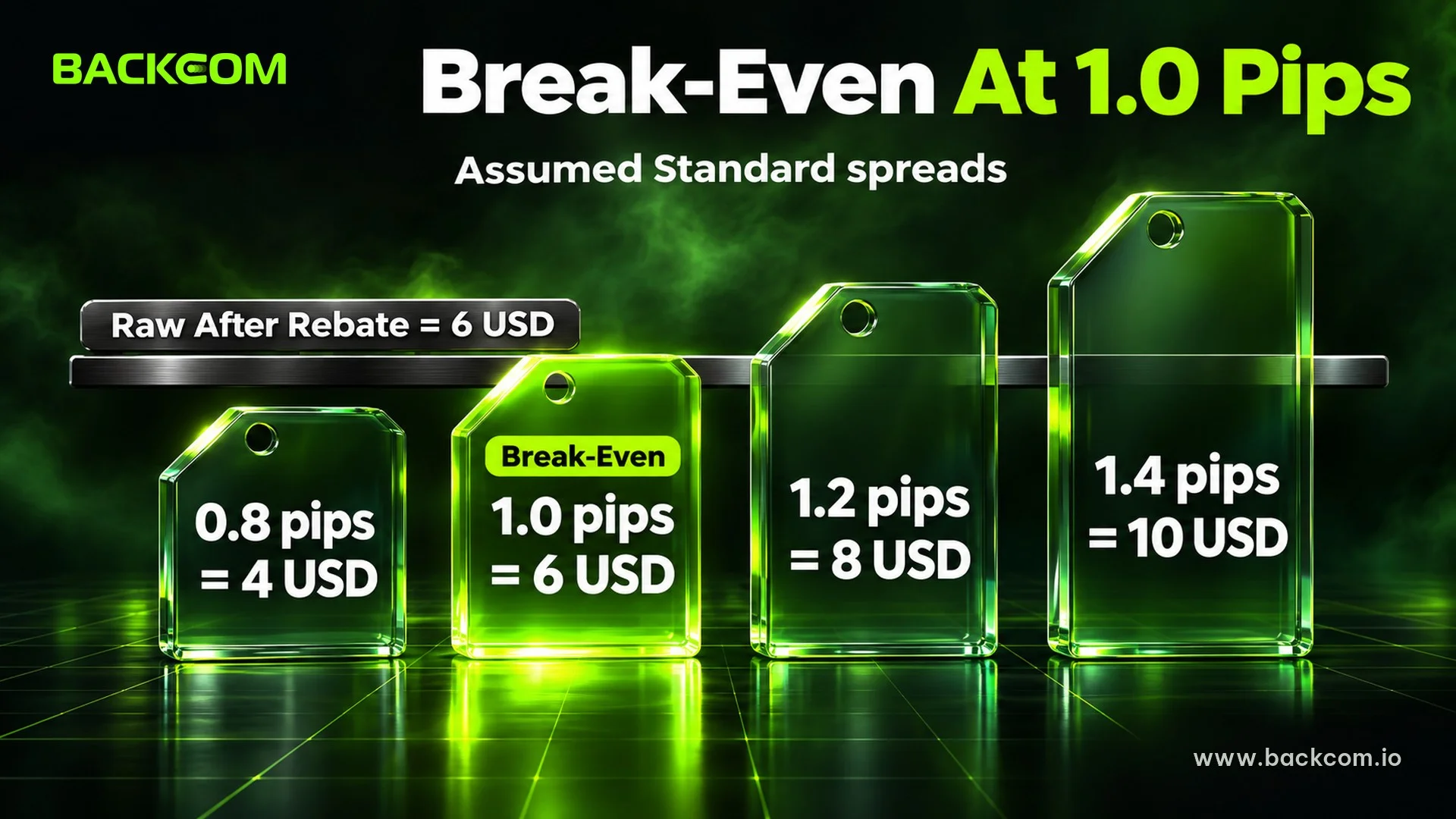
Raw net cost: 0.1 × 10 + 7 − 2 = 6 USD per lot. For Standard the page only says "from 0.8 pips", so four assumed spreads show how the cost moves:
| Assumed Standard spread | Spread cost | After 4 USD rebate | Raw (after rebate) | Cheaper |
|---|---|---|---|---|
| 0.8 pips | 8 USD | 4 USD | 6 USD | Standard |
| 1.0 pips | 10 USD | 6 USD | 6 USD | Tie |
| 1.2 pips | 12 USD | 8 USD | 6 USD | Raw |
| 1.4 pips | 14 USD | 10 USD | 6 USD | Raw |
Reference: IC Markets fee guide and broker page on this site as at 6 November 2026 (rebate table updated 24 October 2026). The Standard spreads in the table are assumptions for illustration, not measured data. Replace them with the spread you measure on your own MT5.
The formula gives a break-even of 0.1 + (7 − 2 + 4) ÷ 10 = 1.0 pips. Without the rebate the break-even would be 0.8 pips. In other words, the higher Standard rebate lifts the bar Raw must clear by 0.2 pips.
A trader opening 20 EURUSD lots a month sees the difference clearly. Raw costs 120 USD, Standard at a real 0.8 pips costs 80 USD, and at 1.2 pips it costs 160 USD. The 40 USD gap flips direction because the Standard spread moved by only 0.4 pips.
Raw Spread Vs Standard Account: Two Brokers, Opposite Results
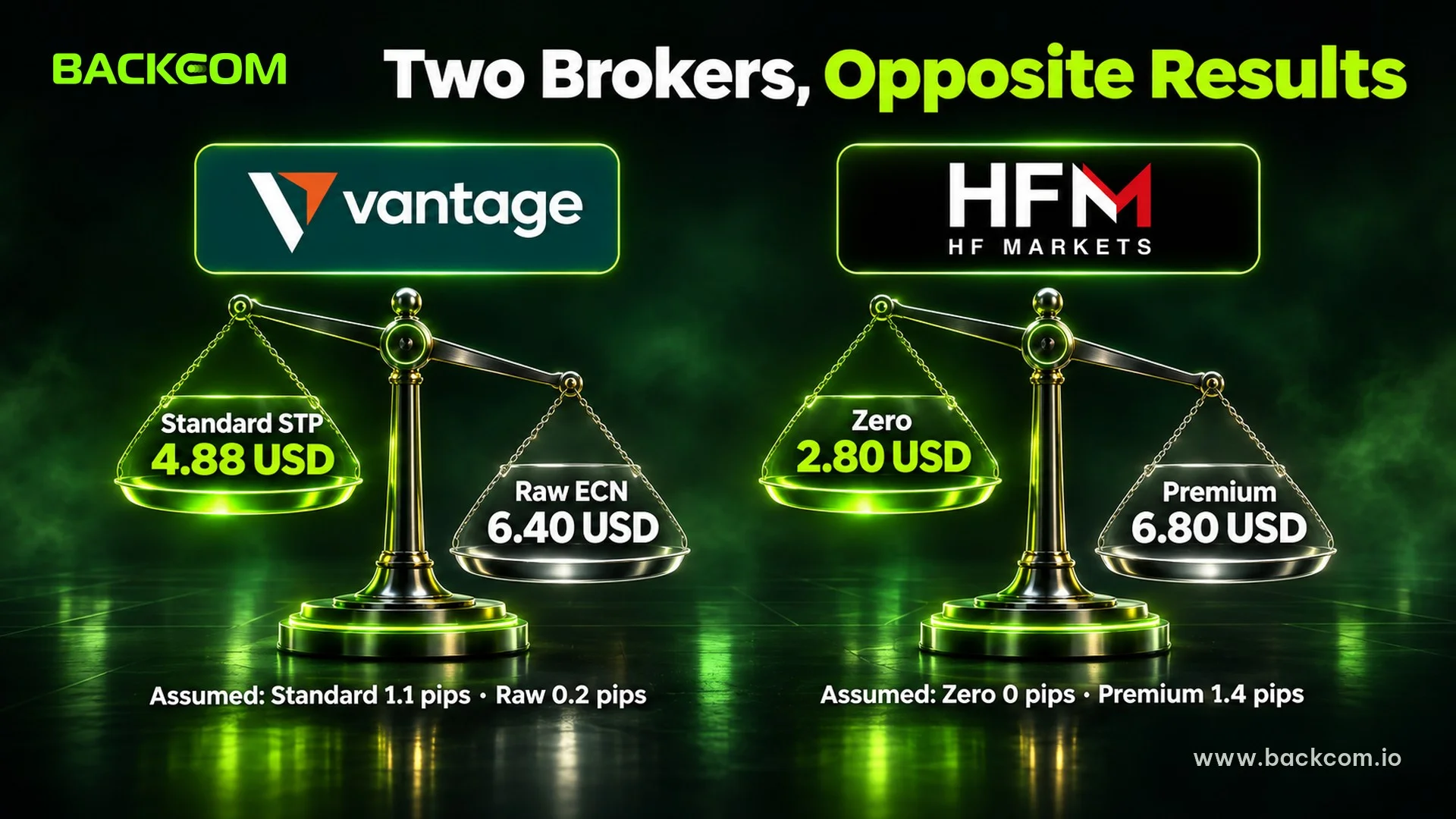
Raw spread vs standard account has no universal answer, because each broker sets fees and rebates differently. The two examples below use the same formula and reach opposite conclusions.
Vantage: Standard STP Can Cost Less Than Raw ECN
The Vantage rebate table on its broker page lists EURUSD at 6.12 USD for Standard STP and 1.60 USD for Raw ECN. The Raw ECN commission is 6 USD per round turn, and this article assumes a 0.2 pip Raw spread.
- Raw ECN: 0.2 × 10 + 6 − 1.60 = 6.40 USD per lot.
- Standard STP at 1.1 pips: 11 − 6.12 = 4.88 USD per lot.
- Standard STP at 1.4 pips: 14 − 6.12 = 7.88 USD per lot.
The break-even is 0.2 + (6 − 1.60 + 6.12) ÷ 10 = about 1.25 pips. The three sources publish different Standard STP spreads (1.0, 1.1 and about 1.4 pips), so the result splits: below 1.25 pips Standard STP costs less than Raw ECN after the rebate, while at 1.4 pips Raw ECN costs less. Vantage Cashback: Standard STP Vs Raw ECN goes deeper on this case.
HFM uses the name Premium for the account that folds the fee into the spread, and Zero for the account that charges commission. The EURUSD rebate is 7.20 USD on Premium and 3.20 USD on Zero. The Premium spread starts at 1.4 pips in the fee guide, while Zero starts at 0 pips plus a 6 USD commission.
- Premium: 14 − 7.20 = 6.80 USD per lot.
- Zero: 0 + 6 − 3.20 = 2.80 USD per lot.
The break-even is 1.0 pips. The sources disagree on the Premium spread: the broker page says "from 1 pip", the fee guide says 1.4 pips. At 1.4 pips Zero costs about 4 USD less per lot with a 0.0 pip Zero spread, and still about 2 USD less at 0.2 pips (2 + 6 − 3.20 = 4.80 USD against 6.80 USD).
At the 1.0 pip figure the two accounts tie at 2.80 USD, and Premium wins if Zero is wider, so the result depends on the spread you measure. HFM Trading Fees has the full tables for this broker.
Gold: Break-Even Is Counted Per Ounce
Gold follows the same formula, but one lot equals 100 ounces (an assumption; confirm it in the Specification). The break-even converts to USD per ounce:
| Broker | Formula | Break-even |
|---|---|---|
| Vantage | (6 + 11.30 − 1.60) ÷ 100 | 0.157 USD/oz |
| HFM | (10 + 12 − 5.60) ÷ 100 | 0.164 USD/oz |
| IC Markets | (7 + 4 − 2) ÷ 100 | 0.09 USD/oz |
Reference: broker pages as at 6 November 2026. The IC Markets and Vantage gold commissions are taken at the forex rate and have not been verified separately for gold.
At Vantage or HFM, a Standard gold spread only needs to be about 0.16 USD per ounce wider than Raw before Raw starts to cost less.
5 Steps To Choose Between Raw Spread And Standard By Net Cost
Choosing an account from your own measurements takes less time than reading a ranking. The routine below works for any broker that offers both account types.
Step 1: Get the rebate table for the exact broker
Open the broker page and note the rebate per lot for Standard and Raw on the product you trade. Record the date the table was updated, because rebates can change.
Step 2: Get the Raw round-turn commission
Read the symbol Specification in MT5 to see whether commission is per side or per round turn. If the broker says "per side", double it.
Step 3: Measure the real spread of both accounts in the same session
Open two demo accounts or two small live accounts and record the average spread in the session you usually trade. Spreads around news and rollover are much wider than the "from" figure.
Step 4: Plug the numbers into the break-even formula
Calculate the break-even standard spread and compare it with your measurement. Below the break-even, Standard is cheaper. Above it, Raw is cheaper.
Step 5: Multiply by your real monthly volume
A 1 USD gap per lot sounds small, but at 50 lots a month it is 50 USD. Read Lot Size In Forex to size volume to your capital.
Low Spread Forex Brokers lists options broker by broker, while this article only teaches the calculation so you can check the numbers yourself.
A fee is only one criterion, so also check the licence, deposits and withdrawals, and order execution using Reputable Forex Broker: 7 Criteria.
Official sources: regulators let you look up a broker's licence before you choose an account type, for example the FCA register and the ASIC website.
Frequently Asked Questions (FAQ) About Raw Spread And Standard Accounts
Is A Raw Spread Account Always Cheaper Than Standard?
No. Raw has a low raw spread but adds commission, and Standard usually earns a larger rebate. In the IC Markets example Standard is cheaper when the real spread is below 1.0 pips, while at HFM Zero beats Premium when the Premium spread is wider than 1.0 pips. Work it out with your own measurements instead of trusting a general rule.
Is A Raw Spread Account Good For Scalping?
Often yes, because scalpers open many small trades and every pip saved on the spread is multiplied by the number of trades. Commission also multiplies with the trade count, so calculate the net cost over a whole month. Spreads that widen around news remain a risk on both account types.
Is Raw Spread Commission Charged Per Side Or Per Round Turn?
Most brokers publish it per side, so a trade that opens and closes costs double. IC Markets states 3.5 USD per side, which is 7 USD per round turn. Check your trade history after the first few trades to confirm.
Does A Rebate Make Raw Spread Cheaper Than Standard?
A rebate makes both accounts cheaper, but it does not fix the winner. Because Standard usually carries the higher rebate, the rebate pushes the break-even up, and Raw needs a wider Standard spread to win. The rebate is calculated on closed lots, whether a trade wins or loses.
Conclusion: Calculate Net Cost First, Choose The Account Second
The question of raw spread vs standard account has a right answer for each trader and no universal answer for the market. Traders need to look at three factors together: the measured spread of both accounts, the Raw round-turn commission, and the rebate per lot on each.
The routine is simple: take the current fees and rebates, measure the spread in the session you trade, plug it into the break-even formula, then multiply by your monthly volume.
Once you have picked a broker, you can check the current rebate on the IC Markets page, the Vantage page or the broker overview. Backcom.io is an independent introducing broker (IB/affiliate) of these brokers; rebates are paid from the commission the broker pays Backcom.io — see the risk disclaimer.
Disclaimer: This content is compiled by Backcom.io for information only and is not investment advice, a trading recommendation or legal advice. Trading forex and leveraged products carries a high level of risk and you can lose all of your capital. Spreads, commissions and rebates can change after the date this article was written. Always check the broker's official page before making a decision.
Was this article helpful?
Join The Backcom.io Community
Get the latest on trading rebates, trading tips, and broker deals — and connect with thousands of traders worldwide.

Backcom App
Track Your Rebates Every Day
Every rebate is visible by broker and by day. Manage your wallet and withdrawals in one place.
Open Backcom App