Maker Vs Taker Fees In Crypto: How They Work And How To Pay Less


What are maker vs taker fees? They are the two trading fee rates most crypto exchanges charge, and which one you pay depends on whether your order waits in the order book or fills at once. In this article, Backcom.io explains the maker fee meaning and the taker fee meaning, shows how a limit order maker fee works in dollars, how crypto fee tiers lower your rate and which habits keep maker vs taker fees from quietly eating your results.
Maker Vs Taker Fees: A Plain Definition
A maker is a trader whose order rests in the order book and adds liquidity, while a taker is a trader whose order fills immediately and removes liquidity. Binance Academy explains that makers place orders that wait until another trader matches them, such as a limit order priced away from the market, and takers place orders that match existing offers right away, such as a market order. The article was checked on 5 November 2026.
Three terms help you read any fee page:
- Order book: the live list of buy and sell orders waiting to be matched.
- Liquidity: how easily you can buy or sell without moving the price. Resting orders supply it.
- Fee rate: a percentage of the trade value, charged on every fill.
The fee follows the order, not your direction. Buying and selling are treated the same way. What matters is whether you waited for someone else or took an offer that was already there.
Why Exchanges Charge Two Different Rates
Exchanges charge makers less because resting orders make the book deeper and the price tighter. According to Binance Academy, makers narrow the bid-ask spread by adding offers, while takers consume those offers and can widen it. A lower maker rate is the exchange's way of paying you to be patient. Some venues go further and pay makers a small rebate instead of charging a fee. For the spread itself, see our guide to bid and ask.
Maker Fee Meaning And Taker Fee Meaning
The maker fee is the lower rate you pay when your order adds liquidity, and the taker fee is the higher rate you pay when your order takes it. Neither word describes a person. The same account can be a maker on one trade and a taker on the next.
| Item | Maker | Taker |
|---|---|---|
| What the order does | Rests in the book | Fills against the book at once |
| Typical order type | Limit order away from market | Market order |
| Liquidity | Adds | Removes |
| Typical fee | Lower, sometimes a rebate | Higher |
| Fill certainty | Not guaranteed | Immediate |
Reference table of how the roles are usually defined. Exact rates and rules vary by exchange, so check the current fee schedule before you trade.
Who Pays The Higher Rate
Market orders always pay the taker fee, because they accept whatever price the book offers. Stop-market orders do the same once triggered. If you want the fill more than the price, you pay for the speed. That is a fair trade sometimes, for example when you must leave a losing position quickly, but it should be a choice, not a habit.
How A Limit Order Maker Fee Works
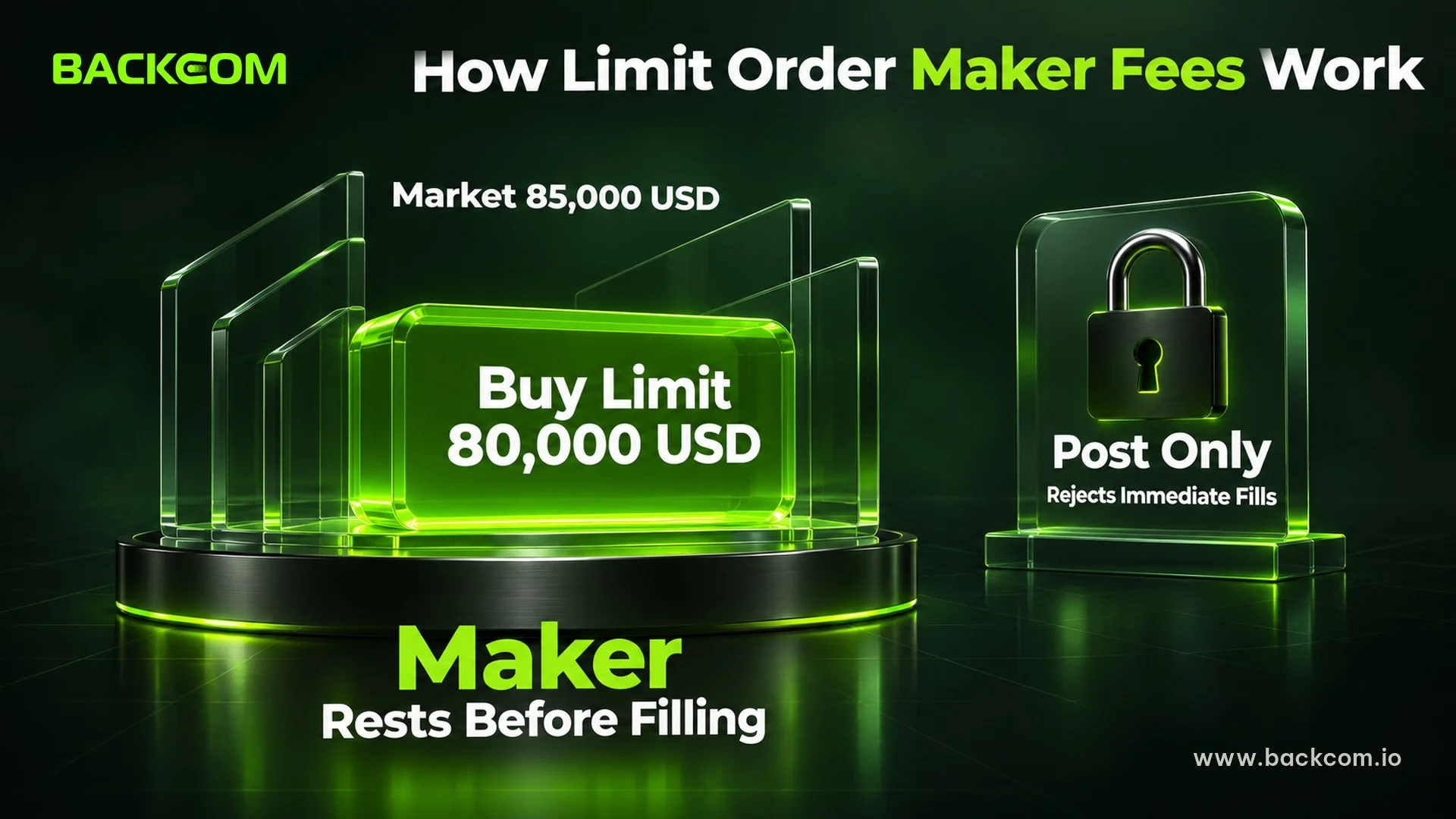
A limit order earns the maker fee only if it rests in the book before anyone fills it. Binance Academy gives the example of a buy limit order for 2 BTC at 80,000 USD placed while the price is 85,000 USD. The order waits in the book until the price falls to 80,000 USD, so it is a maker order.
The catch is that a limit order can also be a taker. If you place a buy limit at or above the best sell price, it matches an existing offer the moment it arrives. In that case you pay the taker rate, even though you used a limit order. The same source suggests using a "Post Only" option where available, which rejects an order that would fill immediately instead of letting it become a taker.
To summarise how to land on the maker side:
- Price the order away from the market: a buy below the best ask, or a sell above the best bid.
- Turn on Post Only if your platform offers it, so the order never fills as a taker by accident.
- Accept that it may not fill: a resting order can sit untouched while the price moves away.
What Maker And Taker Fees Cost In Dollars
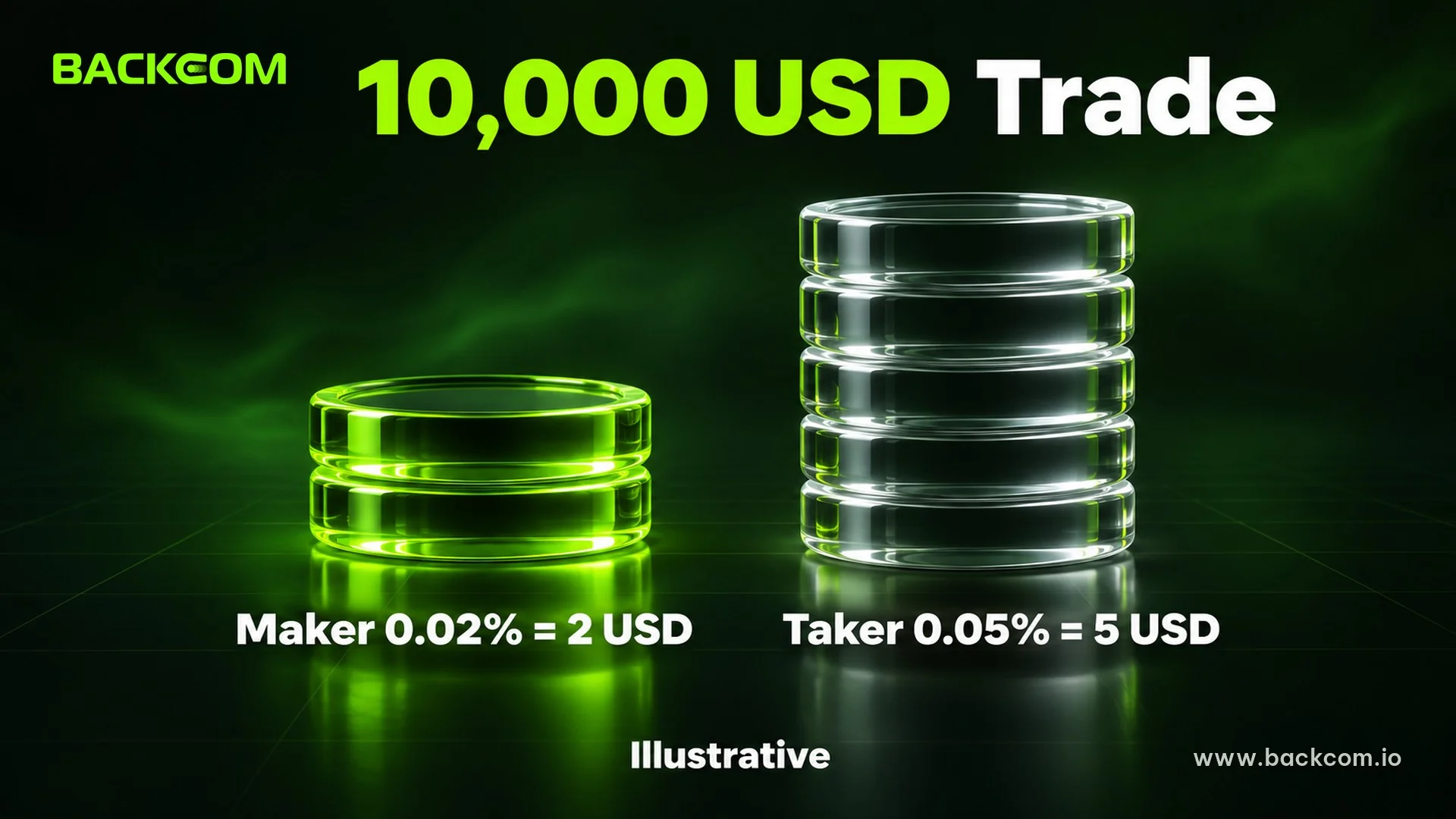
The cost is the trade value multiplied by the fee rate, charged on each fill. The rates below are illustrative figures chosen for easy arithmetic, not the schedule of any exchange.
Fee = Trade value × Fee rate
Take a 10,000 USD position, a 0.02% maker rate and a 0.05% taker rate:
| Fill | Calculation | Fee |
|---|---|---|
| Maker | 10,000 × 0.02% | 2 USD |
| Taker | 10,000 × 0.05% | 5 USD |
A round trip means one entry and one exit, so you pay fees twice:
| Round trip | Entry | Exit | Total fees |
|---|---|---|---|
| Maker and maker | 2 USD | 2 USD | 4 USD |
| Maker and taker | 2 USD | 5 USD | 7 USD |
| Taker and taker | 5 USD | 5 USD | 10 USD |
Illustrative arithmetic only, before spread, slippage and funding. Real rates differ by exchange, product and account tier, so recalculate with your own schedule.
The gap looks small until you repeat it. At 20 round trips a month on 10,000 USD, taker on both sides costs 200 USD and maker on both sides costs 80 USD. That is 120 USD of difference before the market has moved at all. For a trader who aims to win a fraction of a percent per trade, fees can be the larger part of the result.
Fees Are Charged On Position Size
Fees apply to the full value of the trade, not to the margin you put up. In leveraged trading a 10,000 USD position at 10x uses 1,000 USD of margin but still pays fees on 10,000 USD. If you are new to this, read what leverage in crypto trading is first. Frequent small trades with high leverage make fees a much bigger share of your margin than they look on paper.
Crypto Fee Tiers: How Your Rate Gets Lower
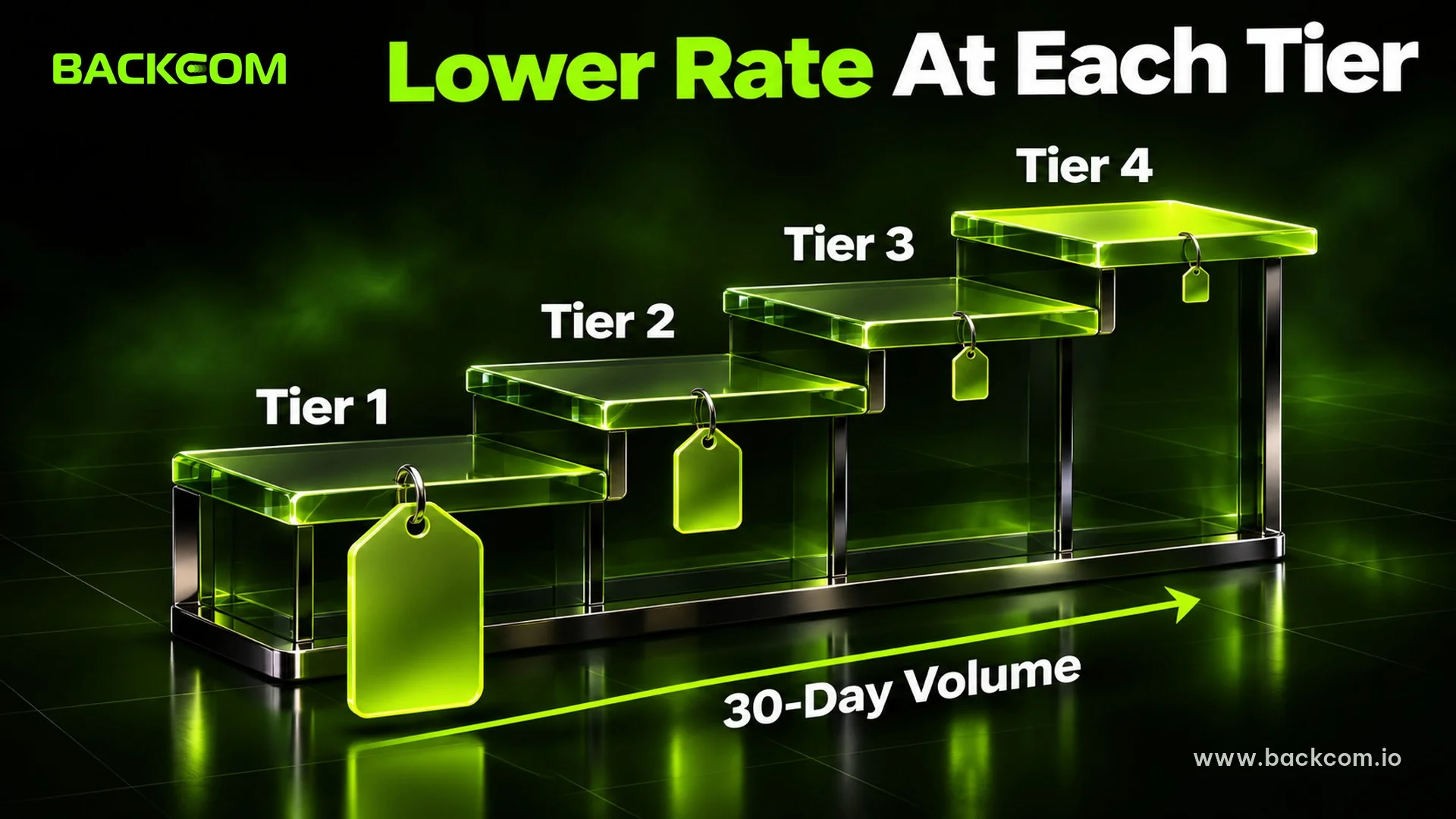
Crypto fee tiers are bands of trading volume, usually measured over the last 30 days, that each carry a lower maker and taker rate. Binance Academy notes that fees often drop as traders reach higher monthly volume tiers. Other things can also lower your rate, depending on the venue:
- Higher 30-day volume: the main route, and the one that favours active traders.
- Holding the exchange's own token: some platforms discount fees if you pay with it. The token itself carries price risk, so do not buy it only for the discount.
- Account or VIP level: some venues tie rates to balance or a status programme.
- Product choice: spot and futures usually have separate schedules.
Not every platform follows this model. Some charge a flat rate for everyone, and some decentralised exchanges charge a pool fee instead, which is covered in centralized vs decentralized exchange. For a full worked schedule, our review of Gate trading fees shows how spot, futures and VIP rates are laid out.
How To Read A Fee Table
A fee table lists a row per tier, with the volume needed and the maker and taker rates side by side. Read it in this order:
- Find your product: spot, perpetual or options.
- Find your tier from your 30-day volume, not from the best row.
- Compare maker and taker in the same row: the gap tells you how much patience is worth.
- Check for discounts and for rebates: a negative maker rate means you are paid.
Costs That Sit Next To Maker And Taker Fees
Trading fees are only one part of what a trade costs. Looking at them alone can push you toward orders that save a fee but lose more elsewhere.
- Spread: a taker crosses the spread and pays it, while a maker earns it only if the order fills.
- Slippage: a market order in a thin book can fill at a worse price than the screen showed. Our guide to slippage in crypto explains it.
- Funding rate: perpetual contracts charge or pay funding at set intervals, covered in what funding rate is and what perpetual futures are.
- Missed trade cost: a maker order that never fills saves the fee but also loses the move.
A simple example: you save 3 USD by waiting as a maker on a 10,000 USD entry, but the price runs 0.5% away and the order never fills. You saved 3 USD and missed a 50 USD move. The cheapest order is not always the best order.
How To Pay Less In Maker And Taker Fees
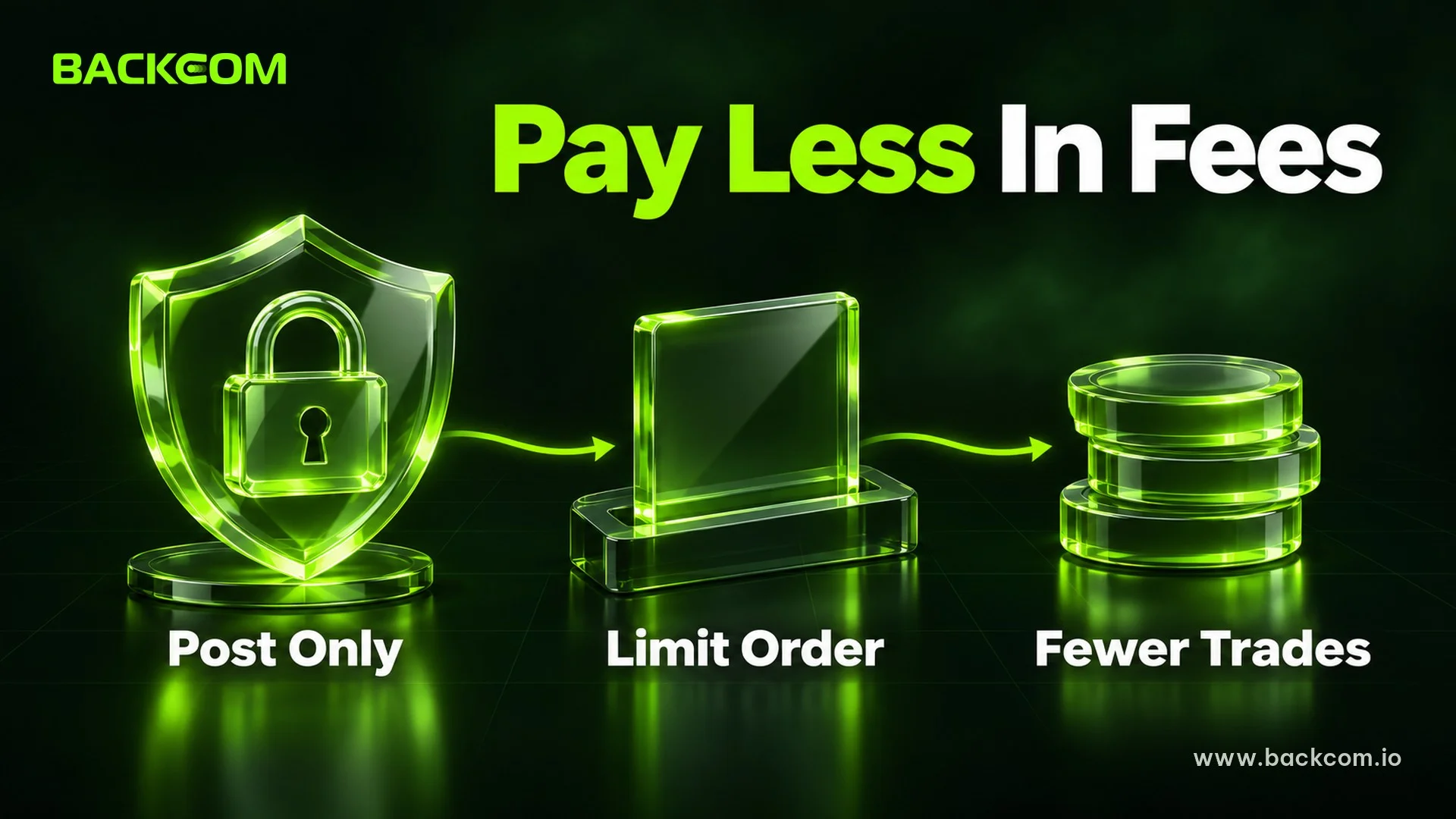
You pay less when you use taker orders only on purpose and let planned entries rest as maker orders. These habits do not remove cost, but they lower it:
- Use limit orders for planned entries. If you have a level in mind, place the order there and wait.
- Switch on Post Only so a limit order cannot turn into a taker by mistake.
- Keep market orders for urgent exits, such as a stop that must close a losing trade.
- Trade less often. Fewer round trips means fewer fees, and many small trades add up faster than most people expect.
- Check your tier and the volume needed for the next one, but do not trade more just to climb a tier.
- Compare the whole cost, not only the headline rate, as in Binance vs Bybit, where fees are one of several factors.
Common Mistakes With Maker And Taker Fees
Most fee surprises come from a few repeated assumptions. Watch for these:
- Assuming every limit order is a maker order: it is not if it fills on arrival.
- Chasing the lowest fee and ignoring fills: a resting order in a fast market may never trade.
- Comparing rates across products: a futures rate and a spot rate are not like for like.
- Ignoring fees in the risk plan: fees on entry and exit add to your loss when a stop is hit.
- Forgetting the quote currency: fees may be taken in the coin you receive, the quote asset or a fee token, so check how your balance changes.
Frequently Asked Questions (FAQ) About Maker Vs Taker Fees
Is A Limit Order Always A Maker Order?
No. A limit order is a maker order only if it rests in the book. If it matches an existing offer when you place it, it fills as a taker order and pays the higher rate. Post Only prevents this by rejecting an order that would fill at once.
Are Maker Fees Always Lower Than Taker Fees?
On most venues, yes, because exchanges want resting orders to deepen the book. Some platforms charge the same rate to both sides, charge a flat rate, or pay makers a rebate. Always read the fee schedule for your product and tier.
Does A Market Order Always Pay The Taker Fee?
Yes, in the usual model. A market order accepts the best price available and fills immediately, so it removes liquidity and pays the taker rate. It also exposes you to spread and slippage on top of the fee.
How Do Crypto Fee Tiers Work?
Tiers are bands of trading volume, often measured over 30 days. Higher volume usually moves you into a band with lower maker and taker rates. Check how your venue counts volume, since the rule differs between spot and futures.
Can I Avoid Trading Fees Completely?
Not on most venues. You can lower them by using maker orders, trading less often and watching your tier, but a fee is part of the cost of every fill. Treat it as a number in your plan, like the spread.
Conclusion: Know Which Side Of The Book You Are On
Maker vs taker fees come down to one question: did your order wait, or did it take what was already there? Makers add liquidity and usually pay less, takers remove it and pay more, and the difference compounds fast when you trade often. Plan entries with limit orders, keep market orders for urgent exits and read the fee table for your own product and tier. Backcom.io publishes this guide for education, and the US regulator CFTC warns that virtual currency trading carries real risks, checked on 5 November 2026. New to the topic? Start with what crypto is.
Disclaimer: This content is compiled by Backcom.io for information only and is not investment advice. Crypto trading carries a high risk of loss, including the loss of your whole deposit. Fee rates in this article are illustrative. Rules and taxes differ by country, so check the requirements that apply to you before trading.
Was this article helpful?
Join The Backcom.io Community
Get the latest on trading rebates, trading tips, and broker deals — and connect with thousands of traders worldwide.

Backcom App
Track Your Rebates Every Day
Every rebate is visible by broker and by day. Manage your wallet and withdrawals in one place.
Open Backcom App