Centralized Vs Decentralized Exchange: Differences, Fees And Risks

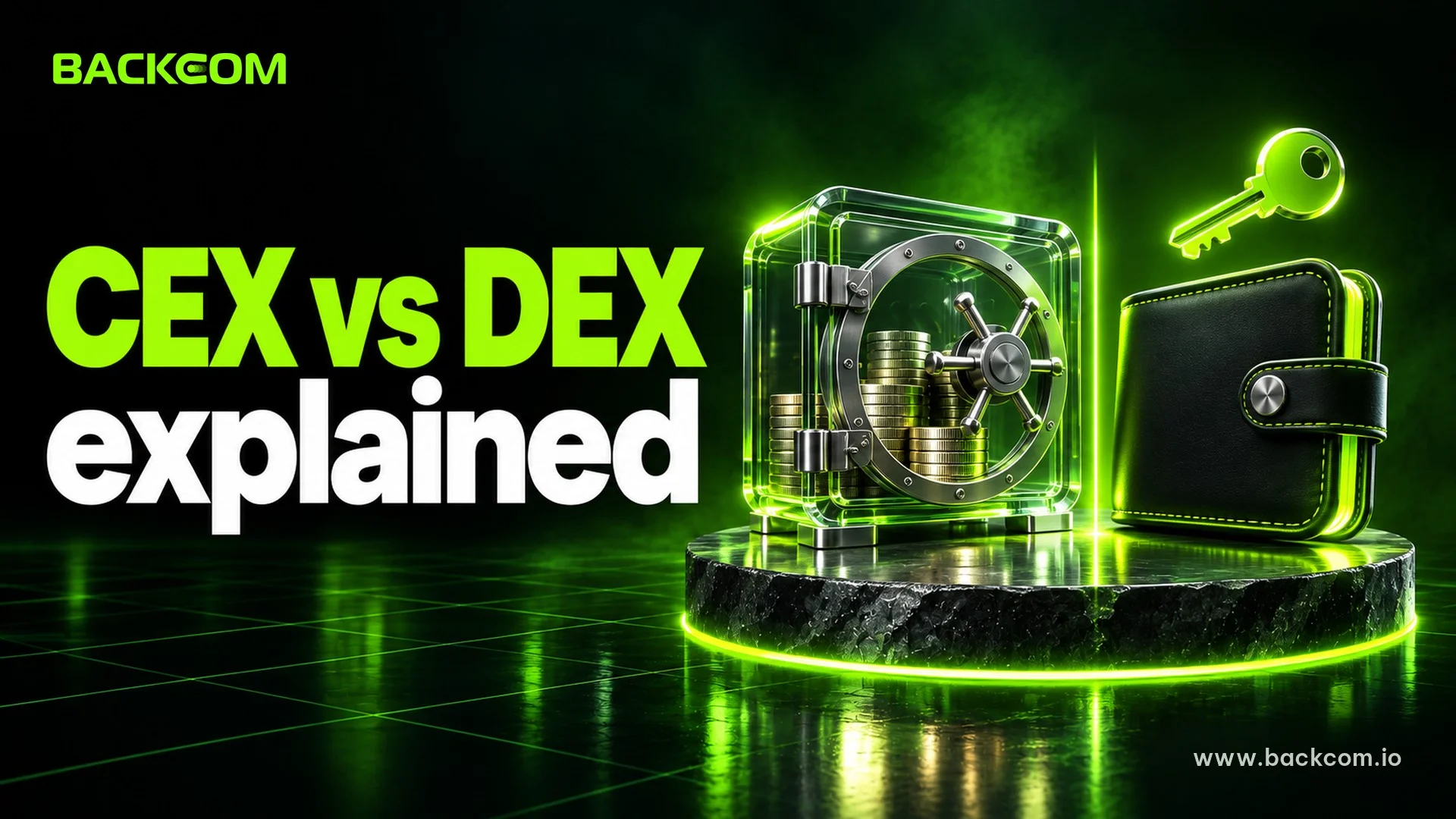
A centralized vs decentralized exchange comparison comes down to two questions: who holds your coins while you trade, and how the price of each trade is set. On a centralized exchange (CEX) a company holds your funds and matches orders on its own servers. On a decentralized exchange (DEX) you keep your coins in your own wallet and a smart contract settles the swap. In this article, Backcom.io explains how each model works, what each one really costs, and which risks come with it, so you can choose with clear eyes.
What Is A Centralized Exchange (CEX)?
A centralized exchange is a trading platform run by a company that holds user deposits, matches buyers with sellers and keeps the records on its own systems. When you deposit coins, they move into wallets controlled by the exchange, and your balance becomes an entry in its database. This is called custodial trading: the platform holds the private keys, not you.
Most CEXs also ask you to verify your identity (KYC) before you can withdraw large amounts. In return, they offer features that beginners find convenient:
- Fiat on-ramps: card payments, bank transfers or peer-to-peer markets to buy coins with local currency.
- Order types and products: limit and stop orders, margin, and perpetual futures.
- Account recovery: a forgotten password can be reset through support, which is not possible with a lost wallet seed phrase.
- Customer support: a team you can contact when a deposit or withdrawal goes wrong.
The cost of this convenience is counterparty risk. You are trusting the company to stay solvent, secure and honest. If you are new to the asset class itself, start with our beginner guide to how cryptocurrency works before choosing a platform.
What Is A Decentralized Exchange (DEX)?
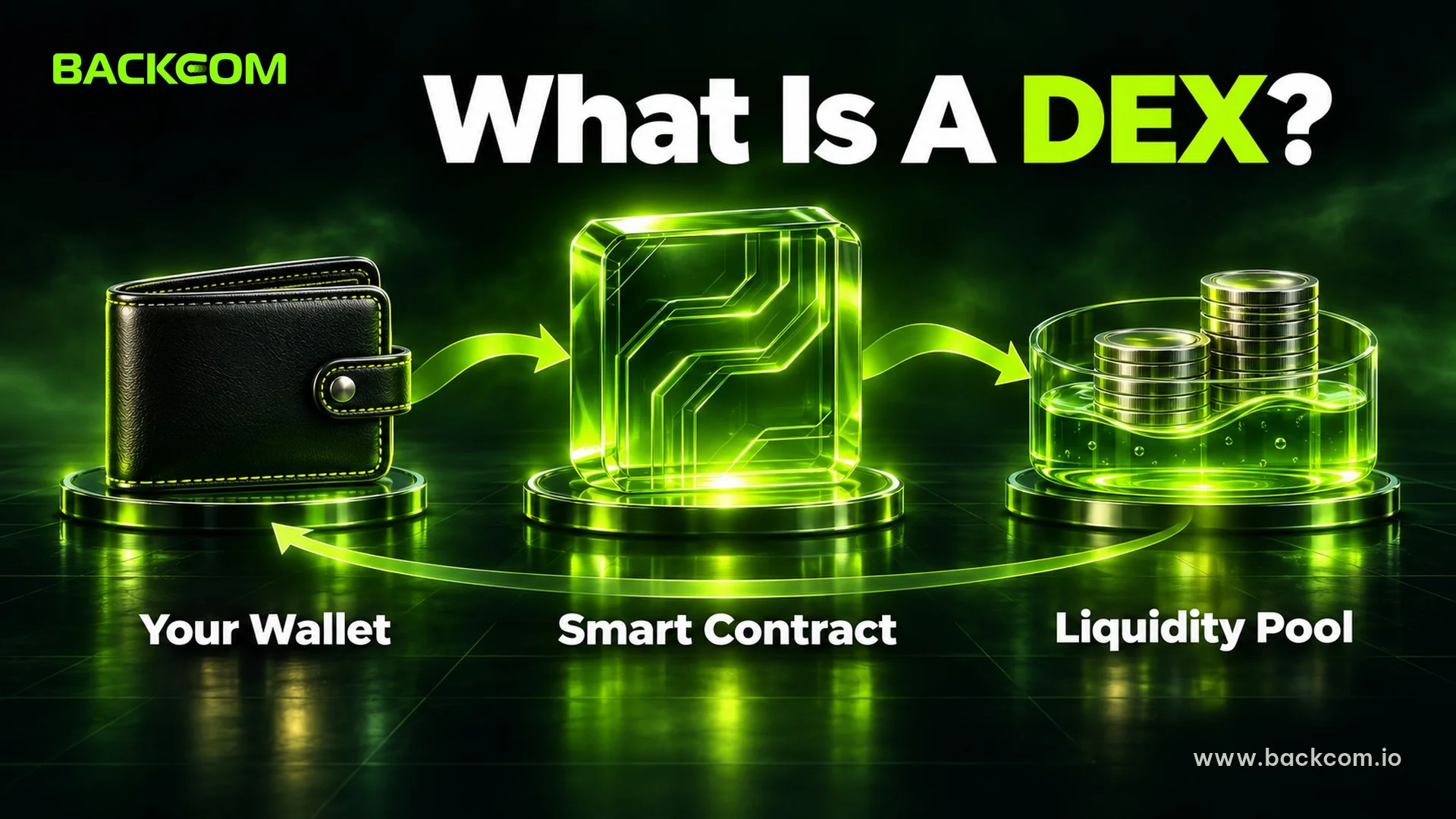
A decentralized exchange is a set of smart contracts on a blockchain that lets users swap tokens directly from their own wallets, with no company holding the funds. You connect a wallet, approve the trade and the contract sends the new tokens straight back to you. This is non-custodial trading: you keep the private keys the whole time.
Most DEXs do not match buyers with sellers at all. They use liquidity pools: shared piles of two tokens supplied by users called liquidity providers (LPs). A formula sets the price from the pool balances, and every trade shifts those balances. Uniswap, one of the best-known DEXs, describes this as an automated market maker, where prices follow a constant product rule written as x × y = k. In its newer versions that rule applies within the price range each liquidity provider chooses (How Uniswap works).
Some newer DEXs run an on-chain order book instead of pools, which feels closer to a CEX while still settling on a blockchain. The key point does not change: the smart contract, not a company, is in charge of your assets during the trade.
DEXs also have trade-offs:
- No account recovery: lose your seed phrase and nobody can restore your coins.
- Network fees: every swap, approval and failed transaction costs gas.
- Token risk: anyone can list a token, including fakes and scams.
- Fewer built-in services: fiat purchases and support are limited or handled by third parties.
Centralized Vs Decentralized Exchange: Side-By-Side Comparison
The difference between CEX vs DEX is easiest to see when you put the two models in one table. The rows below describe the typical case; individual platforms vary.
| Feature | Centralized exchange (CEX) | Decentralized exchange (DEX) |
|---|---|---|
| Who holds your coins | The exchange (custodial) | You, in your own wallet (non-custodial) |
| How prices are set | Order book and matching engine | Usually a liquidity pool formula, sometimes an on-chain order book |
| Account | Email or phone, usually with KYC | Wallet connection, usually no account |
| Fiat deposits | Often supported | Usually not supported directly |
| Fees | Trading fee, sometimes withdrawal fee | Pool fee plus network gas fee |
| Speed | Orders matched off-chain, very fast | Depends on the blockchain and its congestion |
| Tokens available | Listed by the exchange | Anything with a pool, including risky tokens |
| Main risk | Exchange failure, hack or frozen withdrawals | Smart contract bugs, scam tokens, wallet mistakes |
| Support | Support team and recovery tools | Mostly self-service |
Reference summary of typical features, as at 4 November 2026. Individual exchanges differ, so check the platform's own documentation before you trade.
For a broader explanation from an infrastructure provider, see Chainlink's CEX vs DEX overview and Ledger's exchange guide.
How Trading Works: Order Books Versus Automated Market Makers
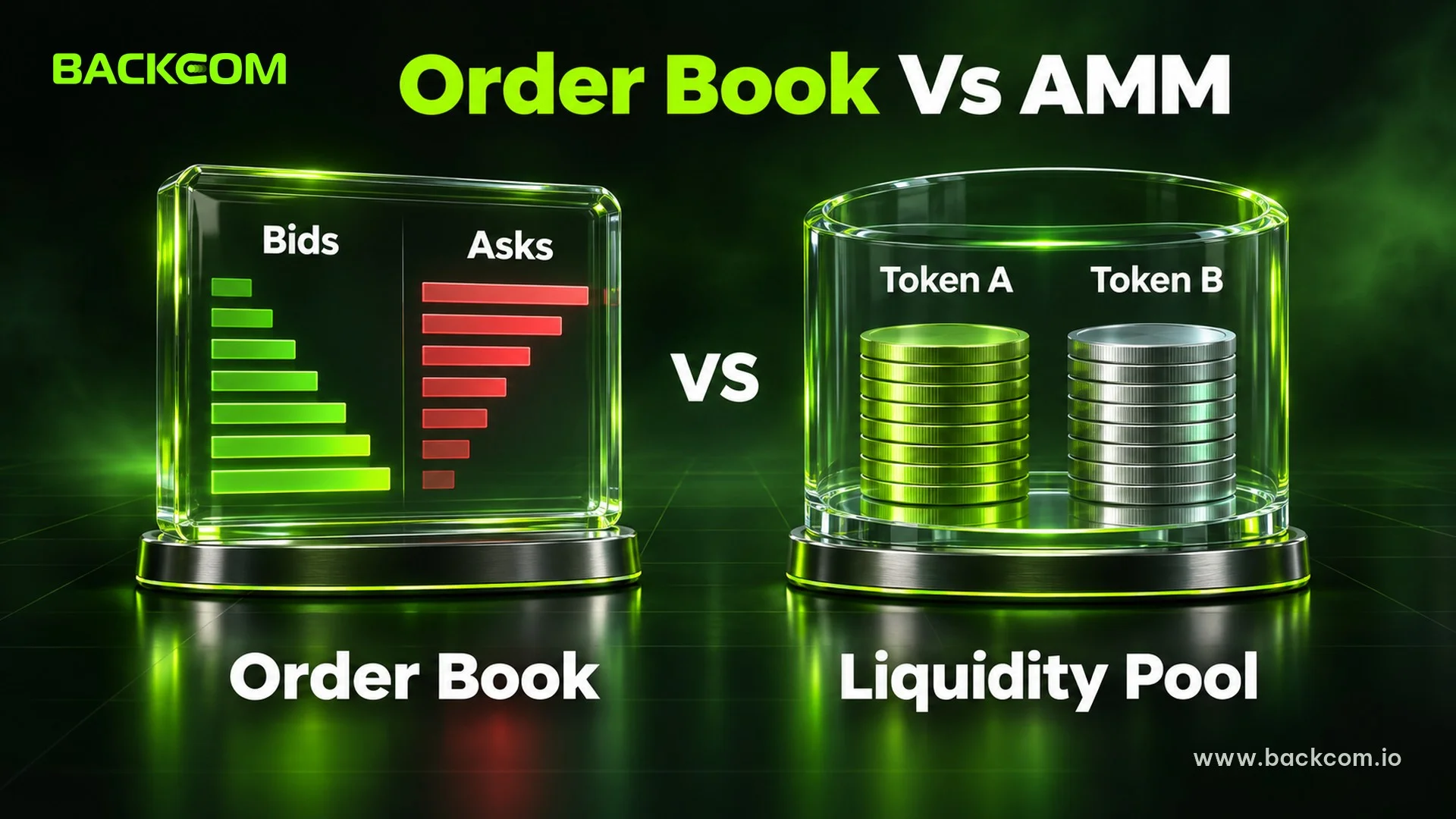
Price formation is the technical heart of the CEX vs DEX debate, and it explains why the two feel so different when you place a large order.
How A CEX Order Book Works
An order book is a live list of buy orders (bids) and sell orders (asks). When your buy order meets a sell order at the same price, the matching engine fills it. Market makers keep the book deep by posting orders on both sides, so you can usually trade a decent size close to the quoted price.
How A DEX Liquidity Pool Works
In a liquidity pool, you trade against the pool, not against another person. Suppose a pool holds equal values of two tokens. If you buy one token, the pool gives you some of it and receives the other, and the formula moves the price against you. Uniswap's documentation explains that a trade that is large relative to the pool depth moves the price more than a small one.
That gap between the quoted price and the price you actually get is price impact. It is separate from slippage, which is the further movement that can happen between the moment you submit the trade and the moment it is confirmed. Our guide to slippage in crypto trading shows how to measure and limit both.
What Liquidity Providers Risk
LPs earn a share of the pool fees, but they also face impermanent loss. If the price of one token in the pool moves strongly against the other, the LP can end up with less value than if they had simply held both tokens in a wallet. This does not affect a normal swapper directly, but it shapes how deep a pool is and therefore how much your trade moves the price.
DEX Vs CEX Fees: What Each Trade Really Costs
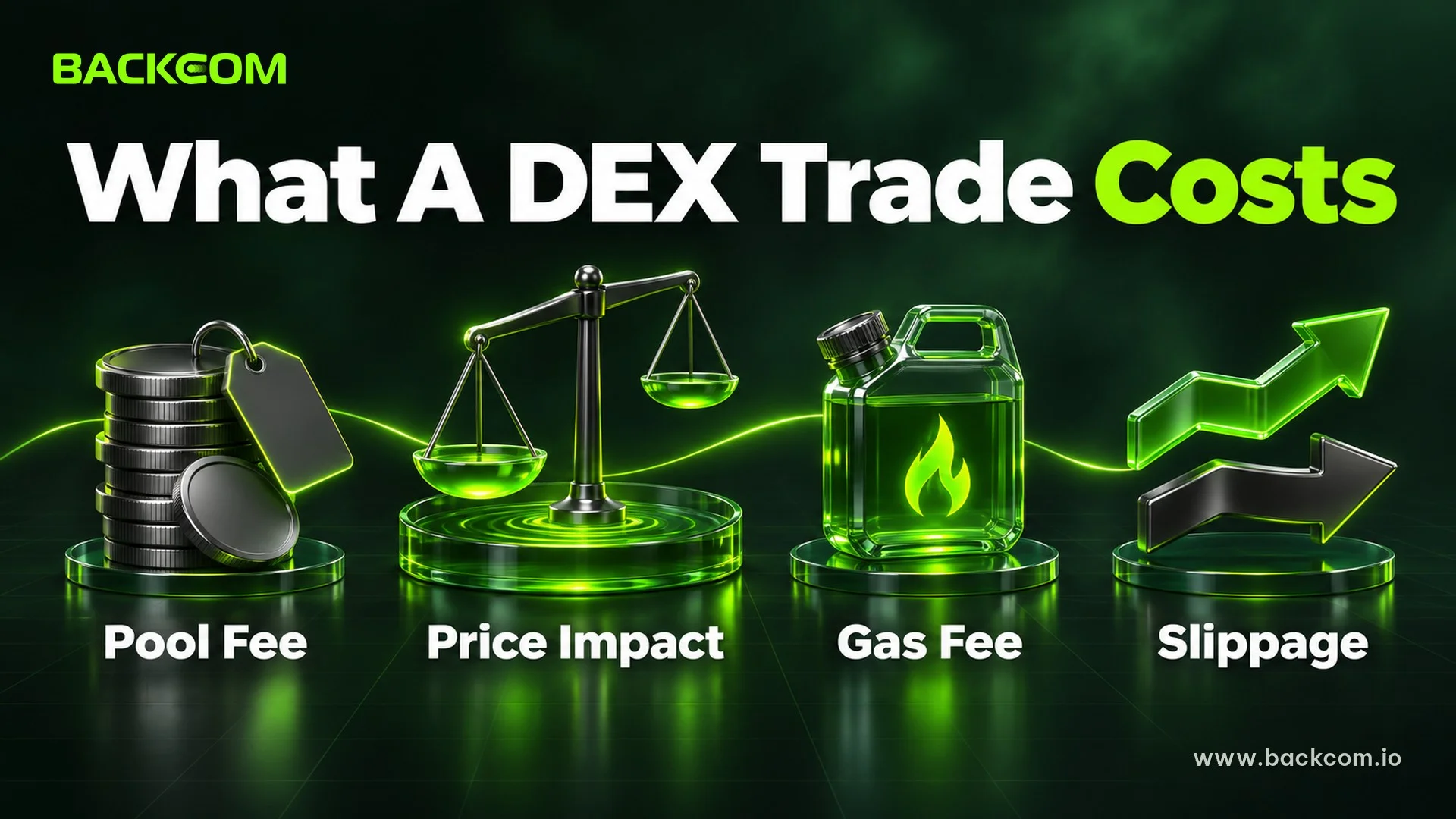
DEX vs CEX fees are not directly comparable because they are made of different parts. A CEX usually charges one percentage fee per trade. A DEX adds up several smaller costs.
On a CEX, Binance's public fee schedule showed a regular-user spot rate of 0.100% for both maker and taker orders, with a discount available when paying fees in BNB, as at 4 November 2026 (Binance fee schedule). Other exchanges publish their own tables; our breakdown of Gate trading fees shows how spot, futures and VIP levels differ.
On a DEX, the cost of a swap has four layers:
Total DEX swap cost = Pool fee + Price impact + Network gas fee + Slippage
| Cost layer | What it is | Example |
|---|---|---|
| Pool fee | Paid to liquidity providers | Uniswap v2 charges 0.30%; v3 offers tiers of 0.01%, 0.05%, 0.30% and 1%; v4 pools set their own fee |
| Price impact | Price moves because your trade changes the pool balance | Grows with trade size relative to pool size |
| Gas fee | Paid to the blockchain network for processing | Changes with network demand, and failed swaps still cost gas |
| Slippage | Extra price movement before confirmation | Limited by the tolerance you set |
Fee tiers per Uniswap's developer documentation as at 4 November 2026. Fees are set by each protocol and can change, so check them before you swap. Source: Uniswap fee documentation.
A quick example shows why the layers matter. Say you swap the equivalent of 1,000 USD in a pool with a 0.30% fee. The pool fee is 3 USD. If price impact is 0.20% (2 USD) and gas is 5 USD, you have spent about 10 USD, or roughly 1.0%, before any slippage. On a CEX with a 0.100% fee, the same 1,000 USD trade would cost about 1 USD in fees, although the exchange may charge a withdrawal fee later. These figures are illustrative, not quotes from any platform.
The lesson is not that one model is always cheaper. Small trades on a busy network can be expensive on a DEX, while very liquid pools on low-cost networks can be competitive. Always add up every layer before comparing.
Risks Of Centralized And Decentralized Exchanges
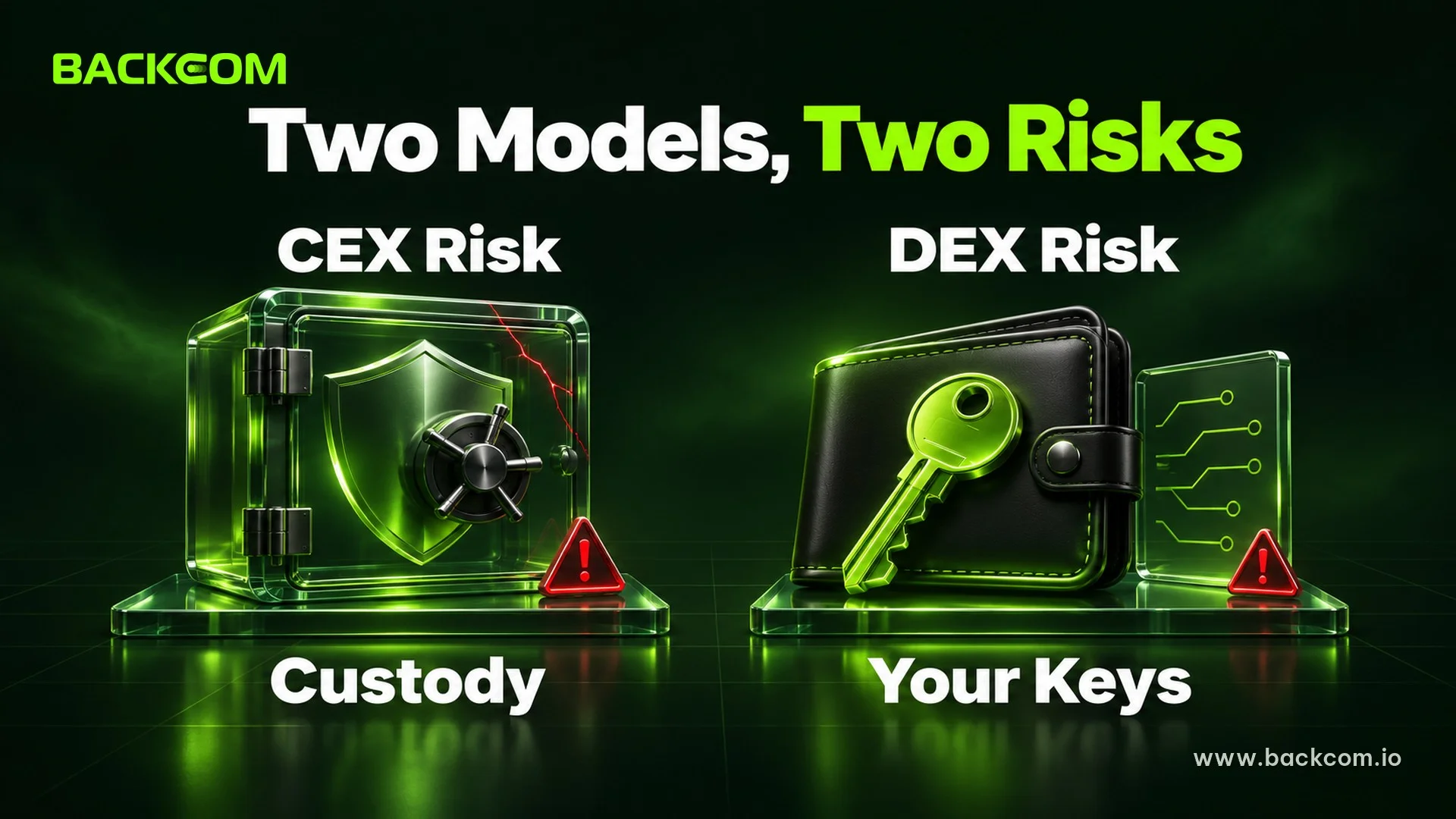
Neither model is risk-free. They simply fail in different ways, and the first step is knowing which failure you are exposed to.
Main Risks On A CEX
- Insolvency or mismanagement: the exchange can lose or misuse customer funds. The FTX bankruptcy in November 2022 left customers unable to withdraw their balances.
- Hacks: a platform that holds millions of users' coins is a target for attackers.
- Frozen withdrawals: accounts can be restricted during investigations, compliance checks or technical problems.
- Account takeover: a stolen password or SIM swap can empty your balance if security settings are weak.
You can lower the last risk yourself. Our checklist for Binance account security covers settings such as two-factor authentication and withdrawal whitelists that apply to most large exchanges.
Main Risks On A DEX
- Smart contract bugs: code that holds funds can contain flaws, even when it has been audited.
- Scam and fake tokens: anyone can create a token and a pool, so always verify the contract address.
- Sandwich attacks: bots can place trades before and after yours to profit from your slippage tolerance. MEV Blocker explains that a higher tolerance leaves more room for the attacker (MEV Blocker docs).
- Wallet mistakes: approving a malicious contract or sending coins to the wrong address cannot be reversed.
Self-custody moves the responsibility from the company to you. That removes exchange failure risk but adds the risk of your own mistakes.
CEX Vs DEX: Which Should You Use?
The right choice depends on what you want to do, how experienced you are and how much responsibility you are ready to take on.
When A CEX Fits Better
A CEX is usually the more practical starting point if you want to buy your first coins with local currency, trade larger size near the quoted price, use stop orders, or trade perpetual futures with leverage. If you use leverage, understand cross margin vs isolated margin and how to calculate your liquidation price first.
When A DEX Fits Better
A DEX tends to suit you if you want to hold your own keys, need access to a token not listed on major exchanges, or want to use on-chain applications directly. It also suits those who accept network fees and are comfortable checking contract addresses.
Many Traders Use Both
The two models are not rivals for everyone. A common pattern is to buy and hold a stablecoin on a CEX, withdraw to a personal wallet, and use a DEX only for specific swaps. Our explainer on how stablecoins work covers the assets people most often move this way.
A simple checklist helps you decide:
- Start small. Test a deposit, a trade and a withdrawal with an amount you can afford to lose.
- Know where your keys are. If a company holds them, you own a claim on the company, not the coins themselves.
- Add up all fees. Include gas, withdrawal charges and price impact.
- Check the rules where you live. Regulation and taxes on crypto differ by country of residence, and some platforms restrict users from certain countries.
- Never invest money you cannot afford to lose. Crypto prices can fall sharply and quickly.
Frequently Asked Questions (FAQ) About CEX Vs DEX
Is A DEX Safer Than A CEX?
Not automatically. A DEX removes the risk of an exchange holding your funds, but adds smart contract bugs, fake tokens and your own wallet mistakes. A CEX adds counterparty risk but offers recovery and support. Which is safer depends on how carefully you manage your keys and how much you trust the platform.
Are DEX Fees Cheaper Than CEX Fees?
It depends on the trade. A CEX charges a single percentage fee, such as 0.100% for a regular spot account on one large exchange. A DEX charges a pool fee plus gas and price impact. Small trades on a congested network can cost more on a DEX, while liquid pools on cheaper networks can be competitive.
Do You Need KYC To Use A DEX?
Most DEX smart contracts do not ask for identity documents, because you only connect a wallet. However, some websites that front those contracts block certain countries, and the rules on crypto differ by country. Check the applicable regulations where you live and do not assume that no KYC means no legal obligations.
Can You Use A CEX And A DEX Together?
Yes, and many traders do. A typical flow is to buy a coin or stablecoin on a CEX, withdraw it to a personal wallet, and then use a DEX for swaps that the exchange does not list. Always double-check the network and address before you withdraw, since a wrong network can cause permanent loss.
Conclusion: Choose The Exchange Model That Matches Your Skills
The centralized vs decentralized exchange choice is about trade-offs, not a winner. A CEX gives you convenience, fiat access and support in return for trusting a company with your funds. A DEX gives you control of your keys and wide token access in return for taking full responsibility, paying gas and watching for scam tokens. Before you trade on either, add up every fee, start with a small test and secure your account or wallet. Crypto trading carries high risk, and nothing in this guide promises a profit.
Disclaimer: This content is compiled by Backcom.io for information only and is not investment advice. Crypto assets are volatile and you can lose all of the money you put in. Fees and features change, so check each platform's own documentation. Rules and taxes differ by country of residence. See the risk disclaimer.
Was this article helpful?
Join The Backcom.io Community
Get the latest on trading rebates, trading tips, and broker deals — and connect with thousands of traders worldwide.

Backcom App
Track Your Rebates Every Day
Every rebate is visible by broker and by day. Manage your wallet and withdrawals in one place.
Open Backcom App