What Is Crypto? A Beginner Guide To How Cryptocurrency Works

What is crypto? In short, crypto is digital money and digital assets that live on a shared public database called a blockchain, rather than in a bank's private ledger. No single company or government runs the network, and ownership is proven with cryptographic keys instead of an account in your name. In this article, Backcom.io explains what is cryptocurrency, how it works step by step, how Bitcoin differs from other coins, and which risks a beginner should understand before buying anything.
What Is Crypto? A Plain-English Definition
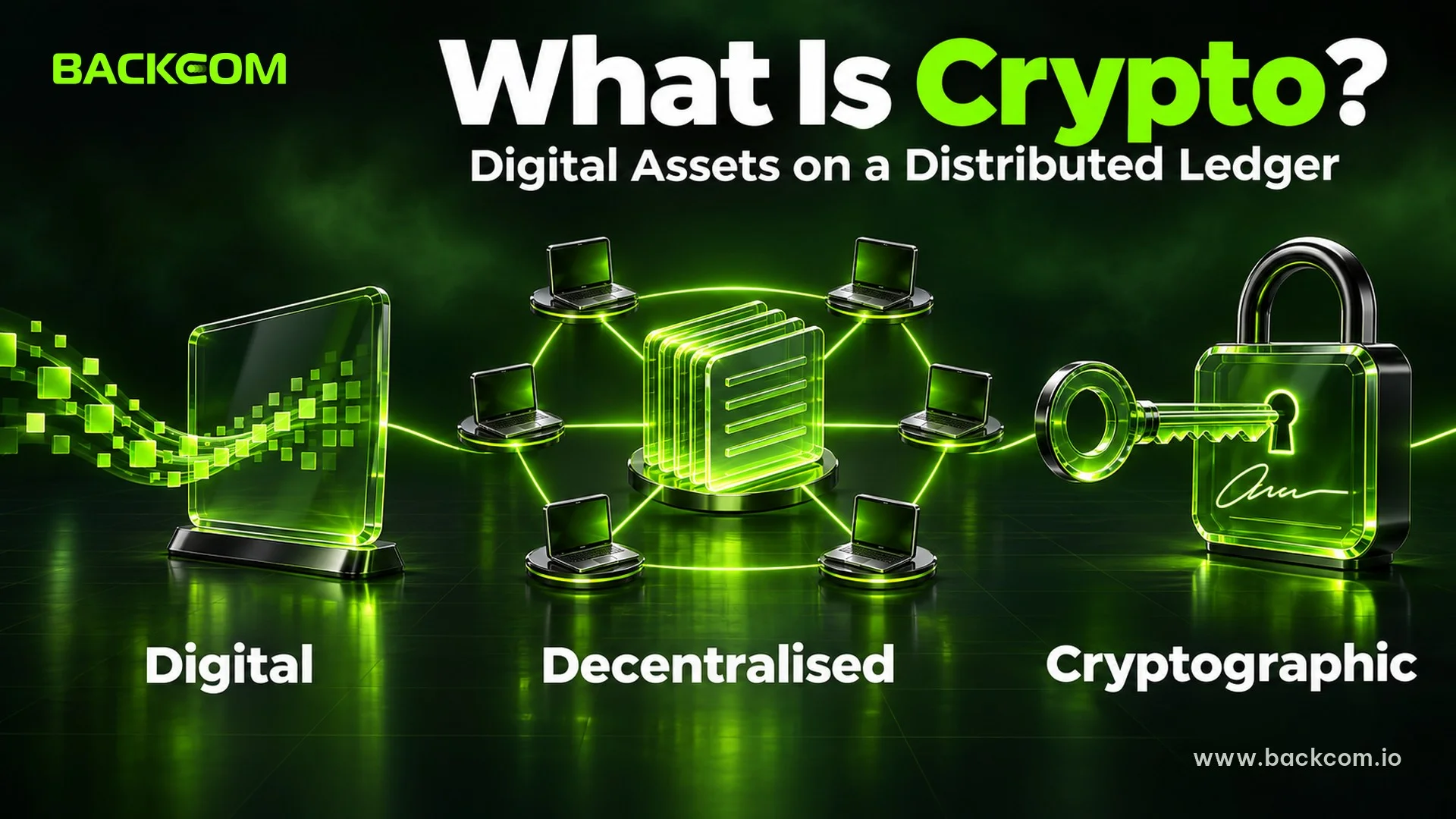
Crypto is a general name for digital assets secured by cryptography and recorded on a distributed ledger. The ledger is copied across thousands of independent computers, so no single party can quietly edit the history of who owns what. Bitcoin, ether and thousands of other tokens all fall under this label.
Three ideas explain most of the field:
- Digital: crypto exists only as data on a network, not as coins or notes.
- Decentralised: many computers, called nodes, keep and check the same record.
- Cryptographic: mathematical signatures prove who authorised each transfer.
Crypto is not one product. Some coins aim to work as money, some power software platforms, and some are pegged to a national currency. Treating them as one thing is the first beginner mistake.
What Is Cryptocurrency, Exactly?
A cryptocurrency is a digital unit of value that moves directly between wallets over a blockchain network. The word is often used as a synonym for crypto, although crypto also covers non-currency tokens such as those used in games or applications.
The idea became public in October 2008, when a person or group using the name Satoshi Nakamoto published the Bitcoin white paper describing a peer-to-peer electronic cash system. The first major platform for programmable assets followed later: according to ethereum.org, Ethereum launched in July 2015 and uses ether (ETH) to pay network fees.
How Does Crypto Work? Wallets, Keys And The Blockchain
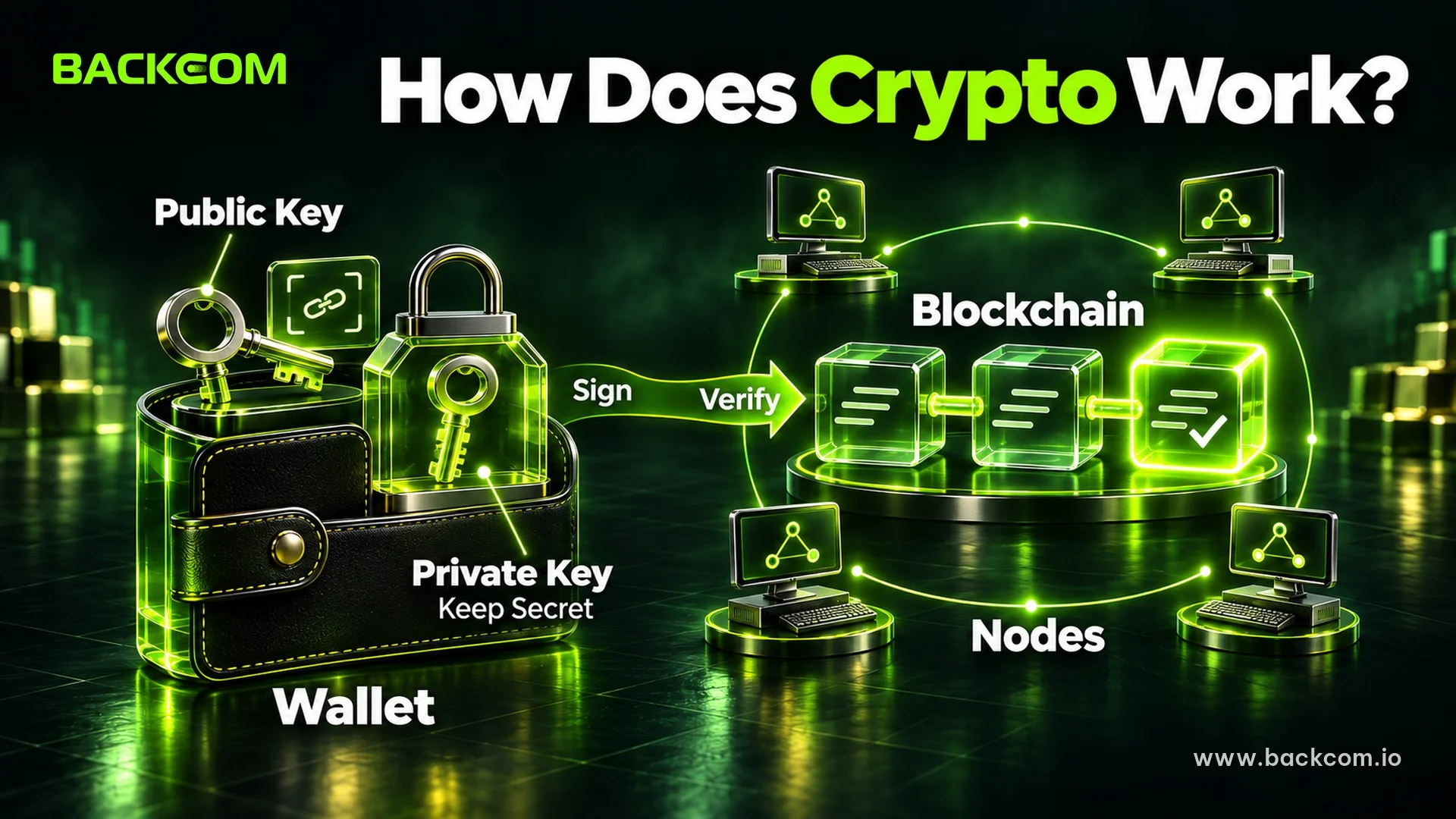
How does crypto work in practice? A wallet signs a transaction, the network checks it, and a block adds it to the shared ledger. Every part of that chain is worth understanding, because most beginner losses come from one broken link.
Wallets And Private Keys
A wallet is software or hardware that stores your keys, not your coins. The coins stay on the blockchain. According to bitcoin.org, each wallet holds a secret private key that signs transactions, and the signature proves the owner approved the transfer and prevents anyone from altering it afterwards.
Two terms matter here:
- Public address: a long string of letters and numbers you share so others can pay you.
- Private key or seed phrase: the secret that controls the funds. Anyone who has it can move your assets.
Lose the seed phrase and nobody can reset it for you. Share it and the money can be gone within minutes.
A blockchain is a public ledger of confirmed transactions grouped into blocks and linked in order. Wallets read it to calculate balances, and the network uses it to verify that a sender is allowed to spend. Because every block refers to the one before it, changing an old record would mean redoing all the later ones.
A typical transfer follows this order:
- You enter the recipient's address and amount, then sign with your key.
- The transaction is broadcast to the network and waits in a pool.
- Validators or miners bundle it into a block.
- Other nodes check the block and add it to the chain.
- After more blocks pile on top, the transfer counts as final.
On Bitcoin, the first confirmation usually takes roughly 10 to 60 minutes, according to bitcoin.org. Other networks are faster or slower.
Mining, Staking And Fees
Consensus is the method a network uses to agree on which block comes next. Bitcoin uses mining, where computers compete to add blocks. Ethereum uses staking, where validators lock up ETH as a deposit and can lose part of it if they cheat, as ethereum.org describes.
Users pay a small fee on most networks. The fee rewards the people securing the ledger and discourages spam. Fees rise when the network is busy, so the cost of a transfer is not fixed.
Bitcoin Vs Altcoins: What Is The Difference?
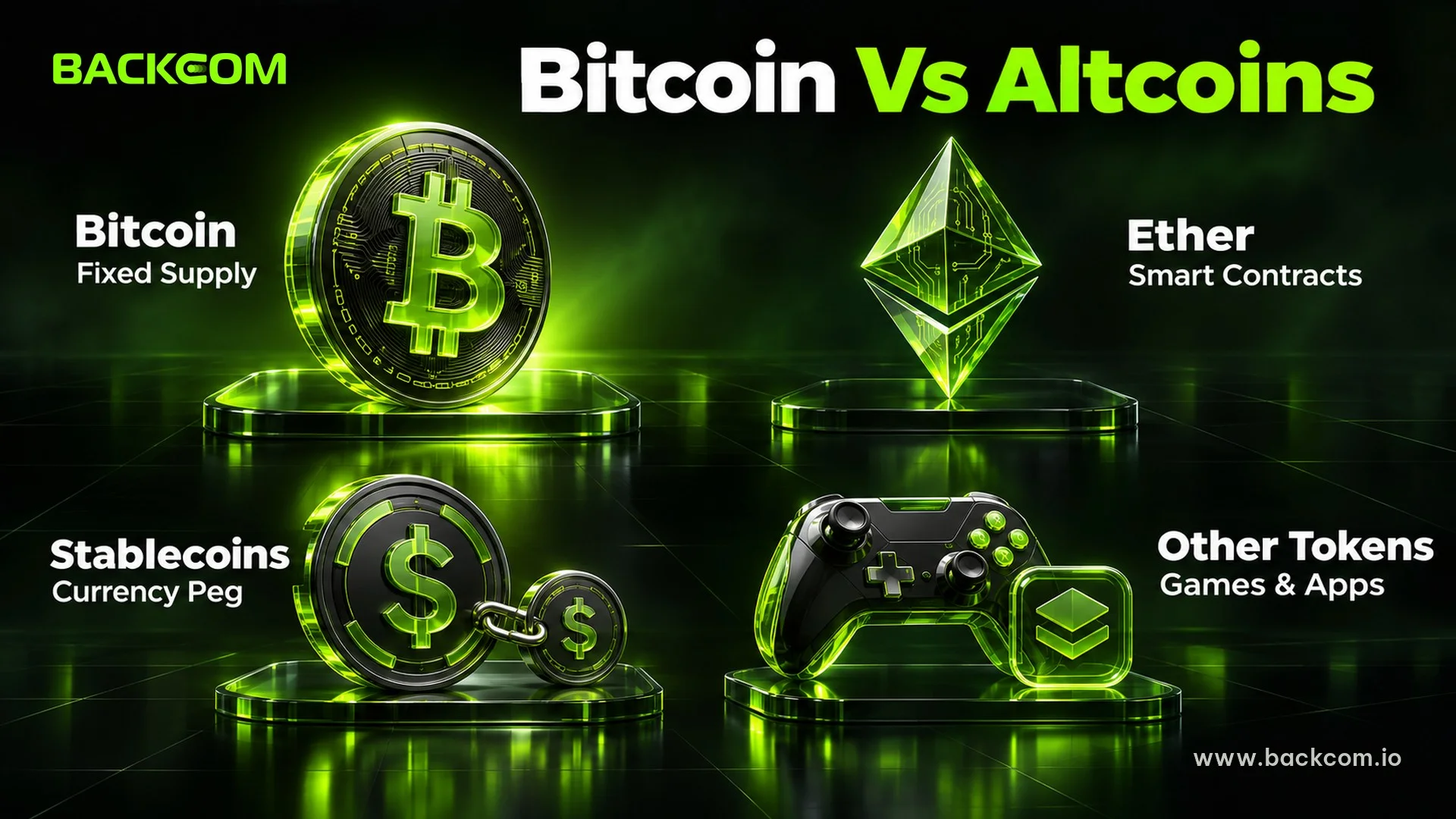
Bitcoin vs altcoins is the most common comparison for newcomers: Bitcoin was the first cryptocurrency, and an altcoin is any other coin. The name simply means "alternative coin". Altcoins range from large networks used by millions to tokens that few people have heard of.
| Type | Main purpose | Example idea | What to watch |
|---|---|---|---|
| Bitcoin | Scarce digital money and store of value | A supply limit of 21 million coins set in the protocol | Large price swings; slow base layer |
| Smart contract platform | Run programs and applications | Ethereum and ETH | Fees, software bugs, competition |
| Stablecoin | Track a currency such as the US dollar | A token meant to stay near USD 1 | Whether reserves really back it |
| Other altcoin | Niche use, community or speculation | Game, meme or utility tokens | Low liquidity; many fail |
This table is a simplified overview for learning, not a ranking of any coin.
Bitcoin: The First And Best-Known Coin
Bitcoin is a decentralised digital currency launched in 2009 with a fixed supply cap of 21 million coins. Its design goal is a payment and savings system that does not need a bank in the middle. The cap is built into the software (see the Bitcoin FAQ), which is why many people compare it to a scarce asset.
Scarcity does not remove risk. The price can move sharply within hours, and no authority guarantees its value.
Ethereum And Smart Contracts
A smart contract is a program stored on a blockchain that runs automatically when its conditions are met. According to ethereum.org, these open programs let people build digital assets and decentralised applications that anyone with an internet connection can use. This is why Ethereum is described as a platform rather than only a currency.
Stablecoins And Other Altcoins
A stablecoin is a token designed to hold a steady value by tracking an asset such as a national currency. Traders use them to move money between exchanges without the swings of Bitcoin. The design only works if the issuer holds real reserves, so read how any stablecoin is backed before relying on it.
For other altcoins, assume nothing. The US Federal Trade Commission advises checking whether a coin has been widely reported in established media, and being wary of big claims made without details or explanations of how the investment works.
Crypto For Beginners: How To Get Started Safely
Crypto for beginners should start with learning, a tiny budget and a secure setup, not with a hot tip. The order below keeps the first mistakes cheap.
- Learn the basics first. Understand wallets, keys and fees before you send a single dollar.
- Pick a regulated, well-known platform. Check which countries it serves and what verification (KYC) it requires.
- Secure your account. Use a unique password and two-factor authentication on an authenticator app, not SMS where possible.
- Start small. Use only money you can afford to lose entirely.
- Back up your seed phrase offline. Write it on paper and never photograph it or store it in cloud notes.
- Test with a small transfer. Send a tiny amount first when moving funds to a new address.
Exchange Wallet Or Self-Custody?
Custody means who controls the private keys. On a centralised exchange, the platform holds the keys and you log in with a password. In self-custody, you hold the keys yourself in a software or hardware wallet.
Exchange custody is convenient but adds the risk of platform failure or account lockouts. Self-custody removes that risk and replaces it with personal responsibility: nobody can recover a lost seed phrase. Many beginners keep small trading amounts on an exchange and move longer-term holdings to their own wallet once they are comfortable.
Trading Versus Holding
Buying and holding means owning the asset itself, while trading means speculating on price moves, sometimes with leverage. Futures and margin products can multiply losses as well as gains. If you later explore them, read our guides on cross margin vs isolated margin and what the funding rate is first. Copy trading carries its own risks, covered in our review of crypto copy trading platforms.
Is Crypto Safe? Main Risks Every Beginner Should Know
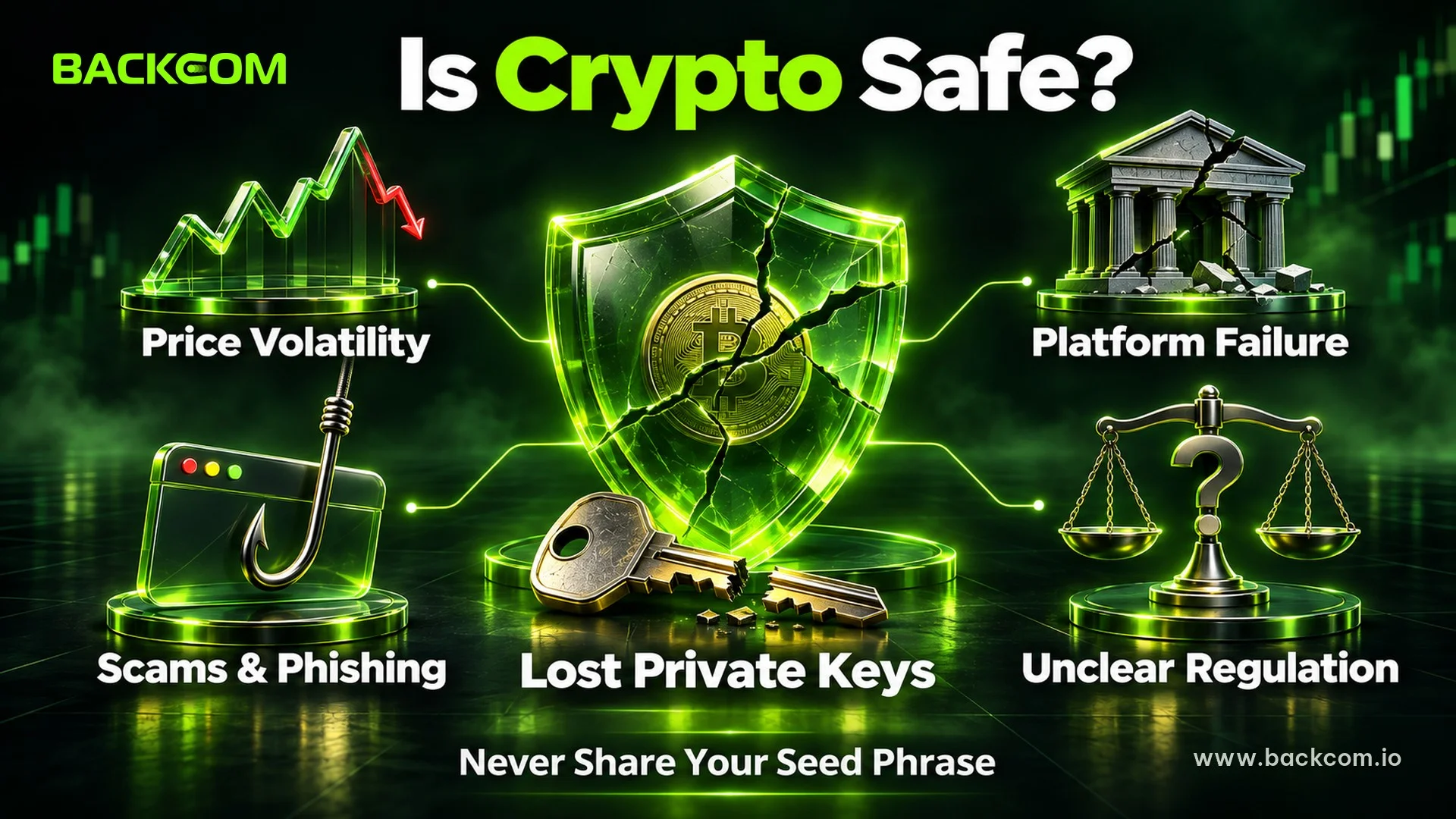
Crypto is not insured or guaranteed, so the main protection is your own knowledge. The FTC notes that crypto is not backed by a government, is not covered like insured bank deposits, and that payments generally cannot be reversed unless the recipient sends the money back.
The risks fall into four groups:
- Price volatility: values can fall by a large share in a single day.
- Scams: fake investment managers, romance schemes and impersonators demand crypto because it is hard to recover.
- Custody errors: a lost seed phrase, a wrong address or a hacked wallet usually means permanent loss.
- Platform and project failure: an exchange or token can collapse, and there may be no compensation scheme.
Warning Signs Of A Crypto Scam
A crypto scam usually pairs a promise of easy profit with pressure to act fast. The FTC describes red flags such as these:
- Anyone guaranteeing profits, big returns or "zero risk".
- A stranger online, including a new romantic contact, offering investment advice.
- Unexpected messages from an "investment manager" or celebrity offering to multiply your coins.
- Callers who say your accounts or benefits are frozen and tell you to pay with crypto to fix it.
- Any demand that you pay a fee in crypto to get a job.
Before putting money in, search the company or coin name with the words "review", "scam" or "complaint". If a deal cannot be explained in plain language, walk away.
Crypto Rules And Taxes Differ By Country
Whether you can buy, hold or trade crypto, and how gains are taxed, depends on the country where you live. Some governments license exchanges and tax each sale. Others restrict or ban certain activities. Rules also change, so treat any article, including this one, as a starting point.
Check the official guidance of your own tax authority and financial regulator before you trade. For an example of how one country approaches the topic, see our crypto tax guide. You can also follow market context on the crypto market page, and see how big macro events move prices in our article on how nonfarm payrolls affect gold, forex and Bitcoin.
Frequently Asked Questions (FAQ) About Crypto
What Is Crypto In Simple Words?
Crypto is digital money and digital assets that run on a blockchain, a shared ledger kept by many computers instead of one bank. You hold it in a wallet, and a private key proves that you own it. Bitcoin is the best-known example, and thousands of other coins and tokens exist alongside it.
Is Crypto A Good Investment For Beginners?
Nobody can promise that it is. Prices can swing widely, and many tokens lose most of their value or disappear. If you decide to take part, learn the basics first, use only money you can afford to lose and avoid anyone who guarantees returns. This content is information, not personal advice.
What Is The Difference Between Bitcoin And Altcoins?
Bitcoin is the first cryptocurrency, launched in 2009 with a supply cap of 21 million coins. An altcoin is any other coin. Some, like ether, power platforms for smart contracts. Others are stablecoins or small speculative tokens. Each has different technology, risks and liquidity, so judge them one by one.
Can I Lose All My Crypto?
Yes. You can lose it through a price collapse, a scam, a hacked account, a lost seed phrase or a wrong address, and these losses are usually final. Reduce the risk with small amounts, strong security, offline backups of your seed phrase and a habit of verifying every address before sending.
Do I Need A Lot Of Money To Start?
No. Most platforms let you buy a fraction of a coin, so you can start with a very small amount while you learn. Keeping the first amount small is wise, because early mistakes are common and the cost of learning should stay low.
Conclusion: Understand Crypto Before You Use It
What is crypto? It is a new kind of digital asset built on shared ledgers, secured by keys and open to anyone with an internet connection. That openness is also the risk: with no bank to reverse errors, your habits matter more than any prediction. Learn how wallets and blockchains work, treat Bitcoin and altcoins as different bets, start small, secure your keys and ignore promises of guaranteed profit. Backcom.io publishes this guide for education, and the next step is simply to keep learning before you commit money.
Disclaimer: This content is compiled by Backcom.io for information only and is not investment advice. Crypto assets are volatile and carry a risk of total loss. Rules and taxes differ by country, so check the requirements that apply to you before trading.
Was this article helpful?
Join The Backcom.io Community
Get the latest on trading rebates, trading tips, and broker deals — and connect with thousands of traders worldwide.

Backcom App
Track Your Rebates Every Day
Every rebate is visible by broker and by day. Manage your wallet and withdrawals in one place.
Open Backcom App