What Is A Stablecoin? Types, Risks And How USDT And USDC Work

What is a stablecoin? A stablecoin is a crypto token designed to hold a steady price, usually one US dollar, instead of rising and falling like Bitcoin. Traders use it to park value between trades, move money across borders and pay margin or fees. In this article, Backcom.io explains how stablecoins work, the four main types, how USDT and USDC differ, and whether stablecoins are safe to hold.
What Is A Stablecoin? A Plain-English Definition
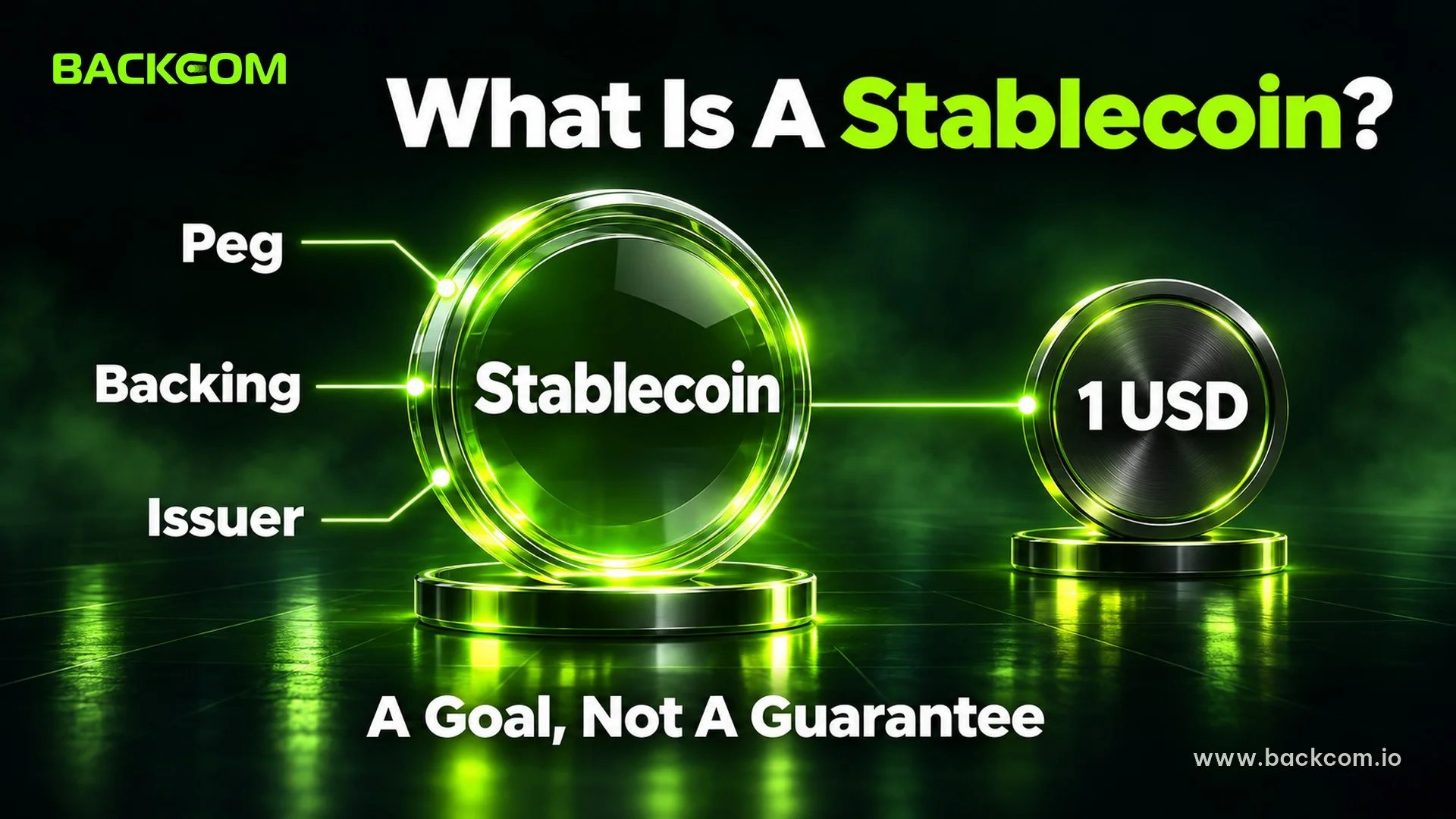
A stablecoin is a digital token whose issuer or code aims to keep its market price close to a reference asset, most often the US dollar. According to ethereum.org, stablecoins are built to stay at a fixed value even when the price of ETH changes, which gives them the reach of crypto with a steadier value.
The word "stable" describes the goal, not a guarantee. A stablecoin is a promise backed by reserves, collateral or an algorithm, and the promise can break.
Three ideas explain the idea quickly:
- Peg: the target price, such as 1 USD per token.
- Backing: the assets or mechanism that is meant to defend that price.
- Redemption: the right, usually limited to approved customers, to swap tokens back into real money at face value.
Why Do Traders Use Stablecoins?
Stablecoins give traders a dollar-like balance that can move on a blockchain at any hour. Common uses include:
- Parking profits: selling a volatile coin into a stablecoin without leaving the crypto ecosystem.
- Trading pairs: many markets are quoted against a stablecoin, so prices read in dollars.
- Transfers: sending value to another wallet or exchange within minutes, at any hour.
- Collateral and fees: some platforms accept stablecoins as margin. Our guide to cross margin vs isolated margin shows how that collateral behaves under pressure.
How Do Stablecoins Work? The Peg Explained

A stablecoin works by linking each token to something the issuer can hold, lock up or adjust, so that buying and selling pressure pulls the price back to the peg. The mechanism depends on the type, but the logic is similar.
When the token trades below 1 USD, approved parties can in theory buy it cheaply and redeem it at face value, which removes supply and lifts the price. When it trades above 1 USD, they can create new tokens and sell them, which adds supply and pushes the price down. That arbitrage only works if redemption is reliable and the reserves are real.
Minting And Redeeming
Minting is the creation of new tokens when a customer deposits dollars, and redeeming is the reverse. Circle, the issuer of USDC, says on its USDC page that the token is redeemable 1:1 for US dollars. Direct redemption through Circle Mint is open to exchanges, institutions and banks, while individuals normally reach USDC through exchanges, neobanks and wallets.
That detail matters. If you are a retail holder, your practical exit is usually a trading platform, not the issuer itself. Platform outages, withdrawal limits or fees can therefore affect you even when the issuer is healthy.
Stablecoin Examples: The 4 Types Of Stablecoins
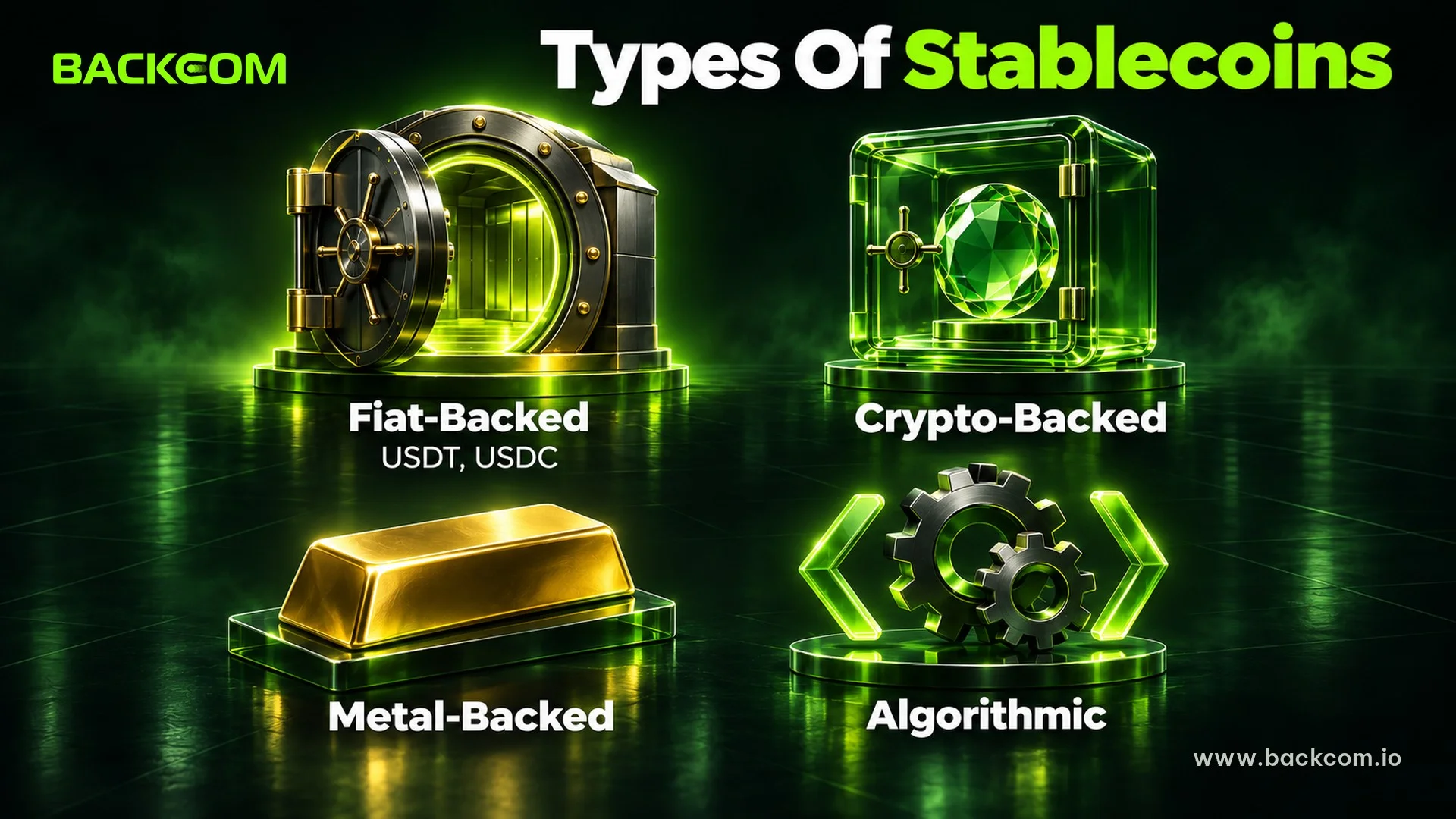
Stablecoin examples fall into four types, grouped by what stands behind the peg. The table summarises the four categories described by ethereum.org.
| Type | What backs it | Example | Main risk |
|---|---|---|---|
| Fiat-backed | Cash and cash-like reserves held by the issuer | USDT, USDC | Trust in one issuer and its audits |
| Crypto-backed | Other crypto, locked in smart contracts | DAI, USDS (its successor) | Collateral can fall in value |
| Precious metals | Gold or other metals | Pax Gold, Tether Gold | Trust in the issuer and the metal reserve |
| Algorithmic | A rule that adjusts token supply | Various experiments | The rule can fail under stress |
Fiat-Backed Stablecoins
Fiat-backed stablecoins hold reserves in traditional money or short-term government assets and issue one token per unit. USDT and USDC belong here. They are the most widely used type, but they depend on a single company, so reserve quality and transparency are the key questions.
Crypto-Backed Stablecoins
Crypto-backed stablecoins lock more value in crypto than the number of tokens issued, a design called overcollateralisation. The extra cushion absorbs price swings in the collateral. According to ethereum.org, DAI and its successor USDS are crypto-backed examples, and these coins can be less stable than fiat-backed ones, so you must watch the collateral.
Algorithmic And Metal-Backed Stablecoins
Algorithmic stablecoins have no reserve of other assets and rely on a rule that expands or shrinks supply to defend the price. That makes them the hardest type to understand and the easiest to break. Metal-backed tokens track gold or similar assets, so they follow the metal price rather than one dollar.
USDT Vs USDC: How Do They Differ?
USDT and USDC are both dollar-pegged, fiat-backed stablecoins, but they have different issuers, disclosures and regulatory histories. Treat the points below as a checklist, not a ranking, because there is no single measure that proves one is safer.
| Point | USDT | USDC |
|---|---|---|
| Issuer | Tether Operations | Circle |
| Stated backing | Pegged 1-to-1 and backed 100% by Tether's reserves | 100% cash and cash-equivalent assets |
| Reserve detail | See Tether's Reports and Reserves section | Majority held in a government money market fund, custodied at BNY Mellon and managed by BlackRock |
| Reporting | Circulation figures published daily | Monthly attestations plus daily portfolio reporting for the fund |
Reference: issuer pages tether.to/en/transparency and circle.com/usdc, checked on 3 November 2026. Issuers can change their disclosures at any time.
What The Issuers Say About Their Reserves
Both issuers describe their tokens as fully backed, and both claims are statements by the issuer, so read the evidence behind them. Tether's transparency page says the tokens are backed 100% by its reserves and that its assets exceed its liabilities. Circle says USDC is backed 100% by highly liquid cash and cash-equivalent assets and reports monthly attestations by a Big Four accounting firm.
An attestation is a limited review at a point in time, not a full audit of every day. Check the date of the latest report, who produced it, and what exactly it covers before you rely on it.
Which One Should You Choose?
There is no universal winner, so choose by how you plan to use the token. Compare these factors:
- Where you trade: the pair or withdrawal network you need may only support one of them.
- Fees and networks: transfer costs differ by blockchain, so check the network before you send.
- Reporting you trust: read the latest reserve report for each token.
- Rules where you live: some countries or platforms restrict particular stablecoins.
Spreading value across more than one issuer is a way some holders reduce single-issuer risk, though it does not remove market-wide risk.
Are Stablecoins Safe? The Main Risks
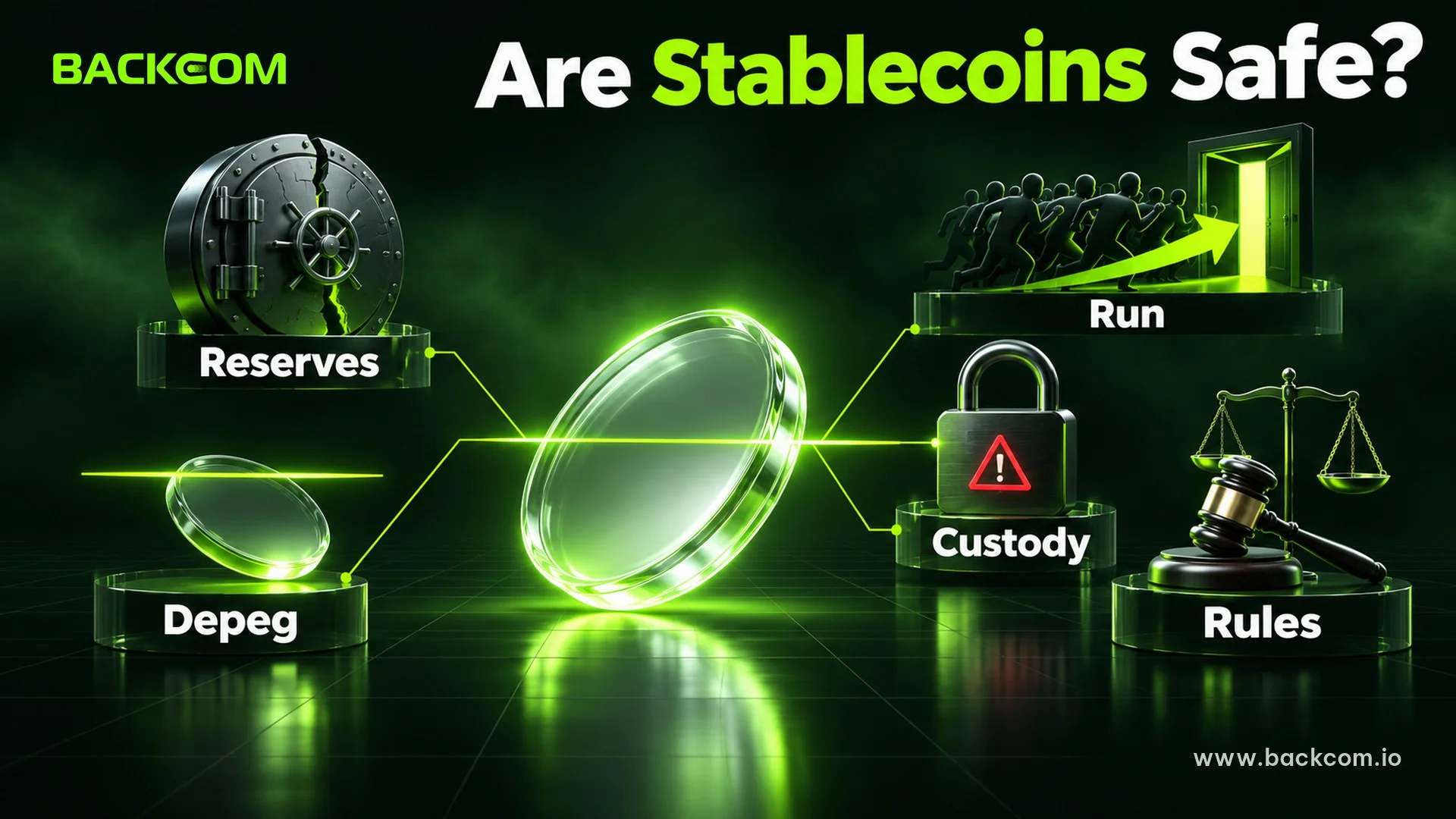
Stablecoins are lower in price volatility than most crypto, but they are not risk free, and they are generally not covered by bank deposit insurance. The Bank for International Settlements has said in its Annual Economic Report 2023 that there have been multiple episodes where stablecoin prices lost their pegs, and linked this to the lack of a central bank acting as lender of last resort. It also noted that the failures of FTX and Silicon Valley Bank coincided with stablecoin price volatility.
The main risks are:
- Depegging: the price drops below 1 USD and may stay there.
- Reserve risk: reserves are weaker, less liquid or less transparent than claimed.
- Run risk: many holders try to redeem at once.
- Platform and custody risk: the exchange or wallet holding your tokens fails or is hacked.
- Regulatory risk: a token can be restricted or delisted in your region.
What Is Depegging And How Does A Run Happen?
Depegging means a stablecoin trades away from its target price, and a run is the rush to sell or redeem that often causes it. The Financial Stability Board, in its 2023 recommendations, calls for clear redemption rights, timely redemption at par for coins pegged to one currency, and measures to mitigate run risk.
A run is self-reinforcing. If holders doubt the reserves, they sell. Selling pushes the price down, which deepens the doubt. A reserve that looks fine in calm markets can be tested in minutes.
How To Reduce Stablecoin Risk
You cannot remove stablecoin risk, but you can limit it with a few habits:
- Read the latest reserve report before holding a large balance.
- Do not keep everything in one token or on one platform.
- Check the network and address before sending, because transfers cannot be reversed.
- Secure your account with an authenticator app. Our account security checklist covers nine settings worth turning on.
- Treat any promised high yield on stablecoins as a warning sign. If a return sounds guaranteed, ask who is paying it and what could go wrong.
How Traders Use Stablecoins Day To Day
For most traders, a stablecoin is a tool for moving and holding value, not an investment that grows by itself. A stablecoin balance earns nothing unless you lend it or place it on a platform, and each option adds a counterparty.
Moving Funds Between Platforms
Stablecoins can shorten the time it takes to fund a trading account, but only if you match the network. If you plan to fund a forex account this way, read our guide to depositing USDT to a forex broker for the withdrawal checks to make first.
Stablecoins And Tax
Swapping or spending a stablecoin can be a taxable event in some countries, even when the price barely moves. Rules vary widely by country of residence. For one example of how a country structures the topic, see our country crypto tax guide. Check your own tax authority for the rules that apply to you.
Stablecoins And Derivatives
Many perpetual futures are settled in stablecoins, so a stablecoin problem can reach your open positions. If you trade these products, learn how the funding rate works and keep collateral amounts conservative. You can also follow the wider crypto market page for context.
Frequently Asked Questions (FAQ) About Stablecoins
What Is A Stablecoin In Simple Words?
A stablecoin is a crypto token meant to keep a steady price, usually one US dollar. It is backed by reserves, other crypto or an algorithm, depending on the type. You can hold it in a wallet, send it on a blockchain and trade it like other tokens, but the peg is only as reliable as what stands behind it.
Are Stablecoins Safe?
They are less volatile than most crypto but not risk free. The main dangers are losing the peg, weak or unclear reserves, platform failure and regulatory limits. Stablecoins are generally not covered by bank deposit insurance, so read the issuer's reserve reports, avoid putting everything in one token and use strong account security.
What Is The Difference Between USDT And USDC?
Both are fiat-backed and pegged to the US dollar. USDT is issued by Tether and USDC by Circle. They differ in the way they disclose reserves, which platforms support them and how regulators treat them. Neither claim of full backing replaces your own check of the latest reserve report.
Can A Stablecoin Lose Its Peg?
Yes. The BIS notes multiple episodes in which stablecoin prices lost their pegs. A peg can slip when reserves are doubted, when a bank or platform fails, or when many holders redeem at once. Some recover quickly, others do not, so size your holdings with that possibility in mind.
Do Stablecoins Pay Interest?
Holding a stablecoin in a wallet usually pays nothing. Some platforms offer a return if you lend or lock tokens, but that return comes from taking extra risk, such as the platform failing. Be careful with any offer that promises a high or guaranteed yield.
Conclusion: Use Stablecoins With Eyes Open
What is a stablecoin? It is a token that tries to hold one price, and its safety depends entirely on what stands behind that price. Know the four types, read the reserve reports for USDT, USDC or any other token, avoid leaving all your funds in one place, and treat promised yields with suspicion. Backcom.io publishes this guide for education, so keep learning before you move real money.
Disclaimer: This content is compiled by Backcom.io for information only and is not investment advice. Crypto assets, including stablecoins, carry a risk of loss, and a stablecoin can lose its peg. Rules and taxes differ by country, so check the requirements that apply to you before trading.
Was this article helpful?
Join The Backcom.io Community
Get the latest on trading rebates, trading tips, and broker deals — and connect with thousands of traders worldwide.

Backcom App
Track Your Rebates Every Day
Every rebate is visible by broker and by day. Manage your wallet and withdrawals in one place.
Open Backcom App