What Is Perpetual Futures Trading In Crypto And How Does It Work

What is perpetual futures trading? A perpetual future is a crypto derivative that tracks the price of a coin like a normal futures contract but has no expiry date, so you can hold it for as long as your margin allows. It is one of the most widely traded crypto derivatives, and it is also one of the easiest ways to lose money fast. In this article, Backcom.io explains what perpetual futures are, how a perpetual contract stays close to spot, how perpetual futures funding works, the perpetual vs futures differences, and where a perpetual swap fits in.
What Is Perpetual Futures Trading In Crypto?
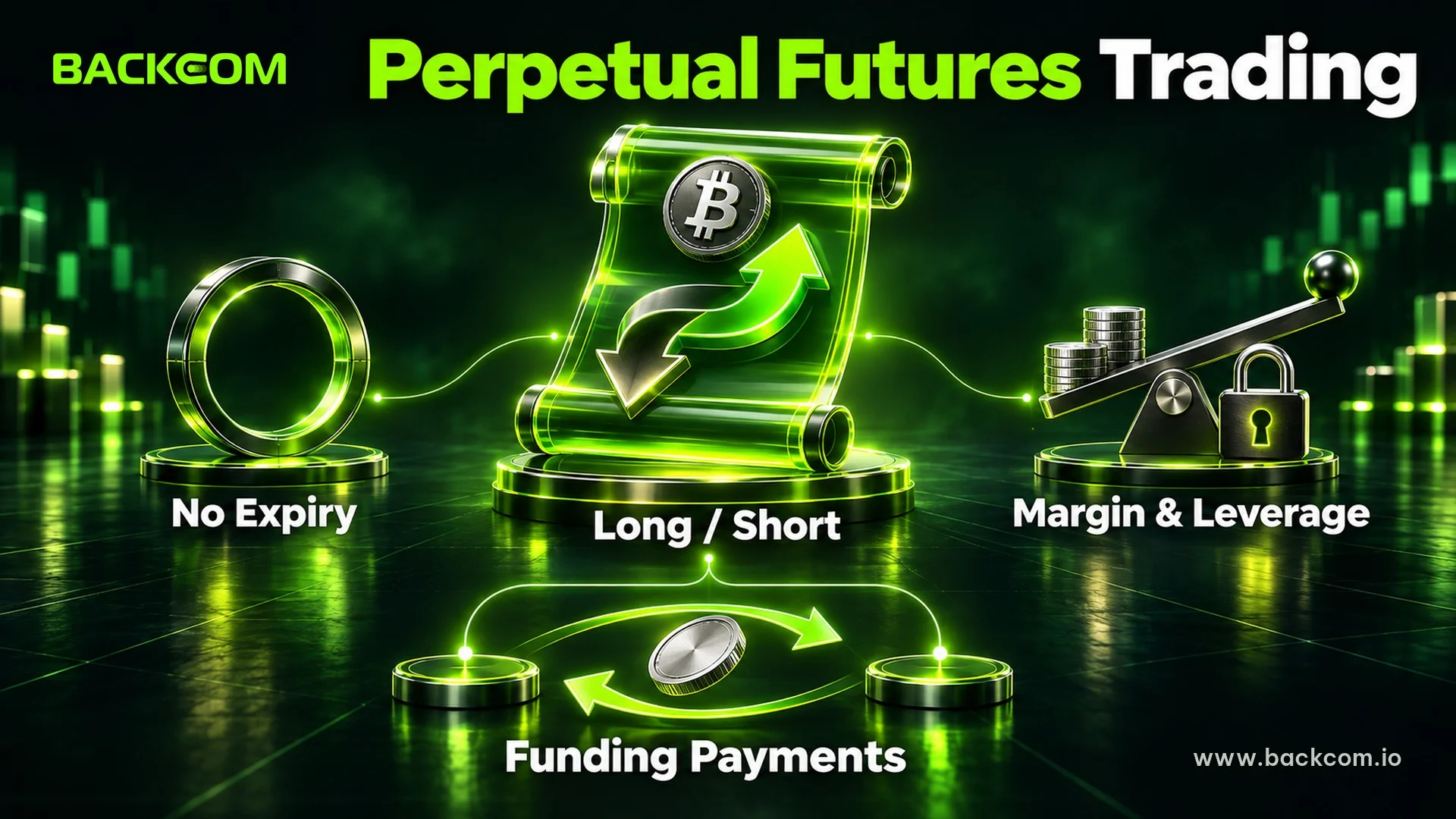
Perpetual futures are derivative contracts that let you take a long or short position on a coin without owning it and without a settlement date. You post margin, choose leverage and profit or lose as the contract price moves. Because there is no expiry, you never have to close or roll the position to a new month.
Three features define the product:
- No expiry: the contract stays open until you close it, you are liquidated or the venue ends the market.
- Margin and leverage: you put up a fraction of the position size, so gains and losses are magnified.
- Funding payments: traders on one side pay the other side at regular intervals, which keeps the contract price near the spot price.
You do not receive the coin itself. You hold a contract whose value is linked to the coin's price, which is why derivatives are very different from buying on the spot market.
Perpetual Contract Basics: Long, Short And Margin
A perpetual contract has two sides: a long that profits when price rises and a short that profits when price falls. A trader who opens a long on 1 BTC worth of contracts gains if the index price climbs and loses if it drops. The short side is the mirror image.
Margin is the collateral that backs the position. Initial margin opens it, and maintenance margin is the minimum that must remain. If your equity falls below that level, the venue closes the position, which is called liquidation. To see how that price is worked out, read our guide on how to calculate liquidation price.
How A Perpetual Contract Stays Close To The Spot Price
A dated futures contract is pulled toward spot because it must settle at spot on its expiry date, and a perpetual has no such date. So perpetuals use a different tool: the funding rate. When the perpetual trades above the spot index, funding pushes traders to sell it, and when it trades below, funding pushes traders to buy it.
Venues also use a mark price to value positions and trigger liquidations. The mark price is usually based on an index of spot prices from several markets rather than the last trade on one order book. This reduces the chance that a brief spike on a single venue wipes out positions.
Perpetual Futures Funding: Who Pays Whom
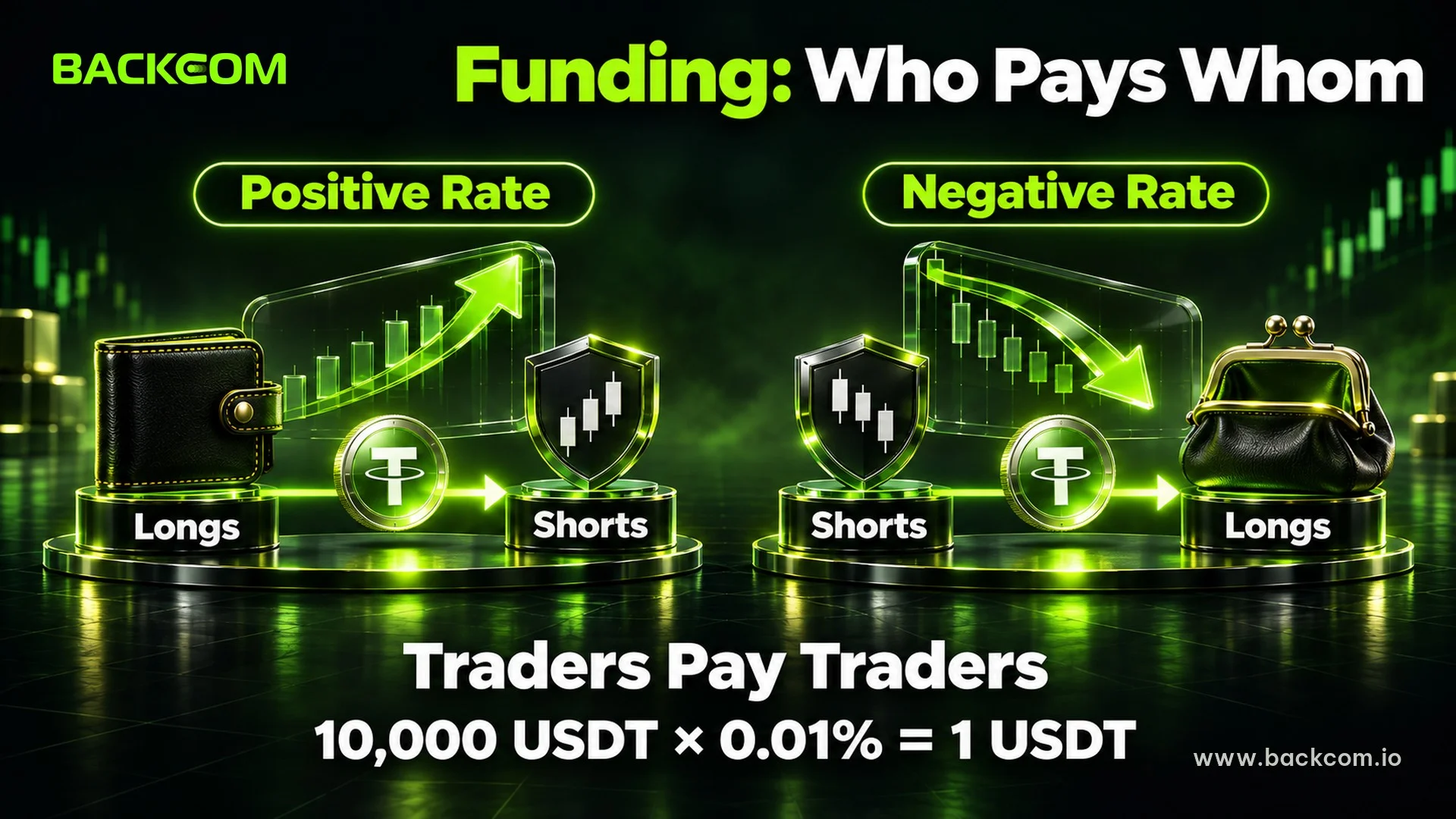
Funding is a periodic payment exchanged directly between long and short traders, not a fee paid to the exchange. Binance explains in its futures funding rate FAQ that when the funding rate is positive, longs pay shorts, and when it is negative, shorts pay longs. Binance also states that it does not charge a fee on funding payments, and that you only pay or receive funding if you hold a position at the funding time.
The same page gives the formula and the default schedule, checked on 3 November 2026:
Funding amount = Position nominal value × Funding rate
| Item | How Binance describes it |
|---|---|
| Default interval | Every 8 hours, at 00:00, 08:00 and 16:00 UTC |
| Nominal value | Mark price × contract size |
| Positive rate | Longs pay shorts |
| Negative rate | Shorts pay longs |
| Interval changes | The venue may shorten the interval, for example to 1 hour, in extreme volatility |
Reference: Binance Support, "Introduction to Binance Futures Funding Rates", checked on 3 November 2026. Other venues use their own intervals and caps, so check the rules of the exchange you use.
For a deeper look at the rate itself, see our article on what the funding rate is.
A Worked Funding Example
Imagine you hold a long position with a nominal value of 10,000 USDT and the funding rate is 0.01% per 8-hour interval. Each payment is 10,000 × 0.0001 = 1 USDT paid by you to the short side.
With three payments a day, that is 3 USDT per day, or about 1,095 USDT over a year if the rate never changed. On a 10,000 USDT position that equals roughly 10.95% a year. The example uses an illustrative rate. Real rates change with every interval and can be negative, so your actual cost or income will differ.
The lesson is simple: holding a leveraged perpetual long for weeks during a crowded rally can cost more than the headline fee suggests, and the cost is paid whether or not the trade is winning.
Perpetual Vs Futures: Key Differences
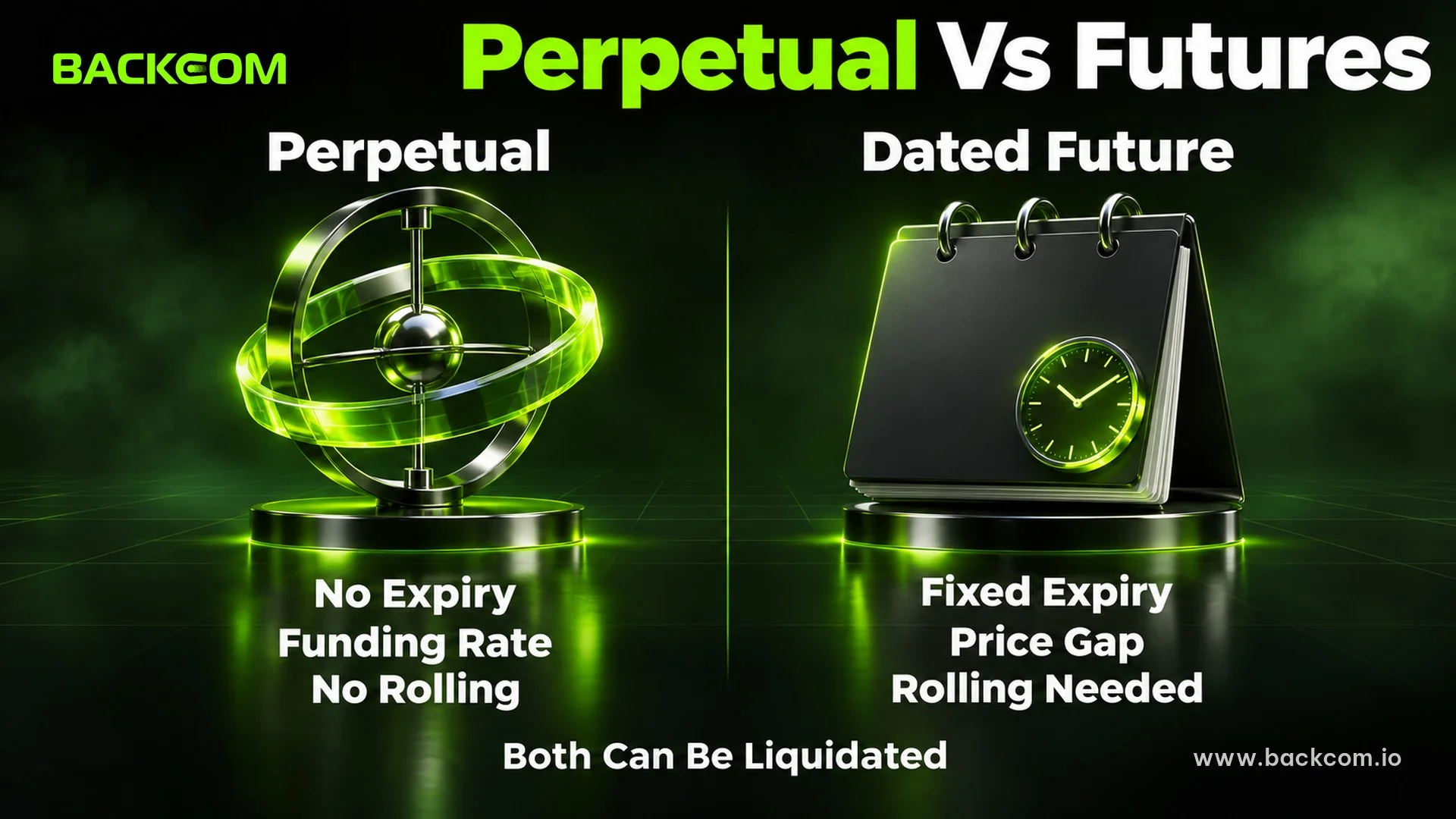
The main difference in perpetual vs futures is time: a dated futures contract expires and settles, while a perpetual does not. The table below compares the two for a trader.
| Point | Perpetual future | Dated (quarterly) future |
|---|---|---|
| Expiry | None | Fixed date |
| Price link to spot | Funding rate | Convergence at settlement |
| Holding cost | Funding, paid or received | Built into the price gap to spot |
| Rolling needed | No | Yes, to keep exposure |
| Typical use | Short-term trading and hedging | Longer hedges, basis trades |
Reference: general product mechanics, with the funding rules taken from the Binance page above, checked on 3 November 2026. Contract specifications differ by venue.
Which One Fits Your Style?
Choose the product that matches your holding period and your tolerance for changing costs. A perpetual suits short trades because there is nothing to roll. A dated future suits a trader who wants a known end date and a holding cost that is fixed in the price when the trade opens.
Neither is safer. Both use leverage, and both can be liquidated in a fast move.
Perpetual Swap: Is It The Same Thing?
A perpetual swap is another name for a perpetual future; in crypto the two terms are used for the same product. The word "swap" comes from the idea that the contract keeps swapping funding payments between longs and shorts. Some venues say "perpetual swap", others say "perpetual contract" or "perp", and the rules are the same in principle.
Do not confuse the term with a token swap on a decentralised exchange, where you exchange one coin for another and receive the asset. A perpetual swap gives you price exposure only.
You may also see two contract types:
- Linear (USDT or USDC margined): profit and loss are paid in a stablecoin, which is easier to follow.
- Inverse (coin margined): collateral and profit are in the coin itself, so your account value moves with the coin's price too.
Pick one type and learn its maths before you trade it. Linear contracts are usually easier for beginners because the profit and loss is quoted in a stable unit.
Risks Of Perpetual Futures
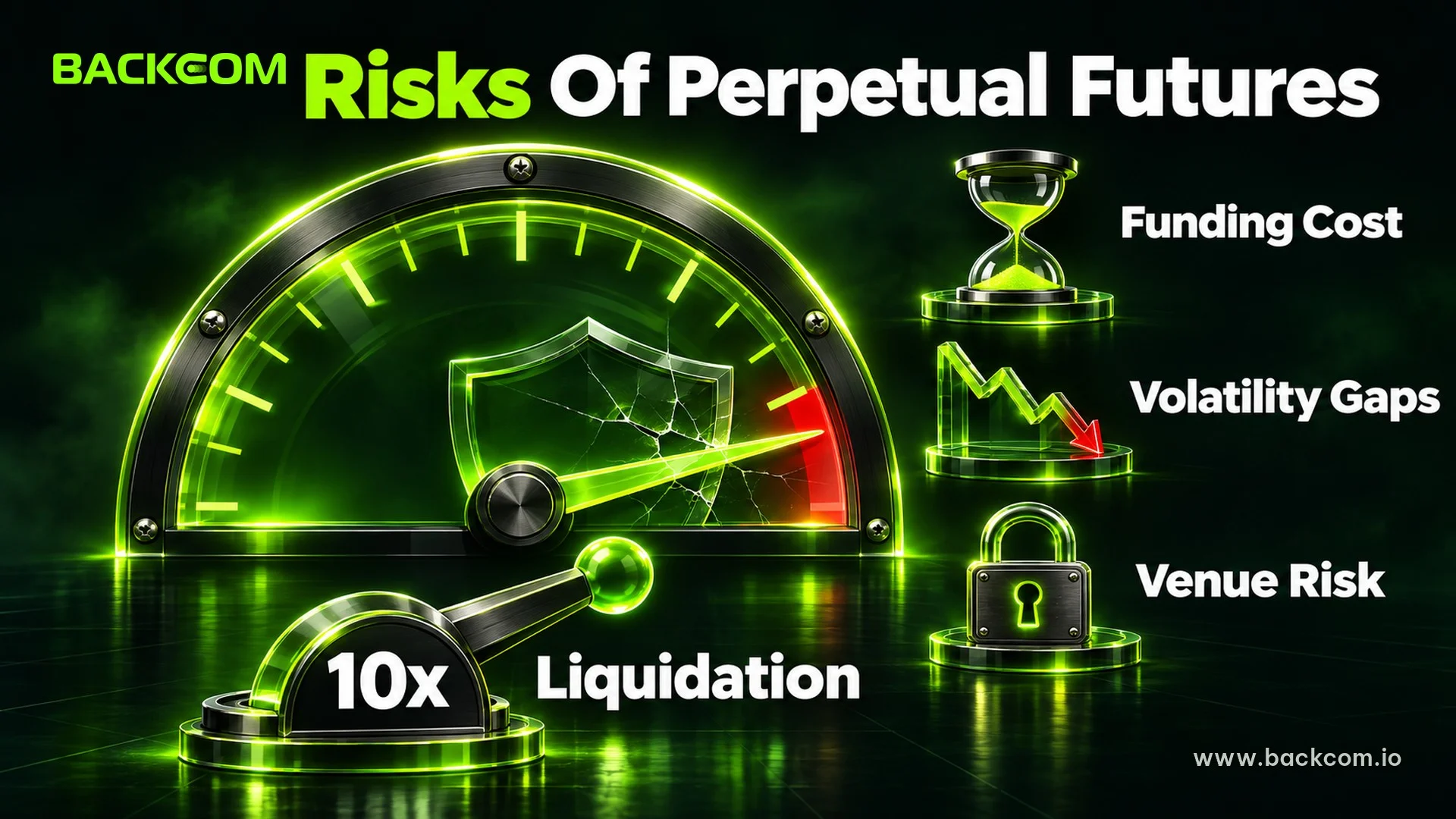
The biggest risk of perpetual futures is leverage, because a small price move can erase your margin. The BIS reports in its Working Paper No. 1087 (April 2023) on crypto carry that crypto futures carry can become very large, up to 60% a year, and that high leverage is involved in the dynamics that may help explain frequent crashes. The paper also notes that margin requirements can spike and positions can be liquidated during drawdowns.
Keep these risks in view:
- Liquidation: with 10x leverage, a move of about 10% against you can wipe out the margin, and maintenance margin and fees make the real level a little closer.
- Funding cost: a large positive rate makes long positions expensive to hold.
- Volatility gaps: price can jump past your stop, so the exit can be worse than planned.
- Venue risk: exchanges differ in rules, insurance funds and auto-deleveraging, so read their terms.
- Overtrading: it is easy to open and close positions all day, and fees add up.
Your margin mode matters here too. Read about cross margin vs isolated margin before you decide how much of your account to put at risk.
A Liquidation Example
Suppose you open a 10x long at a price of 50,000 with 1,000 USDT of margin, which gives a 10,000 USDT position. A fall of about 10% to 45,000 would cost 1,000 USDT, which is your whole margin. Because venues require maintenance margin and charge fees, they would liquidate you before that, slightly above 45,000. The exact price depends on the contract rules, so use the exchange's own calculator.
A Simple Checklist Before Your First Perp Trade
Treat your first perpetual trades as practice, with a small size and a written plan. Use this routine:
- Learn the contract spec of the exact market you plan to trade: margin type, funding interval and maximum leverage.
- Use low leverage until you understand liquidation.
- Check the funding rate before you open and estimate the daily cost.
- Set a stop and a size so a loss stays at a level you accept.
- Review the trade afterwards and note what you would change.
Many exchanges also offer demo or paper-trading modes, which are a safer place to learn the mechanics.
Frequently Asked Questions (FAQ) About Perpetual Futures
What Is Perpetual Futures In Simple Words?
A perpetual future is a futures contract with no expiry date. It follows the price of a coin, lets you go long or short with leverage, and uses funding payments between traders to stay close to the spot price. You can hold it until you close it or are liquidated.
Is A Perpetual Contract The Same As A Perpetual Swap?
In crypto, yes. Perpetual swap, perpetual contract and perp all describe a derivative with no expiry and a funding mechanism. Differences between venues are in the details, such as the funding interval, the margin type and the way liquidations are handled.
Do I Pay Funding Even If I Am Losing?
Yes. Funding depends on your position, the funding rate and the time you hold, not on whether the trade is in profit. If the rate is positive and you are long at the funding time, you pay; if it is negative, you receive. A position closed before the funding time does not pay or receive that payment.
Can I Lose More Than My Margin?
It depends on the venue and the margin mode. Most exchanges liquidate a position before the margin is fully used, and many use insurance funds to cover shortfalls. In a very fast market, however, the closing price can be worse than expected. Read the exchange's rules on negative balances and auto-deleveraging.
Are Perpetual Futures Good For Beginners?
They are complex and risky because of leverage and funding. Beginners should first learn spot trading, margin and liquidation, then practise with a demo account or a very small size. Never trade money you cannot afford to lose.
Conclusion: Learn The Mechanics Before You Trade
What is perpetual futures trading? It is leveraged exposure to a coin's price with no expiry, kept near spot by funding payments between longs and shorts. That design makes it flexible, but funding costs and liquidation risk are real. Backcom.io publishes this guide for education, so study the contract rules, use low leverage and practise before you risk real money.
Disclaimer: This content is compiled by Backcom.io for information only and is not investment advice. Crypto derivatives carry a high risk of loss, including the loss of your whole deposit. Rules and taxes differ by country, so check the requirements that apply to you before trading.
Was this article helpful?
Join The Backcom.io Community
Get the latest on trading rebates, trading tips, and broker deals — and connect with thousands of traders worldwide.

Backcom App
Track Your Rebates Every Day
Every rebate is visible by broker and by day. Manage your wallet and withdrawals in one place.
Open Backcom App