What Is Slippage In Crypto Trading And How To Reduce It

What is slippage in crypto? Slippage is the gap between the price you expect when you place a trade and the price at which it actually executes. In this article, Backcom.io explains what is slippage in crypto, what causes it, how crypto slippage tolerance works on decentralised exchanges, why a slippage market order is exposed to it, how price impact in crypto differs from slippage, and how to avoid slippage or at least keep it small.
What Is Slippage In Crypto? A Plain Definition
Slippage is the difference between the expected price of a trade and its executed price, and it can work against you or in your favour. Binance Academy describes it the same way: the price you expect when placing a trade versus the actual price at which it fills. The glossary page was checked on 3 November 2026.
Two directions exist:
- Negative slippage: you pay more than expected when buying, or receive less than expected when selling.
- Positive slippage: you get a better price than expected.
Most traders only notice the negative kind, because it feels like a hidden cost. It is not a fee charged by anyone. It is the market moving, or running out of depth, between the moment you decide and the moment you are filled.
Slippage Is Not A Trading Fee
A fee is a published charge, while slippage is a price effect you can only measure after the fill. A venue's fee schedule is fixed and visible in advance. For an example of how those published charges are laid out, see our guide to Gate trading fees. Slippage comes on top of fees, so a trade can look cheap on paper and still cost more than planned.
What Causes Slippage In Crypto Trading?
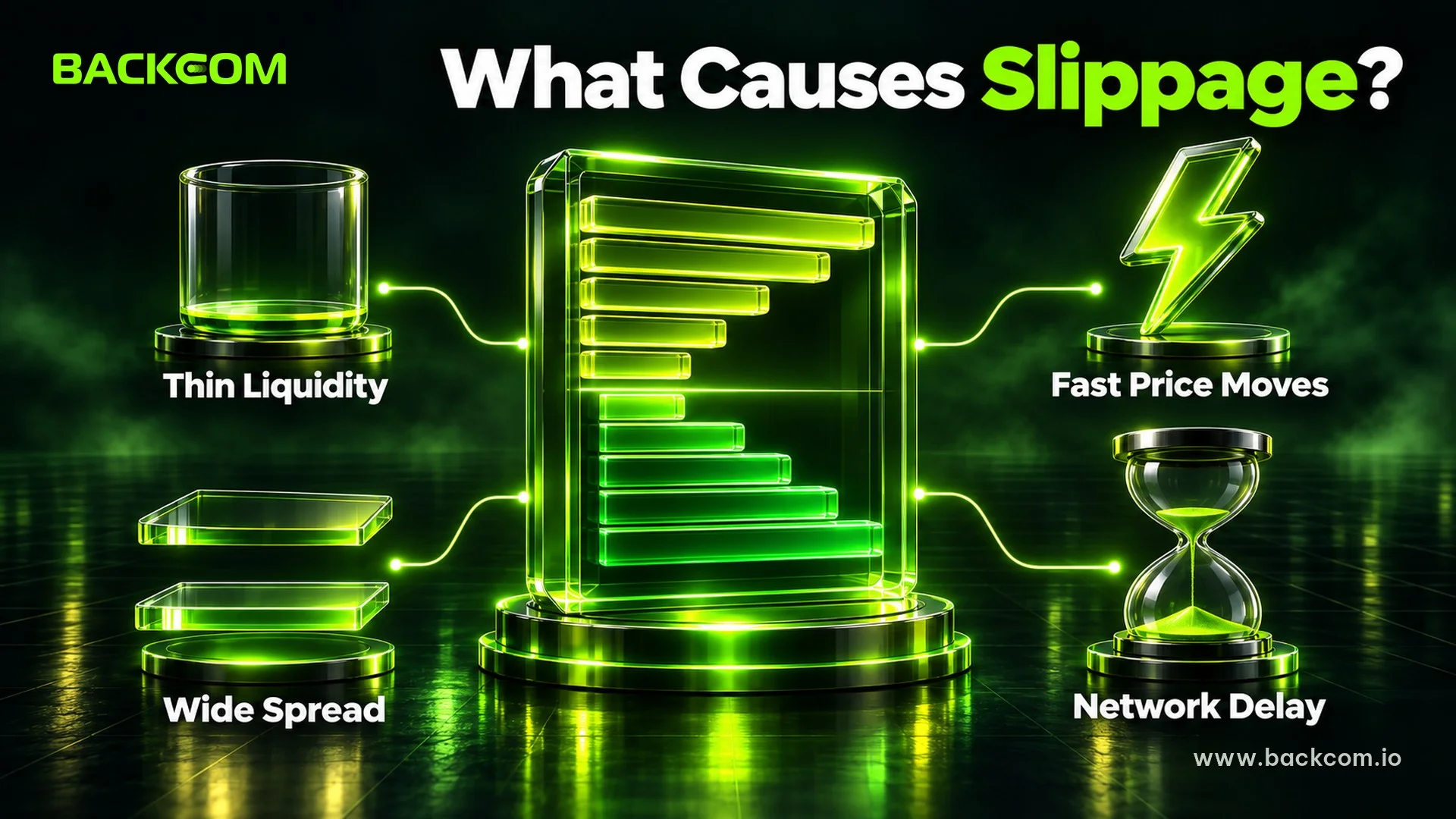
Slippage appears when there is not enough liquidity at your price, or when the price moves before your order is processed. The same two causes show up on centralised order books and on decentralised pools. They are easiest to separate like this:
- Thin order book depth: a large order uses up the best offers and fills at the next, worse levels.
- Fast price moves: in volatile moments, the quote you saw is gone before the order reaches the market.
- Wide bid-ask spreads: less active pairs often have a wider gap between the best buy and sell, so even a small market order starts from a worse price. The concept is the same as in forex; our article on the forex spread explains the gap in detail.
- Order size versus pool size: on an automated market maker (AMM), a trade that is large compared with the pool moves the price by itself.
- Network delay: on-chain swaps wait to be included in a block, and the price can change while the transaction is pending.
Why Volatility And Low Liquidity Matter Most
Volatility makes prices move faster, and low liquidity makes each trade move the price more. Together they produce the largest slippage. Major pairs such as BTC against a dollar stablecoin usually have deep books in calm periods. Small tokens, new listings and news-driven spikes usually do not.
Slippage Market Order: A Worked Example
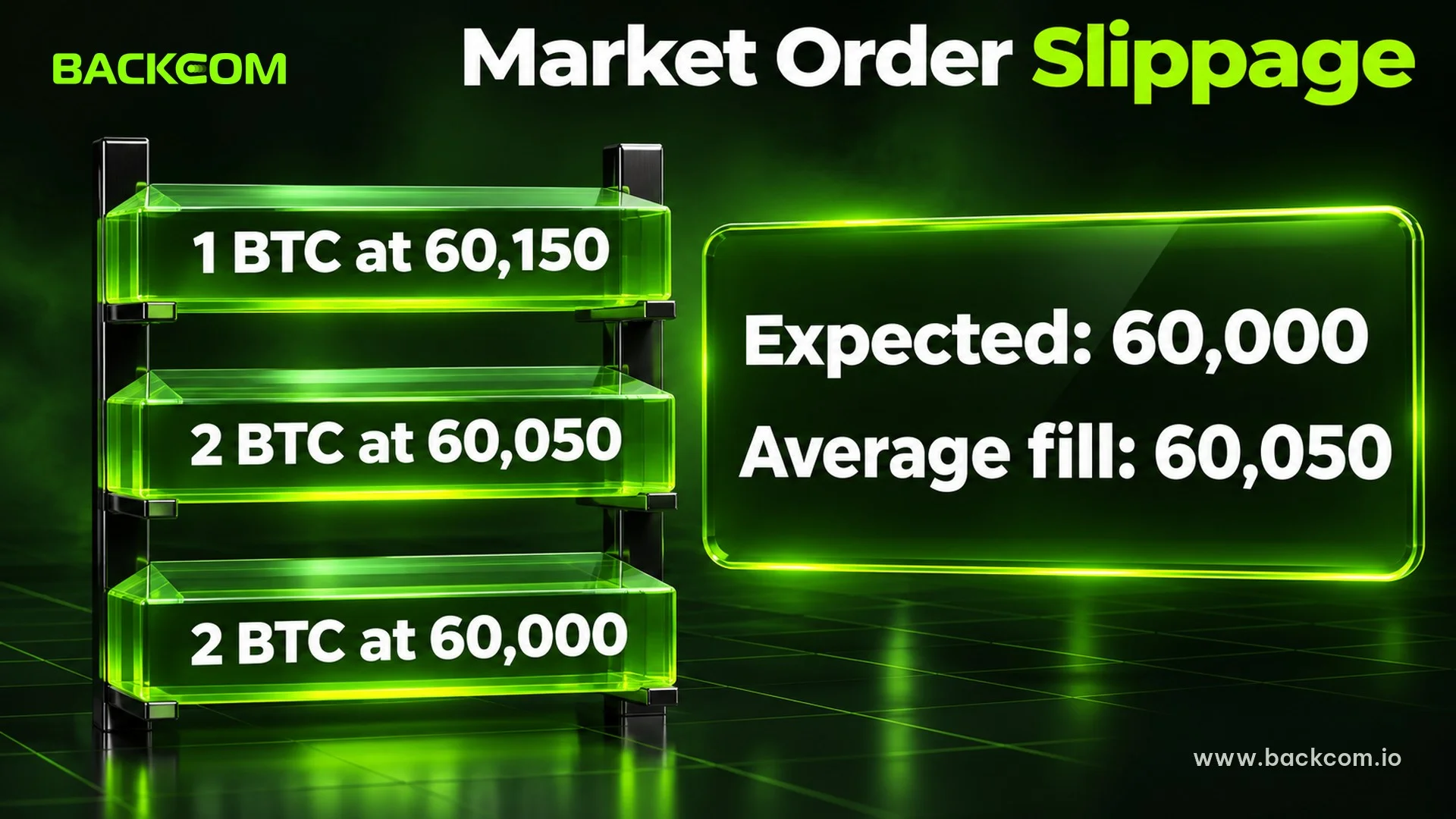
A market order takes the best available prices until it is filled, so the final average price depends on how much depth the book has. Here is a simplified order book for a buyer, with sell offers listed from the lowest price upward:
| Sell offer size | Price (USD) |
|---|---|
| 2 BTC | 60,000 |
| 2 BTC | 60,050 |
| 1 BTC | 60,150 |
You see 60,000 as the top price and send a market order to buy 5 BTC. The order fills across all three levels:
Average price = (2 × 60,000 + 2 × 60,050 + 1 × 60,150) ÷ 5 = 300,250 ÷ 5 = 60,050
You expected 60,000 and paid an average of 60,050. That is 50 USD per BTC, or about 0.083% slippage. On a 10,000 USD order the same percentage is roughly 8.33 USD. The figure is small here because the example is calm and the book is deep. The same order in a thin market could cost many times more.
Slippage Versus Price Impact Crypto Traders Should Separate
Price impact is the move your own trade causes, while slippage is the total difference between expected and executed price. The Uniswap developer documentation (checked on 3 November 2026) describes price impact as the price shift during swap execution in an AMM. It adds that less liquidity at a given price means a higher impact for the same swap size.
In the example above, the 50 USD gap is mostly price impact, because your order consumed several levels. Slippage can also include market movement that has nothing to do with you. So the two overlap, but they are not identical.
Crypto Slippage Tolerance On Decentralised Exchanges
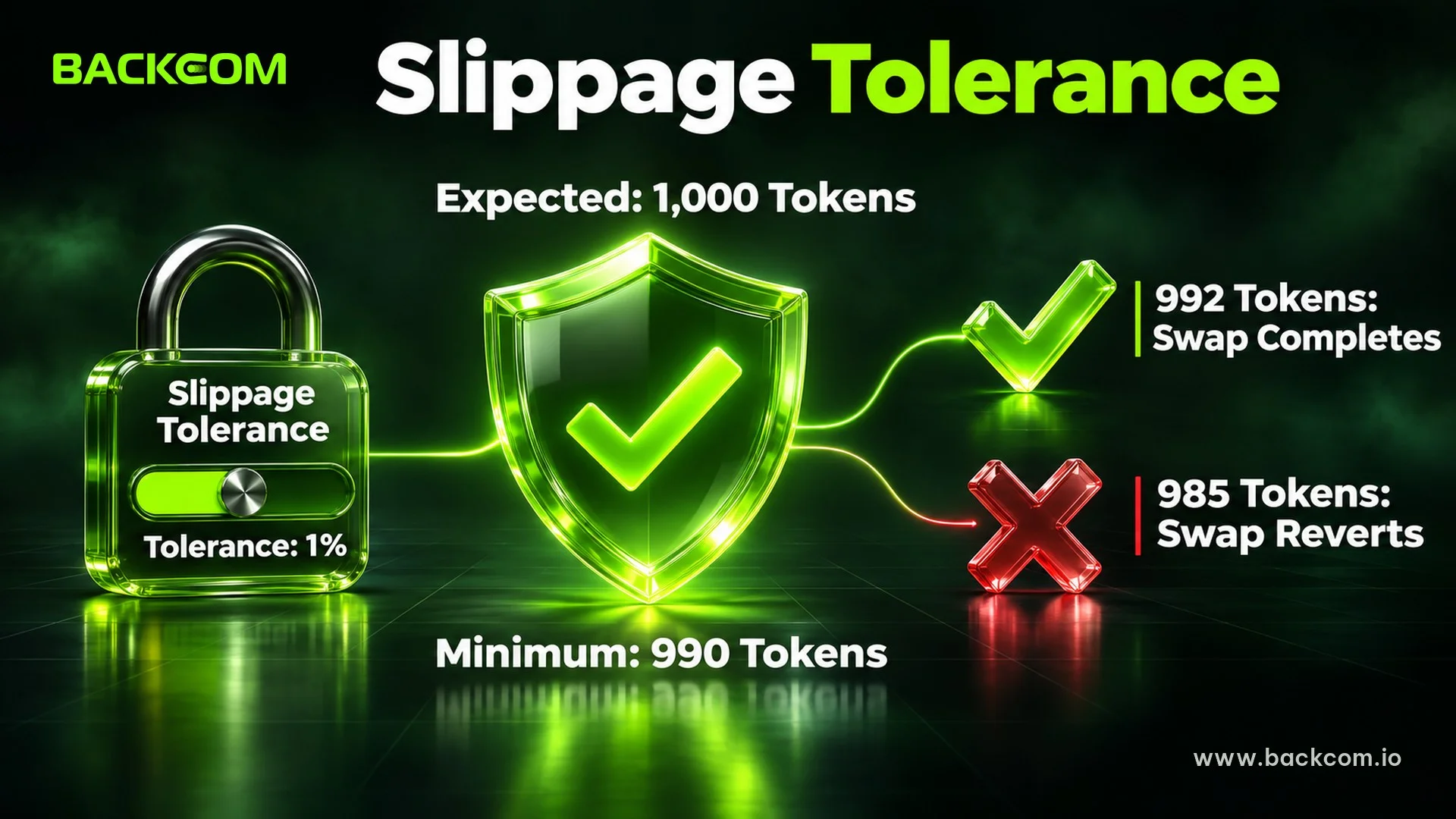
Slippage tolerance is a limit you set on a swap: the largest price change you accept before the transaction is cancelled. According to the Uniswap documentation, a tolerance such as 1% sets how far the execution price can move before the swap fails. Many interfaces show it as a percentage with an editable default.
The mechanism is simple. The interface turns your tolerance into a minimum amount you must receive. If the swap would return less, it reverts. Uniswap's documentation names this value "amountOutMinimum" for exact-input swaps and lists other reasons a swap can revert, including an expired deadline.
| Setting | What it means | Main risk |
|---|---|---|
| Very low (for example 0.1%) | Almost no price change is tolerated | The swap fails often and you can still pay network fees |
| Moderate (for example 0.5% to 1%) | A normal buffer for liquid pairs | Small extra cost in fast markets |
| Very high (for example 5% or more) | The swap goes through at almost any price | You may accept a much worse price |
A Tolerance Example With Numbers
Imagine you expect to receive 1,000 tokens and set a 1% tolerance. The minimum you accept is 990 tokens. If the price moves while the transaction is pending and the swap would return only 985 tokens, it reverts and you receive nothing, though the network fee for the attempt is normally still spent. If it would return 992 tokens, it completes.
Why A Very High Tolerance Is Risky
A high tolerance protects the swap from failing, but it also removes your protection against a bad fill. Binance Academy notes that setting tolerance too high can mean worse prices and more exposure to MEV front-running. In plain terms, someone watching pending transactions may profit from the room you left. Set the number only as high as the pair actually needs.
How To Avoid Slippage In Crypto Trading
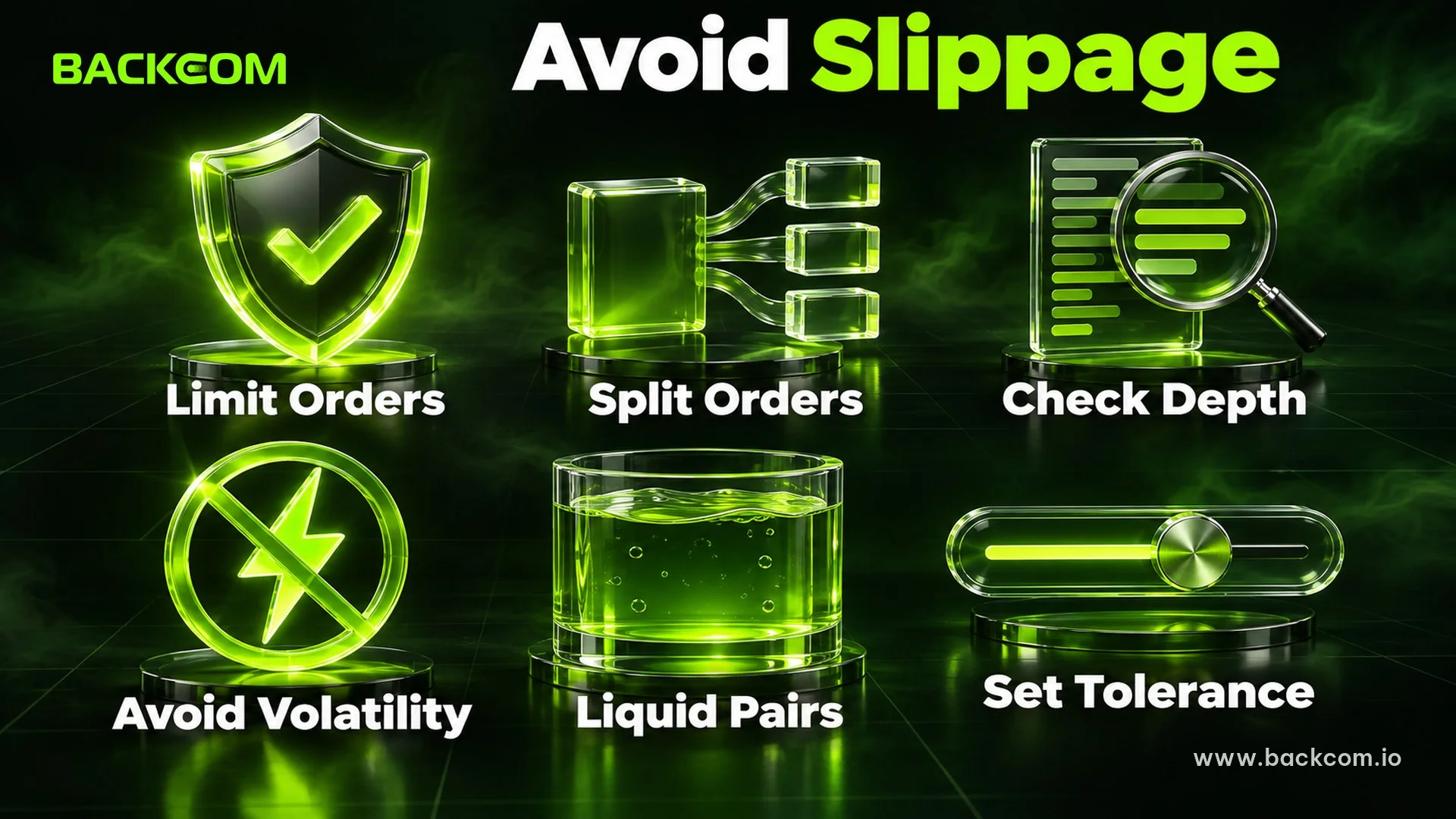
You cannot remove slippage entirely, but you can control how much of it you accept. These steps work on both order-book exchanges and DEXs:
- Use limit orders when the exact price matters. A limit order only executes at your price or better, although it may not fill at all. Our guide to forex order types on MT5 explains market, limit and stop orders in the same terms.
- Split large orders. Several smaller orders let the book refill and reduce price impact.
- Check depth before you click. Look at the order book or pool size and compare it with your trade.
- Avoid the most volatile minutes. Major news and sharp candles are when books thin out.
- Choose liquid pairs. The same dollar amount causes far less impact on a deep pair than on a small token.
- Set tolerance deliberately on DEXs. Not so low that swaps keep failing, not so high that a bad fill goes through.
- Consider an aggregator. Binance Academy lists DEX aggregators as a way to find better average rates across pools.
Limit Orders Have A Trade-Off
A limit order gives price control and gives up certainty of execution. If price runs away from your limit, you may miss the trade entirely. Decide which matters more for the trade in front of you: the exact price or getting filled.
Slippage On Stop Orders And Liquidations
Stop-market and liquidation orders execute as market orders once triggered, so they are the most exposed to negative slippage. When a stop triggers in a fast fall, the fill can be far from the stop price. A leveraged position can also close at a worse price than the calculated liquidation level. For the mechanics of that level, read how to calculate liquidation price.
Copy trading adds one more layer. If you copy another trader, your fills can differ from theirs because of timing and size, a point covered in our overview of crypto copy trading platforms and their risks.
How To Measure Your Own Slippage
Measure slippage by comparing the price you saw with your average fill price, as a percentage. The formula is:
Slippage % = (Executed price − Expected price) ÷ Expected price × 100
For a buy, a positive result is negative slippage (you paid more). For a sell, the sign flips. Keep a simple log of expected price, fill price, size and market conditions for several trades. After a few weeks you can see which pairs and times cost you the most, and adjust order type and size to fit.
Frequently Asked Questions (FAQ) About Slippage In Crypto
What Is A Good Slippage Percentage In Crypto?
There is no single good number. For deep, liquid pairs, many traders aim for a fraction of one percent, while thin tokens can need more. Treat tolerance as a safety limit, not a target, and compare it with how much depth the pair really has.
Why Did My Swap Fail With A Slippage Error?
The price moved beyond your tolerance while the transaction was pending, so the swap reverted to protect you. You normally still pay the network fee for the failed attempt. Retrying with a modest increase in tolerance, or a smaller trade, may help, but a higher tolerance also means accepting a worse price.
Can Slippage Be Positive?
Yes. If the market moves in your favour between your decision and the fill, you can get a better price than expected. Positive slippage is less talked about, but it is part of the same effect, and over many trades it can partly offset the negative kind.
Do Limit Orders Avoid Slippage?
A limit order will not fill at a worse price than you set, so it avoids negative slippage on the fill itself. The cost is that it may not execute. In a fast market the price can pass through your limit and never come back.
Is Slippage Worse In Futures Than In Spot Trading?
It can be, because leveraged positions are often closed by stop or liquidation orders in the middle of fast moves. A small price gap then becomes a larger loss on the position. Depth, order type and size matter in both markets, so check them before every trade.
Conclusion: Control What You Can
What is slippage in crypto? It is the difference between the price you expected and the price you got, driven by liquidity, volatility and the size of your order. You cannot remove it, but limit orders, smaller order sizes, liquid pairs and a sensible tolerance keep it from eating your plan. Backcom.io publishes this guide for education, so practise on small amounts before you trade size.
Disclaimer: This content is compiled by Backcom.io for information only and is not investment advice. Crypto trading carries a high risk of loss, including the loss of your whole deposit. Rules and taxes differ by country, so check the requirements that apply to you before trading.
Was this article helpful?
Join The Backcom.io Community
Get the latest on trading rebates, trading tips, and broker deals — and connect with thousands of traders worldwide.

Backcom App
Track Your Rebates Every Day
Every rebate is visible by broker and by day. Manage your wallet and withdrawals in one place.
Open Backcom App