What Is Leverage In Crypto Trading And How Risky Is It


What is leverage in crypto trading? Leverage lets you open a position larger than your own money by borrowing the difference, so every price move counts for more. In this article, Backcom.io explains what is leverage in crypto trading, gives crypto leverage explained with plain numbers, shows what a 10x leverage meaning looks like in practice, how leverage and liquidation are linked, and how much leverage to use if you decide to use it at all.
What Is Leverage In Crypto Trading? A Plain Definition
Leverage is the ratio between the size of your position and the money you put up as margin. Binance Academy describes margin trading as borrowing funds to open a position larger than your own capital, and it notes that this amplifies both potential gains and potential losses. The article was checked on 4 November 2026.
Three terms appear in every leveraged trade:
- Margin: the part of your own money locked as collateral for the position.
- Position size: the full value of the trade, which is margin multiplied by leverage.
- Leverage ratio: written as 2x, 5x, 10x and so on, where 10x means the position is ten times your margin.
Leverage is not extra profit. It is extra exposure, and exposure works in both directions.
Leverage Versus Spot Trading
In spot trading you pay the full price and own the coin, while in leveraged trading you post a fraction of the value and hold a contract. A spot buyer can only lose what they paid, and only if the price falls to zero. A leveraged trader can be closed out much earlier, because the borrowed part has to stay covered. The same idea exists in currency markets, which our guide to leverage in forex covers separately.
Crypto Leverage Explained: A Step By Step Example

With 10x leverage, 1,000 USD of margin controls a 10,000 USD position, and your profit or loss is calculated on all 10,000 USD. The Binance Academy article uses the same 10,000 USD at 10x framework, with 9,000 USD borrowed. Here are three outcomes, ignoring fees and funding:
| Price move | Position value change | Result on 1,000 USD margin |
|---|---|---|
| +5% | +500 USD | +50% |
| −5% | −500 USD | −50% |
| −10% | −1,000 USD | −100%, margin gone |
A 5% move sounds small on a chart. At 10x it is half of your margin. That is the core of crypto leverage explained in one line.
Return on margin = Price change % × Leverage
The 10x Leverage Meaning In Numbers
A 10x position is wiped out, roughly, by a 10% move against you, and in practice by less than that. Exchanges set a maintenance margin above zero, so a forced close normally happens before the full 100% loss. Fees and funding charges also eat into the buffer. The 10% figure is therefore the best case, not a safe distance.
Leverage On Long And Short Positions
Leverage works the same way whether you bet on a rise or a fall. A long position profits when the price rises. A short position involves borrowing the asset, selling it and buying it back later, so it profits when the price falls. With 10x on a short, a 5% rise costs about half of your margin, exactly like a 5% fall on a long. Many beginners forget that a sharp rebound can liquidate a short just as fast as a drop liquidates a long.
Leverage And Liquidation
Liquidation is the forced closing of your position by the exchange when your margin can no longer cover the loss. According to Binance Academy, if account margin falls below the maintenance requirement you may face a margin call or the position may be force-closed if you do not respond in time. In fast markets that can happen within seconds.
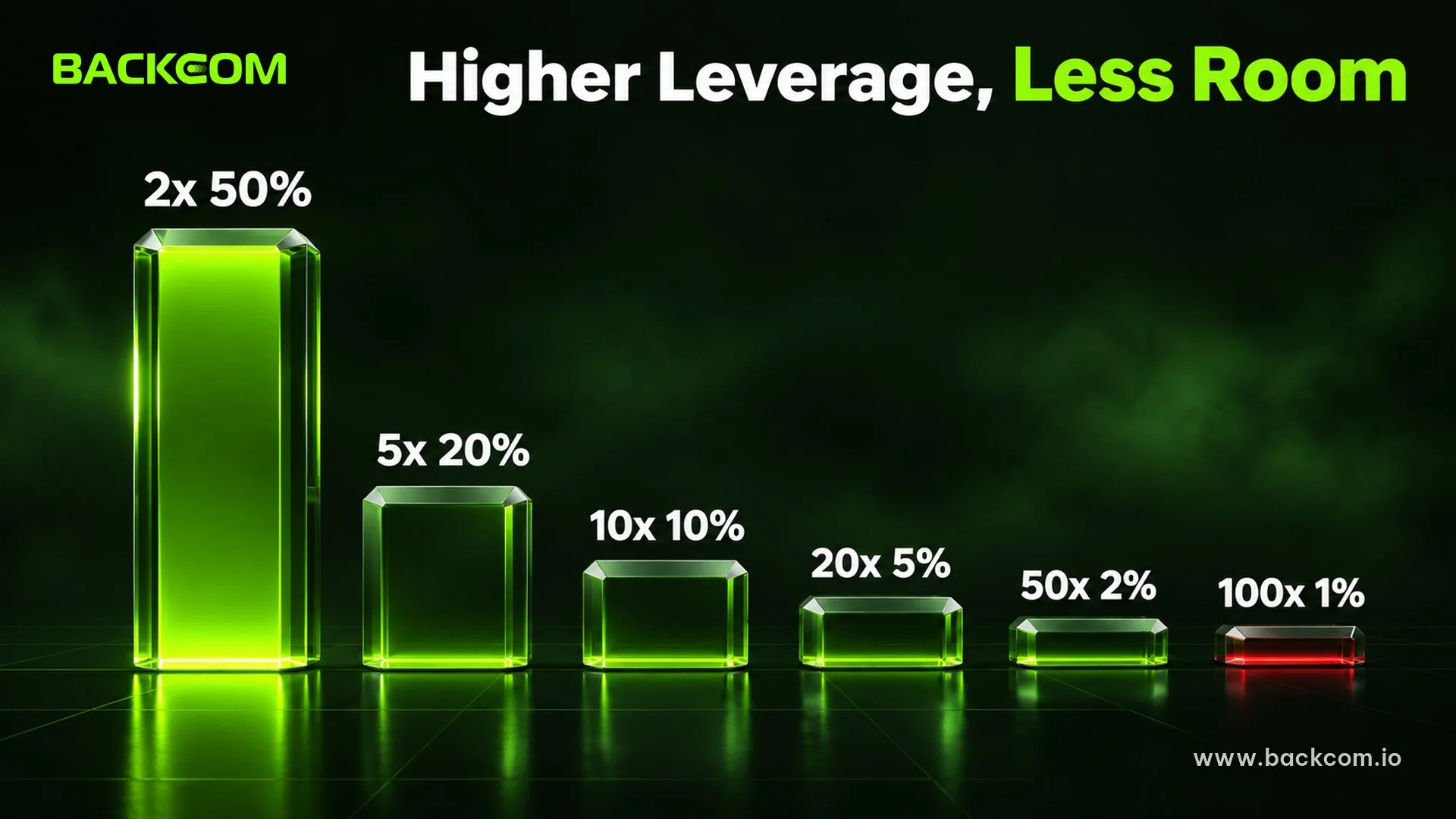
A simple rule of thumb shows how the distance shrinks as leverage grows:
Approximate price move that erases margin = 100 ÷ Leverage
| Leverage | Approximate adverse move that erases margin |
|---|---|
| 2x | 50% |
| 5x | 20% |
| 10x | 10% |
| 20x | 5% |
| 50x | 2% |
| 100x | 1% |
Reference figures from a simplified formula, before fees and maintenance margin. Real liquidation prices are closer than this, so check the exact figure on the venue before you trade. For the full calculation with BTC examples, read how to calculate liquidation price.
Why Liquidations Can Cascade
When many leveraged positions are closed at once, the forced selling can push the price further, which triggers more liquidations. Binance Academy calls this a liquidation cascade and notes it is most likely in thin order books. If you hold a long position, you are not only exposed to the market; you are also exposed to other traders' forced exits.
Isolated Margin Versus Cross Margin
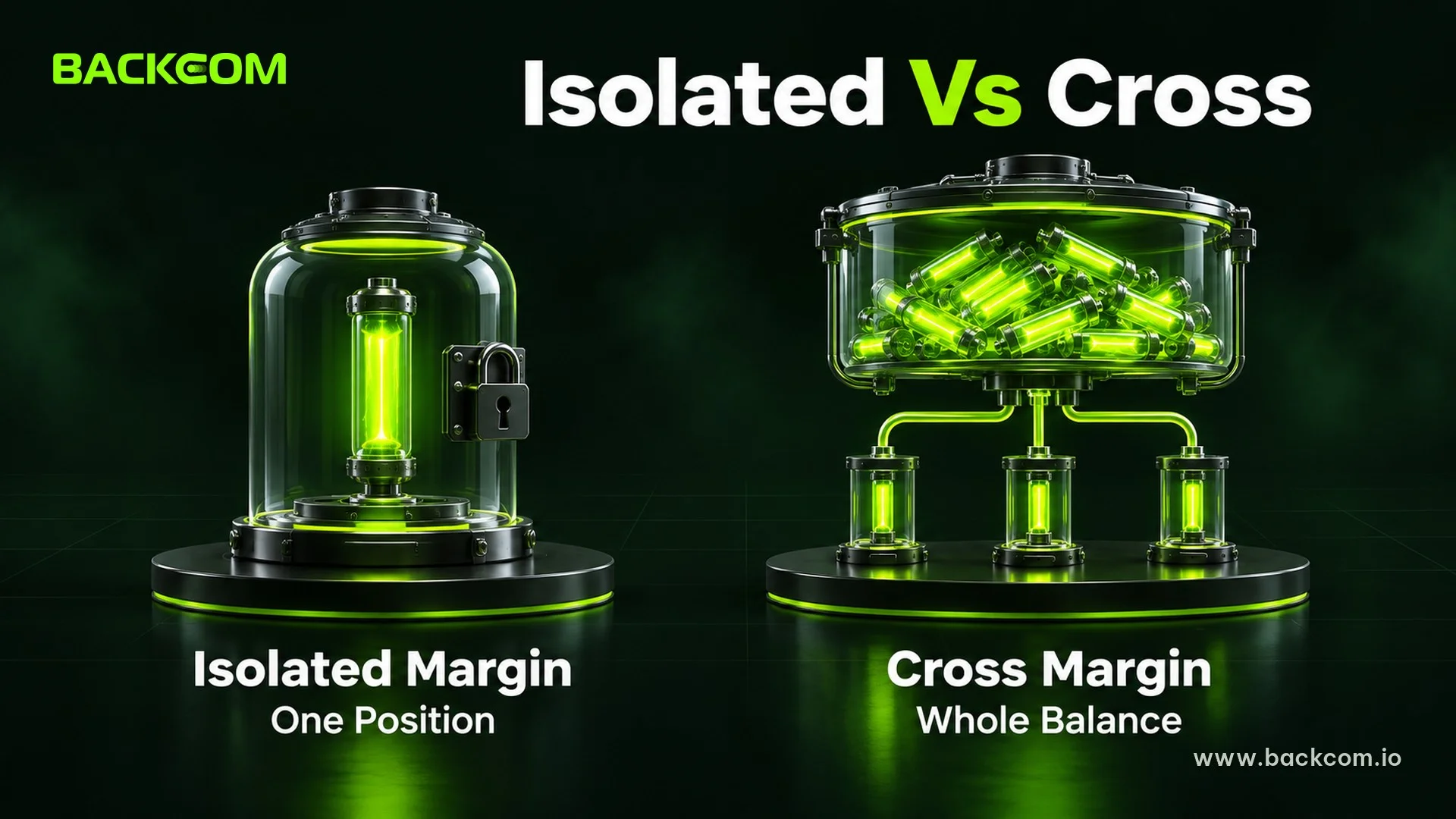
Isolated margin limits the loss to the margin assigned to one position, while cross margin uses your whole account balance as collateral. Binance Academy points out that cross margin can prevent a single position from being liquidated, but it puts the full balance at risk. In general, isolated margin keeps the damage contained, but the position can be liquidated sooner because it has only its own margin to draw on. Our comparison of cross margin versus isolated margin goes through when each mode fits.
The Costs And Risks Beyond The Price Move
Leverage adds costs and risks that do not exist in a plain spot purchase. The main ones are:
- Funding or borrowing cost: holding a leveraged position can cost money over time. In perpetual futures this is the funding rate, explained in our guide to what funding rate is. The contract itself is covered in what perpetual futures are.
- Trading fees on the full position size: fees are charged on 10,000 USD, not on your 1,000 USD margin.
- Slippage on stops: a stop that triggers in a fast move can fill far from your price, which makes the loss larger than planned.
- Losses larger than expected: the US Commodity Futures Trading Commission (CFTC) warns that leverage amplifies the underlying risk and that traders may lose more than their initial investments. See its page on the risks of virtual currency, checked on 4 November 2026.
How Much Leverage To Use In Crypto Trading
There is no safe number that fits everyone, but lower leverage gives your trade more room to survive normal price swings. The better question is how much you can lose, not how much you can control. Position size should come from your risk limit and your stop distance, and leverage only decides how much margin you lock.
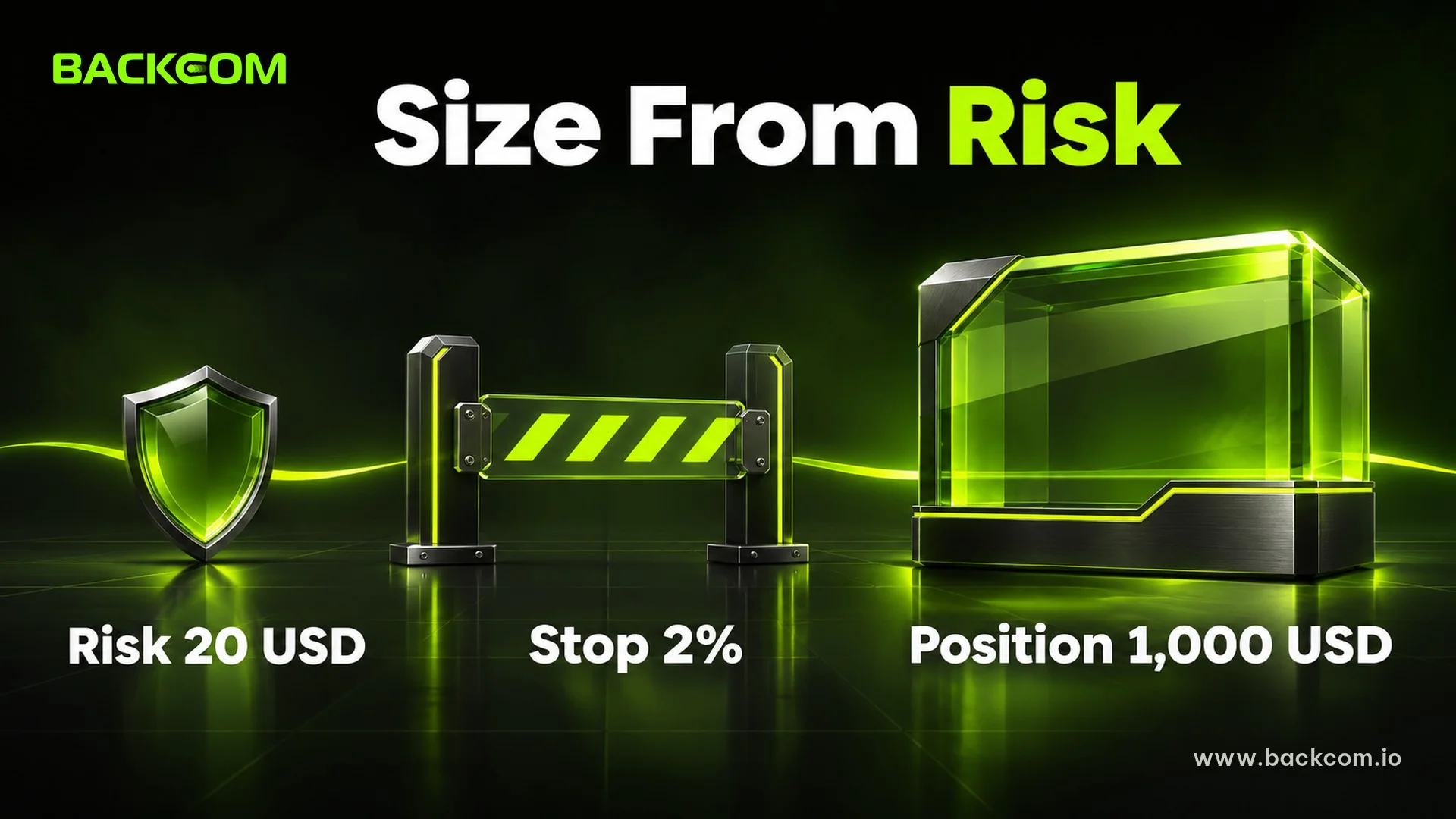
Here is a worked example. Say your account is 2,000 USD and you risk 1% on one trade:
Risk amount = 2,000 × 1% = 20 USD
If your stop is 2% away from entry, then:
Position size = 20 ÷ 0.02 = 1,000 USD
At 10x that needs only 100 USD of margin, and at 2x it needs 500 USD. In both cases a stop hit costs about 20 USD. What changes is how close liquidation sits to your stop. At 50x, liquidation would sit around 2% away, so it could come before your stop does. You can test numbers like these with the position size calculator.
Six Rules For Using Leverage More Safely
These habits do not remove risk, but they reduce the chance that one trade ends the account.
- Start low. Binance Academy suggests gaining spot trading experience first and starting with low leverage.
- Set the stop before you enter. Place it where your trade idea is wrong, not where it feels comfortable. See how to set a stop loss.
- Keep liquidation far behind the stop. If liquidation is closer than your stop, the leverage is too high.
- Risk a small fixed share per trade. Many traders use 1% or less.
- Prefer isolated margin while learning. It caps the loss on each position.
- Do not add to a losing position. Adding size raises the risk exactly when the trade is going wrong.
Common Leverage Mistakes Beginners Make
Most blown accounts come from a few repeated habits rather than from bad luck. Watch for these:
- Choosing leverage first and size second: picking 50x because it is available, then sizing the trade to fit a hope instead of a risk limit.
- Trading without a stop: relying on liquidation as the exit means giving up the whole margin every time you are wrong.
- Ignoring volatility: a coin that often moves 8% in a day is a poor match for 20x, because ordinary noise can reach liquidation.
- Moving the stop further away: this makes the loss on a failed trade bigger than the plan allowed.
- Using all available balance as margin: it leaves no buffer, so a small adverse move leaves nothing to add.
A written plan with entry, stop, size and maximum loss, made before you click, prevents most of these.
Frequently Asked Questions (FAQ) About Leverage In Crypto Trading
Does 10x Leverage Mean I Make Ten Times More Money?
It means the profit or loss on your margin is roughly ten times the price change, so a 2% gain is about 20% on your margin. The loss works the same way. Ten times the exposure is ten times the risk, not ten times the skill.
Can I Lose More Than My Margin?
On many venues a position is closed before the margin is fully used, and choosing isolated margin limits the loss to the margin assigned to that position. Still, the CFTC warns that traders may lose more than their initial investments in leveraged products. Check how your venue handles losses beyond margin and which margin mode you are using.
What Happens When I Get Liquidated?
The venue force-closes your position, usually at market, and you lose the margin assigned to it. With cross margin, other funds in your account can be pulled in as well. Fees may apply and fills can be worse than the liquidation price in a fast move.
Is High Leverage Ever A Good Idea?
High leverage leaves very little room for normal price noise, so a small move against you can end the trade. Some experienced traders use it with tiny positions and tight stops, but it is a high-risk approach. Beginners are better off with low leverage.
Is Crypto Leverage The Same As Forex Leverage?
The mechanism is the same: a borrowed multiple of your margin. The difference is volatility. Crypto prices can move much more in a day, which makes a given leverage ratio riskier than the same number in a calmer market.
Conclusion: Leverage Magnifies Everything
What is leverage in crypto trading? It is borrowed exposure that multiplies your gains and your losses by the same factor, and brings liquidation closer as the ratio rises. Use it only after you understand margin, liquidation and position sizing, and size every trade by what you can afford to lose. Backcom.io publishes this guide for education, so practise the calculations on paper or a demo account before risking real money.
Disclaimer: This content is compiled by Backcom.io for information only and is not investment advice. Crypto trading carries a high risk of loss, including the loss of your whole deposit. Rules and taxes differ by country, so check the requirements that apply to you before trading.
Was this article helpful?
Join The Backcom.io Community
Get the latest on trading rebates, trading tips, and broker deals — and connect with thousands of traders worldwide.

Backcom App
Track Your Rebates Every Day
Every rebate is visible by broker and by day. Manage your wallet and withdrawals in one place.
Open Backcom App