What Is An IB In Forex? How Introducing Brokers Work And How They Differ From Rebates

You open a trading account and hear one person call themselves an IB, another talk about "partners", and a third mention IB commission and rebates. For many new traders these sound like the same thing, yet they are different roles with different flows of money.
Put simply, what is an IB in forex is a question about the person who sits between the broker and the trader: who refers the client, who gets paid by the broker, and whether any of that money is shared back with the trader. Understanding this role helps traders choose the right referrer and spot offers to "earn as an IB" that are not transparent.
In this article, Backcom.io explains what an introducing broker is, how IB commission is calculated, how an IB differs from an affiliate, the practical steps to become one, and what traders should ask before choosing an IB for rebates.
What Is An IB In Forex? Where An Introducing Broker Sits Between Broker And Trader
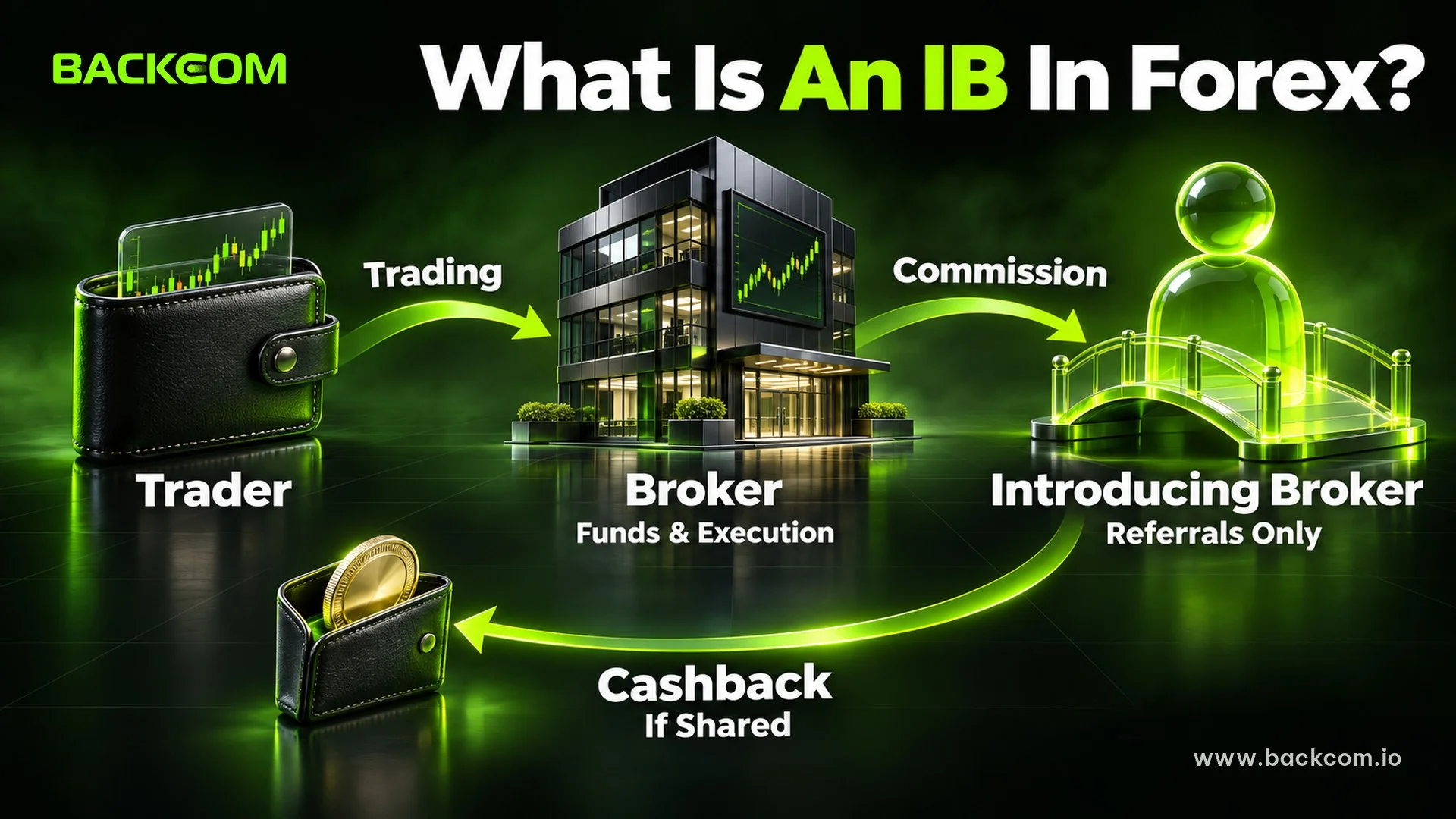
An IB in forex (short for introducing broker) is a person or company that refers clients to a broker and earns commission from the broker based on those clients' trading activity. The IB does not hold the trader's money and does not execute orders. Orders are still filled by the broker, and funds stay in the trader's own account inside the broker's system.
The relationship looks like this:
Trader opens an account through the IB's link → Broker records the account under the IB → Trader trades and the broker earns spread or commission → Broker pays part of that revenue to the IB
In this chain the trader pays nothing extra to the IB. The commission comes out of revenue the broker already collects. So the useful question for a trader is not "how much does the IB take from me", but "does the IB share that commission back, and how".
What Is An Introducing Broker Under US Rules?
The term has its clearest definition in the United States. According to the NFA's official registration page, an IB is a person or firm that solicits or accepts orders for futures contracts, commodity options, retail off-exchange forex or swaps, but does not accept money or property from customers to support those orders.
Read it directly: NFA's Introducing Broker registration page.
The NFA also says a US IB must be an NFA member, file Form 7-R and have at least one principal who is a registered associated person. A person or firm outside the US is exempt from registering if it has only non-US clients and sends all trades to an FCM for clearing.
The CFTC, the US federal regulator of derivatives markets, describes an IB in a similar way: someone who is paid, directly or indirectly, to solicit or accept trading orders without accepting margin funds or property from the client. See the CFTC intermediaries page.
Keep one point in mind: this is the US legal framework. Each country and each broker uses different names, conditions and levels of oversight, so these rules cannot be applied as-is to every IB program worldwide.
Why Do Brokers Use IBs?
A broker pays IB commission because it is a client acquisition channel with a measurable cost. Instead of spending on advertising with unclear results, the broker pays only when referred clients actually trade. For the trader, the benefit appears only when the IB shares commission back or provides real support during trading.
How Is IB Commission In Forex Calculated And Paid?
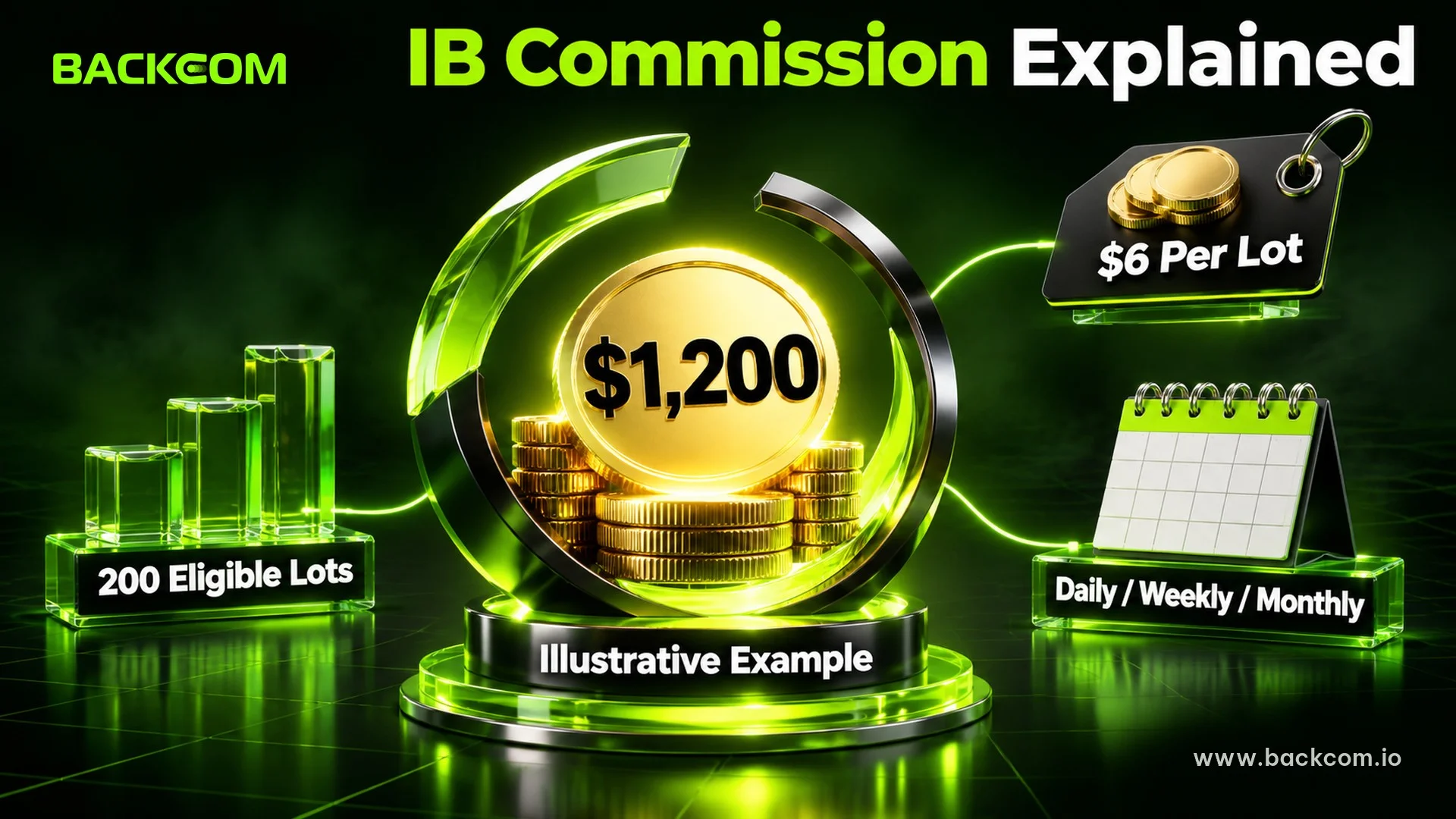
IB commission in forex is the money a broker pays an IB based on the trading of accounts under that IB's partner tree. Every broker uses its own mechanism, but two models are common.
- Per volume (USD per lot): the broker pays a fixed amount for each eligible lot closed, which varies by account type and product.
- Revenue share: the broker pays a percentage of the spread or commission generated by the IB's clients.
For the per-lot model the simplest formula is:
IB commission = Total eligible lots × Commission in USD per lot
Worked example: suppose an IB's clients trade a combined 200 eligible lots in a month and the commission for that account type is 6 USD per lot. The IB commission is 200 × 6 = 1,200 USD. This figure only illustrates the calculation and is not any broker's real rate.
A few practical points:
- Commission is usually calculated on closed trades, regardless of whether the trader wins or loses.
- Eligible lots may exclude very short trades, internal trades or products outside the program.
- Rates differ by account type and product.
- Payment can be daily, weekly or monthly depending on the broker.
Program names and payment models differ by broker: some pay IBs by revenue share and affiliates per action (CPA), while others merge the two. Rates and conditions can change, so read the current terms of the specific broker. A promise of fixed monthly income from being an IB is a warning sign.
What Is The Difference Between An IB And An Affiliate?
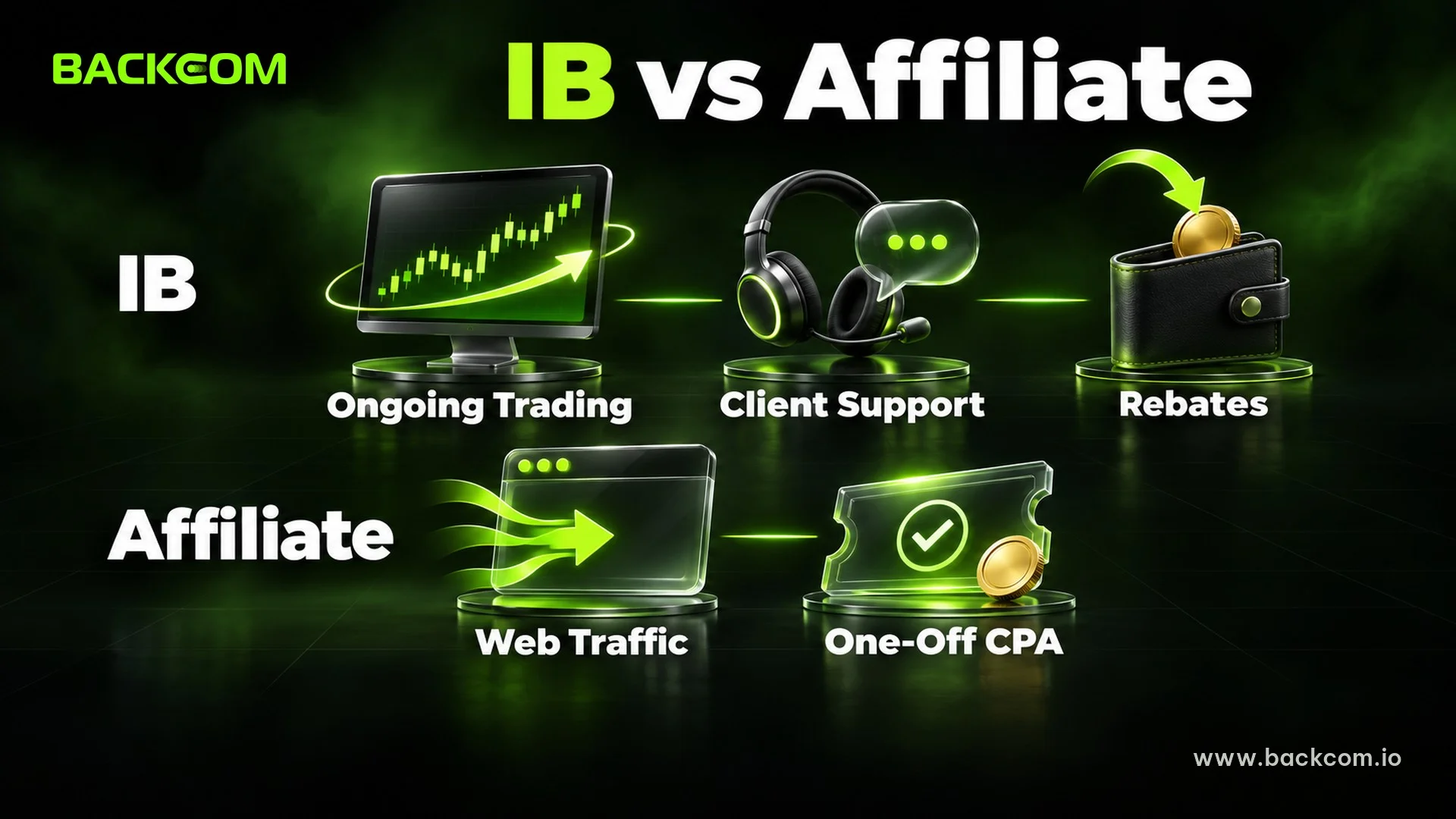
The difference between an IB and an affiliate lies mainly in how they are paid and how close they stay to the client. Both refer clients to a broker, but the payment model and the role after sign-up are not the same.
| Criteria | IB (Introducing Broker) | Affiliate |
|---|---|---|
| How it is paid | Usually ongoing, based on trading (per lot or revenue share) | Usually a one-off action (CPA) such as a sign-up or qualifying deposit |
| Duration | Lasts as long as the client keeps trading | Usually ends once the action is completed |
| Relationship with client | Closer, often supports the client while trading | More distant, mainly sends web traffic |
| Best suited to | People with an active trader community | Content creators, advertisers, web traffic owners |
| Can share back to the trader | Yes, this is the basis of rebates | Less common |
Classification as at 4 November 2026. Names and conditions differ by broker, so check the broker's official partner page before signing up.
The line between the two roles is not always clear, because some brokers call every partner a "partner". Ask directly whether the payment is calculated per lot or as a one-off action.
How Is An IB Different From A Rebate? The Trader's Place In The Chain
A rebate is the part of the commission that an IB or partner shares back with the trader, while IB commission is what the broker pays the IB. Both sit on the same flow of money but at opposite ends.
The article on what a forex rebate is and how to calculate cashback per lot goes into the calculation from the trader's side, while this article focuses on the IB role.
A rebate does not change the spread, does not change order execution and does not turn a losing strategy into a profitable one. It only reduces cost per lot, so it is not a reason to trade more than planned.
Backcom.io is an independent introducing broker (IB/affiliate) of several forex brokers. Rebate levels and conditions for each broker are shown on that broker's page, for example the Exness page. As checked on 4 November 2026, that page states that the rebate shared back is up to 100% of the IB commission the broker pays, by account type and product. Read the rebate table on the page before deciding, because figures can be updated.
Rebates are paid from the commission the broker pays its introducing partner. See the risk disclaimer for details.
How To Become An IB In Forex: Practical Steps
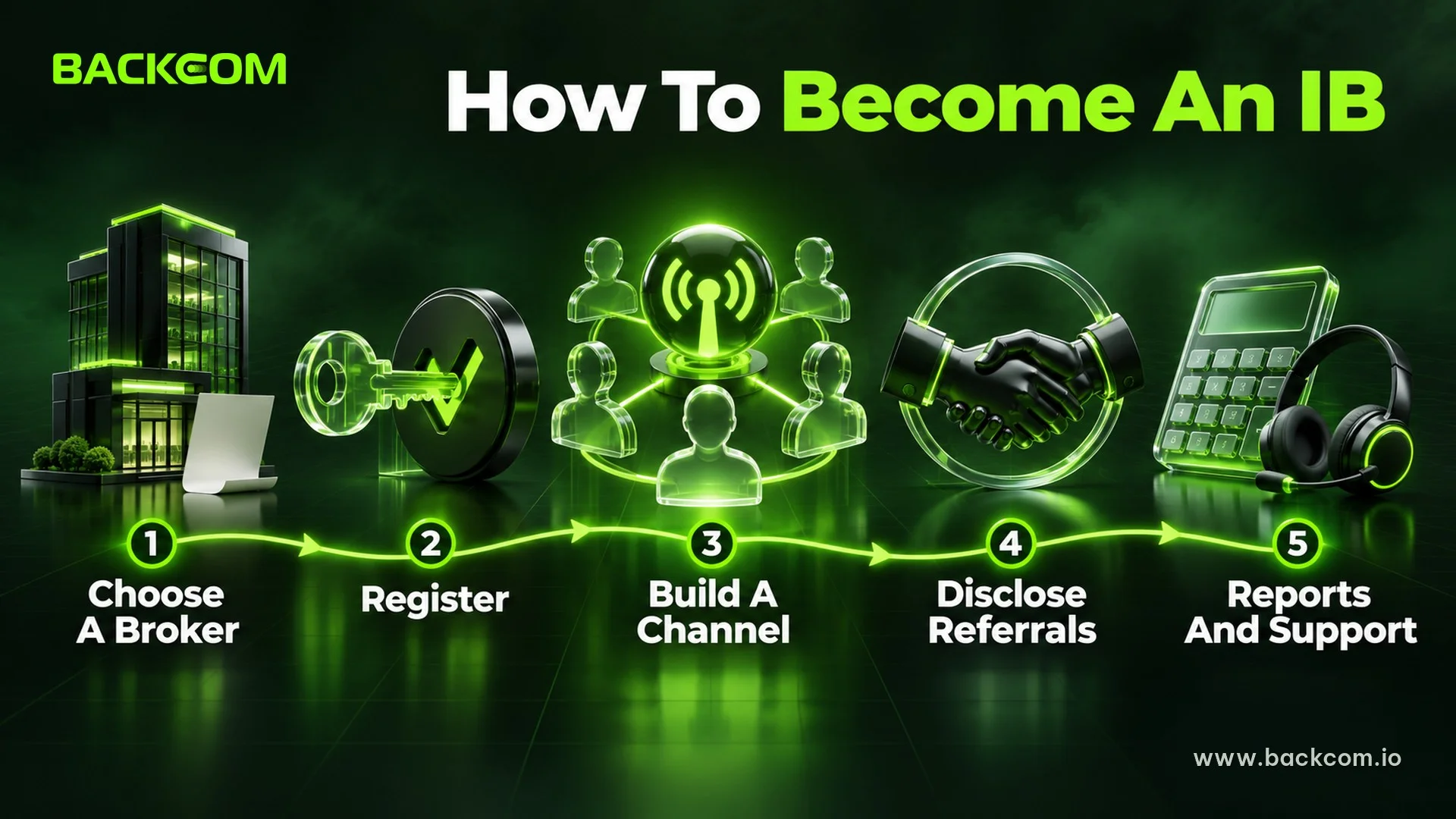
How to become an IB in forex depends on the broker and country, but the general process follows a similar pattern.
Step 1: Choose A Broker And Read The Partner Terms
The partner program page shows the payment model, eligibility, payment cycle and prohibited practices. Read the restrictions on countries and promotion carefully.
Step 2: Register A Partner Account
Brokers usually require identity verification (KYC). Once approved, the IB receives a personal code or referral link, and a broker may offer several link types with different commission levels.
Step 3: Build A Channel That Reaches Traders
An IB needs a channel with real people interested in trading, such as a group, content channel or website.
Step 4: Disclose The Referral Relationship
An IB should state clearly that it earns commission from the broker.
Step 5: Reconcile Reports And Support Clients
The broker provides volume and commission reports. The IB should reconcile them regularly and support clients with account issues or partner transfers.
Before starting, check the rules on promoting financial products where you live and the tax obligations on commission income. The partner terms of some brokers may limit commission on the IB's own accounts, so read that part before trading within your own network.
Warning Signs When Dealing With An IB
The IB model is not wrong in itself, but there are many non-transparent ways to run it. Traders should recognise these signs:
- Promising fixed income: IB commission depends on client volume, so a promise of "steady earnings every month" ignores this.
- Asking you to deposit into the IB's account: under the NFA definition an IB does not accept client money or property, so every deposit should go straight to your own account at the broker.
- Not saying whether the broker is licensed: see how to check a forex broker license before opening an account.
- Pushing you to trade more to "reach the lots": spread costs and risk are always larger than the rebate.
- Not disclosing the relationship with the broker: it is hard to judge whether advice is biased.
So treat an IB as a paid referral service, not an investment adviser, and keep your own plan for forex money management and lot size.
What Should You Ask When Choosing An IB For Rebates?
Choosing an IB for rebates is simpler than choosing a broker, but a few points still need checking. Ask or verify:
- Which broker the IB refers and whether it is licensed: the details should match the regulator's record, not only the sales pitch.
- What the rebate is based on: per lot, a share of commission or a share of spread, and for which account type.
- Where and when it is paid: into the trading account or a separate wallet, daily or monthly.
- Whether trading conditions change: a rebate should not alter spreads or execution.
- How you can verify it: compare closed lots with the rebate received.
- What happens if you already have an account: some brokers allow a partner transfer, others require a new account.
If you already have an Exness account and want to switch partner, read how to transfer your Exness IB/partner for rebates. To compare rebates across brokers on the same terms, see the rebate comparison page. For questions you can reach the team on WhatsApp or Telegram.
Frequently Asked Questions (FAQ) About IBs In Forex
What Is An IB In Forex, And Is It A Broker?
An IB is a person who refers clients to a broker. It is not the broker and does not hold the trader's money. Orders are filled at the broker and funds stay in the trader's account there. The IB earns commission from the broker based on referred clients' trading. If someone calling themselves an IB asks you to send money to a personal account, stop and check with the broker.
Does It Cost Anything To Become An IB?
Whether joining a partner program costs anything depends on the broker and country. In the United States, according to the NFA, an IB must pay registration and membership fees. Read the partner terms of the specific broker before deciding.
What Is The Difference Between An IB And An Affiliate?
An IB is usually paid on ongoing trading by clients, while an affiliate is usually paid per action such as a sign-up or deposit. However, the boundary depends on how each broker names its programs. The safest way is to ask whether the payment is calculated per lot or per action.
Do I Need To Become An IB To Get A Rebate?
No. A trader only needs to trade through an IB that shares commission back. You need to register as an IB only if you want to build your own network of clients and earn commission yourself.
Conclusion: What An IB Is And How To Use One Wisely
An IB in forex can be summed up in one sentence: a person who refers clients to a broker and earns commission from the broker based on their trading, without holding money or executing orders. Traders should look at three things together: who receives the commission, which part is shared back, and whether the broker behind it is transparent about its license.
Understanding IB commission, telling an IB from an affiliate and knowing the steps to become one helps traders avoid vague offers. For someone who only wants lower trading costs, choosing a partner that shares commission clearly is usually enough, with no need to become an IB.
If you are weighing which broker to open an account with, start with how to check a forex broker license, then compare rebates on the brokers page.
Disclaimer: This content is compiled by Backcom.io for information only and is not investment advice, a trading recommendation or tax/legal advice. Trading CFDs and forex is leveraged, high risk and can lose all your capital. Partner programs, commission rates and rebate conditions can change over time, so check official sources and consult a suitable professional for your own situation.
Was this article helpful?
Join The Backcom.io Community
Get the latest on trading rebates, trading tips, and broker deals — and connect with thousands of traders worldwide.

Backcom App
Track Your Rebates Every Day
Every rebate is visible by broker and by day. Manage your wallet and withdrawals in one place.
Open Backcom App