What Is A Pip In Forex? How To Calculate Pip Value By Currency Pair And Lot Size


Many new traders watch EUR/USD jump from 1.0850 to 1.0875, hear someone say “25 pips,” and have no idea what that is worth in their own account. What is a pip in forex is the first question to settle, because the pip is the common unit for measuring price movement, working out profit and loss, placing a Stop Loss and judging trading costs.
In this article, Backcom.io walks through the questions traders search for most:
- What a pip is, and why pairs with the Japanese yen (JPY) are counted differently from the rest.
- How much 1 pip is in price terms, and what a pipette is when your quote shows one extra decimal.
- What pip value means, that is, how much money one pip is worth for each currency pair and lot size.
- How to calculate pips in forex step by step, with illustrative examples for EUR/USD, USD/JPY, GBP/USD and USD/CAD.
What Is A Pip In Forex? The Unit That Measures Price Movement
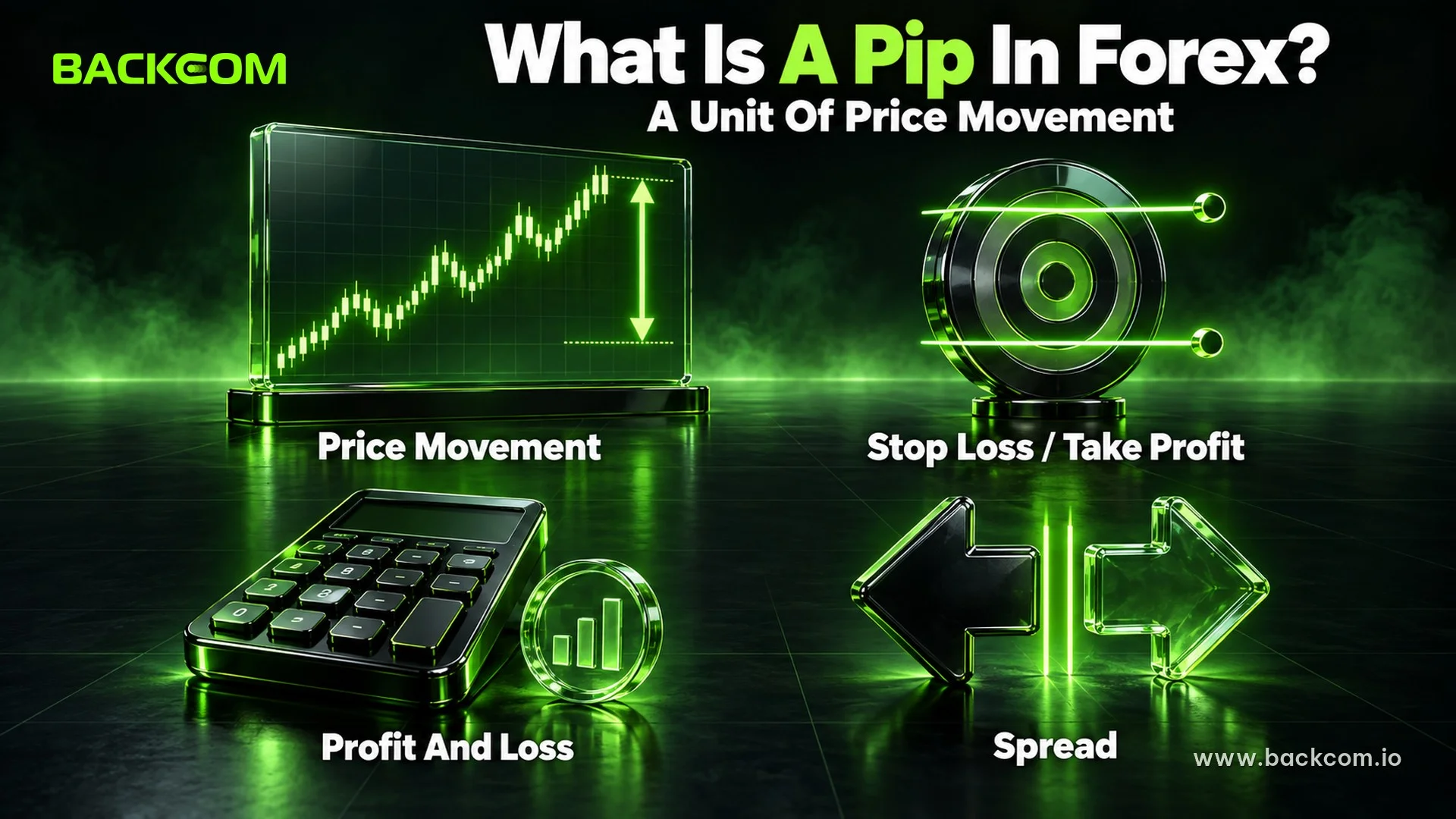
A pip is the smallest standard price change in a currency pair’s exchange rate, used to measure how far the price has moved. The name is usually explained as “percentage in point” or “price interest point.”
The key point is that a pip is not a fixed amount of money. It is a distance in price, while the cash value depends on the pair and the number of lots you hold. So “up 30 pips” can mean a few cents or a few hundred dollars, depending on trade size.
Traders use pips for four main jobs:
- Measuring movement: saying how far price has travelled without reading a long string of decimals.
- Placing Stop Loss and Take Profit: distances are usually counted in pips.
- Calculating profit and loss: multiply pips by the pip value and the lot size.
- Measuring cost: the forex spread is also quoted in pips.
According to the definition on BabyPips, a pip is the smallest conventional change in an exchange rate, and a pipette is one tenth of it. Thanks to this convention, two traders on different platforms speak the same language when they discuss a move.
How Much Is 1 Pip? Decimal Places For Each Currency Pair
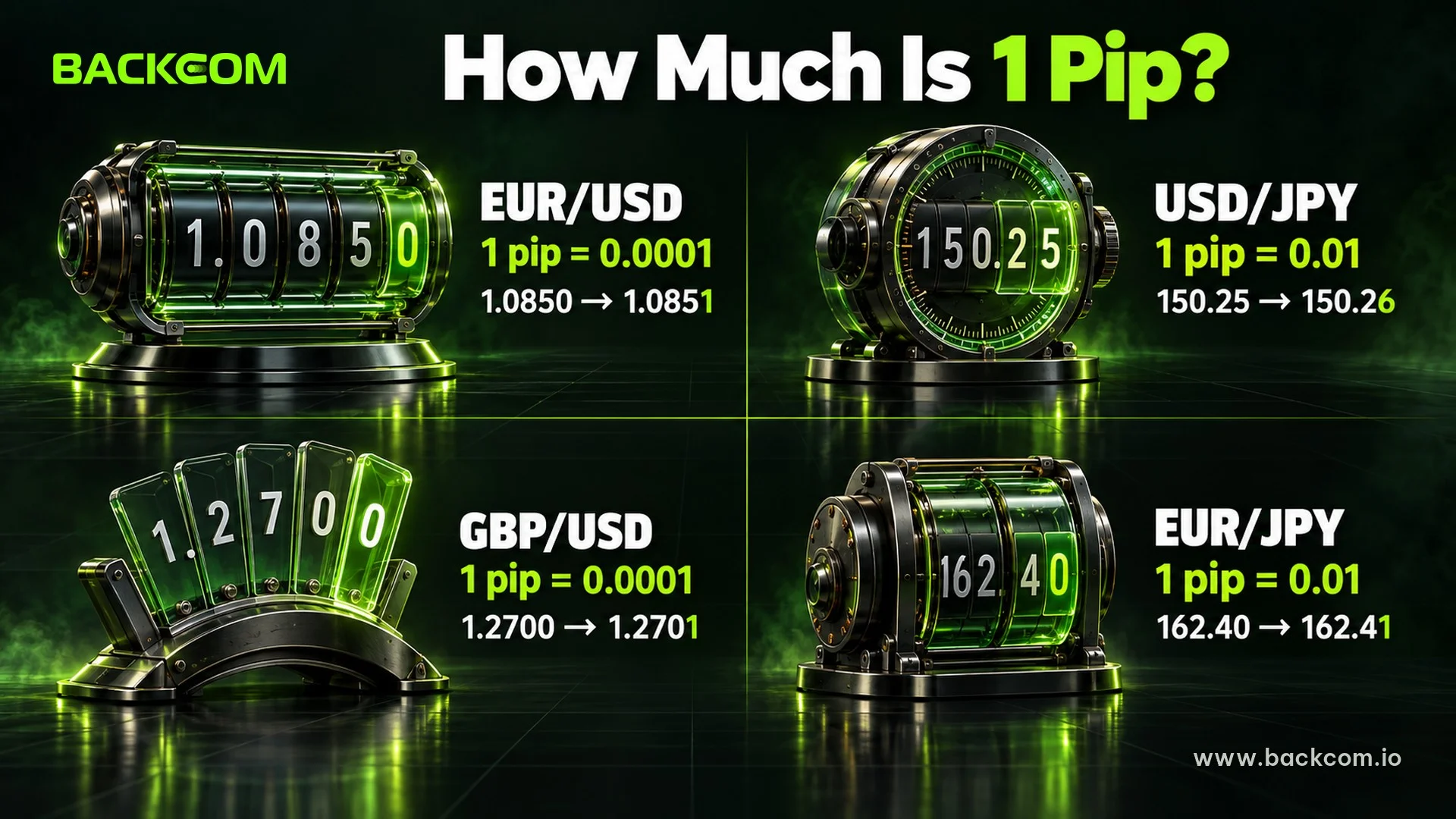
How much is 1 pip? For most currency pairs, 1 pip is 0.0001, the fourth decimal place. For pairs involving the Japanese yen, 1 pip is 0.01, the second decimal place.
| Currency pair | Quote format | 1 pip equals | Example of a 1-pip move |
|---|---|---|---|
| EUR/USD | 4 decimals (5 with a pipette) | 0.0001 | 1.0850 to 1.0851 |
| GBP/USD | 4 decimals | 0.0001 | 1.2700 to 1.2701 |
| USD/JPY | 2 decimals (3 with a pipette) | 0.01 | 150.25 to 150.26 |
| EUR/JPY | 2 decimals | 0.01 | 162.40 to 162.41 |
Pip convention referenced as at 2 November 2026. Prices in the table are illustrative; check live prices on your platform before sizing a trade.
A few points make the table easier to read:
- The yen has a low nominal value, so its exchange rates carry fewer decimals, which is why the JPY pip is 100 times larger.
- Gold, silver, indices and crypto have no single pip convention, so each broker may define it differently.
- For gold, check the broker’s contract specification instead of applying the currency-pair formula.
What Is A Pipette? The Fifth Decimal On Your Price Feed
A pipette is one tenth of a pip: the fifth decimal place on regular pairs and the third on JPY pairs. For example, GBP/USD moving from 1.30542 to 1.30543 is a rise of 1 pipette.
Brokers that quote five digits can show finer spreads. Instead of 1 pip or 2 pips, the spread might read 1.3 pips, which is 13 pipettes. Quick conversions:
- 10 pipettes = 1 pip, for both regular and JPY pairs.
- 1 pipette on EUR/USD = 0.00001, and on USD/JPY = 0.001.
- When sizing a trade, convert to pips first and then multiply by the pip value to avoid a factor-of-10 mistake.
A common error is reading 15 pipettes as 15 pips and then setting a Stop Loss far too close to price. Before placing an order, check whether your calculator or Stop Loss field counts in pips or in points.
What Is Pip Value? How Much One Pip Is Worth In Money
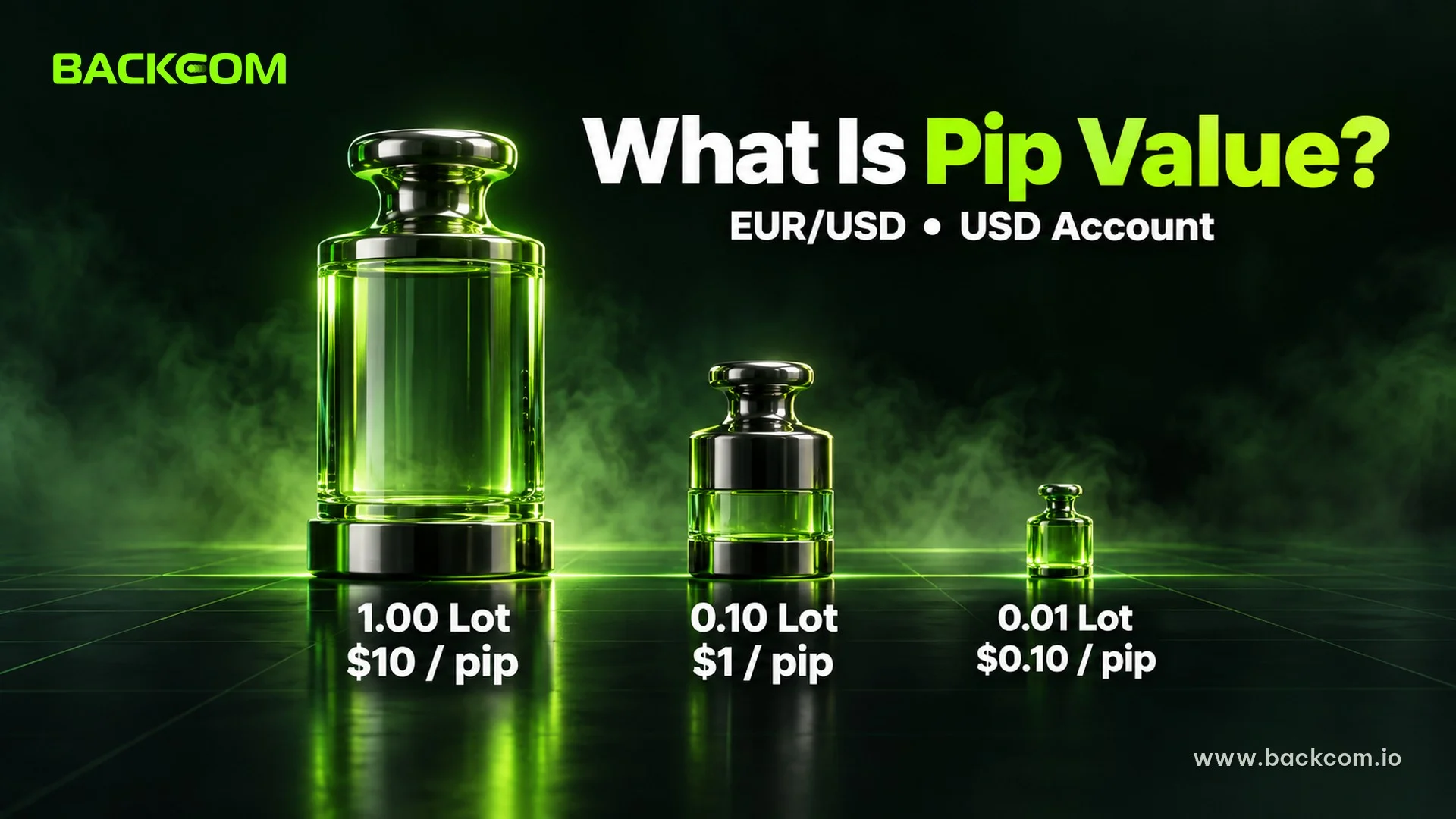
Pip value is the amount gained or lost when price moves one pip, for a specific trade size. It scales with lot size and changes by pair, because it is first calculated in the quote currency and then converted into your account currency.
The general formula for a standard pair is:
Pip value = (1 pip × Contract size) ÷ Exchange rate
This follows the calculation IG describes. Dividing by the exchange rate converts the result into the base currency, so it applies only when your account currency comes first in the pair, such as USD/JPY or USD/CAD with a USD account. A pair quoted in USD needs no division.
For 1 standard lot of 100,000 base units:
- EUR/USD: 0.0001 × 100,000 = USD 10 per pip. The quote currency is USD, so no conversion applies.
- USD/JPY: 0.01 × 100,000 = JPY 1,000 per pip. At a rate of 150 that is about 1,000 ÷ 150 = USD 6.67. This is an illustrative figure.
- GBP/USD: USD 10 per pip, because USD is the quote currency.
- USD/CAD: 0.0001 × 100,000 = CAD 10, which at 1.36 is about 10 ÷ 1.36 = USD 7.35. This is an illustrative figure.
Smaller lots scale proportionally: a mini lot of 0.10 gives USD 1 per pip and a micro lot of 0.01 gives USD 0.10 per pip on EUR/USD. If lot sizes are still unclear, read the guide to forex money management and lot size first.
Pip values referenced as at 2 November 2026. Exchange rates change constantly and contract specifications differ by broker; check again before sizing a trade.
Why The Pip Value Of Cross Pairs Keeps Changing
For a pair without USD, such as EUR/GBP, the pip is counted in pounds and must be converted to USD at the current GBP/USD rate. If GBP/USD is 1.27, one pip on 1 lot of EUR/GBP is worth 10 × 1.27 = USD 12.70 (illustrative). The next day the rate differs and so does the value. Traders who use many cross pairs should rely on a calculator rather than a memorised number.
How To Calculate Pips In Forex, Step By Step
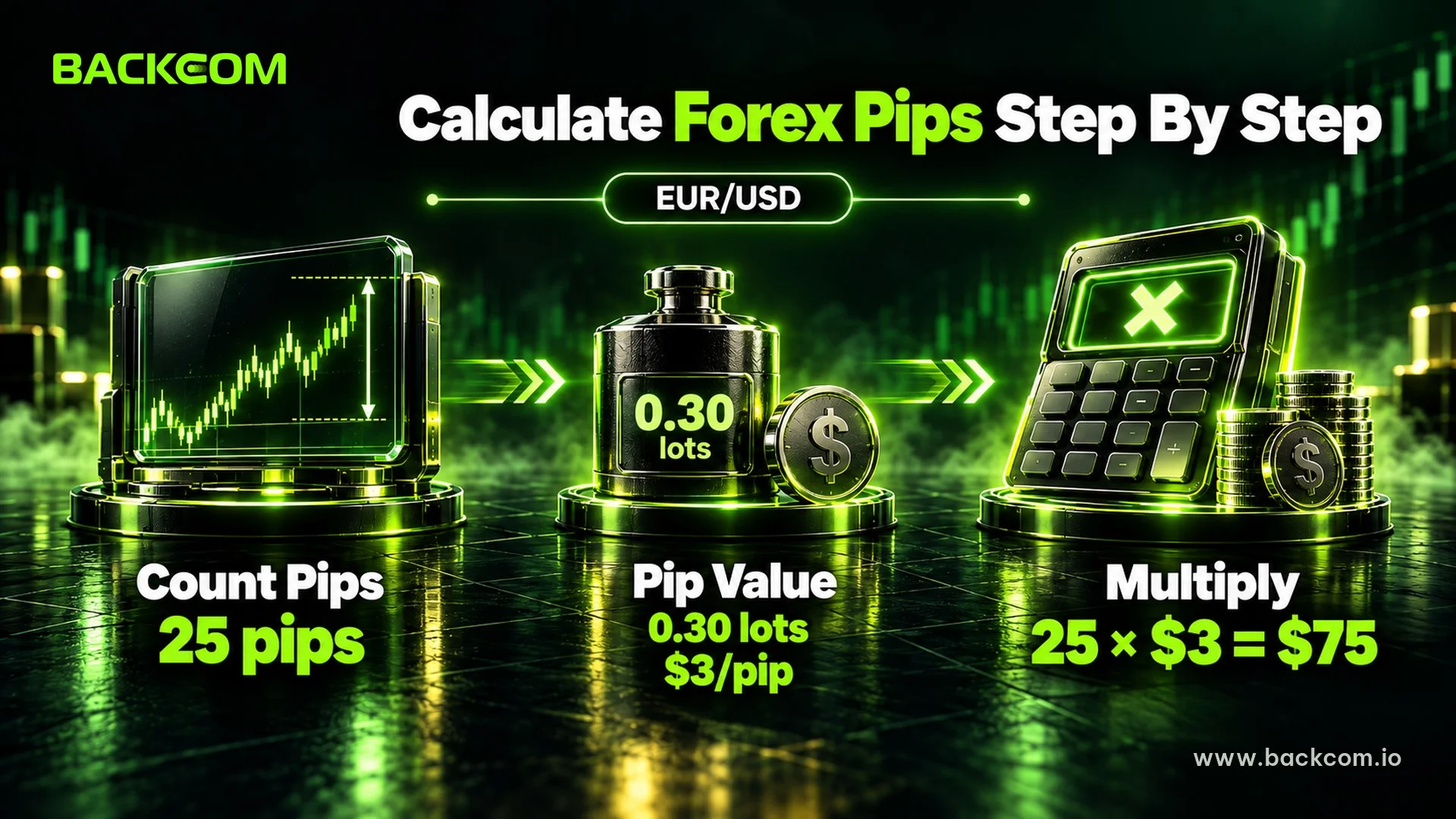
Calculating pips in forex takes two separate operations: counting how many pips price has moved, then converting those pips into money. Keeping the steps apart stops you from mixing price distance with cash.
Step 1: Count the pips price has moved
Subtract the opening price from the closing price and divide by the pip size of the pair. If you buy EUR/USD at 1.0850 and close at 1.0875, the difference is 0.0025, divided by 0.0001 gives 25 pips. For USD/JPY, buying at 150.25 and closing at 150.85 gives 0.60, divided by 0.01, so 60 pips.
Step 2: Get the pip value for your lot size
Use the formula above to get the value per pip for the size you hold. With 0.30 lots of EUR/USD, each pip is worth 10 × 0.30 = USD 3.
Step 3: Multiply the two
Profit or loss = Pips × Pip value of 1 lot × Number of lots
Illustrative example: a trader buys 0.30 lots of EUR/USD and price moves 25 pips in their favour. The profit is 25 × 10 × 0.30 = USD 75. If price moves 25 pips against them, the loss is also USD 75. These are hypothetical numbers, not real trading results.
The table below applies the same 25-pip move to different EUR/USD trade sizes:
| Trade size | Value of 1 pip | Profit or loss on a 25-pip move |
|---|---|---|
| 0.01 lot | USD 0.10 | USD 2.50 |
| 0.10 lot | USD 1.00 | USD 25.00 |
| 0.30 lot | USD 3.00 | USD 75.00 |
| 1.00 lot | USD 10.00 | USD 250.00 |
Referenced as at 2 November 2026, assuming 1 lot = 100,000 units and a USD account. Contract size may differ by broker.
The pip count stays the same while the money changes 100-fold as the lot goes from 0.01 to 1.00. This is where new traders lose control: they still risk “only 25 pips” as planned, but the size is many times larger than intended.
Using Pips To Set A Stop Loss And Choose Lot Size By Risk
Pips are most useful when you work backwards from the amount you are willing to lose, rather than only calculating profit after a trade has moved. This keeps risk per trade stable whether the Stop Loss is wide or tight.
Lots = Amount at risk ÷ (Stop Loss in pips × Pip value of 1 lot)
There are four steps:
- Choose the amount at risk: many traders use about 1% of the account, which is a common starting point, not a rule.
- Set the Stop Loss from price structure, then count the distance in pips.
- Take the pip value of 1 lot for the pair you trade.
- Calculate the lots and round down to the broker’s lot step.
Illustrative example: a USD 1,000 account, 1% risk is USD 10, with a 20-pip Stop Loss on EUR/USD. The size is 10 ÷ (20 × 10) = 0.05 lots. If the Stop Loss widens to 40 pips, the size drops to 0.025, rounded down to 0.02. The wider the stop, the smaller the lot needed to hold risk constant.
You can test combinations with the position size calculator, and see how to place stop orders on MT5 in the guide to forex order types. The numbers here only show how the calculation works; they are not a recommendation on account size or risk level.
Common Mistakes When Calculating Pips
New traders often make these errors:
- Applying USD 10 per pip to every pair, although that only holds for pairs quoted in USD.
- Confusing pips with pipettes, which puts the Stop Loss ten times closer than intended.
- Forgetting that JPY pairs use 0.01, and miscounting pips from the price table.
- Using the forex formula for gold and indices even though each broker defines the pip its own way.
- Looking only at pips and ignoring lots, which understates the real loss.
To avoid these, open the product’s Specification on MT5, note the contract size and number of decimals, and check with one small test trade on a demo account.
Pips And Trading Costs: Spread, Commission And Rebates
The spread is the gap between the selling and buying price, quoted in pips, and it is the cost you pay as soon as you enter. A 1.2-pip spread on EUR/USD equals 1.2 × 10 = USD 12 per lot, or about USD 1.20 for 0.10 lot. This is an illustrative figure.
It means a new trade starts “negative” by exactly the spread, and price has to cross that gap before the trade breaks even. Active traders who open many positions a day should compare spreads in pips together with commission per lot, as the guide to bid and ask prices explains.
Part of this cost can be offset by a forex rebate, a payment calculated on the lots you close. Because a rebate depends on lots, not on pips won or lost, it lowers cost but does not change whether a trade was right or wrong.
Backcom.io is an independent introducing broker (IB/affiliate) of the brokers it lists, and rebates are paid from the commission the broker pays Backcom.io; see the risk disclaimer. You can check current terms and rebate levels for each broker in the list of partner brokers. A rebate only offsets costs and cannot make up for losing trades.
Frequently Asked Questions (FAQ) About Pips In Forex
How Much Money Is 1 Pip Worth?
1 pip has no fixed cash value because it depends on the pair and the lot size. On EUR/USD, one pip is worth USD 10 per standard lot, USD 1 per 0.10 lot and USD 0.10 per 0.01 lot. For pairs quoted in another currency, convert at the exchange rate: about USD 6.67 per pip on USD/JPY at 150.
How Many Points Is 1 Pip?
On a broker quoting five digits, 1 pip usually equals 10 points, since a point is the last decimal place. A four-digit quote makes 1 pip equal to 1 point. Check the number of digits in the Specification on MT5 before placing a Stop Loss.
What Is A Pipette, And Does It Matter?
A pipette is one tenth of a pip, shown at the fifth decimal place (the third on yen pairs). It matters when comparing spreads between brokers, because a few pipettes can decide the cost for someone trading often. When calculating profit and loss, convert everything to pips to avoid a factor-of-10 error.
Do JPY Pairs Calculate Pips Differently?
Yes, the pip on a yen pair is 0.01 instead of 0.0001. The money calculation follows the same formula, but the result comes out in yen and is then converted to dollars at the exchange rate. So the pip value of USD/JPY moves with the rate and is not fixed like EUR/USD.
Conclusion: Understand What A Pip Is To Count Profit, Loss And Risk Correctly
Knowing what a pip is means holding three ideas together: a pip is a price distance, not money; the convention differs between regular and JPY pairs; and the value of each pip depends on the pair and the lot size. Traders should look at pips, pip value and trade size together rather than at the pip count alone.
A practical next step is to open the Specification of your product on MT5, work out the pip value for the pair you trade, and use the backward formula to choose lot size from your set risk. Once you are ready, the guide to forex money management and lot size helps build a full risk rule.
Disclaimer: This content is compiled by Backcom.io for information and reference only and is not investment advice or a trading recommendation. Trading forex and CFDs on leverage is high risk and you can lose your entire capital. Numerical examples in this article are hypothetical, contract specifications differ by broker, and traders must check them before placing an order.
Was this article helpful?
Join The Backcom.io Community
Get the latest on trading rebates, trading tips, and broker deals — and connect with thousands of traders worldwide.

Backcom App
Track Your Rebates Every Day
Every rebate is visible by broker and by day. Manage your wallet and withdrawals in one place.
Open Backcom App