Lot Size In Forex: What Is A Lot, How Much Is 1 Lot And How To Choose Position Size


Many new traders place their first order without knowing lot size in forex, type 1.00 instead of 0.01, and lose most of the account within minutes. A lot is the unit that measures how large an order is, and it decides how much money each pip of price movement adds to or removes from the account.
In this article, Backcom.io walks through the questions traders search for most often:
- What is a lot in forex, and how many units is 1 lot on every broker.
- Micro lot vs standard lot: how mini, micro and nano lots differ.
- What 0.01 lot is worth per pip on EUR/USD, USD/JPY and gold.
- How to choose a position size from account balance and risk, instead of from a feeling.
What Is A Lot In Forex? The Unit That Measures An Order
A lot in forex is the standardized unit used to measure the size of an order, meaning how many units of the base currency a trader buys or sells. Because every platform counts size the same way, traders can compare positions across brokers.
The key point is that a lot is not the money a trader puts in. It only shows how big the position is. The cash the broker actually holds as margin depends on leverage and on the price of the pair, so two traders opening the same 0.1 lot can have two different margin amounts locked.
Three numbers are tied to lot size, and traders need to keep them apart:
- Position size: the number of lots in the order, for example 0.01 or 1.00.
- Pip value: the profit or loss when price moves one pip, directly proportional to the lots.
- Margin: the money the broker holds to keep the order open, set by leverage.
All three change together. This is why the guide on forex money management and lot size starts the trading plan with position size.
How Much Is 1 Lot? Four Lot Sizes From Standard To Nano
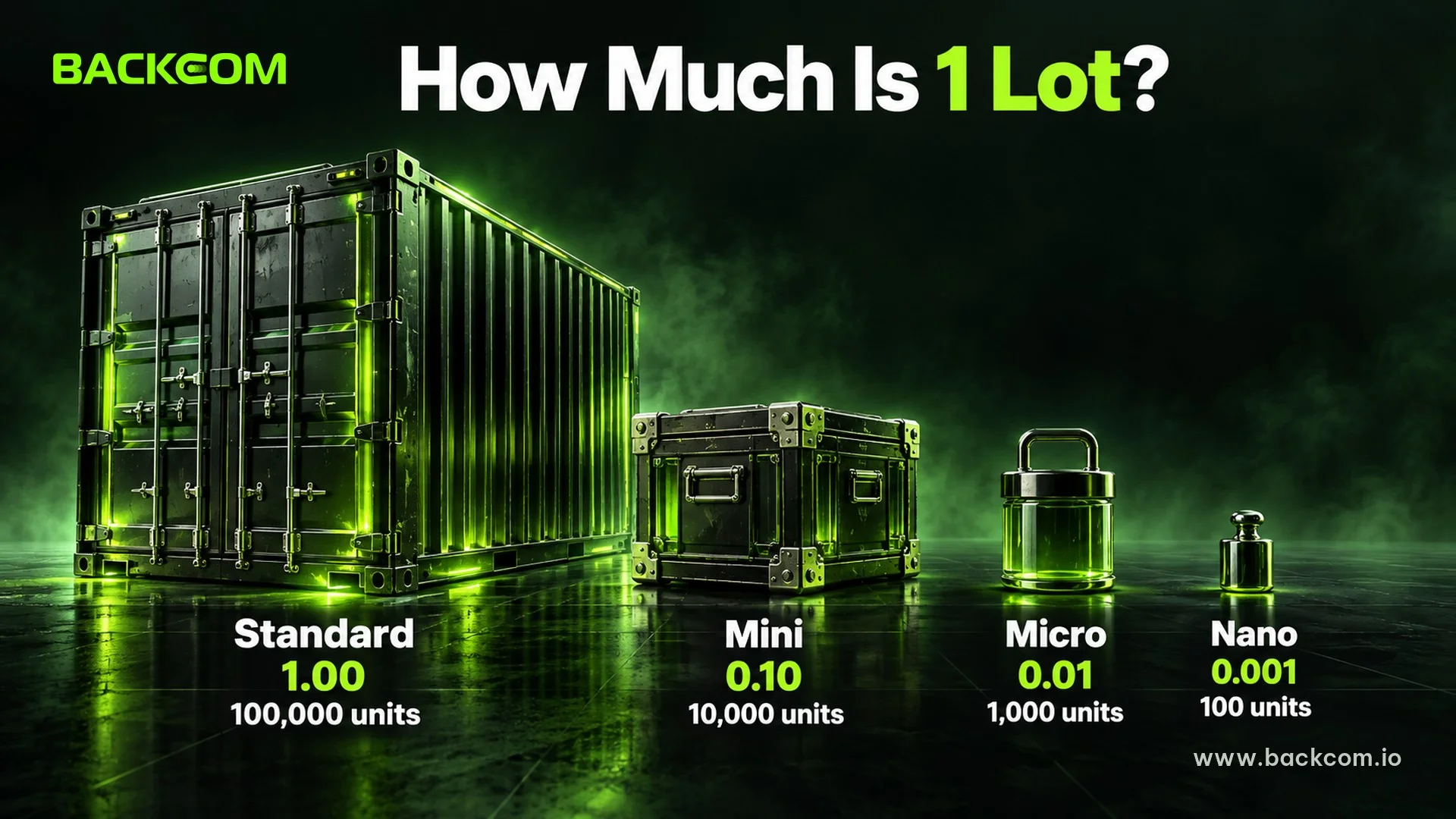
How much is 1 lot? A standard lot equals 100,000 units of the base currency of the pair being traded. On EUR/USD, opening 1 lot means buying or selling 100,000 euros, whatever the account balance is.
The other lot sizes scale down from that figure. Based on BabyPips and ATFX, the common conversion looks like this. For one more reference, see the TradeLocker glossary entry on the standard lot.
| Lot type | Volume on MT5 | Units of base currency | EUR/USD pip value (approx.) |
|---|---|---|---|
| Standard | 1.00 | 100,000 | 10 USD |
| Mini | 0.10 | 10,000 | 1 USD |
| Micro | 0.01 | 1,000 | 0.10 USD |
| Nano | 0.001 | 100 | 0.01 USD |
Lot conventions referenced on 01/11/2026. Minimum lot and lot step vary by broker and account type, so check them again before placing an order.
One point is worth noting: nano lots are not offered everywhere. Most platforms treat the micro lot of 0.01 as the smallest tradable size, so traders usually work with the first three rows of the table.
A few notes help avoid mistakes when reading the table:
- Volume on MT4 or MT5 is always a decimal number, so 0.10 is a mini lot and not 10 lots.
- The pip value is only approximate for pairs where the quote currency is USD.
- Pip value scales exactly with lots, so doubling the lot doubles the profit and the loss.
Does Lot Size Differ Between Brokers?
The 100,000-unit standard lot is an industry convention, so EUR/USD is measured the same way at any broker. What differs is the minimum lot, the lot step and the account type. Some cent accounts, for example, count volume in much smaller units, so a trader should always read the contract specification of the account in use.
A quick check on MT5 is to right-click the symbol in Market Watch, choose Specification, and read the contract size, minimum volume and volume step.
Micro Lot vs Standard Lot: Why New Traders Start Small
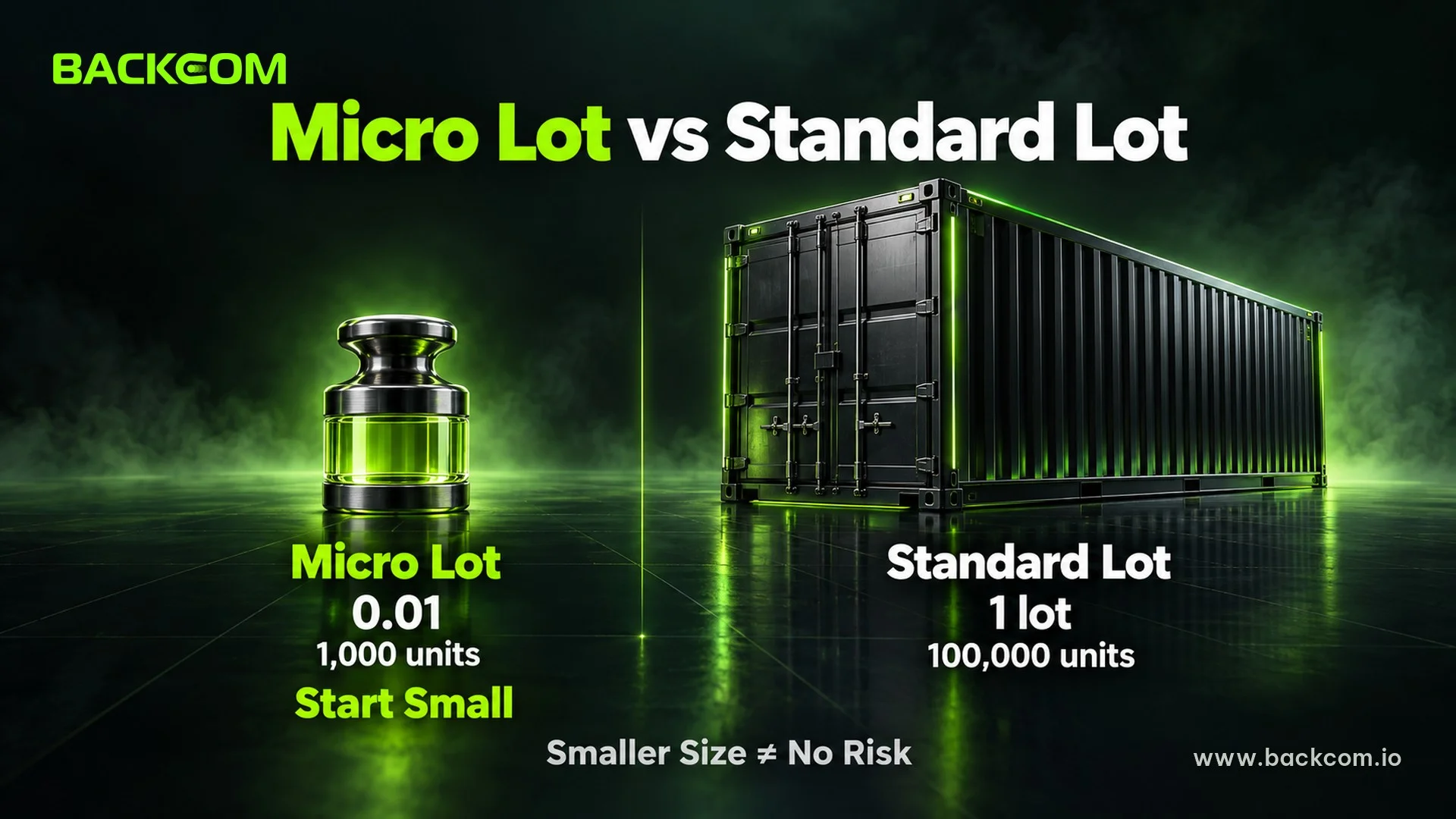
A micro lot is one hundredth of a standard lot, or 1,000 units of the base currency, shown as 0.01 on the trading platform. It is the smallest size most accounts allow.
For a new trader, the micro lot is useful for three reasons:
- Each pip is worth about 0.10 USD on EUR/USD, so a string of bad trades does not drain the account quickly.
- Margin is low, which allows several practice trades on a small balance.
- Real orders on a real account keep emotions light enough to learn discipline.
However, a micro lot does not turn a weak strategy into a good one. A smaller size only shrinks the loss, while trading costs such as spread and commission still scale with each lot. Traders should treat the micro-lot stage as time to practice a process, not as a way to earn quickly on thin capital.
Two common misunderstandings are worth avoiding. First, micro lots are not automatically safe, because several micro orders opened together can add up to a large total volume. Second, a bigger lot does not raise the chance of winning, it only magnifies the result in both directions.
Lot Size And Pip Value: What Is 0.01 Lot Worth On EUR/USD, USD/JPY And Gold
What is 0.01 lot worth? On EUR/USD, 0.01 lot equals 1,000 euros and each pip is worth about 0.10 USD. A 10-pip move in favor makes roughly 1 USD, and a 10-pip move against costs roughly 1 USD.
The general formula for a single order is:
Profit or loss = Pips × Pip value of 1 lot × Number of lots
An illustrative example: a trader buys 0.05 lot of EUR/USD and price moves 40 pips in favor. The pip value of 1 lot is 10 USD, so the profit is 40 × 10 × 0.05 = 20 USD. If price moves 40 pips against the trade, the loss is also 20 USD. These are assumed figures, not real trading results.
Pip Value Changes With The Instrument
The 10 USD per pip figure only holds for pairs quoted in USD. Other instruments need a fresh calculation:
- USD/JPY: one pip is 0.01, so 1 lot is worth 1,000 yen per pip. In dollars that depends on the rate, about 6.67 USD when USD/JPY is at 150, from 1,000 ÷ 150. This is an assumed figure.
- XAUUSD (gold): at many brokers 1 lot of gold is 100 ounces, so a 1 USD move in gold makes or loses 100 USD on a 1-lot order. At 0.01 lot, which is 1 ounce, a 1 USD move is worth 1 USD.
- Cross pairs: pip value is converted through the exchange rate, so it moves with the market.
The gold specification above has not been verified against each broker's official documentation, because contract size can differ by broker. Traders should read the Specification on MT5 before entering a trade.
Pip values referenced on 01/11/2026. Exchange rates and contract specifications change by broker and time, so check again before sizing an order.
Margin On One Lot: How Leverage Changes The Number

Margin is the money the broker holds in the account when an order opens, and it rises with lot size. A bigger position holds more, while higher leverage holds less.
Margin = (Lots × 100,000 × Price) ÷ Leverage
An illustrative example on EUR/USD at 1.0800:
- 0.01 lot with 1:100 leverage needs about 0.01 × 100,000 × 1.08 ÷ 100 = 10.80 USD.
- 0.01 lot with 1:500 leverage needs only about 2.16 USD.
- 1.00 lot with 1:100 leverage needs about 1,080 USD.
The examples show how high leverage makes margin tiny, and that is the trap. Low margin does not make the loss smaller, because the loss is still counted on the full position. At 1:1000 leverage a 100 USD account can open 0.5 lot on only about 54 USD of margin, but a 20-pip move against it already costs 100 USD.
For this reason, traders should pick lots from the loss they can accept, not from the lots their margin allows. The guides on leverage in forex and how to calculate margin cover this relationship in more depth.
How To Choose Forex Lot Size From Account Balance And Risk
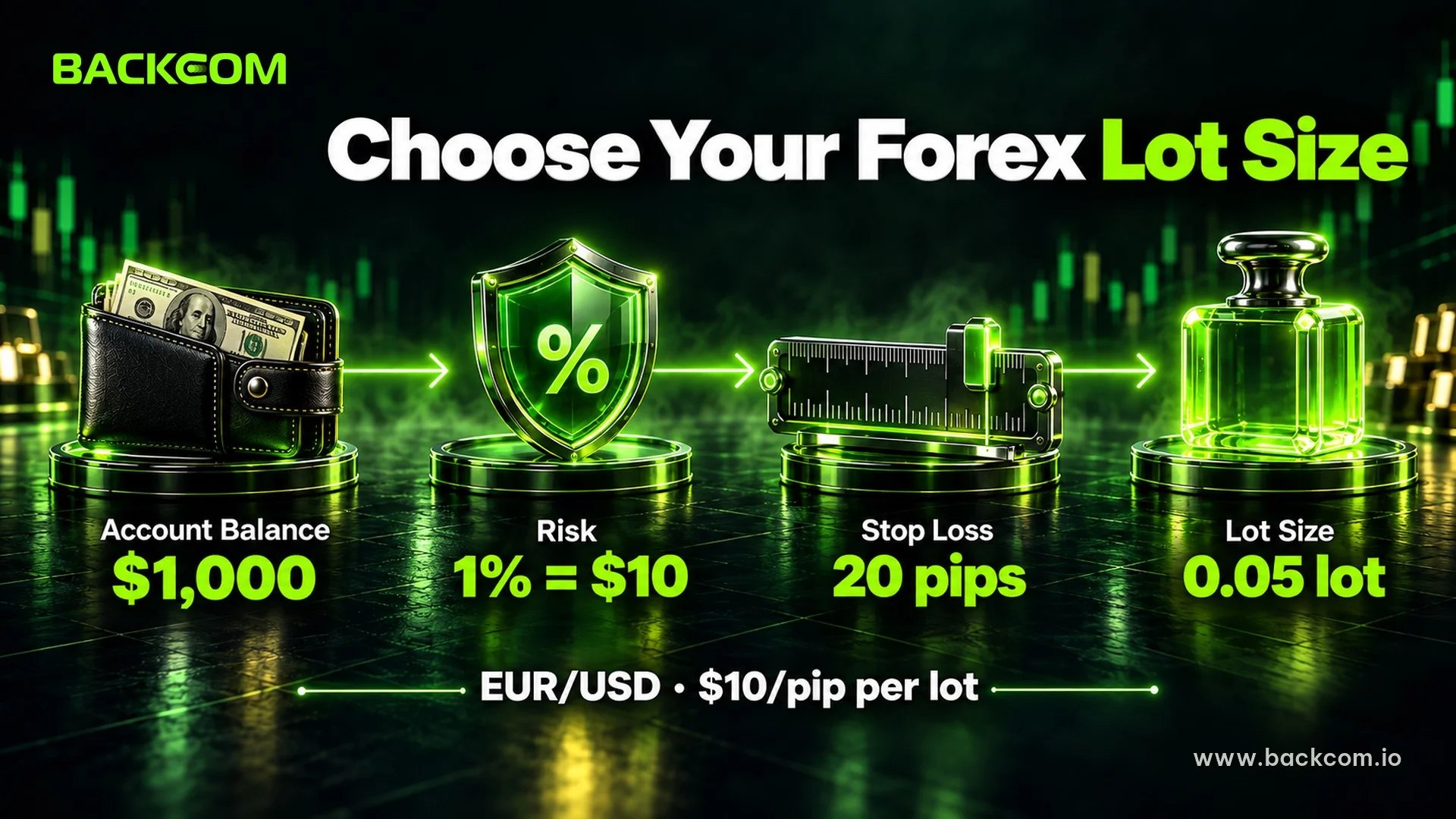
Lot size in forex should be calculated backwards from the amount a trader is willing to lose on one trade, and only then converted into lots. This keeps risk fixed even when the balance or the Stop Loss changes.
Lots = Risk amount ÷ (Stop Loss in pips × Pip value of 1 lot)
The process has four steps:
- Pick the risk per trade: many traders use 1% of the account, which is a common starting point and not a rule.
- Set the Stop Loss in pips from market structure, not from the lot size you want.
- Take the pip value of 1 lot for the instrument being traded.
- Calculate the lots and round down to the lot step the broker allows.
An illustrative example for EUR/USD with 1% risk and a 20-pip Stop Loss:
| Account balance | 1% risk | Formula | Lots to open |
|---|---|---|---|
| 500 USD | 5 USD | 5 ÷ (20 × 10) = 0.025 | 0.02 lot (rounded down) |
| 1,000 USD | 10 USD | 10 ÷ (20 × 10) = 0.05 | 0.05 lot |
| 5,000 USD | 50 USD | 50 ÷ (20 × 10) = 0.25 | 0.25 lot |
| 10,000 USD | 100 USD | 100 ÷ (20 × 10) = 0.50 | 0.50 lot |
Lot size moves with the Stop Loss. On the same 1,000 USD account, widening the Stop Loss to 40 pips cuts the size to 0.025, rounded down to 0.02. A wider stop calls for a smaller lot to keep the same risk.
Traders can test balance, risk and Stop Loss combinations with the position size calculator instead of working them out by hand each time. The examples in the table only illustrate the method and are not a recommendation on balance or risk level.
Common Lot Size Mistakes
New traders often fall into these errors when sizing an order:
- Typing 1.00 instead of 0.01 by misplacing the decimal point in the volume box.
- Raising lots after a losing streak to win the money back, which is emotional pyramiding, as the guide on pyramiding vs averaging down explains.
- Using one lot size for every instrument, although gold and EUR/USD have very different pip values.
- Opening several small orders in the same direction and forgetting to add up the total volume.
- Sizing from remaining margin instead of from the loss the trader can accept.
To avoid these, traders can write the maximum lot size for each instrument into the trading journal and re-check the volume box before sending any order. The guide on forex order types shows how to place orders on MT5 step by step.
How Lot Size Affects Costs And Rebates
Trading costs at many brokers scale with lots: commission is usually a fixed amount per lot, and spread converts to money through pip value and lot size. Twice the lot means twice the cost.
An illustrative example: a 1.2-pip spread on EUR/USD equals 1.2 × 10 = 12 USD for 1 lot, or about 0.12 USD for 0.01 lot. For traders who open many orders a day, total costs add up, so the guide on forex spread is worth reading alongside this one.
Part of that cost can be offset by a forex rebate, a payment calculated on the lots a trader has closed. Because rebates are paid per lot, they also create a wrong incentive: raising lot size just to earn more rebate usually grows risk faster than the rebate grows.
Backcom.io is an independent introducing broker (IB/affiliate) of the brokers it lists; rebates are paid from the commission the broker pays Backcom.io, see the risk disclaimer. Traders can review the current terms of each broker in the list of partner brokers. A rebate only offsets costs and cannot make up for losing trades.
Frequently Asked Questions (FAQ) About Lot Size In Forex
How Much Money Is 1 Lot In Forex?
1 lot has no fixed money value, because it is 100,000 units of the base currency. On EUR/USD, each pip of 1 lot is worth about 10 USD, and the notional value of the order is about 108,000 USD when price is at 1.0800. The margin actually held is far smaller and depends on leverage.
What Is 0.01 Lot Worth Per Pip?
On EUR/USD, 0.01 lot is worth about 0.10 USD per pip, so 10 pips equal about 1 USD. On USD/JPY the figure is about 0.067 USD per pip when the rate is near 150, and on gold 0.01 lot usually equals 1 ounce. Traders should check the contract specification on MT5 before placing an order.
What Lot Size Should A 100 USD Account Use?
There is no universal lot size. With 1% risk of 1 USD and a 20-pip Stop Loss on EUR/USD, the result is 1 ÷ (20 × 10) = 0.005 lot, below the 0.01 minimum at most brokers. In that case a trader should consider a cent account or a larger balance first, rather than forcing the lot size up to fit.
Is The Micro Lot The Smallest Lot?
Most platforms treat the 0.01 micro lot as the smallest size. Some brokers offer nano lots or cent accounts with even smaller volume. Traders need to read the minimum lot and lot step of the account they use, and not assume them from another broker.
Conclusion: Understand Lot Size Before You Send The Order
Understanding lot size in forex means holding three facts together: 1 lot is 100,000 units, pip value grows with lots, and margin does not reflect the real loss. Traders need to look at volume, Stop Loss and balance together, not each alone.
The next step is to check the Specification of the instrument on MT5, calculate lots from a chosen risk level, start from micro lots and record the results to adjust. To go further, traders can read the guide on forex money management and lot size and build a full risk rule.
Disclaimer: Content is compiled by Backcom.io for information and reference only and is not investment advice or a trading recommendation. Trading forex and CFDs with leverage carries high risk and you can lose all of your capital. Numeric examples in this article are assumptions, contract specifications differ by broker, and traders must verify them before placing an order.
Was this article helpful?
Join The Backcom.io Community
Get the latest on trading rebates, trading tips, and broker deals — and connect with thousands of traders worldwide.

Backcom App
Track Your Rebates Every Day
Every rebate is visible by broker and by day. Manage your wallet and withdrawals in one place.
Open Backcom App