Pyramiding In Forex Vs Averaging Down: Adding To Positions And The Risk Of A Blown Account


Many traders hear about pyramiding in forex as a way to ride a trend, or about adding to a trade as a way to recover a loss. Few stop to ask what an extra order does to the risk of the whole account. The same action, opening one more position in the same direction, can protect profit when it is done into strength, and it can wipe out an account when it is done into weakness.
The mechanics are simple multiplication: more lots mean more profit, more loss, more margin and more cost at the same time. In this article, Backcom.io explains pyramiding versus averaging down, shows how the martingale strategy differs from both, works through an XAUUSD example with the average entry price and margin, and looks at how prop firms treat extra orders.
The aim is not to promote or ban a technique. It is to let you see the numbers before the second order goes in.
What Is Pyramiding In Forex: Adding Orders In The Same Direction
Pyramiding in forex means adding positions in the same direction while the earlier position is in profit and price keeps moving as expected. It belongs to a wider habit of adding to a position, also called scaling in, where total size grows and the average entry price of the group changes with every order added.
Adding to a position is not an indicator or a signal. It is a way of managing position size. With the same view that price will rise, a trader can buy 0.3 lot at once or split the trade into three 0.1 lot orders at three prices. The two choices differ in average entry and in the moment when risk is highest.
A few terms appear together:
- Pyramiding: adding orders while the position is in profit.
- Averaging down: adding orders while price moves against the view, to pull the average entry closer to the market.
- Break-even price: the price at which the whole group of orders returns to zero after volumes are combined.
So the useful question is not whether adding is good or bad. It is when to add, how much to add, and whether the group shares one stop.
Pyramiding Versus Averaging Down: Adding To A Losing Position
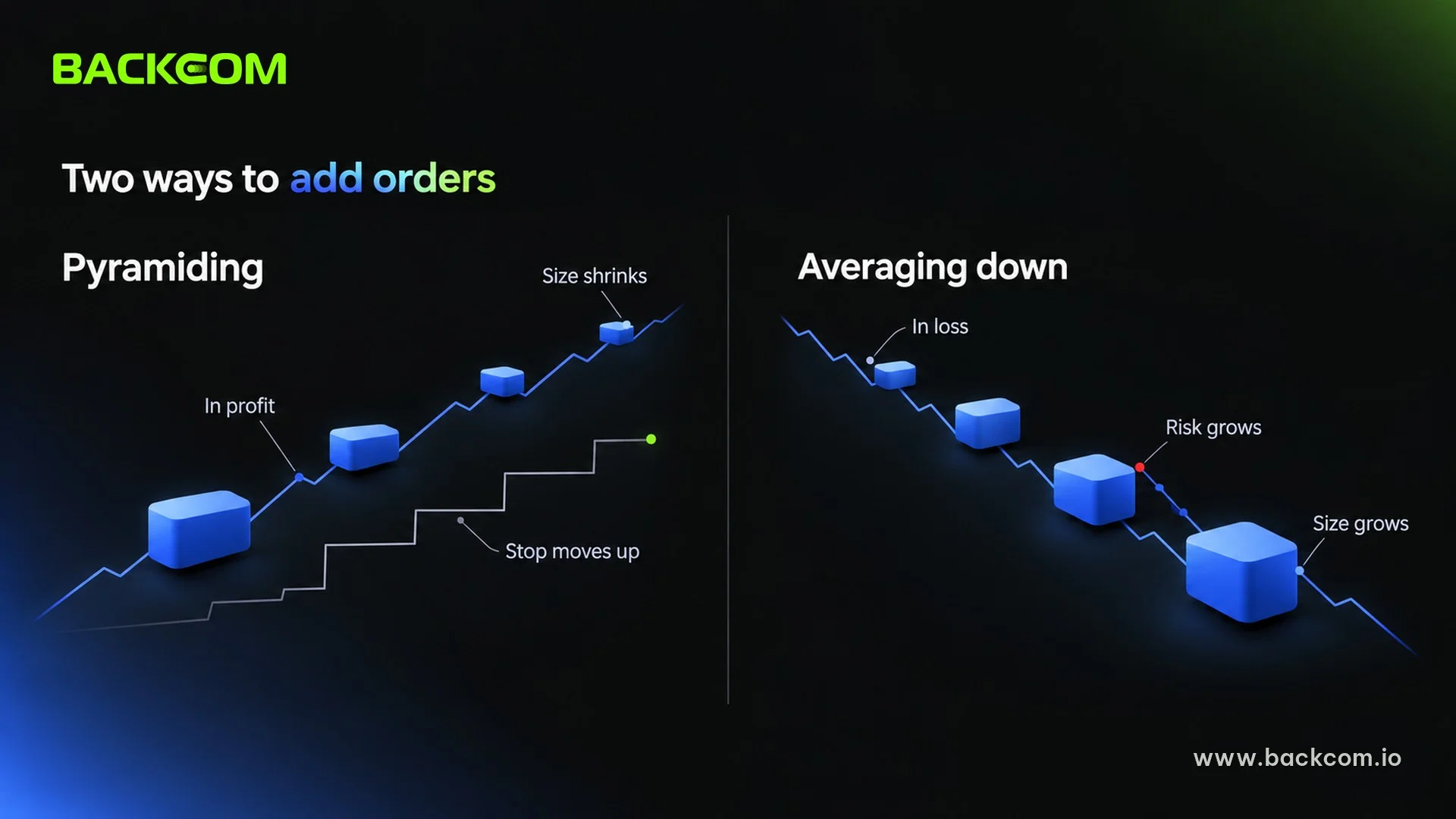
Pyramiding adds an order after the first one is in profit and price keeps moving as expected. The market has confirmed the idea first, so each new order is usually the same size or smaller, and the shared stop loss moves up to protect profit.
Adding to a losing position, also called averaging down, adds an order while the first one is at a loss, hoping price will return and pull the break-even price lower. Nothing has been confirmed, yet risk has increased, which makes it the more dangerous form.
The two differ in four ways:
- Timing: pyramiding adds in profit, averaging down adds in loss.
- Size: pyramiding usually shrinks the order size, averaging down keeps or grows it.
- Shared stop: pyramiding moves the stop to lock profit, averaging down often has no clear stop.
- Worst case: pyramiding gives back open profit, averaging down can lose the account.
The Martingale Strategy Is Averaging Down With A Doubling Rule
Martingale is a family of methods that raises the stake after every loss so that one win recovers all earlier losses. According to the Wikipedia article on the martingale betting system, it fails when the player meets a limit on funds or on bet size, because a long enough losing streak exhausts the bankroll before a win arrives.
In forex the martingale strategy is often coded into an expert advisor that doubles the lot after each losing trade. It is still averaging down with a fixed formula, so it inherits every weakness of averaging down. The robot side is covered in the guide to what a forex expert advisor is. This article stays with manual orders.
Average Entry Price, Margin And Maximum Loss: An XAUUSD Example
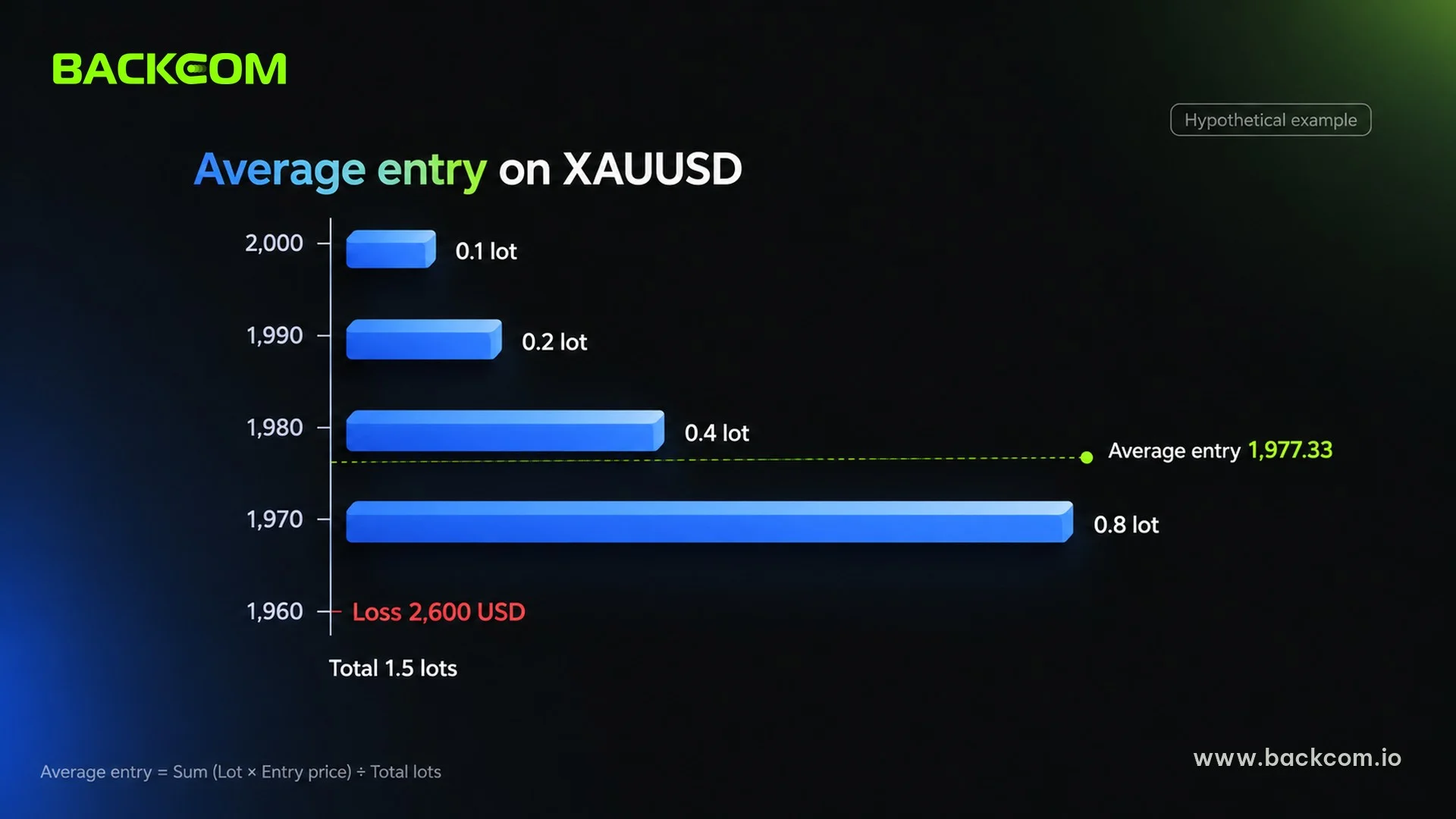
The average entry price is the break-even price of several same-direction orders, calculated as a volume-weighted average. The formula to remember:
Average entry price = Sum (Lot × Entry price) ÷ Total lots
The example below uses hypothetical numbers for illustration, not a gold price forecast. Assume 1 lot of XAUUSD equals 100 ounces (traders should check the contract specification of their own broker), so a 1 USD move is worth 100 USD per lot. The account is 5,000 USD with 1:100 leverage, and the trader buys gold and averages down three times, 10 USD lower each time.
| Order | Entry price | Lots | Floating loss at 1,960 |
|---|---|---|---|
| Order 1 | 2,000 | 0.1 | 400 USD |
| Order 2 | 1,990 | 0.2 | 600 USD |
| Order 3 | 1,980 | 0.4 | 800 USD |
| Order 4 | 1,970 | 0.8 | 800 USD |
| Total | Average 1,977.33 | 1.5 | 2,600 USD |
Illustrative hypothetical figures. Do not use this table to predict prices or as a basis for trading.
Three points stand out from the table:
- Price only needs to recover to 1,977.33 for the group to break even, which means a rebound of about 17.33 USD from the assumed low of 1,960.
- The first order alone would lose 400 USD, but the four-order group loses 2,600 USD, 6.5 times as much, over the same price move.
- Doubling the size at each step makes the last order more than half of all lots, so another 10 USD against the trader costs 800 USD on that order and 1,500 USD on the whole group.
Margin Grows With Total Lots
Margin is calculated on the whole open position. In the assumed case the contract value is about 296,600 USD, based on each order's opening price, and at 1:100 leverage the required margin is about 2,966 USD. When price reaches 1,960, equity is roughly 5,000 − 2,600 = 2,400 USD, which is below the margin being held.
When equity falls below the required margin, a broker may issue a margin call. It may also close positions, as described in the Wikipedia article on margin. The margin level at which warnings and stop-outs happen differs by broker and account type, so traders should read the exact terms before adding. The calculation is explained in the guide to how to calculate margin for forex and XAUUSD, and the effect of leverage in forex has its own article.
Pyramiding Has Limits Too
Suppose a trader buys 0.1 lot at 2,000, adds 0.1 lot at 2,010 and another 0.1 lot at 2,020. At 2,020 the open profit is 200 + 100 + 0 = 300 USD. If price falls back to 2,000, the first order is flat, the second loses 100 USD and the third loses 200 USD, a total loss of 300 USD. Open profit of 300 USD has turned into a loss of 300 USD.
Pyramiding therefore only makes sense when the shared stop loss moves above the average entry of the group. Otherwise the order added near the top is where the largest loss sits. The basics of stop placement are in the article on forex money management and the 1% rule.
The Real Cost Of Adding Orders: Spread, Commission And Swap By Total Lots
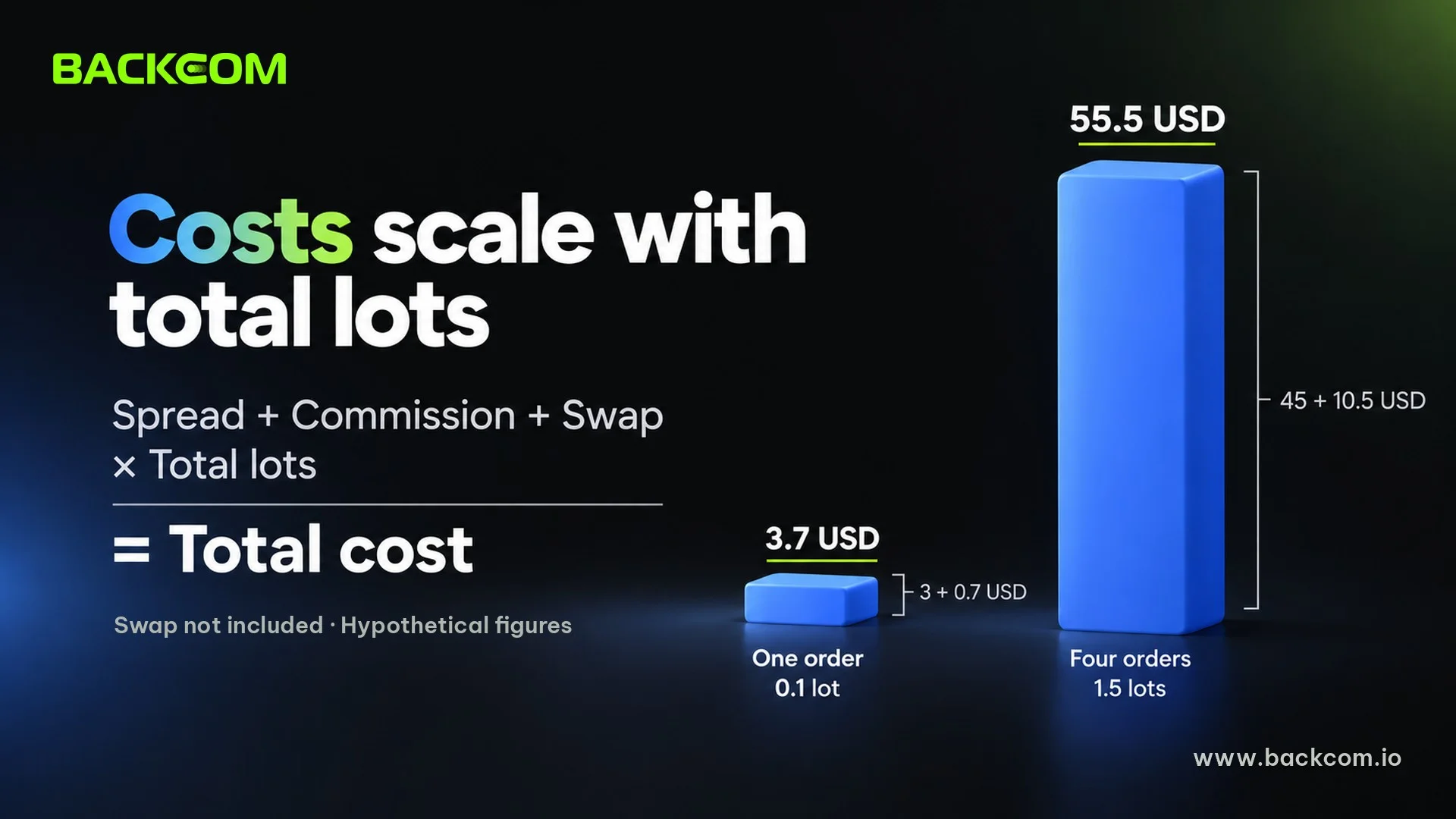
Every trading fee is charged per lot, so adding orders raises costs in proportion to total lots. Three items need to be added up: spread, commission and swap for positions held overnight.
With an assumed gold spread of 0.30 USD per ounce (30 USD per lot) and a round-turn commission of 7 USD per lot, the two plans cost:
| Plan | Total lots | Spread | Commission | Total cost |
|---|---|---|---|---|
| One order | 0.1 | 3 USD | 0.7 USD | 3.7 USD |
| Four orders | 1.5 | 45 USD | 10.5 USD | 55.5 USD |
Illustrative hypothetical figures. Real spread, commission and swap vary by broker, account type and time, and should be measured again before trading.
Swap also scales with lots for every night a position is held, and averaging down tends to extend the holding time because the trader is waiting for a rebound. The components of spread are explained in the article on what a forex spread is.
Rebates Per Lot Cannot Offset A Losing Add-On
A rebate is calculated on executed lots, so larger total lots do produce a larger rebate. Compare two numbers, though: at an assumed rebate of 3 USD per lot, 1.5 lots return 4.5 USD, while the floating loss in the example above is 2,600 USD. A rebate lowers the real cost of each trade, but it is not a reason to add size, and traders should not open extra orders just to collect more rebate.
The formula is in the guide to what forex rebates are and how to calculate cashback per lot.
Do Prop Firms Allow Martingale And Adding To Positions?
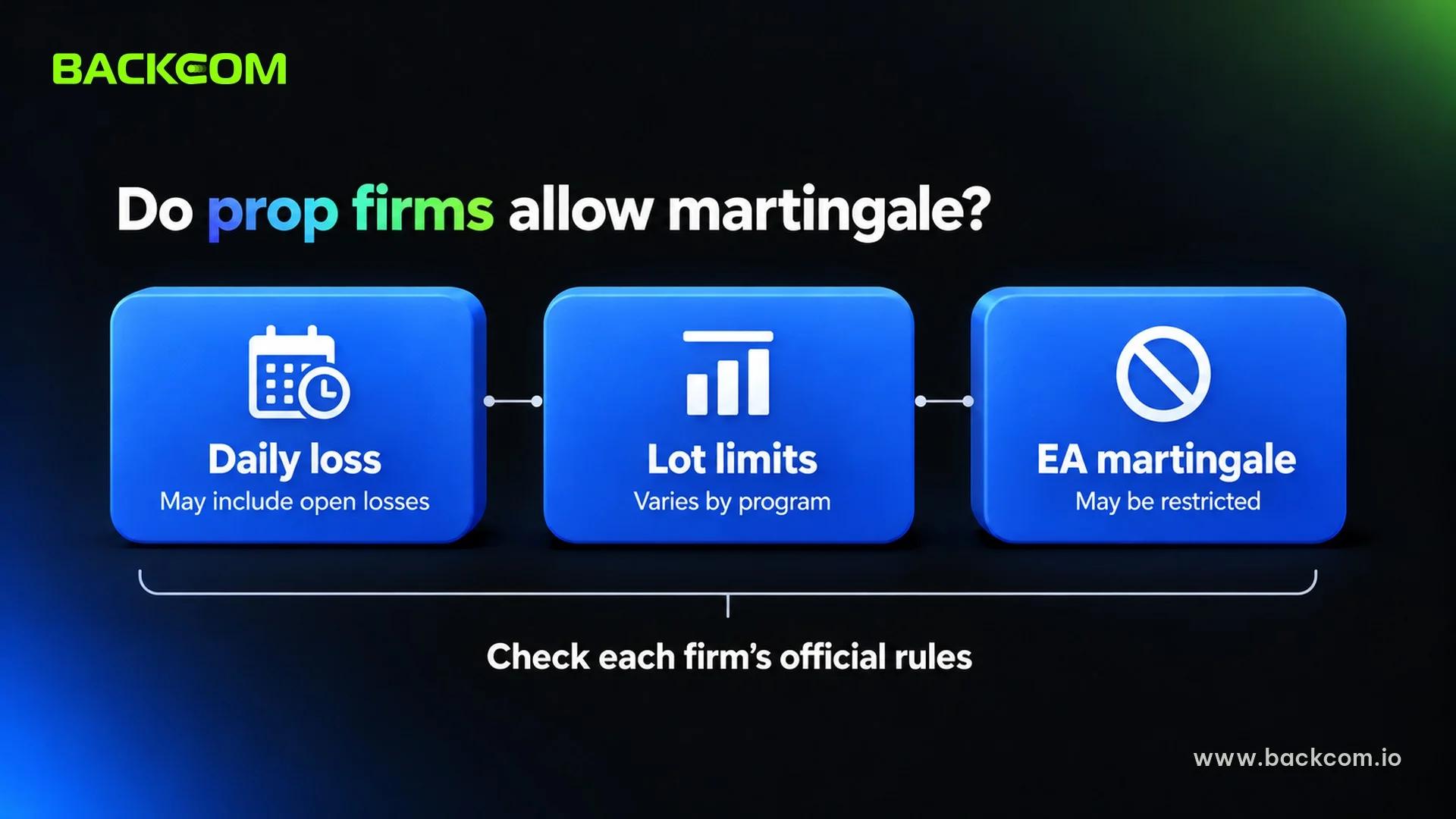
Whether a prop firm allows martingale or added orders depends on the rules of each firm and each program, so there is no single answer. Many firms do not ban opening several same-direction orders, yet they apply limits that make averaging down hard to survive.
Traders should check these terms in the firm's official documents before adding:
- Daily loss: the maximum loss in one day. According to FTMO's article on open losses, open trades can count toward this limit, so traders need to read how their chosen firm calculates it.
- Maximum drawdown: the largest fall allowed from the starting balance or equity.
- Lot or order limits: some programs cap volume open at one time.
- EA and martingale rules: some firms may restrict lot-multiplying, grid or no-stop-loss strategies.
- Consistency rule: a rule that asks for evenly spread profits and rarely suits piling volume into a few large trades.
If a firm counts floating losses toward the daily limit, a run of averaging down can hit the limit before price has time to recover. EA rules at several firms are summarised in the guide to prop firm EA trading rules, and there is a separate guide to the consistency rule in prop trading.
Prop firm rules can change, so check the official FAQ of the firm before buying a challenge.
Safety Rules If You Still Want To Add To A Position
Traders can still use added orders as long as the risk of the whole group is calculated before the first order is opened. Four rules help:
- Size the risk for the group: the total loss at the shared stop should not exceed the planned risk for one trade, commonly 1% of the account.
- Reduce size step by step: each added order is smaller than the last, never doubled.
- Add only in profit: prefer pyramiding after the stop has moved above the average entry.
- Cap orders and total lots: decide both limits in advance, not during the trade.
Traders should avoid averaging down with no shared stop, with margin level already low, or just before major news. In those moments price can run a long way in one direction, and each extra order only makes the position heavier.
Frequently Asked Questions (FAQ) About Adding To Positions
What Is Pyramiding In Forex?
Pyramiding in forex is adding orders in the same direction while an earlier position is already in profit. The wider habit of adding to a position also includes averaging down, which adds in loss. Either way, total lots rise and the average entry changes, so traders should calculate the risk of the whole group before adding, not just the latest order.
What Is The Difference Between Pyramiding And Averaging Down?
They differ in timing and in the direction of risk. Pyramiding adds after price confirms the idea and lets the trader move the stop to lock profit. Averaging down adds while price is moving against the trade, so the position grows exactly when the view may be wrong. It therefore needs far tighter limits.
Is The Martingale Strategy A Form Of Adding Orders?
Yes, martingale is averaging down with a rule that doubles the lot after each loss. The martingale strategy only works if capital and broker limits allow a losing streak to continue indefinitely, which does not happen in practice. Some prop firms also restrict it, so read their rules first.
Do Prop Firms Allow Adding To Positions?
It depends on the firm and the program. Many allow several same-direction orders but limit daily loss and drawdown, and some restrict martingale or grid methods. Traders should read the official FAQ at the time of purchase because rules can change. At firms that count floating loss toward the daily limit, such as FTMO, averaging down can break the rules before price recovers.
Conclusion: Adding Orders Multiplies Risk At The Same Time As Volume
Pyramiding in forex and averaging down share one effect: extra same-direction orders raise total lots, which raises profit, loss, margin and cost together. Traders need to look at three things at once: the average entry price, the margin left and the shared stop of the whole group.
Pyramiding can be a reasonable tool when the stop moves up with it. Averaging down and martingale belong in a plan only when maximum risk has already been calculated in numbers. A per-lot rebate does not cover a losing add-on, so it should not be a reason to increase size.
To build the foundation first, start with the guide to forex money management and lot size, then compare broker conditions on the rebate comparison page. Backcom.io is an independent introducing broker (IB/affiliate) of the brokers it lists; rebates are paid from the commission the broker pays Backcom.io, as explained in the risk disclaimer.
Disclaimer: This content is compiled by Backcom.io for information only and is not investment advice, a trading recommendation or legal advice. Trading leveraged CFDs carries a high risk of losing all of your capital. The numerical examples are hypothetical illustrations, and traders must assess their own risk tolerance.
Was this article helpful?
Join The Backcom.io Community
Get the latest on trading rebates, trading tips, and broker deals — and connect with thousands of traders worldwide.

Backcom App
Track Your Rebates Every Day
Every rebate is visible by broker and by day. Manage your wallet and withdrawals in one place.
Open Backcom App