Forex Trading For Beginners: What Is Forex, Currency Pairs, Lots And Risks


Many people hear about forex through ads promising big profits before they understand how the market works, which is why many new traders make avoidable mistakes on their very first trade. This guide to forex trading for beginners starts from the basics: forex is the market where one currency is bought or sold against another, with no central exchange and nobody guaranteeing a profit.
In this article, Backcom.io walks through what a new trader needs to understand, in order:
- What is forex, and what forex trading means when you look at a single trade.
- How forex trading works: who takes part, how big the market is and when it is open.
- How to read forex currency pairs, and how to calculate pips, lots, margin and profit or loss with real numbers.
- The costs, the risks and the steps to take before you deposit your first dollar.
What Is Forex? A Plain Definition Of The Foreign Exchange Market
What is forex? Forex, short for foreign exchange, is the market where currencies are traded in pairs, for example euros against US dollars. A trader does not hold physical cash. Instead, the trader opens a position based on whether the price of a pair will rise or fall.
One point matters from the start: forex is not a listed exchange like a stock market. It is a decentralised over-the-counter (OTC) market, where prices come from a network of banks, market makers and brokers. At any moment, the quote at two brokers can differ slightly.
For retail traders, forex is usually traded as a CFD, a contract for difference. You do not receive or deliver the actual currencies. You earn or lose the difference between the opening price and the closing price.
A few basic terms to know before going further:
- Broker: the company that provides the platform and price feed, usually MetaTrader 4 or MetaTrader 5.
- Currency pair: two currencies quoted against each other, such as EUR/USD or USD/JPY.
- Buy and Sell orders: a bet that the pair will go up or down.
- Leverage: a tool that lets you open a position larger than your deposit, explained in what is leverage in forex.
Because of this, forex should be seen as a high-risk trading instrument, not a savings product or a passive investment.
How Does Forex Trading Work? Who Takes Part And When The Market Is Open

How does forex trading work? The market runs almost 24 hours a day, five days a week, in overlapping sessions from Asia to Europe to the Americas. Prices move constantly with economic news, interest rate decisions and large flows from institutions.
The market is enormous. According to the Bank for International Settlements triennial survey, average daily foreign exchange turnover reached USD 9.6 trillion in April 2025, up 28% from USD 7.5 trillion in 2022. Spot trading made up about 31% of that. For the original data, see the BIS report on FX turnover in April 2025.
This shows how small an individual trader is. The main players moving money are:
- Commercial and investment banks, which act as market makers.
- Central banks, which influence exchange rates through interest rates and intervention.
- Investment funds, hedge funds and corporations that exchange currency for trade.
- Retail traders who trade through brokers, usually with small accounts and high leverage.
In the same survey, the US dollar was on one side of about 89.2% of trades, the euro 28.9%, the Japanese yen 16.8% and the pound sterling 10.2%. These shares overlap because every trade involves two currencies. As a result, pairs with the dollar usually have the deepest liquidity and the tightest spreads.
BIS figures referenced as at 1 November 2026. Survey data may be revised by the BIS, so check the source again before quoting it.
On trading hours, most traders pay attention to the London and New York sessions because volatility is higher. The forex market hours tool and the guide to forex trading hours in UTC help you convert sessions to your own time zone, including daylight saving changes.
Forex Currency Pairs: How To Read Prices, Pips And Lots
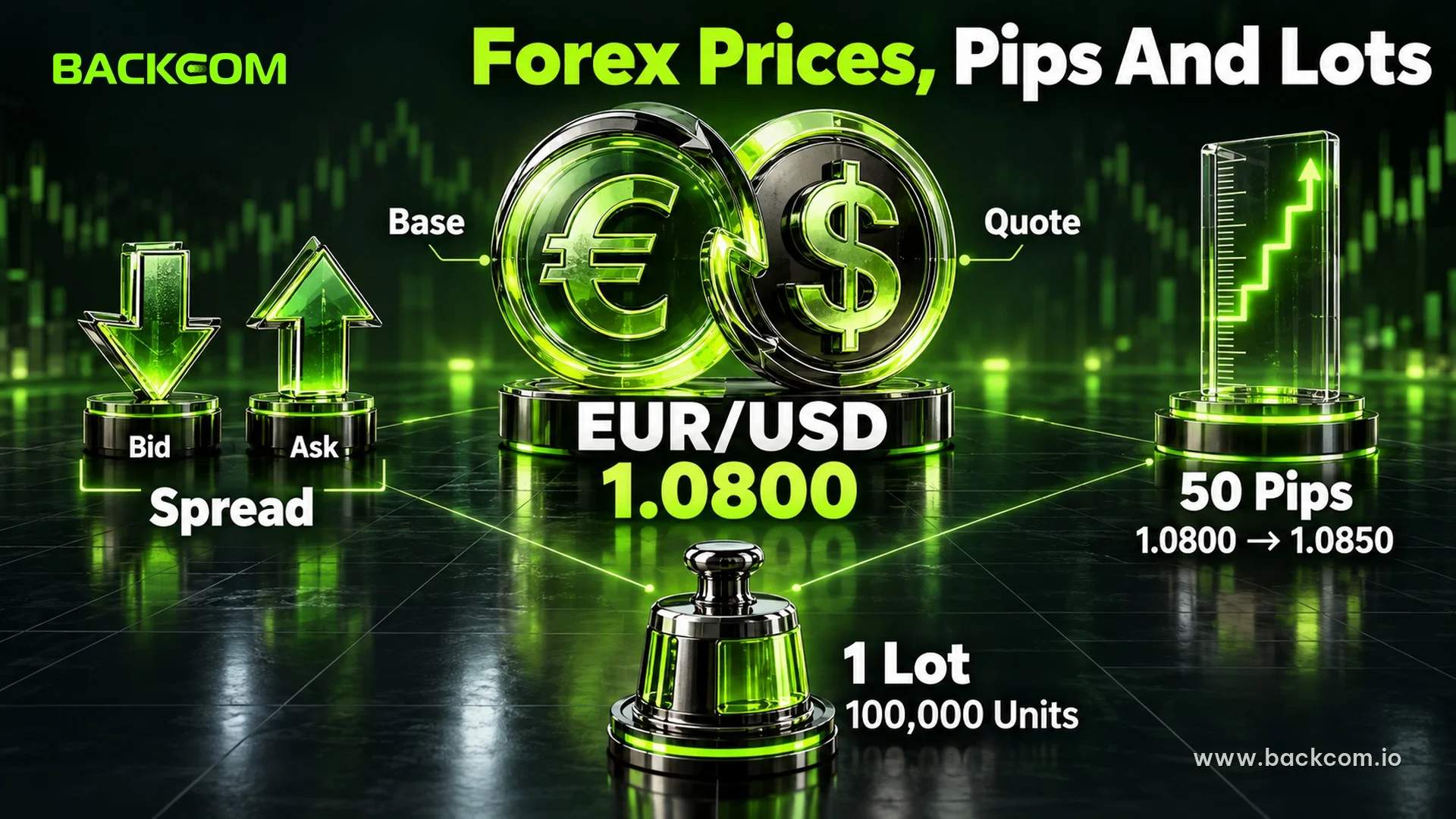
Forex currency pairs have a base currency first and a quote currency second. If EUR/USD is at 1.0800, one euro buys 1.08 US dollars. Buying the pair means you expect the euro to strengthen against the dollar.
Pairs fall into three main groups:
- Majors: pairs that include the US dollar, such as EUR/USD, GBP/USD, USD/JPY and USD/CHF. They have low spreads and high liquidity.
- Minors (crosses): pairs without the dollar, such as EUR/GBP or EUR/JPY.
- Exotics: a major currency paired with an emerging-market currency, with wide spreads and erratic moves.
Every quote has two prices. The Bid is the price at which you sell, the Ask is the price at which you buy, and the difference is the spread. The article what is forex spread shows how to calculate it.
Pips And Lots: The Two Units That Decide Your Profit And Loss
A pip is the smallest price step commonly used to measure movement. For most pairs it is the fourth decimal place, so EUR/USD moving from 1.0800 to 1.0850 is a rise of 50 pips. For pairs that include the Japanese yen, one pip is 0.01.
A lot is the size of the trade. One standard lot is 100,000 units of the base currency, a mini lot is 0.1 lot and a micro lot is 0.01 lot. According to the BabyPips definition of a lot, on a pair quoted in US dollars one standard lot is worth about USD 10 per pip.
Profit or loss = Number of pips × Value per pip × Number of lots
Here is an illustrative example. A trader buys 0.1 lot of EUR/USD at 1.0800 and the price rises to 1.0850. The value per pip for 0.1 lot is USD 1, so the profit is 50 × 1 = USD 50. If the price instead falls to 1.0770, the loss is 30 pips, or USD 30. These are hypothetical numbers, not real prices or results.
Each instrument has a different pip value, so always check the contract specification on MetaTrader before placing an order.
What Is Forex Trading? One Trade From Open To Close
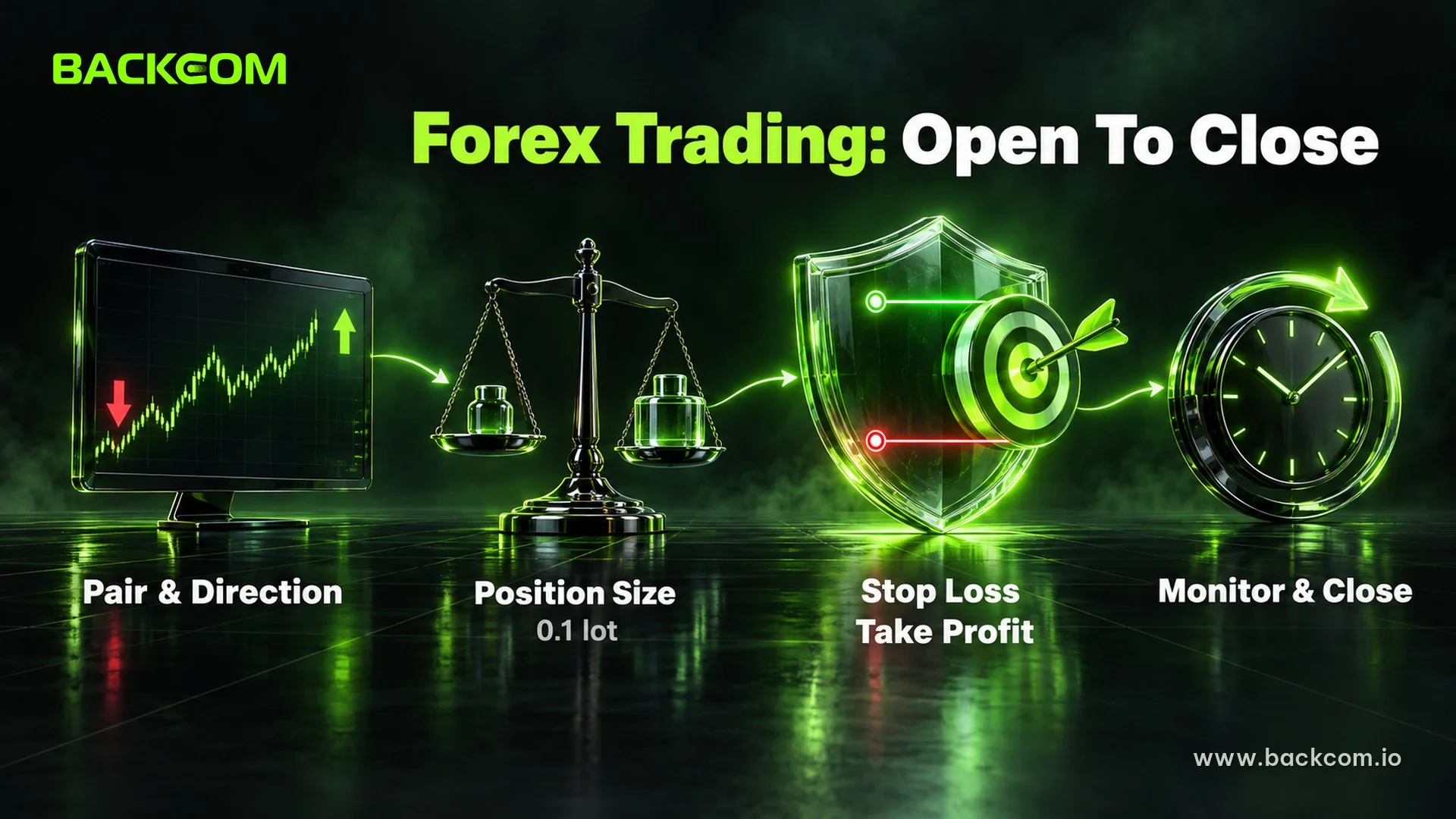
What is forex trading? It is the process of opening a buy or sell position on a currency pair, holding it for some time, then closing it to lock in the price difference. Every trade has an entry, a stop loss and usually a take profit.
The basic workflow of one trade looks like this:
- Choose the pair and direction: Buy if you expect the price to rise, Sell if you expect it to fall.
- Choose the size: calculate lots from the amount you accept to risk, not from a feeling.
- Set Stop Loss and Take Profit: decide the maximum loss and the profit target in advance.
- Monitor and close: the trade closes at Stop Loss, at Take Profit, or when you close it yourself.
Margin And Leverage In A Single Trade
When you open a trade, the broker holds part of your balance as margin. The amount depends on the leverage you choose.
Margin = (Lots × 100,000 × Price) ÷ Leverage
In the example above, 0.1 lot of EUR/USD at 1.0800 with 1:100 leverage needs about 0.1 × 100,000 × 1.08 ÷ 100 = USD 108 of margin. Leverage lets you open a large trade with a small deposit, but it magnifies losses in the same proportion. The guide to what is margin and how to calculate it goes into detail.
One point is critical: the loss is calculated on the full trade size, not only on the margin. If your account cannot absorb the price movement, the broker will close your trades automatically when margin falls to the stop-out level.
Forex Trading Costs: Spread, Commission And Swap
You pay costs on every trade, whether it wins or loses. The three most common are:
- Spread: the gap between the buy and sell price, paid when the trade opens.
- Commission: a fixed fee per lot, usually seen on Raw or ECN accounts.
- Swap: a fee or credit for holding a trade overnight, based on the interest rate gap between the two currencies.
Here is an illustrative example. A spread of 1.2 pips on 0.1 lot costs about USD 1.20 per trade. The figure is small, but it adds up with the number of trades and lots, so active traders should count total cost rather than a single trade.
Part of this cost can be offset by forex rebates, a payment per lot closed. Backcom.io is an independent introducing broker (IB/affiliate) of its partner brokers, and rebates are paid from the commission the broker pays Backcom.io — see the risk disclaimer. A rebate only offsets cost. It cannot make up for a losing trade.
Forex Risks And Rules Every New Trader Should Check First
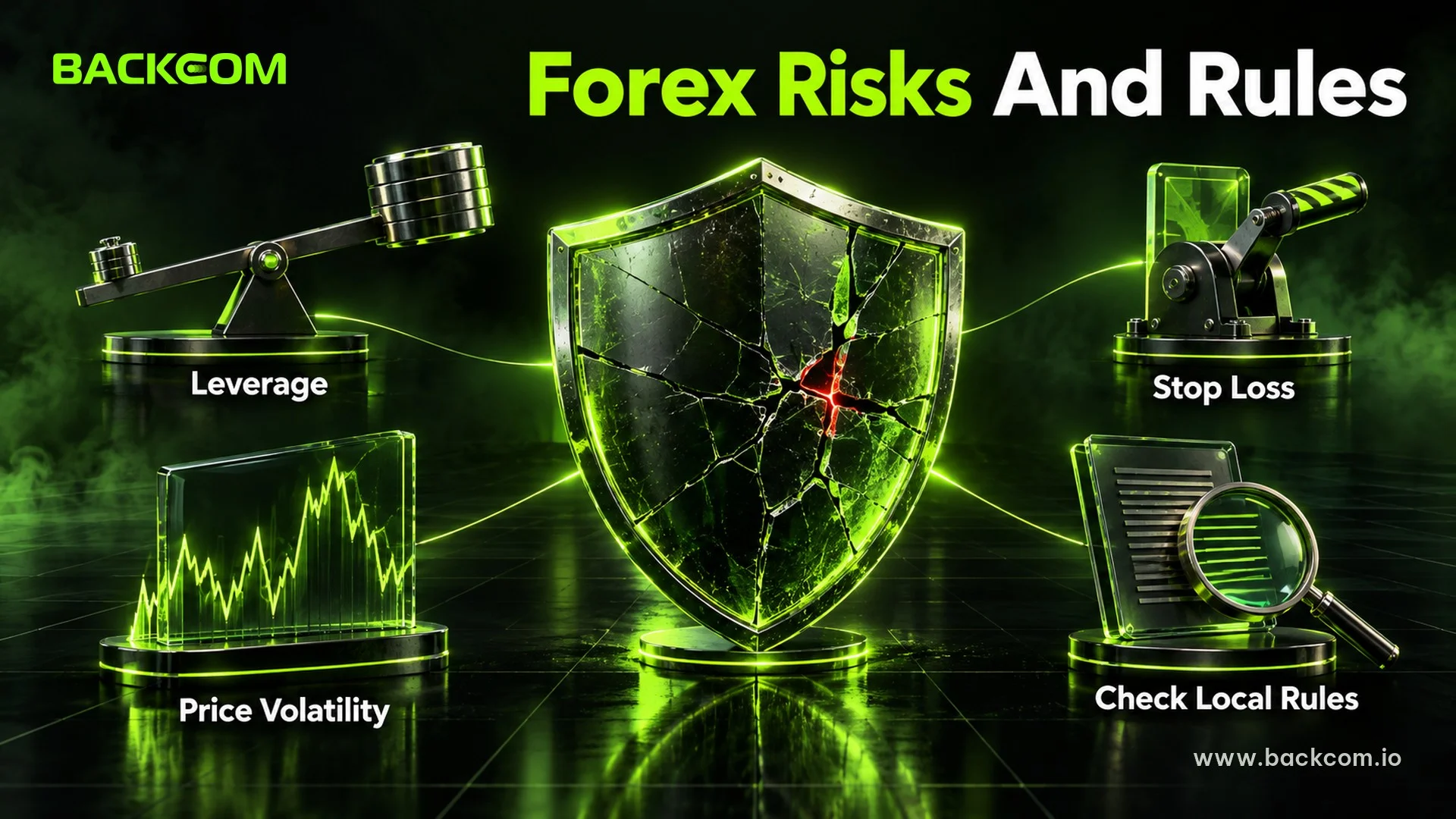
Forex risk comes from three main sources: leverage, price volatility and the trader's own behaviour. Many blown accounts are not caused by bad analysis so much as by trades that are too large for the account and have no stop loss.
The risks new traders meet most often:
- Using maximum leverage and opening trades beyond what the account can absorb.
- Averaging down or chasing losses right after a loss.
- Trading around major news, when spreads widen and prices slip.
- Choosing an opaque broker or following promises of fixed returns.
- Trusting "signals" or private groups that ask for money first.
Rules for retail forex differ by country of residence, as do licensing, tax and leverage limits. A broker licence from one regulator does not mean the service is legal or suitable where you live. Check the rules that apply to you and ask a qualified adviser before sending money.
To avoid scams, read signs of a forex broker scam and the 7 criteria for choosing a reputable forex broker.
Forex Trading For Beginners: What To Do Before Your First Live Trade
A beginner should treat the first two to three months as a learning period, not an earning period. The goal is to understand the mechanics, control risk and avoid losing capital.
A practical path looks like this:
- Learn the core terms: pip, lot, spread, margin, swap, Stop Loss.
- Open a demo account: practise on MetaTrader 4 or 5. The guide to MT4 vs MT5 helps you choose a platform.
- Calculate risk before each trade: risk only a small share of the account per trade.
- Keep a trading journal: record the reason for entry, the result and your emotions.
- Move to a live account with a small deposit: only once you have a clear process.
On money management, the 1% rule is a common starting point. Here is an illustrative example. With a USD 1,000 account, risking 1% is USD 10. With a 20-pip stop loss, a suitable size is 10 ÷ (20 × 10) = 0.05 lot. The position size calculator and the guide to forex money management and lot size cover this in more depth.
In addition, new traders should not rush into robots before they understand the underlying strategy. The article what is a forex expert advisor is better read after the basics in this guide.
Frequently Asked Questions (FAQ) About Forex Trading For Beginners
What Is Forex And Is It A Scam?
No. Forex itself is a real market with trillions of dollars traded every day, according to BIS data. However, many fake brokers and "signal" groups borrow the name to take money. You should check the broker's legal entity, licence and withdrawal process, and avoid any promise of fixed returns.
How Much Money Do I Need To Start Forex Trading?
There is no universal minimum, because each broker sets its own minimum deposit. What matters more is the amount you can afford to lose without affecting daily life. Start with a demo account, then use a small deposit and small trade sizes to control risk.
Is Forex Trading Guaranteed To Make Money?
No. Forex has no guaranteed profit, and leverage makes losses grow as fast as gains. Results depend on strategy, discipline and money management. Any ad promising a fixed return is a warning sign.
How Much Is One Forex Lot Worth?
One standard lot is 100,000 units of the base currency. On a pair quoted in US dollars, such as EUR/USD, each pip of a standard lot is about USD 10. A 0.1 lot is about USD 1 per pip. Check the contract specification on your platform before placing a trade.
Conclusion: Understand What Forex Is Before Your First Order
Understanding what forex is means seeing the market clearly: huge in size, decentralised in pricing, real in cost and high in risk. As a trader, you need to look at three things together: how the market works, how you manage capital and whether your broker is legitimate where you live.
The next steps are to learn the core terms, practise on a demo account, size each trade by risk and check the broker carefully before depositing. When you are ready to choose where to trade, see the list of partner brokers and read each broker's conditions closely.
Disclaimer: This content is compiled by Backcom.io for information only and is not investment advice, a trading recommendation or legal advice. Forex and CFD trading uses leverage, carries a high level of risk and can result in the loss of all your capital. The numerical examples in this article are hypothetical, rules may change, and you should check the rules that apply to you and consult a qualified adviser.
Was this article helpful?
Join The Backcom.io Community
Get the latest on trading rebates, trading tips, and broker deals — and connect with thousands of traders worldwide.

Backcom App
Track Your Rebates Every Day
Every rebate is visible by broker and by day. Manage your wallet and withdrawals in one place.
Open Backcom App