Major Minor Exotic Currency Pairs: What They Mean And Which To Trade First


Open a trading platform for the first time and you meet a list of dozens, sometimes hundreds, of symbols such as EUR/USD, GBP/JPY or USD/TRY, with no clue which ones are meant for you. In practice, forex currency pairs fall into three groups called major, minor and exotic, and the group decides most of the trading cost and difficulty of each pair.
In this article, Backcom.io explains how major minor exotic currency pairs differ, how to compare costs between pairs, how to avoid opening two trades that are really one bet, and which pair a beginner should start with:
- How to read a pair, plus the three groups with market data from the BIS.
- How to compare low spread currency pairs by real cost per lot instead of a raw pip number.
- How to spot correlated currency pairs so you do not double your risk without noticing.
- How to choose one or two pairs to practise on before widening your list.
What Are Forex Currency Pairs? Base Currency, Quote Currency And How To Read A Price
A forex currency pair is two currencies quoted together to show how much of one currency is worth in terms of the other. The first currency is the base currency, the second is the quote currency, and the price is the number of quote units needed to buy one unit of the base.
For example, if EUR/USD trades at 1.1000, one euro costs 1.1000 US dollars. Buying EUR/USD means buying euros and selling dollars. Selling the pair means selling euros and buying dollars. Every forex trade is two transactions in one, which is why one currency weakening always means the other is strengthening.
Two quoting basics matter before the groups:
- Bid and ask: the broker always shows two prices, and the gap between them is the spread. The guide to bid and ask prices covers it in detail.
- Pip size: most pairs measure a pip at the fourth decimal place, while pairs with the Japanese yen use the second. The conversion is explained in what a pip is in forex.
Major Minor Exotic Currency Pairs: Majors Are The 7 Dollar Pairs That Lead Liquidity
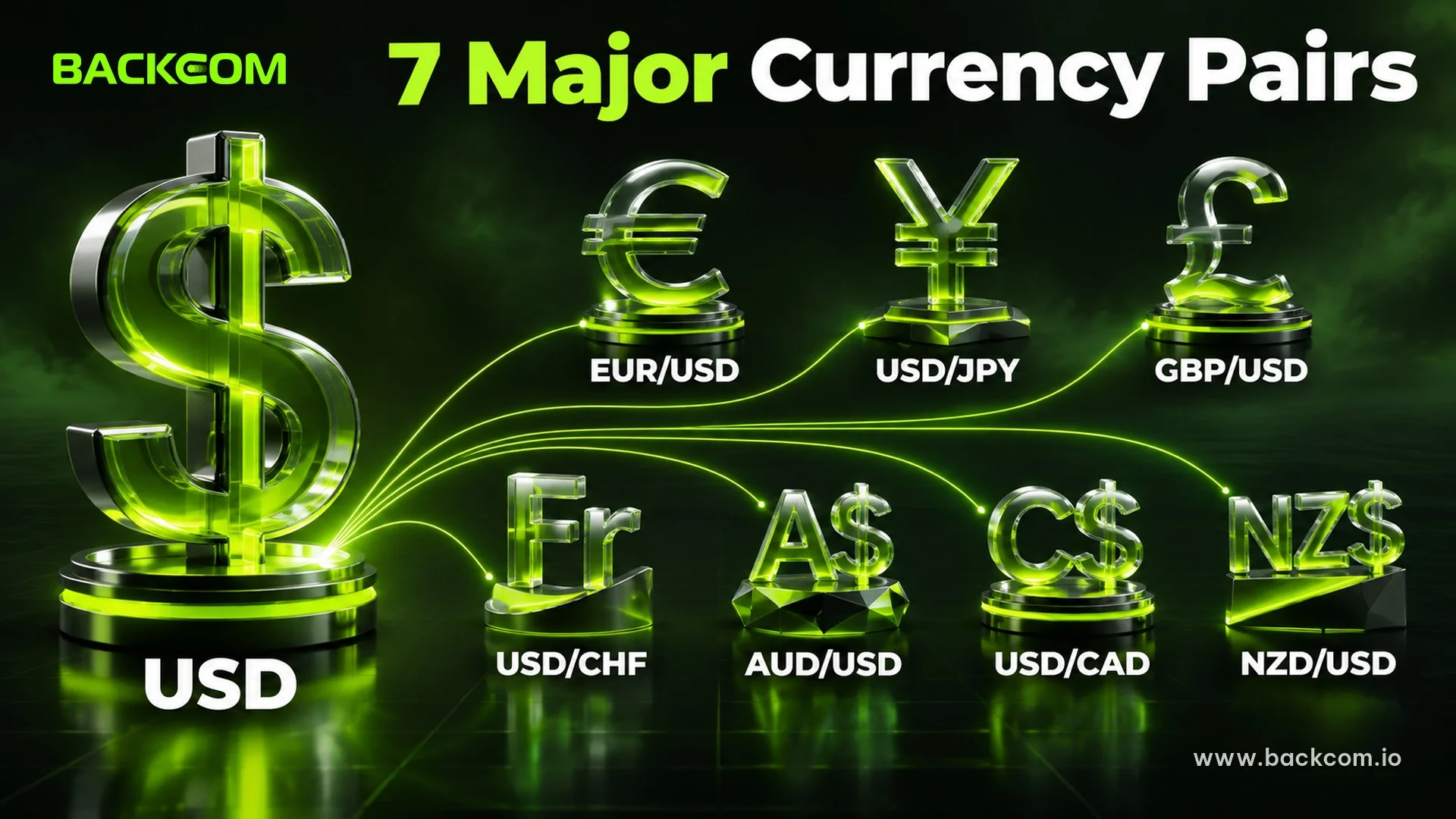
Major pairs combine the US dollar with one of the other large currencies, and the common list has seven pairs. Platforms usually put this group at the top of the symbol list, although the exact grouping can differ slightly between brokers.
| Pair | The two currencies |
|---|---|
| EUR/USD | Euro, US dollar |
| USD/JPY | US dollar, Japanese yen |
| GBP/USD | British pound, US dollar |
| USD/CHF | US dollar, Swiss franc |
| AUD/USD | Australian dollar, US dollar |
| USD/CAD | US dollar, Canadian dollar |
| NZD/USD | New Zealand dollar, US dollar |
Why are these called majors? The answer is liquidity. The Bank for International Settlements (BIS) Triennial Survey puts over-the-counter FX trading at roughly USD 9.5 trillion per day in April 2025 (the first release on 30 September 2025 said 9.6 trillion, later revised by the BIS), and the US dollar appears on one side of 89.2% of trades. The euro appears in 28.9%, the yen in 16.8% and the pound in 10.2%. These shares add up to 200% because every trade has two currencies.
The BIS detail tables show how large the gap between pairs is:
| Pair | Average daily turnover, April 2025 (all contract types) |
|---|---|
| EUR/USD | about USD 1,970 billion |
| USD/JPY | about USD 1,370 billion |
| GBP/USD | about USD 715 billion |
| USD/CAD | about USD 492 billion |
| AUD/USD | about USD 467 billion |
| USD/CHF | about USD 455 billion |
Source: Table 3 of the BIS Triennial Central Bank Survey 2025, published on 30 September 2025 and checked on 14 November 2026, net of inter-dealer double counting and covering spot, forwards, swaps and options. The BIS may revise these numbers, so check the BIS site before relying on them.
Read the source directly: the BIS statistics page on FX turnover in April 2025, the revised figures in the BIS Quarterly Review of December 2025, the BIS release on the April 2025 FX survey and the Bank of England results for the London market.
High liquidity has three practical effects: spreads tend to be tighter, prices slip less on entry, and news on each currency is widely analysed. The flip side is that majors react sharply to macro events such as Fed rate decisions or the US jobs report. The explainer on the Fed and interest rates shows why the dollar is so often the main character in sudden price jumps.
Minor And Cross Pairs: No Dollar, Usually Higher Costs
Minor pairs, also called cross pairs, combine two major currencies without the US dollar. Common examples are EUR/GBP, EUR/JPY, GBP/JPY, EUR/CHF, AUD/JPY, EUR/AUD and GBP/CAD.
They are called crosses because their price can be derived from two major pairs. EUR/JPY, for instance, reflects EUR/USD and USD/JPY together. Three traits are worth remembering:
- Spreads are usually wider: turnover is lower than in majors, although the gap varies by broker and account type.
- Ranges are larger: pairs such as GBP/JPY often move more within a day than EUR/USD, so the same stop distance in pips carries a different risk.
- Pip value shifts with the exchange rate: the quote currency is not the dollar, so one pip has to be converted and the figure changes over time.
Take a hypothetical example. In EUR/GBP the quote currency is the pound, so one pip is worth 10 pounds per standard lot. If GBP/USD stands at 1.3000, that is about 13 US dollars. When GBP/USD moves, the pip value of EUR/GBP moves with it even if the EUR/GBP price does not.
That is why traders should size cross trades with a tool rather than by mental maths. The position size calculator does this, and the guide to lot sizes explains the unit.
Exotic Pairs: Why Spreads And Swaps Run Higher
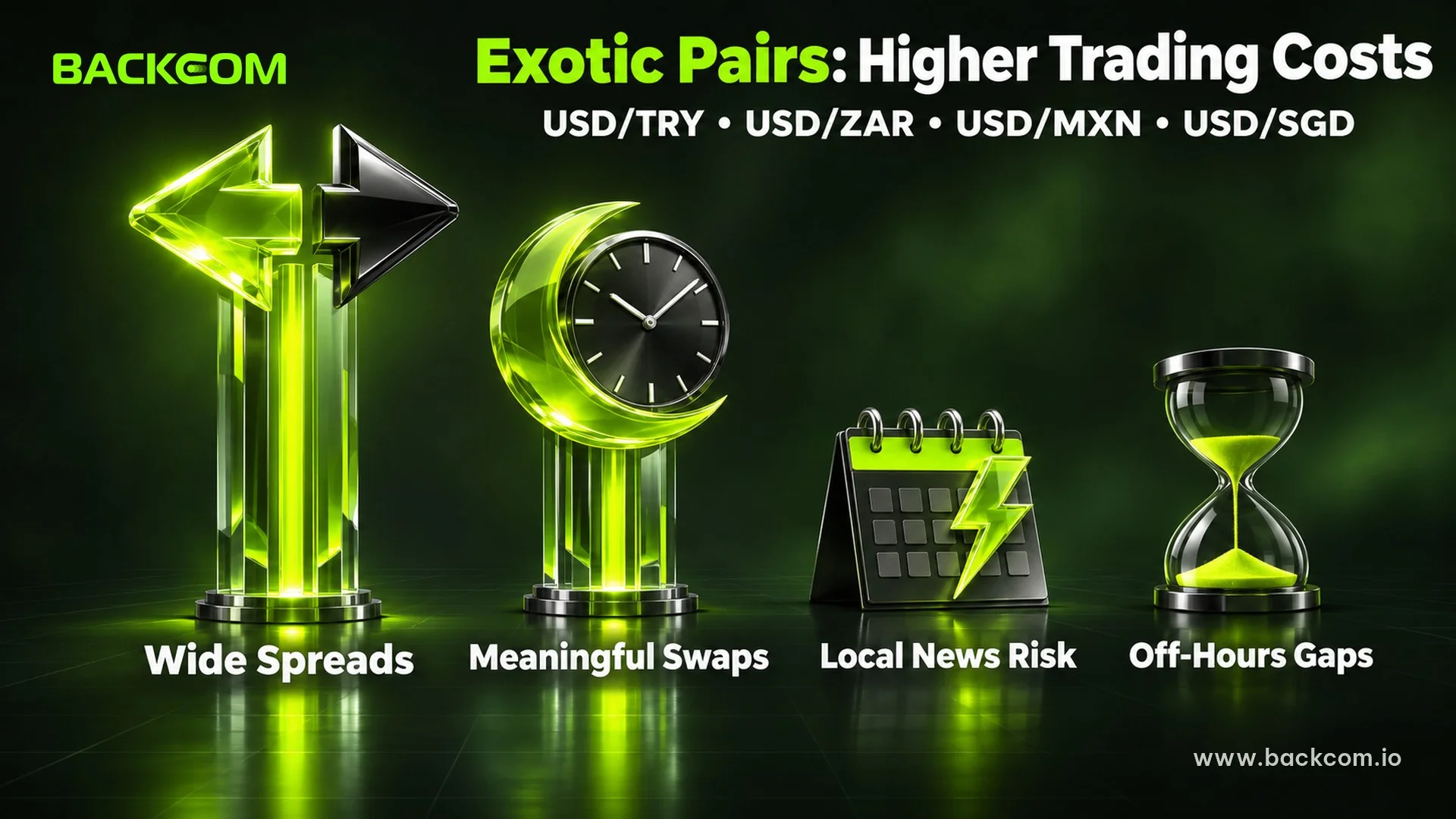
Exotic pairs combine a major currency with the currency of a smaller or emerging economy, for example USD/TRY (Turkish lira), USD/ZAR (South African rand), USD/MXN (Mexican peso) or USD/SGD (Singapore dollar). Some brokers file USD/SGD here even though the Singapore dollar is fairly stable, so check the classification on your own platform.
Exotics bring four things to weigh:
- Wide spreads: low liquidity means the bid and ask gap is often far larger than in majors and can widen further when markets are thin or news hits.
- Meaningful swaps: interest rate gaps between the two currencies are often large, so overnight costs can add up when a trade stays open for days. Trade direction decides whether you pay or receive swap.
- Local news risk: a decision by a smaller central bank or a domestic shock can move the price sharply.
- Off-hours gaps: exotics tend to be most active in the home country's session, and prices get thin and jumpy outside it.
Exotics are not "bad", but their costs and risks have more layers, so beginners can leave them alone for now. The guide to what the spread is in forex is the place to start.
Low Spread Currency Pairs: How To Compare Costs Between Pairs
The most common question is which pair has the lowest spread, but the answer depends on the broker, the account type and the time of day. Among majors, EUR/USD is usually one of the tightest pairs, yet the exact figure differs from broker to broker, so no single number applies to the whole market.
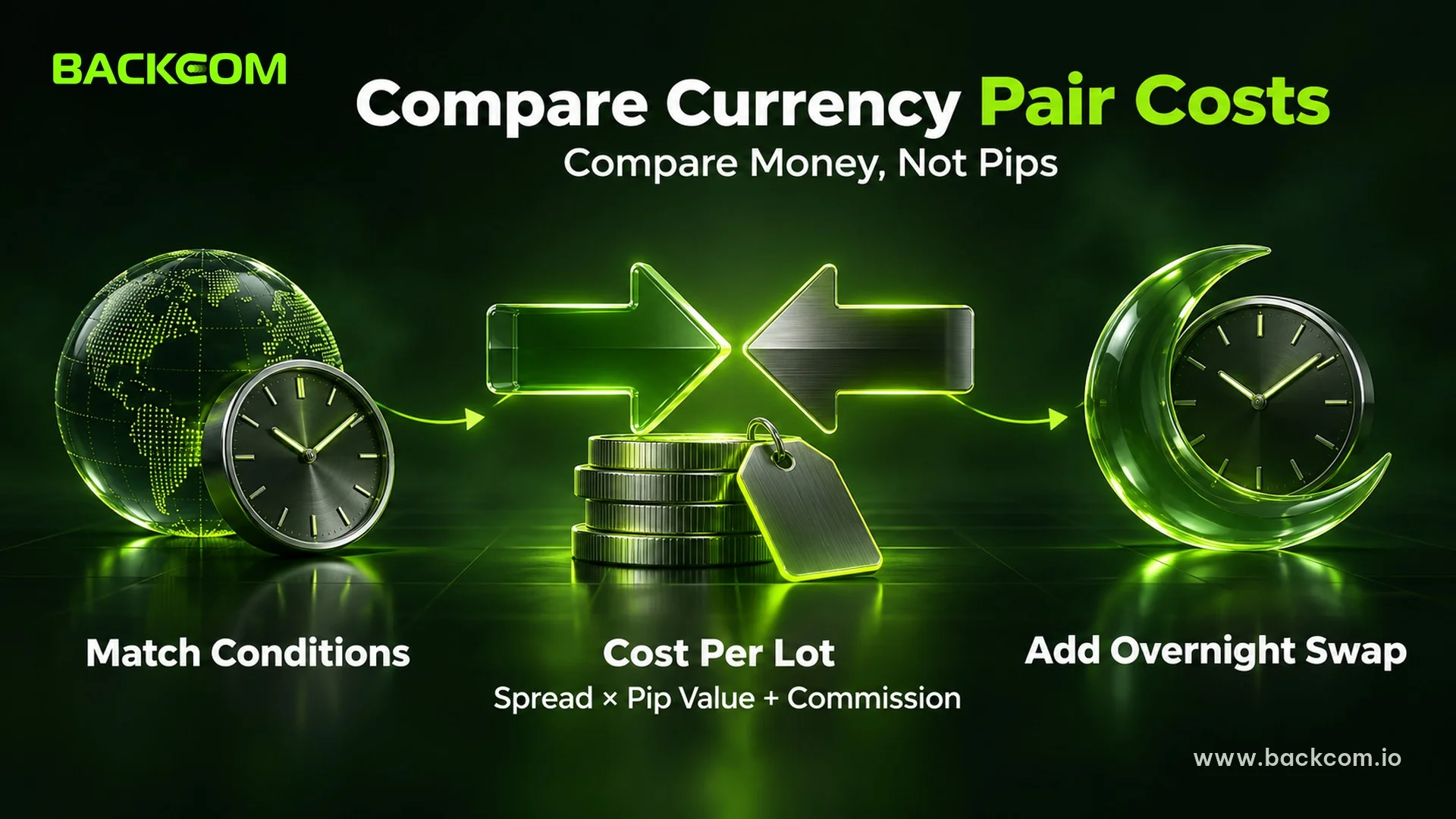
A fair comparison has three steps:
- Match the conditions: same broker, same account type, same time window. A spread at a quiet overnight hour cannot be compared with one at the start of the European session.
- Convert to money per lot: cost = spread in pips × value of one pip, plus commission if the account type charges one.
- Add swap if you hold overnight: it can be ignored for intraday trades, but over several days swap can exceed the spread.
Here is a hypothetical case, not a figure from any broker. Pair A has a 0.8 pip spread and one pip is worth 10 USD, so entry costs about 8 USD per lot. Pair B has a 12 pip spread and one pip is worth 7 USD, so it costs about 84 USD per lot, more than ten times higher. This is why traders should ask "how much does one round trip cost in money" instead of comparing pips alone.
A formula to keep handy:
Spread cost per lot = Spread (pips) × Value of one pip (USD)
Traders who place many lots should total the cost per month. Rebates reduce part of that cost but do not replace choosing pairs with sensible costs. See the broker list to compare rebate levels by broker. Backcom.io is an independent introducing broker (IB/affiliate) of the brokers listed, and rebates are paid from the commission the broker pays Backcom.io, see the risk disclaimer.
Correlated currency pairs are pairs whose prices tend to move in the same direction or in opposite directions in a fairly stable pattern. Correlation is measured by a coefficient from -1 to +1: near +1 means they usually move together, near -1 means they usually move opposite, and near 0 means little relationship.
The most common cause is a shared currency. EUR/USD and GBP/USD both have the dollar as the quote currency, so when the dollar strengthens both often fall. USD/CHF has the dollar first, so it often moves against EUR/USD. AUD/USD and NZD/USD often travel close together because the two economies share many traits.
For risk counting, this means:
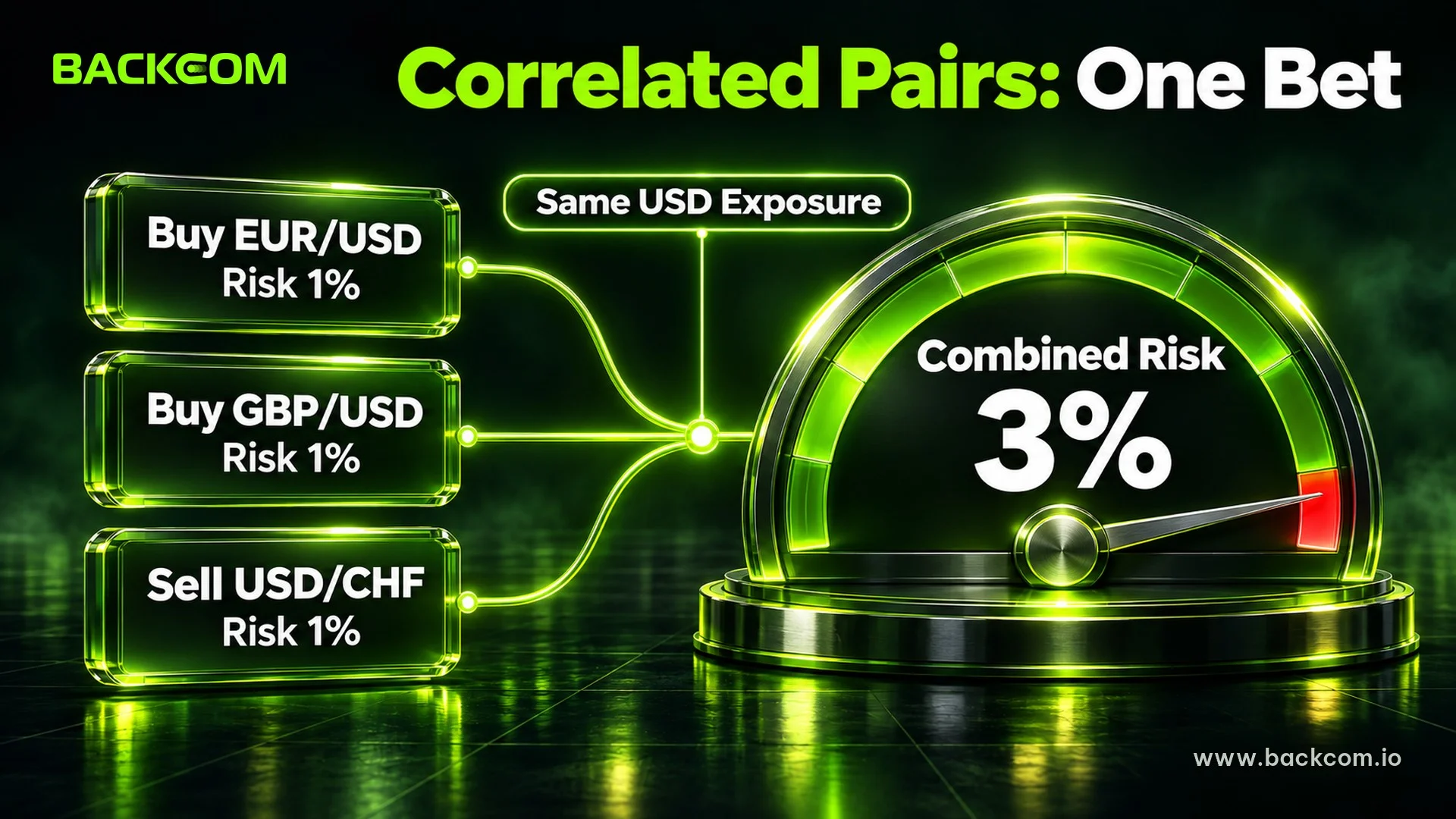
- Buying EUR/USD and buying GBP/USD at the same time is two trades that both sell the dollar.
- Buying EUR/USD and selling USD/CHF also sells the dollar twice, even though the symbols look different.
- If each trade risks 1% of the account and three trades lean the same way on the dollar, real risk can approach 3% when the dollar reverses.
Correlation is not fixed. Two pairs that moved together for months can split when a central bank changes policy. A simple routine is to list every open trade, write down which currency is bought and which is sold, then count which currency repeats.
The guide to forex money management and lot size shows how to size trades so total risk stays within your limit.
Best Currency Pairs For Beginners: How To Choose
A newcomer does not need hundreds of symbols, only a deep understanding of one or two pairs, because each pair has its own rhythm and reaction to news. Four criteria help you narrow down fast:
- Liquidity and spread: prefer majors, because entry cost is low and prices spike less often.
- Your trading hours: pick a pair that is active during the hours you are free. The guide to forex trading hours in UTC and the market hours tool show which session is open when.
- Volatility that suits you: a fast pair pays quickly but also loses quickly, so you need a smaller size.
- Easy to research: EUR/USD and USD/JPY are analysed widely, so calendars and data are easier to find than for thinly traded pairs.
A practical path has three stages:
- Stage 1: follow one major pair on a demo account and note the hours when price moves most and which news causes spikes.
- Stage 2: trade that same pair live with a small size, keeping risk per trade low.
- Stage 3: add a second pair only after checking correlation, and avoid two pairs with the dollar on the same side if you do not want to double risk. Once you can calculate pip value, consider minors, and read about leverage in forex first.
Frequently Asked Questions (FAQ) About Forex Currency Pairs
Which Currency Pair Is Best For Beginners?
No pair is best for everyone, but new traders usually start with a major such as EUR/USD or USD/JPY because of deep liquidity and plenty of learning material. What matters more than the symbol is following one pair for a few weeks on demo, then moving to live trading with a small size.
What Is The Difference Between Major, Minor And Exotic Pairs?
Majors pair the US dollar with another large currency and have the highest liquidity. Minors pair two large currencies without the dollar, such as EUR/GBP. Exotics pair a large currency with that of a smaller or emerging economy, such as USD/TRY. Spreads and risk generally rise from majors to exotics.
Which Pair Has The Lowest Spread?
Spread depends on the broker, the account type and the hour, so there is no single number. EUR/USD is often among the tightest, but compare the same broker, account type and time window, then convert to money per lot.
Only if you deliberately want the same direction and have counted the combined risk. Buying EUR/USD and GBP/USD together is effectively two trades selling the dollar, so total risk is close to double a single trade. For beginners the safe habit is one trade per main currency.
Conclusion: Pick Few Pairs, Know Them Well And Count Combined Risk
Forex currency pairs are manageable once you sort them into major, minor and exotic and judge each by three things: liquidity, cost per lot in money, and correlation with trades you already hold. Traders need to look at all three together instead of picking a pair because it is said to move a lot.
The practical next step is short: choose one major pair, watch it on demo, work out the real cost per lot, write down which currencies you are buying and selling in every trade, and only then think about a second pair. If you are starting from zero, read the beginner's guide to forex first and come back here to choose.
Disclaimer: This content is compiled by Backcom.io for information only and is not investment advice, a trading recommendation or tax or legal advice. Trading forex and CFDs with leverage carries a high risk of losing money. Market data is quoted from the BIS and may be revised, so check the original source before use.
Was this article helpful?
Join The Backcom.io Community
Get the latest on trading rebates, trading tips, and broker deals — and connect with thousands of traders worldwide.

Backcom App
Track Your Rebates Every Day
Every rebate is visible by broker and by day. Manage your wallet and withdrawals in one place.
Open Backcom App