What Is Revenge Trading? 5 Signs You Are Trading To Get Even And How To Stop

After two losing trades in a row, many traders look at the chart with one thought: I have to win it back right now. That is the moment revenge trading begins. The next order no longer comes from the plan. It comes from frustration and the urge to take the money back from the market.
In trading psychology, this is one of the most expensive habits, because it breaks three things at once: position size, entry quality and the stop loss.
In this article, Backcom.io explains what revenge trading is, lists 5 signs of revenge trading, works through a $5,000 account example and gives a set of rules to stop trading after a loss, which a trader can write down before the first order of the day.
1. What Is Revenge Trading And How Is It Different From A Normal Recovery Trade?
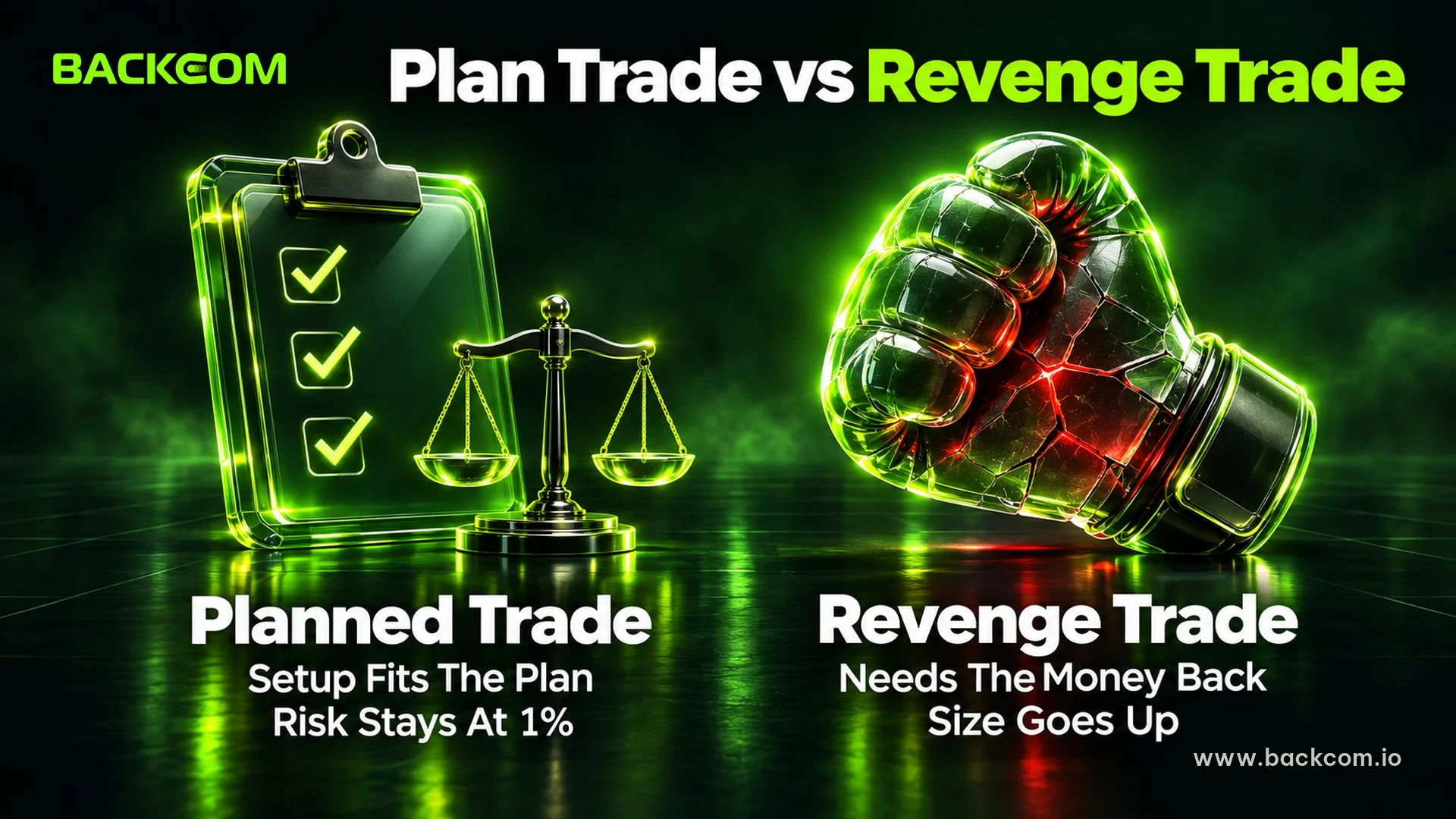
Revenge trading is placing trade after trade, often with a larger size than usual, only to recover a loss that just happened instead of waiting for a signal that fits the plan. An FXStreet analysis (28 December 2025) describes it as an emotional reaction in which the trader places impulsive, higher-risk orders instead of following a set strategy.
The difference lies in the motive for entering, not in the outcome. A trade opened after a loss is still valid if the setup meets the plan's conditions and the risk stays at 1%, like every other trade. It becomes a revenge trade only when the sole reason to enter is "I need that money back".
Some terms that are often confused with it:
- Overtrading: taking too many trades in a day, even before a loss. Revenge trading often causes overtrading, but overtrading is not always revenge.
- Averaging down: adding to a losing position. It is one form of revenge on the same pair, and the guide on pyramiding in forex versus averaging down covers its risks.
- FOMO: fear of missing out. FOMO starts from regret over a missed move, while revenge trading starts from the feeling of losing.
- Planned recovery: the trader keeps risk fixed and waits for the next setup instead of raising size to make up the loss.
2. Why Does Trading Psychology Push Traders To Win It Back?
Trading psychology after a loss is pulled by three forces, and all of them are common to people in general.
The first force is loss aversion. According to an analysis published on FXStreet on 28 December 2025, people feel a loss roughly twice as strongly as the pleasure of an equal gain. A $50 loss therefore weighs much more than a $50 win feels good.
Direct reference: the FXStreet analysis of revenge trading and the brain.
The second force is the urge to hold losers and close the books with a winner. Terrance Odean's classic study, published in the Journal of Finance in October 1998 and based on the records of 10,000 accounts at a large discount brokerage, found that investors tend to sell winners early and hold losers too long. This is the disposition effect, and it shows that avoiding a realised loss is real behaviour, not a personal feeling.
Direct reference: Terrance Odean's paper "Are Investors Reluctant to Realize Their Losses?".
The third force is the illusion of control. After a losing streak, traders believe that more focus, a bigger size or a closer read of the market will fix it quickly. The market does not know how deep the account is in the red.
These forces are strongest in the following conditions:
- The losing trade that just closed was larger than usual.
- The losing streak came at the start of the session, before any winner.
- A news release made price jump both ways, so it feels like "the market is cheating me".
- The account is close to a personal loss limit or a funded-account limit.
3. 5 Signs Of Revenge Trading You Can Spot During The Session
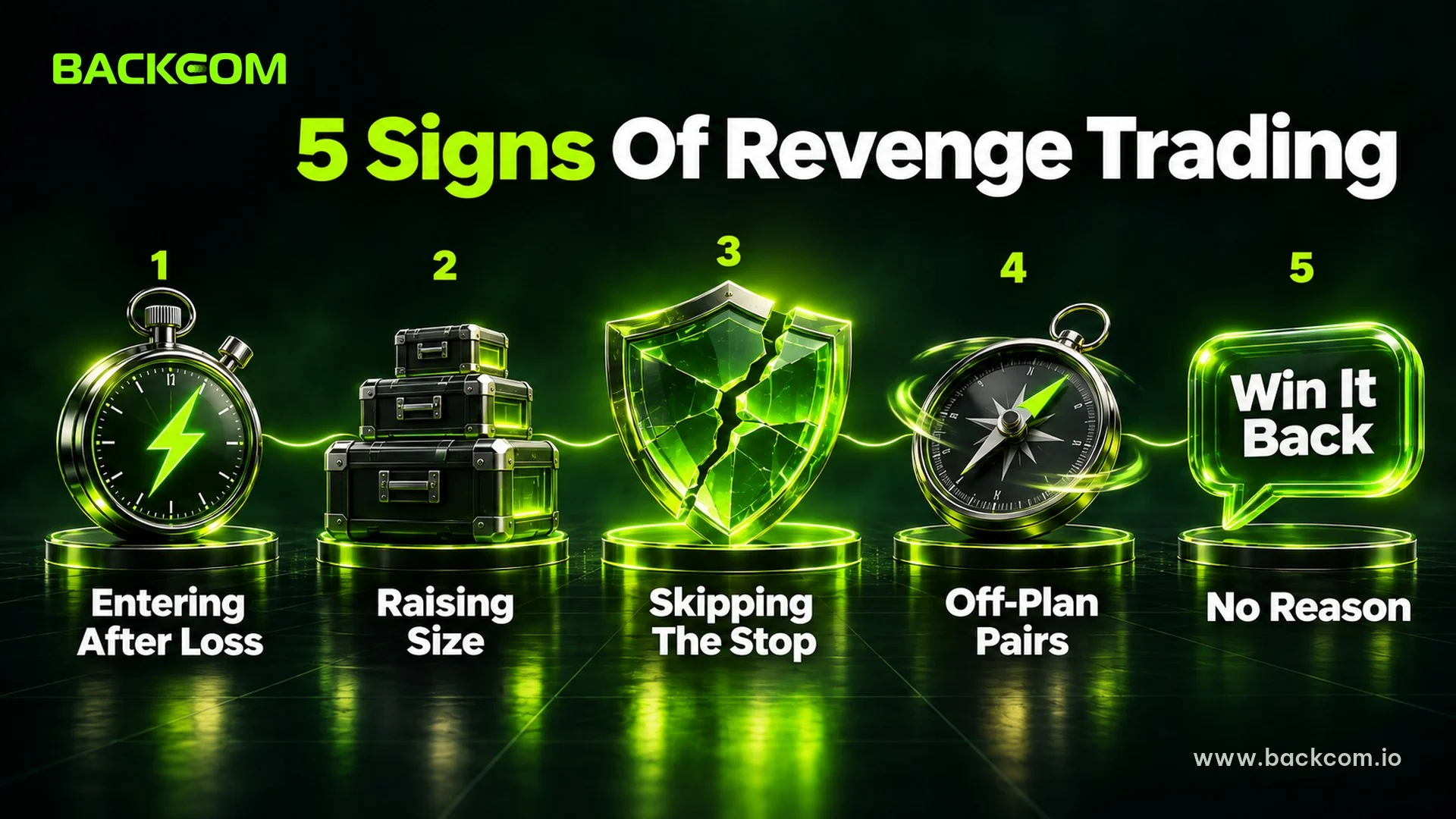
Spotting revenge trading while it is happening is much harder than seeing it after the account is down. The five signs below let a trader check against events instead of feelings.
Entering Right After Closing A Loser
The clearest sign is a very short gap between the losing trade and the next entry, a few minutes or less. A trader with a plan usually waits for a candle close, a price zone or a confirmation, so two valid setups 90 seconds apart are rare.
Raising Size Or Risk Above The Plan
The plan says 0.1 lot or 1% risk, but the next order goes to 0.3 lot or 3–5% risk. This sign causes the largest money damage.
Skipping Or Moving The Stop Loss
The trader sets a wider stop "to give the trade room", sets none, or deletes it when price touches it. The stop-loss rule is the first thing sacrificed, because cutting the loss means accepting one more loss.
Trading Pairs Or Hours Outside The Plan
A trader who only trades EURUSD in the London session switches to gold or a cross pair after a losing streak because it is "moving fast". When the choice of instrument follows volatility instead of the plan, the trade is often a recovery trade.
Having No Reason Except "I Need To Win It Back"
If the trade note says only "recover", "get back" or nothing, that is the last sign. A normal trade can be described in one sentence about price structure. A revenge trade can only be described by the amount to recover.
Keep these five signs next to the screen: with two signs at once, the session should stop. Each breach belongs in a trading journal.
4. How Fast Does Revenge Trading Burn An Account? A $5,000 Example
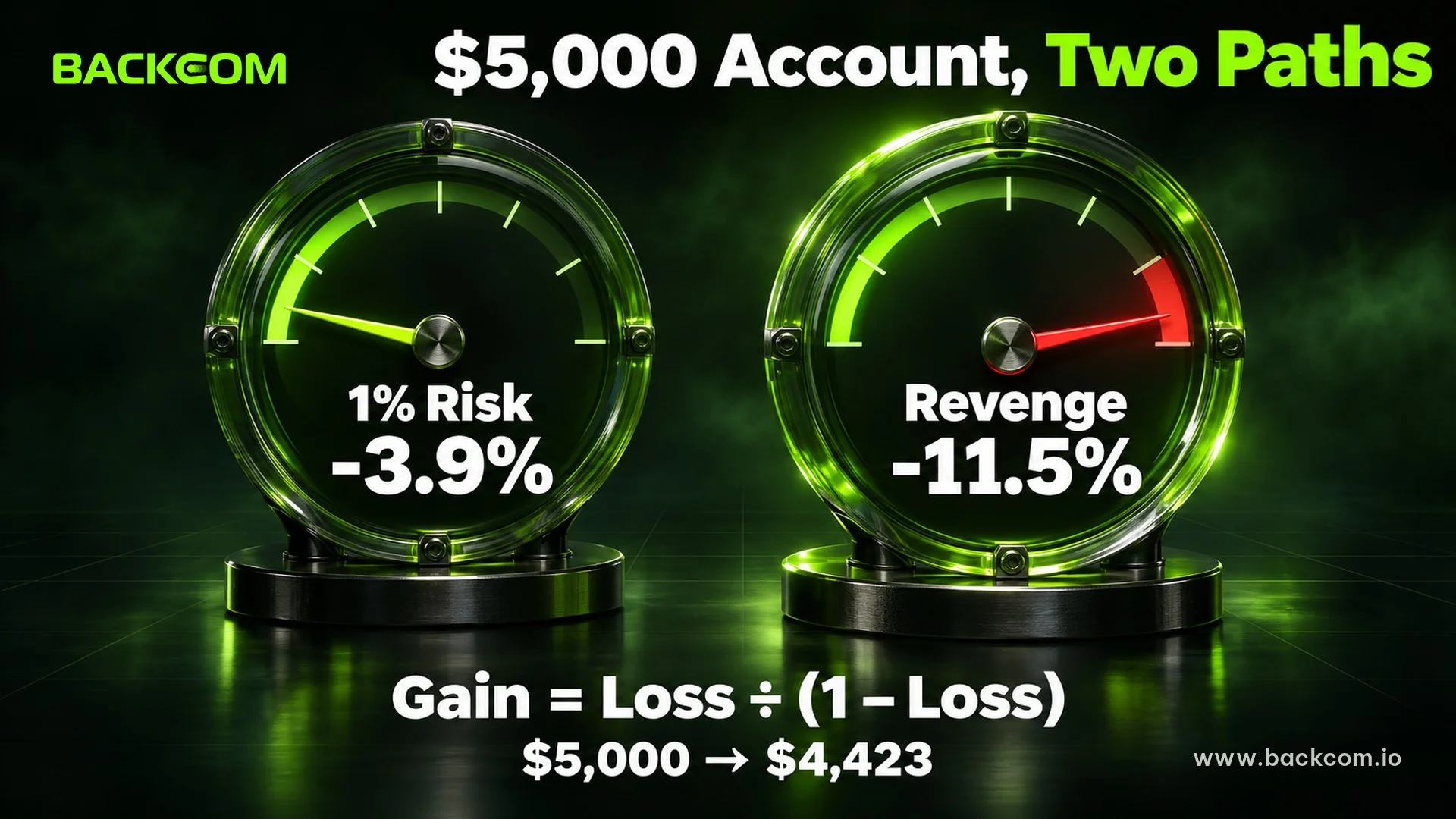
The cost of revenge trading is not one losing trade. It is a multiplication: size goes up while trade quality goes down. The calculation below is an illustration, not data from a real account.
Assume a $5,000 account with a plan of 1% risk per trade (about $50). In the morning the trader loses two trades that followed the plan, leaving about $4,900. Then the revenge starts: the third and fourth trades each risk 5% of the balance.
| Trade | Risk | Result | Balance after trade |
|---|---|---|---|
| 1 (follows plan) | 1% ≈ $50 | Loss | $4,950 |
| 2 (follows plan) | 1% ≈ $50 | Loss | $4,900 |
| 3 (revenge) | 5% ≈ $245 | Loss | $4,655 |
| 4 (revenge) | 5% ≈ $233 | Loss | $4,423 |
Reference calculation as at 14 November 2026. Figures are assumptions for comparison, and real trading results differ by trader.
Comparing the two scenarios:
- Risk kept at 1%: four losing trades cost about $197, or 3.9% of the account.
- Revenge on the last two trades: the total loss is about $577, or 11.5% of the account.
- Difference: within four trades, the damage is almost three times the planned amount.
The road back is worse. The gain needed to break even does not rise in a straight line with the loss. It follows this formula:
Gain needed to break even = Loss ÷ (1 − Loss)
| Account loss | Gain needed to return to the starting balance |
|---|---|
| 5% | 5.3% |
| 10% | 11.1% |
| 20% | 25% |
| 30% | 42.9% |
| 50% | 100% |
Reference formula and figures calculated as at 14 November 2026. This is plain arithmetic and ignores fees and swap.
In the example, an account down about 11.5% needs a gain of about 13% to get back to $5,000, and that gain is measured on the smaller balance. This is why professionals accept a small streak of planned losses: they avoid climbing a long hill.
Setting risk by balance and calculating size are covered in the guide to forex money management, the 1% rule and lot size. A position size calculator helps measure risk before pressing Buy or Sell.
5. How To Stop Revenge Trading: 5 Rules To Stop Trading After A Loss
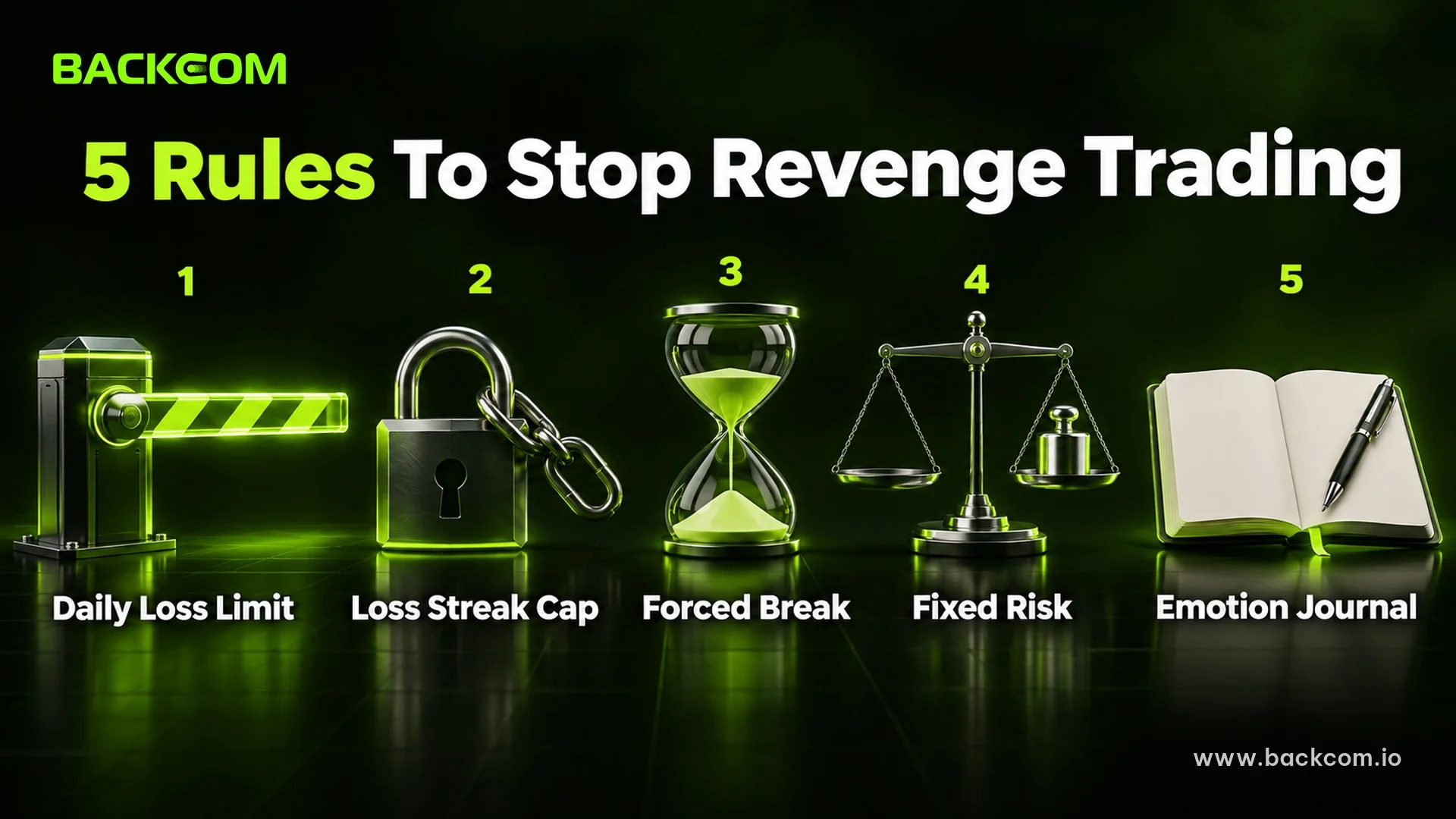
How to stop revenge trading works best when it does not rely on willpower in the heat of the moment, but on rules set in advance.
Below are five rules a trader can adjust to their own style. The numbers are starting examples, and each trader should test and tune them to their account and strategy.
Set A Daily Loss Limit
The most important daily loss limit in forex is a fixed cap. For example, if the account loses 2% from the start-of-day balance, close the platform and open no more trades until the next day. The cap should be 2 to 3 times the risk of one trade, enough for a few planned losses but too small for a revenge streak.
Cap The Number Of Consecutive Losses
Two or three losses in a row is a signal to pause, even when the daily total has not reached the cap. The reason is not that the market is "wrong", but that the trader's emotional state has changed.
Take A Forced Break After Each Loss
After each losing trade, set a fixed break, for example 30 minutes or until the next higher-timeframe candle closes. The FXStreet analysis suggests stopping for about 30 minutes or until the next session. Any duration works as long as it is fixed and not negotiable.
Keep Risk Per Trade Fixed
Risk per trade must not rise after a losing streak. The cleanest way is to calculate size with a formula in advance (fixed risk ÷ stop distance) and write the maximum size into the plan. Then there is no decision left for emotion to interfere with.
Log Your Feelings Before And After Each Trade
One quick line before entry ("what setup, how much risk, how do I feel") is enough to expose a revenge trade, because it is hard to write a real reason for one. A journal with one column for feelings and one for whether the plan was followed makes this easy.
One more adjustment concerns the stop: a trade with a clear invalidation point removes much of the temptation to move the stop, and the guide on how to set a stop loss using invalidation and ATR shows how to choose that point.
6. What To Do Right After You Have Already Taken A Revenge Trade
No trader is completely immune, so what matters is a way out once you notice you are off course. It has four steps, in this order.
- Close or reduce the positions outside the plan: any trade without a price-structure reason should be closed, not held until price returns to the entry.
- Leave the screen: stand up, drink water and breathe slowly for about a minute.
- Write down what happened: three lines on what triggered it, which signs appeared and which rule was broken.
- Do not trade again that day: even if the market still offers chances, the day has already produced a result to learn from.
Avoid promising to win it back tomorrow with a larger size. The goal of the next day is to return to exactly 1% risk and a setup that meets the conditions, not to repay the old loss.
Frequently Asked Questions (FAQ) About Revenge Trading
Is Revenge Trading Only A Beginner Mistake?
No. Experienced traders do it too, because it comes from a reaction to loss, not from a lack of knowledge. The difference is that experienced traders usually have stop rules in place and notice the signs sooner. So instead of trying not to feel angry, build rules that stop a wrong trade even when you are angry.
Can A Revenge Trade Ever Win?
It can win once or twice, but that does not prove the method. Risk still grows with size, and over time abandoning the plan usually leads to losses larger than planned, as in the $5,000 example above.
How Big Should A Daily Loss Limit Be?
There is no single number for every trader. Many choose 2 to 3 times the risk of one trade, such as 2–3% when each trade risks 1%. What matters more is setting it in advance and keeping to it: if a funded account or broker already has a daily loss limit, your personal cap should be tighter than that limit.
Conclusion: Stopping Is Part Of The Trading Plan
Revenge trading is an emotional reaction to loss. You can spot it through five signs: entering right away, raising size, dropping the stop, switching to pairs outside the plan and having no reason except "win it back". Traders need to look at three things together: the motive for entering, the risk per trade and the stop rule set in advance.
The immediate job is to write down three numbers and put them in the trading journal:
- Daily loss limit: the loss that makes the trader close the platform.
- Consecutive losses allowed: usually two or three.
- Break after each loss: fixed and not negotiable.
If you are building a money-management base, start with the guide to forex money management and lot size.
Traders who are choosing a broker to apply this plan can see the list of forex brokers. Backcom.io is an independent introducing broker (IB/affiliate) of the brokers listed; rebates are paid from the commission the broker pays Backcom.io, as set out in the risk disclaimer.
Disclaimer: This content is compiled by Backcom.io for information only and is not investment advice, a trading recommendation or psychological counselling. Trading forex and CFDs with leverage carries a risk of losing capital, and the numerical examples in this article are for illustration only.
Was this article helpful?
Join The Backcom.io Community
Get the latest on trading rebates, trading tips, and broker deals — and connect with thousands of traders worldwide.

Backcom App
Track Your Rebates Every Day
Every rebate is visible by broker and by day. Manage your wallet and withdrawals in one place.
Open Backcom App