Forex News Trading Strategy: A Step-By-Step Process Before, During And After CPI And FOMC


Most new traders see a CPI or FOMC release as a price explosion to catch, but experience with forex news trading strategy shows that the hard part sits around the number: spreads widen, orders fill at worse prices, and the market can reverse within seconds.
A clear process for each stage matters more than guessing the direction.
In this article, Backcom.io walks through one process that works for every high-impact release: preparing before the news, costing in spread widening during news, the pending-order straddle and its weaknesses, when to stay out of the market on news, and how to manage trades afterwards. How to read each individual indicator is covered in the linked guides.
1. A Forex News Trading Strategy Starts With What News Does To Price
Forex news trading means trading the price reaction around a scheduled data release or policy decision, such as CPI, nonfarm payrolls (NFP) or a Federal Reserve rate decision. The key point is that you do not trade the number itself. You trade the gap between the published figure and what the market expected.
A hot inflation print can still push price down if traders had priced in something even hotter. The first reaction after a release usually has three layers stacked on top of each other:
- Layer one: an instant jolt in the direction of the headline, lasting seconds to a minute.
- Layer two: a reversal as resting orders are swept and liquidity returns.
- Layer three: the real move, which forms once the market has digested the information and can take tens of minutes.
Most losing trades from new traders happen in layers one and two, when costs are highest. So choose which layer you take part in instead of trying to capture all three.
If you need the detail on each indicator, read the guides on how to trade CPI news, how to trade PPI news and what nonfarm payrolls are. This article keeps only the shared process.
2. Prepare Before The News: Calendar, Time Zone And Scenarios
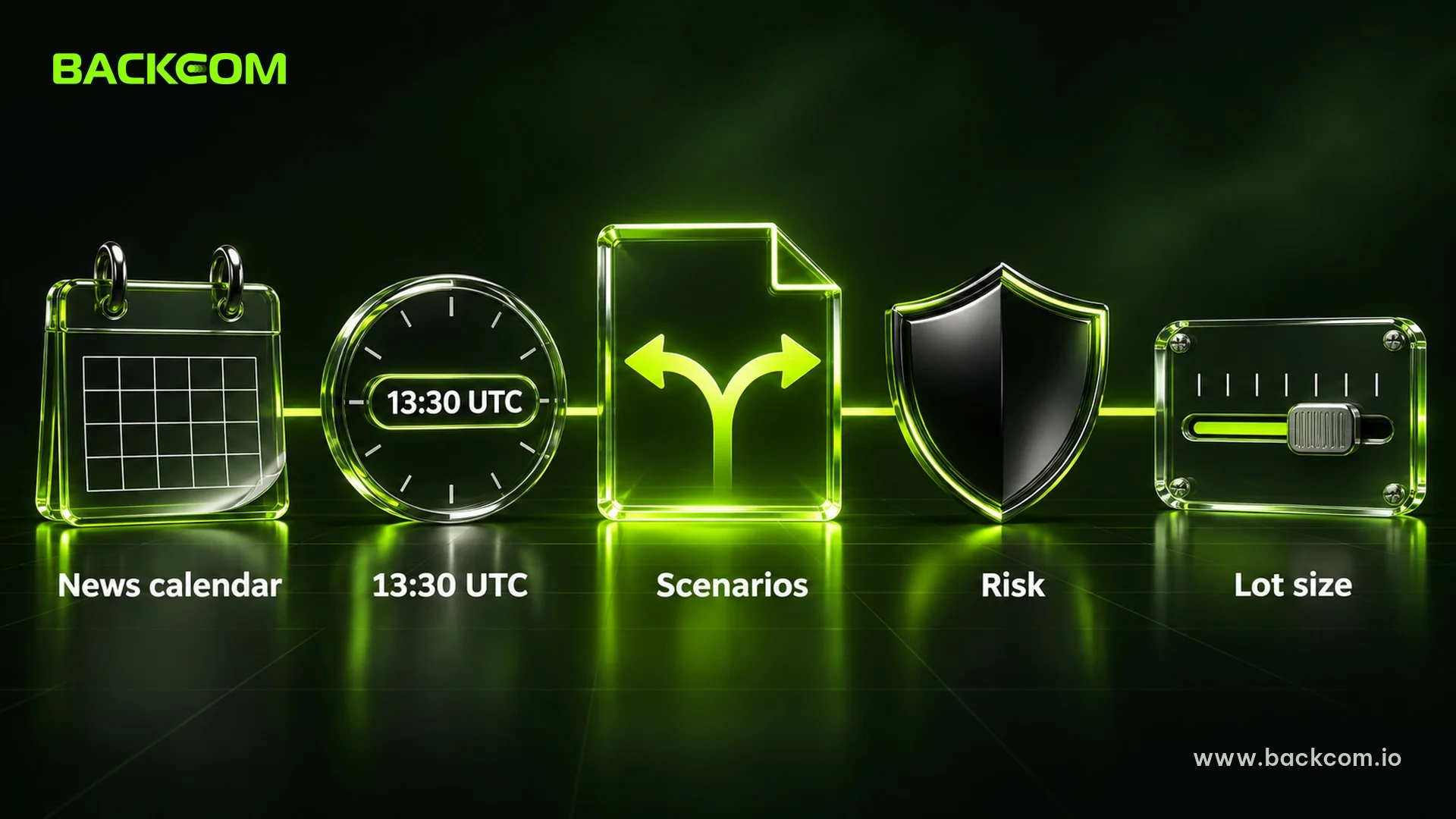
Preparing before the news means everything a trader does from several days to a few minutes before the release, so that they already know what to do when price starts moving.
The preparation process has five steps:
- Decide whether the release matters for your pair. US data moves the dollar, gold and the major pairs strongly, but has little effect on pairs without USD.
- Take the official release time and convert it to your own time zone. Every indicator has a schedule published in advance by its source.
- Write down three numbers: the forecast, the previous reading and the level that would count as a surprise.
- Prepare two scenarios: data above forecast and data below forecast, each with a specific action.
- Set a maximum risk for this release and keep it smaller than your normal risk per trade.
On timing, the US Bureau of Labor Statistics (BLS) schedules the November 2026 CPI for 10 December 2026 at 08:30 Eastern Time, which is 13:30 UTC. See the source: BLS CPI release schedule.
The Fed schedules its December FOMC meeting for 8–9 December 2026, a meeting that comes with updated economic projections. The decision is normally published at 14:00 Eastern Time on the second day, which is 19:00 UTC on 9 December. The original calendar is on the Federal Reserve FOMC calendar page.
You can follow the full list of releases in the economic calendar tool. US daylight saving time shifts these conversions twice a year, so check each time.
Thirty to sixty minutes before the release, check the current spread against its normal level, the free margin you have (see how to calculate margin) and any open positions without a stop loss. Position size should come from a fixed-risk formula:
Lot size = Amount you accept to risk ÷ (Stop loss in pips × Value of 1 pip per lot)
On high-impact news the stop distance should be wider than on a normal day, so the lot size must shrink. The full method is in forex money management and the 1% rule.
3. Spread Widening During News And How Slippage Eats Into Trades
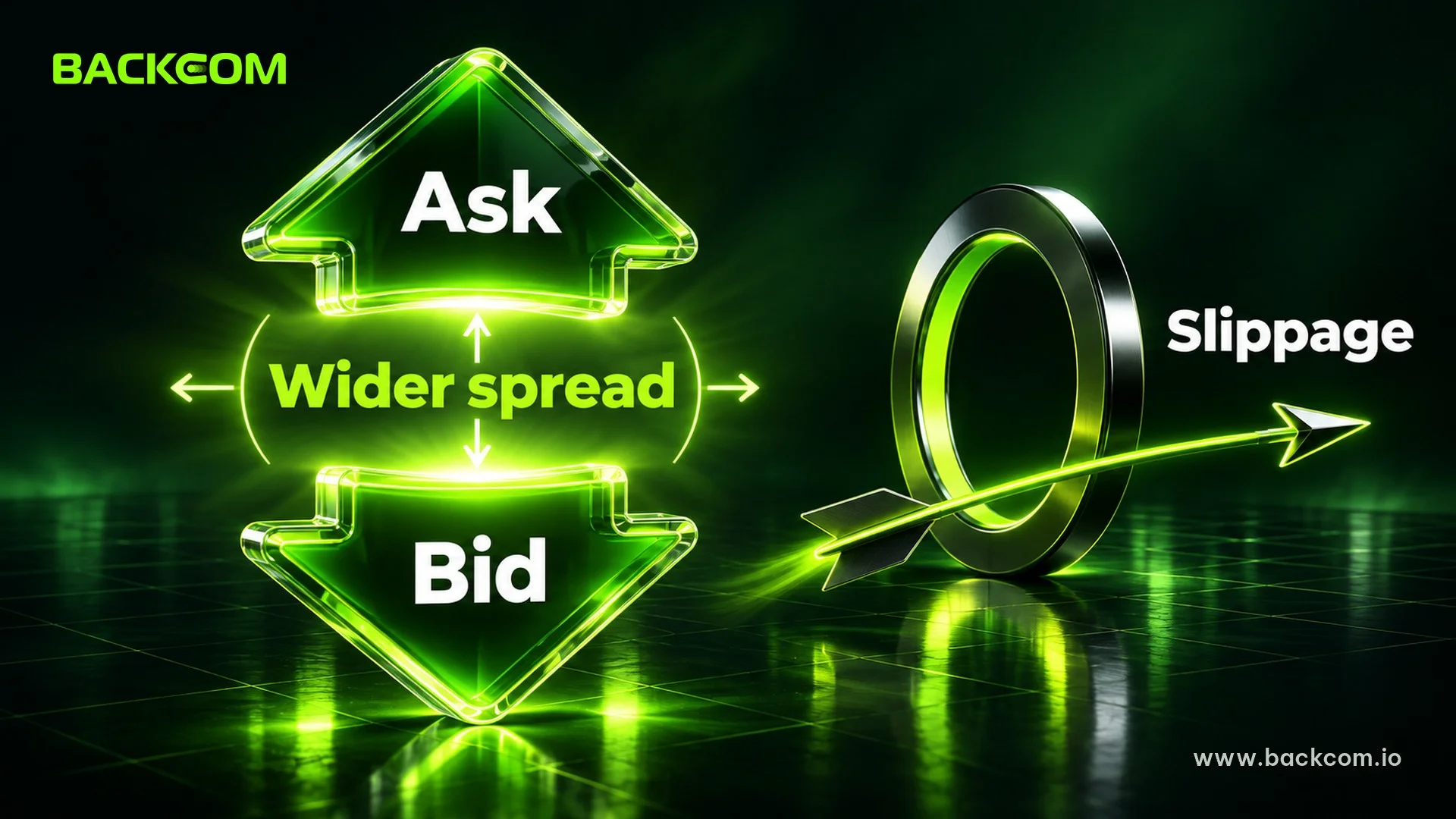
Spread widening during news is the sudden increase in the gap between the buy and sell price around the release, because liquidity providers pull back their resting orders to avoid risk. As a result, execution at the exact requested price is not guaranteed.
This cost has two parts that traders often mix up:
- Wider spread: the cost of entering rises immediately, because the buy and sell prices sit further apart.
- Slippage: a stop loss or pending order fills at a worse price than the one you set.
Both land at the exact moment price moves fastest. The guide on what a forex spread is explains how spreads form. To see the cost, take a hypothetical EUR/USD example where 1 pip is worth about $10 per lot:
| Situation | Spread | Lot size | Spread cost |
|---|---|---|---|
| Normal session | 1 pip | 0.10 | 1 × $1 = $1 |
| At the release (hypothetical) | 8 pips | 0.10 | 8 × $1 = $8 |
The figures above are a hypothetical calculation, not the real spread of any broker. Actual widening varies by broker, account type and release.
The point is that this cost is paid before price chooses a direction. A trade opened while the spread is wide starts several pips in the red, and a stop loss can be triggered by the spread alone even if the market price has not reached it.
Three rules help:
- Do not open a market order in the first second unless there is a very clear reason.
- Size the stop to the widened range, for example using the ATR indicator on a short timeframe instead of a fixed pip number.
- Accept that a stop loss does not always fill at its price. When price jumps past the stop, the order fills at the next available price and the loss can be larger than planned.
4. News Trading Straddle With Pending Orders: Setup And Weaknesses
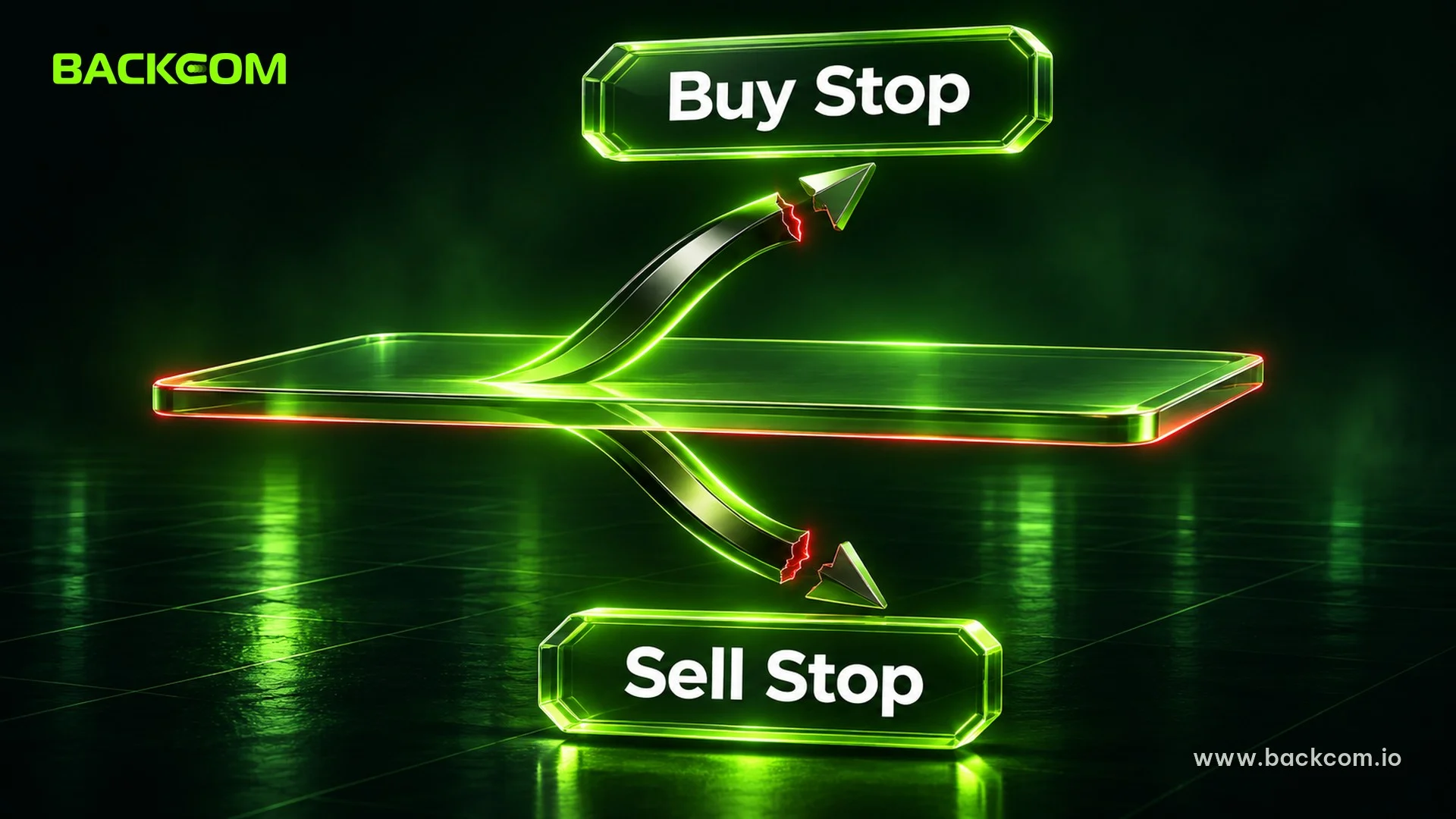
A news trading straddle places a Buy Stop above and a Sell Stop below the current price just before the release, so whichever level is touched first opens the trade in that direction. It looks attractive because you do not have to guess the direction, but its weakness lies in how pending orders work.
A common setup looks like this:
- Place both pending orders at a distance of 1–1.5 times the pre-news candle range, a few minutes before the release.
- Put each stop loss on the other side of the expected range and set the take profit as a multiple of the stop.
- When one order fills, cancel the other immediately, or use OCO if your platform supports it.
- If neither order fills within a few minutes, cancel both so they do not trigger on a late swing.
How Buy Stop and Sell Stop work on MT5 is explained in the guide to forex order types. Still, a straddle has three weaknesses that many guides play down:
- Being whipsawed both ways. Price jumps up and fills the Buy Stop, then reverses and fills the Sell Stop, so both trades hit their stop loss.
- Slipped fills. A pending order fills at a worse price than set when price gaps through it, especially in fast markets.
- Spread-triggered entries. A Buy Stop triggers on the ask price, so an ask that jumps because the spread widens can fill the order even though the mid price has not travelled far.
A hypothetical example: each order has a 20-pip stop and 0.10 lot (1 pip is worth about $1 at 0.10 lot). If price sweeps both sides, you lose about 2 × 20 = 40 pips, roughly $40, before slippage and spread, while only the order that goes the right way can profit.
For that reason, use a straddle only with small size on liquid pairs. Many prop firms also restrict this style around news, so read about news trading rules at prop firms before using it in a challenge.
5. When To Stay Out Of The Market On News

Staying out of the market on news is a complete trading decision, not giving up. Many experienced traders pick only a few releases they have prepared for, which helps them keep capital long enough to meet good opportunities.
Stay out of the market on news if any of these apply:
- A small account with high leverage. One slipped fill can push the margin level close to the warning zone. See margin call versus stop out for the danger levels.
- You hold open trades without a stop loss, or you are carrying a losing trade from the previous session.
- You cannot write a scenario for both directions of the data.
- The spread is already wide before the release, which makes the entry cost too high compared with the expected range.
- You are in a prop challenge or on an account with its own rules about news.
- Your mindset is off, for example after several losses in a row and a wish to win it back with one release.
Staying out does not mean leaving the screen. You can still record the range, the spread and how fast price recovers, and use that to improve your scenarios. The simple rule: if your preparation checklist is not complete, this release is not yours.
6. CPI And FOMC Trading: How The Two Releases Differ
CPI and FOMC trading share one framework but react differently, so treat them separately.
| Item | CPI release | FOMC decision |
|---|---|---|
| Nature | One number, published instantly | A rate decision, then a press conference later |
| Price jolts | Usually one main move, often reversed | Several: statement, projections, press conference |
| What to read | Actual versus forecast and previous | Tone of the statement and rate guidance |
| Common mistake | Market order in the first second | Trading the statement, then reversed by the press conference |
With CPI, the reaction is mostly decided in the first few minutes, so preparation and cost control matter most. With FOMC, the statement comes first and the Chair's press conference follows, so price swings through several opposing moves and it is safer to wait until the press conference ends before judging the trend. Meeting-by-meeting details are in what the FOMC is and the 2026 meeting schedule.
7. Manage The Trade After The News: The First 15 Minutes
Managing the trade after the news is the stage many traders skip, even though it decides most of the result. After the first jolt, price often retraces part of the move before choosing a direction, so open profits are easy to give back.
A practical framework:
- Minutes 0–2: no new trades. Only check that open trades have the right stop loss and where the spread is now.
- Minutes 2–15: scale out. When a trade reaches a profit equal to one unit of risk, take half off and move the stop to breakeven for the rest.
- After 15 minutes: enter only on your normal signals. By then the spread has settled and price usually shows a clearer structure.
- For FOMC: wait for the press conference before reassessing the direction.
- Log the result: entry time, spread at entry, slippage, outcome and the reason.
A loss on news can feel like being tricked, which pushes traders to win it back at once. Set a clear limit: each news trade can lose at most the risk you defined, and once you hit it, close the platform until the next session.
Frequently Asked Questions (FAQ) About Forex News Trading
Should Beginners Trade Forex News?
It is not a good place to start. News widens spreads and raises slippage exactly when price moves fastest, and beginners are not yet used to reading the reaction. Observe for a few months, log the range and costs, and only test with very small size on a demo account.
Does A Stop Loss Fully Protect You During News?
No. When price jumps past the stop level, the order fills at the next available price, so the loss can exceed what you planned. So reduce your lot size on news instead of relying on the stop alone.
Should You Enter Before Or After The Release?
Cautious traders usually enter after, once the spread has narrowed and price has formed a structure. Entering before can give a better price but exposes you to the full two-way whipsaw, so it only suits small size.
Conclusion: A Clear Process Beats Guessing The Direction
A forex news trading strategy comes down to three stages: preparing before the news with a calendar, scenarios and fixed risk; controlling the cost of wider spreads and slippage; and managing the trade after the release by time. Traders need to watch cost, risk and discipline together, and remember that staying out is always a valid choice.
Before the next release, open the economic calendar, write your two scenarios and set the maximum risk before placing any order. If you trade many lots, spread and slippage add up, so you can compare trading conditions and rebates on the broker comparison page.
Backcom.io is an independent introducing broker (IB/affiliate) of the brokers listed on that page; rebates are paid from the commission the broker pays Backcom.io. See the risk disclaimer.
Disclaimer: This content is compiled by Backcom.io for information and reference only and is not investment advice or a trading recommendation. Trading forex and CFDs carries a high risk and you can lose all your capital, especially around news releases. The numerical examples in this article are hypothetical and do not represent real results.
Was this article helpful?
Join The Backcom.io Community
Get the latest on trading rebates, trading tips, and broker deals — and connect with thousands of traders worldwide.

Backcom App
Track Your Rebates Every Day
Every rebate is visible by broker and by day. Manage your wallet and withdrawals in one place.
Open Backcom App