Bitget Vs Bybit Fees: Spot, Futures And Fee Tier Comparison

Bitget vs Bybit fees look almost identical on the first line of each fee page, and that is exactly why the comparison is easy to get wrong. Both charge a 0.02% maker fee on standard futures, yet the taker fee differs by a few thousandths of a percent, and the discount and tier systems behind those numbers work very differently. In this article, Backcom.io compares the published base rates as at 16 November 2026, prices real round trips on both exchanges, and shows how much a 50% rebate changes the gap.
1. What Are The Bitget Vs Bybit Maker Taker Base Fees?

The base fee is what a standard account pays before any VIP tier, token discount or rebate. On Bitget, the official trading fees FAQ states a spot fee of 0.1% for makers and takers, and a futures fee of 0.02% for makers and 0.06% for takers. On Bybit, a Regular User pays 0.1% on spot and, in the Standard Crypto futures group, 0.02% maker and 0.055% taker.
| Product | Bitget maker | Bitget taker | Bybit maker | Bybit taker |
|---|---|---|---|---|
| Spot | 0.1% | 0.1% | 0.1% | 0.1% |
| USDT futures (standard) | 0.02% | 0.06% | 0.02% | 0.055% |
Reference rates as at 16 November 2026. They can change, so check the live fee schedule before trading.
Two things stand out. Spot is identical, so the spot choice cannot be made on base fees. On futures, the makers pay the same and only the taker rate differs by 0.005 percentage points, which is about 8% of the Bitget rate. If you are new to the terms, our guide to maker vs taker fees in crypto explains why a resting limit order and a market order are charged differently.
Bybit also runs separate fee groups for products such as TradFi perpetuals and its Innovation Zone, with different rates on the same page. Check the group of the contract you actually trade, because the Standard Crypto row is not the whole schedule.
2. How Do Bitget Vs Bybit VIP Tiers Compare?
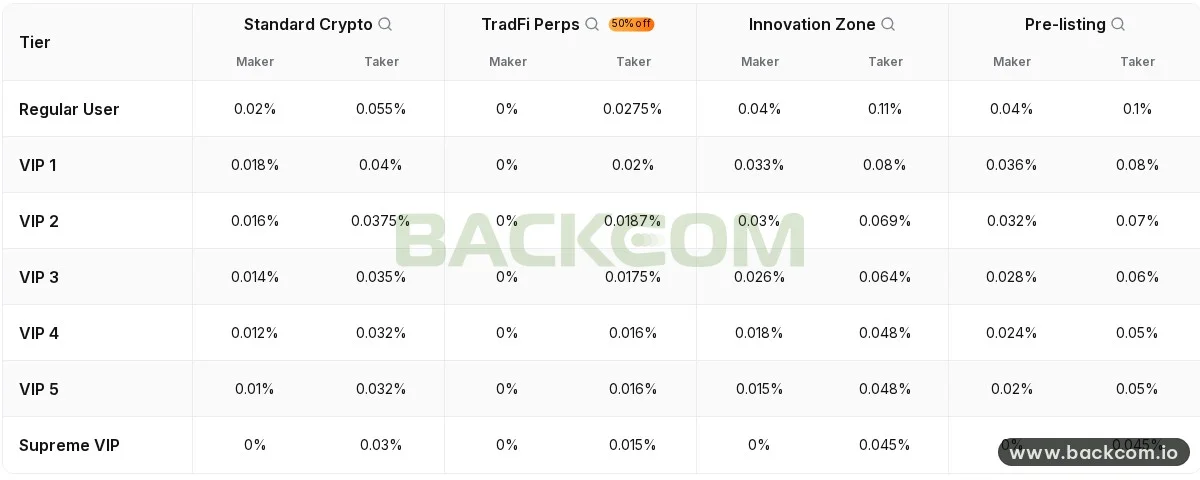
A fee tier lowers your rates as your account assets or 30-day volume grow. Bybit publishes the full ladder and Bitget does not, which makes a like-for-like tier comparison impossible from public pages alone.
Bybit's official fee schedule lists Regular User through VIP 5, plus an invitation-only Supreme VIP. For Standard Crypto futures the rates step down like this:
- Regular User: 0.02% maker and 0.055% taker;
- VIP 1: 0.018% maker and 0.04% taker;
- VIP 2: 0.016% maker and 0.0375% taker;
- VIP 3: 0.014% maker and 0.035% taker.
The first step alone cuts the taker rate by more than a quarter.
Bybit's VIP programme page sets the entry thresholds. VIP 1 needs 100,000 USD in assets, or 1 million USD of 30-day spot volume, or 10 million USD of 30-day derivatives volume, and meeting one criterion is enough.
Bitget's fee FAQ describes a tiered VIP programme where fees decrease as qualifying volume, account assets or BGB holdings increase. It gives no thresholds or tier rates on that page, and other Bitget pages mention separate PRO tiers with different schedules. For that reason this article does not compare VIP levels rate by rate. If you trade enough volume to care, read the live tier table inside your own Bitget account.
For a smaller retail trader the practical point is simpler: the base rates are the rates you will actually pay, because the first tier is out of reach at modest volume.
3. What Does A Round Trip Cost In Bitget Vs Bybit Futures Fees?
A $50,000 futures round trip costs between $20 and $60 on Bitget and between $20 and $55 on Bybit at standard rates, because you pay the fee on entry and again on exit. The order type moves that number far more than the exchange does, as the arithmetic below shows.
Fee = Position Value × Fee Rate, charged on entry and again on exit
Take a $50,000 futures position at the standard rates. These are assumptions for illustration, not forecasts:
| Round trip | Bitget | Bybit | Difference |
|---|---|---|---|
| Maker entry, maker exit | $20.00 | $20.00 | $0.00 |
| Maker entry, taker exit | $40.00 | $37.50 | $2.50 |
| Taker entry, taker exit | $60.00 | $55.00 | $5.00 |
Figures calculated from the base rates as at 16 November 2026, before any tier, token discount or rebate. Rates can change, so check the live schedule before trading.
The worked lines are short. On Bitget, a taker leg is $50,000 × 0.06% = $30, and a maker leg is $50,000 × 0.02% = $10. On Bybit, a taker leg is $50,000 × 0.055% = $27.50 and a maker leg is also $10.
Notice the scale. Moving from two taker legs to two maker legs saves $40 on Bitget and $35 on Bybit, while choosing Bybit over Bitget saves at most $5 on the same trade. Order type is the bigger lever. For a step-by-step method you can reuse, see how to calculate crypto futures trading fees.
On spot the picture is simpler. A $10,000 round trip at 0.1% per leg costs $20 on either exchange.
4. Which Discounts Apply: BGB On Bitget Or MNT On Bybit?
Bitget's BGB offset covers spot only, while Bybit's MNT discount covers spot and futures. Both let you pay fees in the exchange's own token at a lower rate, with different scope.
On Bitget, the FAQ says enabling "Use BGB to offset fees" discounts your spot trading fee, and that it can apply together with your VIP level. It states no discount percentage and tells you to check the live fee schedule. Bitget's own wording applies the BGB offset to spot only, so do not assume it lowers futures fees.
On Bybit, paying with MNT, per Bybit's own FAQ, reduces fees by 25% on spot and 10% on futures, applied on top of your VIP rate. Our guide to Bybit fee discounts lists the exclusions, which include API orders, liquidation orders, Trading Bot orders and Copy Trading followers.
Applied to the Regular User rates, the MNT discount gives:
- spot, 0.1% becomes 0.075%: $10,000 per leg costs $7.50 instead of $10;
- futures taker, 0.055% becomes 0.0495%: a $50,000 taker round trip costs $49.50 instead of $55;
- futures maker, 0.02% becomes 0.018%: a $50,000 maker round trip costs $18 instead of $20.
Under those numbers a Bybit taker round trip at $49.50 sits $10.50 below the Bitget standard taker round trip of $60. Remember that this needs you to hold MNT, and that holding a token is itself a market risk. Bitget's BGB offset also needs you to hold a token, and its futures effect is not stated.
5. How Much Does A 50% Rebate Change The Gap?
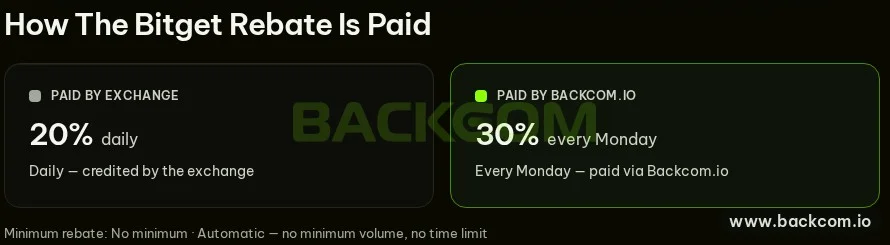
A 50% rebate halves both bills, so it also halves the gap between them: on a $50,000 taker round trip the difference falls from $5.00 to $2.50. A rebate returns a share of the fees you have already paid, so it lowers your net cost but does not change the fee on the order. The exchange pages on this site list a 50% total fee rebate on spot and futures for both Bitget and Bybit, with terms last updated on 23 October 2026.
The payout schedule differs. For Bitget, the page splits the 50% into 20% paid daily by the exchange and 30% paid every Monday by the partner. For Bybit, the page lists 50% paid every Monday by the partner. Both list no minimum volume and no time limit.
Apply 50% to the two standard taker round trips from section 3:
| Standard taker round trip, $50,000 | Fees paid | 50% rebate | Net cost |
|---|---|---|---|
| Bitget | $60.00 | $30.00 | $30.00 |
| Bybit | $55.00 | $27.50 | $27.50 |
Illustration only, using terms last updated on 23 October 2026. The rebate is a share of fees paid, not of volume or profit, and it does not return funding payments or trading losses.
The gap is $2.50 instead of $5.00. The rebate lowers both bills at the same rate, so the exchange with the lower fee stays slightly ahead, and the difference matters less than whether you trade as a maker or a taker. A rebate is also only paid on a linked account: you must register through the partner link before your first trade, link your UID in the Backcom App, and link each sub-account separately. Existing accounts are usually tied to another referrer. For how these programmes differ in general, see our crypto exchange rebate comparison.
You can read the full Bitget Rebates terms on the Bitget exchange page. Backcom.io is an independent introducing broker (IB/affiliate) of the exchanges it lists, including Bitget and Bybit; rebates are paid from the commission the exchange pays Backcom.io. See the risk disclaimer for the full disclosure. A rebate is not a reason to open an account, deposit funds or trade more than you planned.
6. Do Funding And Other Costs Change The Comparison?
No, funding does not change the fee comparison, because it sits outside both fee schedules. Funding is a payment between long and short holders of a perpetual contract, not a trading fee. Bitget's FAQ gives the formula as position value × funding rate, exchanged every 8 hours, and says that when the rate is positive, long holders pay short holders.
Because funding moves between traders, it sits outside the trading fees both exchanges list and outside what a fee rebate is based on. A position held through many settlements can pay more in funding than in trading fees, whichever exchange you use. Our guide to the funding rate and how to calculate funding fees shows the calculation.
Other costs sit outside the fee schedule as well:
- Withdrawals: Bitget states that it does not charge deposit fees for crypto, and that withdrawal fees depend on the coin and network and are shown before you confirm;
- Slippage: a market order on a thin contract can cost more than the fee gap between two exchanges;
- Losses: no fee level or rebate offsets a leveraged position moving against you.
7. How Should You Compare Them For Your Own Trading?
The fair comparison uses your own order mix, your own contracts and your own volume, not a headline rate. Five checks cover it:
- Order type. Count how many of your orders fill as maker and how many as taker, because that split decides most of the cost.
- Product. Confirm which fee group your contract belongs to on each exchange.
- Tier. Check whether your assets or 30-day volume reach a tier, using the thresholds in your own account.
- Token discounts. Decide whether holding BGB or MNT is worth the extra market risk to you.
- Everything else: liquidity, supported products, withdrawal options and regulation. See our reviews of Bitget and Bybit for the non-fee side, and our OKX vs Bybit fee comparison for a third option.
None of this is a ranking. Fee level is one input, and leverage and position size will decide your result long before a fraction of a basis point does. Before you size a trade, read how to calculate your liquidation price.
Frequently Asked Questions (FAQ) About Bitget Vs Bybit Fees
Which Is Cheaper, Bitget Or Bybit?
On standard base rates Bybit is slightly cheaper for takers on futures, at 0.055% against 0.06%, and the two are equal for futures makers and for spot. The gap is $5 on a $50,000 taker round trip. Tiers, token discounts and rebates can change the result, so compare your own order mix.
Are Bitget And Bybit Spot Fees The Same?
At the standard level, yes. Both list 0.1% for makers and takers on spot. Differences appear only after discounts: Bitget's BGB offset applies to spot with no percentage stated on its FAQ, and Bybit's MNT discount lowers spot by 25%.
Does A 50% Rebate Make Bitget Cheaper Than Bybit?
No. A 50% rebate lowers both exchanges' fees by the same share, so the exchange with the lower fee stays ahead. On a $50,000 taker round trip the net cost is $30 on Bitget and $27.50 on Bybit. Rebates are paid on linked accounts only.
Do Bitget And Bybit Charge Funding Fees On Top?
Yes, on perpetual futures. Funding is a transfer between long and short holders at set intervals, not a trading fee, so it is not part of the figures above and is not returned by a fee rebate. Count it separately.
Can I Add A Rebate To An Existing Account?
Usually not. Existing accounts are generally tied to another referrer, so a new registration with a new email is normally needed. Check the current steps on the exchange page before you register.
Conclusion: Compare Order Type First, Exchange Second
Bitget vs Bybit fees differ by only 0.005 percentage points on standard futures taker orders, and not at all on spot or futures maker orders. Order type, funding and position size change your cost far more than the exchange does. Before choosing on fees, count your maker and taker orders, check which tier you can reach, and treat any rebate or token discount as a smaller adjustment on top.
Disclaimer: This content is compiled by Backcom.io for information only and is not investment advice. Crypto trading carries a high risk of loss, and fee terms and rebate terms can change. Nothing here encourages you to open an account, deposit funds or trade more because of a fee difference.
Was this article helpful?
Join The Backcom.io Community
Get the latest on trading rebates, trading tips, and broker deals — and connect with thousands of traders worldwide.

Backcom App
Track Your Rebates Every Day
Every rebate is visible by broker and by day. Manage your wallet and withdrawals in one place.
Open Backcom App