OKX Vs Bybit Fees: Maker, Taker And Futures Fee Comparison

OKX vs Bybit fees come down to a few small gaps: the same 0.0200% futures maker rate, a taker rate that differs by 0.0050 percentage points, and a spot schedule where OKX is cheaper for makers. In this article, Backcom.io sets the published base rates side by side, works out what a $50,000 futures round trip and a $10,000 spot round trip cost on each exchange, and explains why the gap is usually smaller than the effect of your own order type. Rates were checked on 13 November 2026 and both exchanges can change them, so confirm them on the live fee pages before you trade.
1. How Do The OKX Bybit Maker Taker Fees Compare At A Glance?
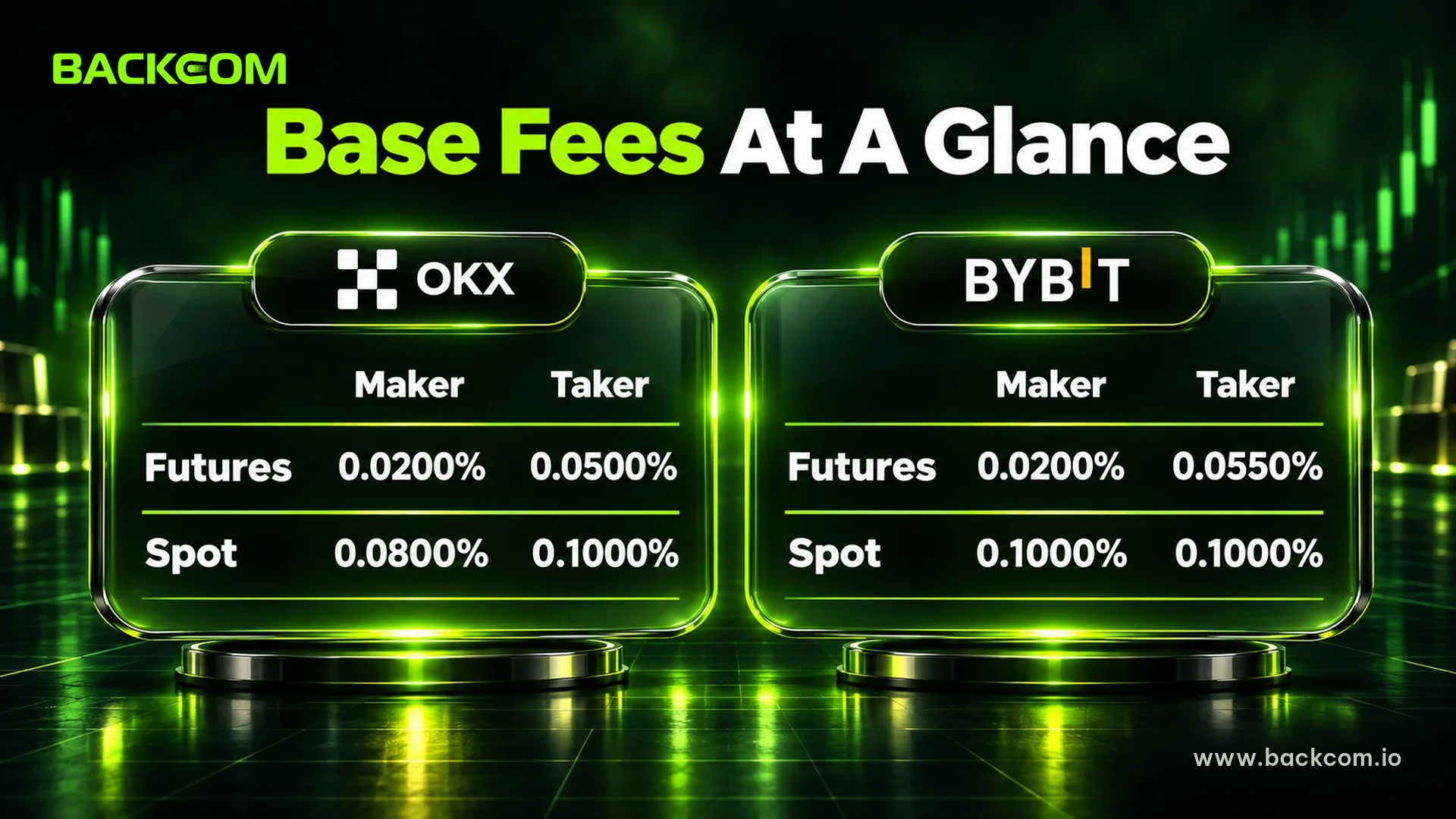
At the base level the two exchanges are almost identical on futures and differ mainly on spot maker fees. The OKX Bybit maker taker fees below are the standard, non-VIP rates. Three things decide what you actually pay:
- Product: futures and spot use different schedules on both exchanges.
- Order type: a maker order rests on the book and pays the lower rate, while a taker order fills at once.
- Tier: a VIP level lowers both rates once your balance or 30-day volume qualifies.
| Product | OKX Maker / Taker | Bybit Maker / Taker |
|---|---|---|
| Futures (perpetual) | 0.0200% / 0.0500% | 0.0200% / 0.0550% |
| Spot | 0.0800% / 0.1000% | 0.1000% / 0.1000% |
OKX figures come from the OKX global fee framework notice, effective 25 November 2025. Bybit figures come from Bybit's trading fee structure page, last updated 5 November 2026, read on 13 November 2026. Both can change, so check your own account before you trade.
Two cautions apply. First, OKX's notice refers to "Futures Markets" and does not break out perpetual swaps separately, so confirm the rate for the exact contract you trade. Second, these are rates for the global platforms. Regional entities, such as those serving the US or EU, can publish different schedules.
2. What Are The OKX Vs Bybit Futures Fees?
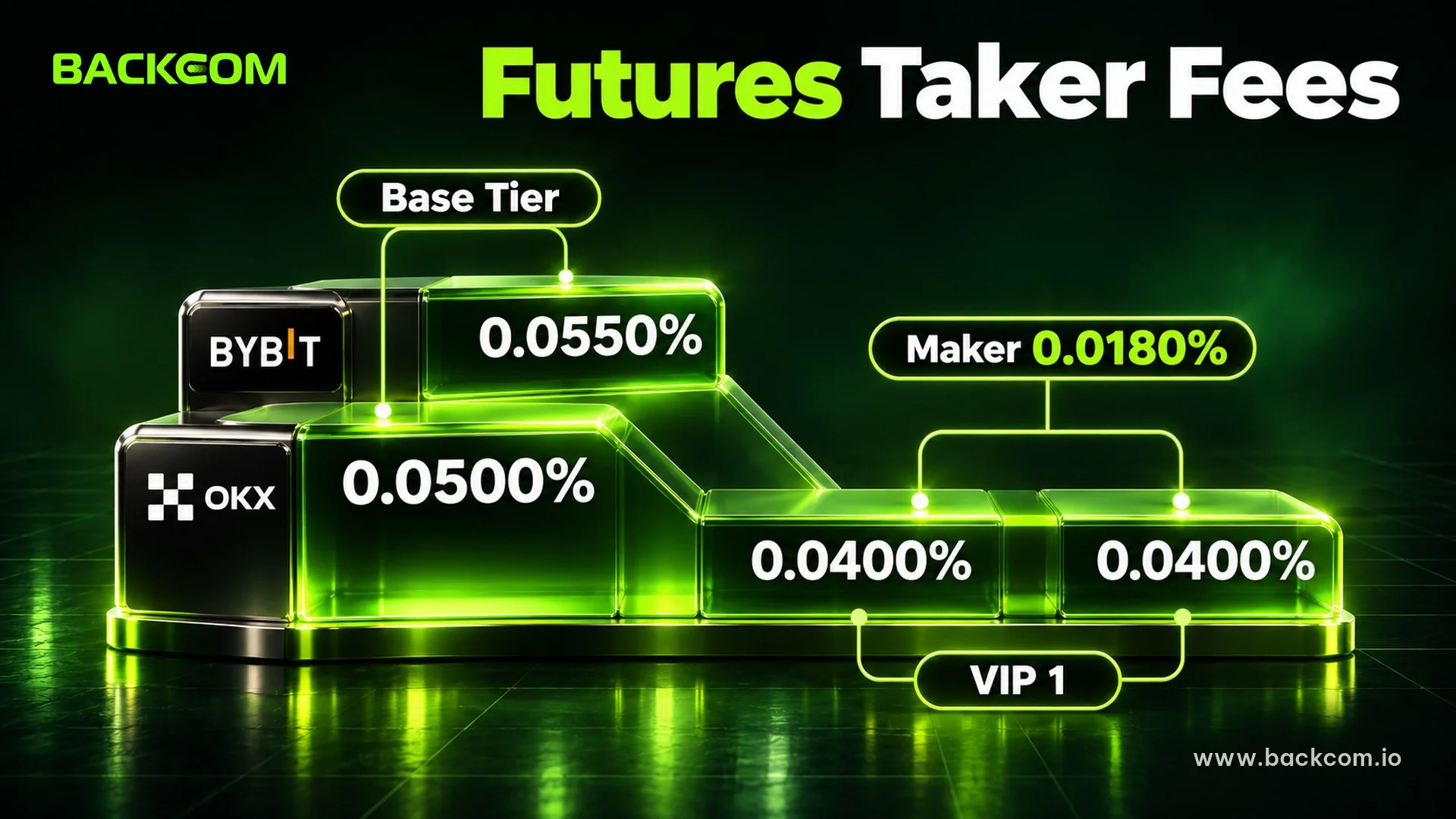
The OKX vs Bybit futures fees show OKX slightly cheaper for takers, with the two level for makers. At the base tier both charge 0.0200% for a resting limit order. The taker side is 0.0500% on OKX and 0.0550% on Bybit.
The gap sounds trivial and mostly is. Think of it as half a basis point of notional. For a $50,000 market-order entry, that is $2.50 more on Bybit each time you take liquidity. Over a hundred taker fills, the difference adds up to $250, which a very active trader will notice and an occasional one will not.
The first VIP tier reverses the taker gap. OKX's fee page lists 0.0160% maker and 0.0450% taker at VIP 1 for futures, reached with an asset balance of at least $100,000 or a 30-day futures volume of at least $5,000,000. Bybit's fee page lists 0.0180% maker and 0.0400% taker at VIP 1, reached with an asset balance of at least $100,000 or 30-day derivatives volume of at least $10,000,000. OKX VIP 1 is easier to reach on volume and cheaper for makers, while Bybit VIP 1 is cheaper for takers.
3. Which Exchange Has Cheaper Spot Fees?
OKX is cheaper for spot makers, and the two match for spot takers. At the base tier OKX lists 0.0800% maker and 0.1000% taker across its three main pair groups. Bybit lists 0.1000% for both sides.
For a spot trader who places limit orders, that is a 20% lower maker fee on OKX. For a trader who buys at market, there is no difference at the base level. OKX also lists a short group of stablecoin pairs at 0% in its framework notice, which matters only if you convert between those specific assets.
One more mechanical point: on spot, the fee is usually taken from the asset you receive, not billed separately. OKX's trading fee rules FAQ gives the example of a 0.1% taker fee when buying 1 BTC, which leaves you with 0.999 BTC. Keep that in mind when you compare your filled quantity with what you ordered.
4. What Does A Real Round Trip Cost On Each?
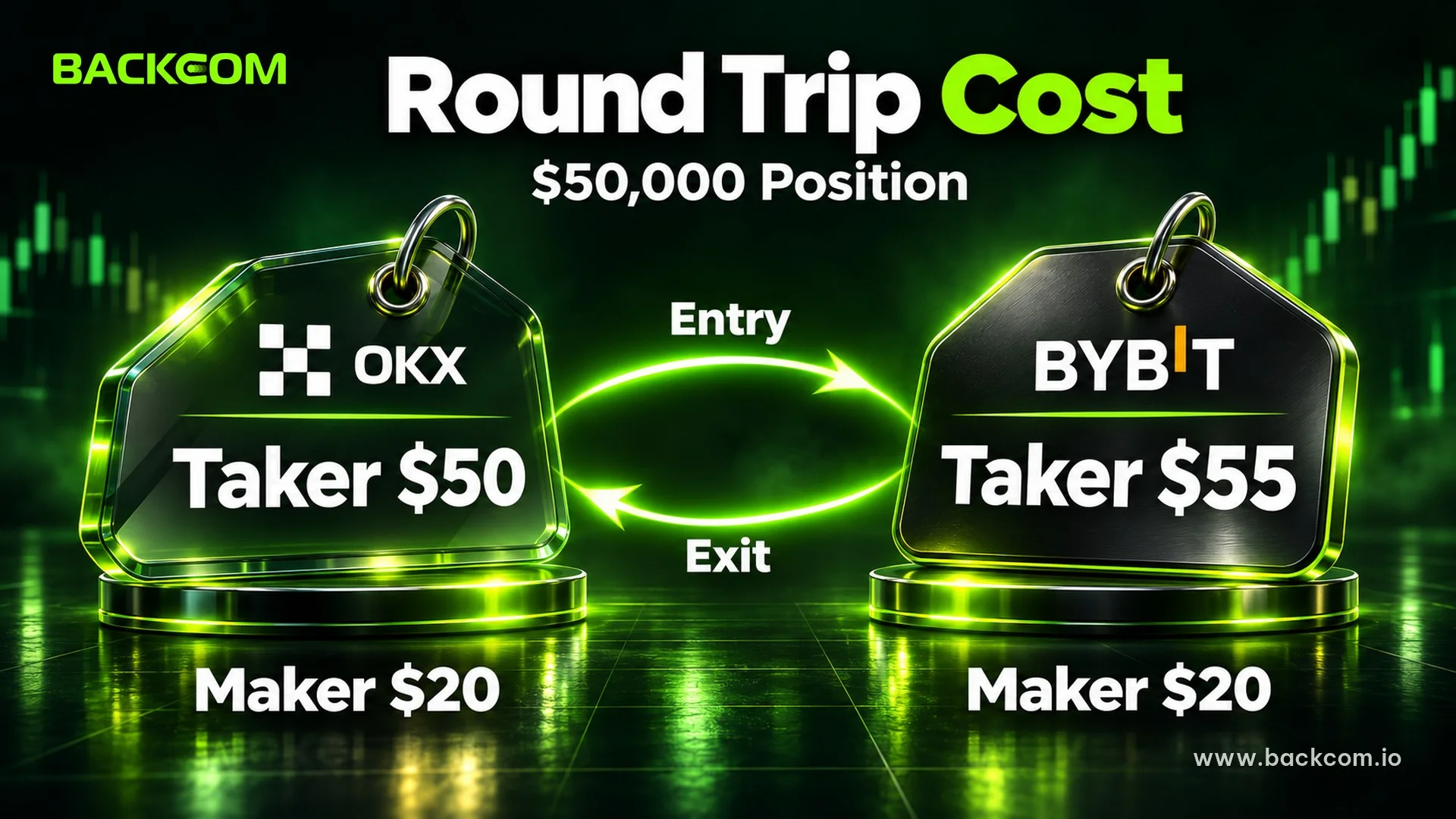
A round trip is one entry plus one exit, so every fee is charged twice. The figures below are calculated from the base rates in section 1 on an assumed $50,000 futures position. They are illustrations, not results you should expect.
| Scenario | OKX | Bybit |
|---|---|---|
| Maker entry, maker exit | $20.00 | $20.00 |
| Maker entry, taker exit | $35.00 | $37.50 |
| Taker entry, taker exit | $50.00 | $55.00 |
| VIP 1, taker entry and exit | $45.00 | $40.00 |
Calculated from base futures rates read on 13 November 2026. The table excludes spread, slippage and funding payments.
The spot version on an assumed $10,000 trade, both legs charged at the base rate, looks like this:
| Scenario | OKX | Bybit |
|---|---|---|
| Maker entry, maker exit | $16.00 | $20.00 |
| Taker entry, taker exit | $20.00 | $20.00 |
Calculated from base spot rates read on 13 November 2026. The table excludes spread and slippage.
Three details sit behind these numbers:
- Notional value: fees are charged on the full position size, not on your margin, so leverage makes the dollar amount larger.
- Both legs count: the exit is charged as well as the entry, and a stop-loss that triggers as a market order pays the taker rate.
- Liquidation: a forced liquidation is charged at the taker rate on OKX, according to its fee rules FAQ, so a losing trade can also be an expensive one.
The pattern is clear. Your order type moves the cost far more than your choice of exchange. On either platform, switching a taker round trip to a maker round trip saves $30 to $35 on a $50,000 position. Switching from OKX to Bybit changes the same trade by $5 at most. If you want the mechanics behind this, read our guide to maker vs taker fees in crypto.
5. Do Funding Fees Differ Between OKX And Bybit?
Funding is a payment between long and short holders of a perpetual contract, not a fee the exchange keeps, and it applies on both platforms. OKX's FAQ states that the platform takes no cut of the funding payment and that you pay or receive it only if you hold a position at the settlement time. Settlement runs every 8, 4, 2 or 1 hours depending on the instrument.
Bybit's help center uses an 8-hour interval as its standard example, with settlements at 00:00, 08:00 and 16:00 UTC, and moves a contract to hourly settlement when its funding rate hits the cap. The safe habit is the same on both: open the contract page, read the current rate and the time of the next settlement, and compare that with the trading fee before you decide to hold overnight.
A simple illustration shows why this matters. Assume a funding rate of 0.01% for one settlement, a figure chosen only to show the arithmetic. On a $50,000 position it costs $5 if you are on the paying side, which is a quarter of a maker-only round trip fee. A strategy that holds through several settlements can pay more in funding than in trading fees, whichever exchange it uses. For the calculation in full, see our guide to the funding rate and how to calculate funding fees.
6. How Do Rebates Change The Comparison?
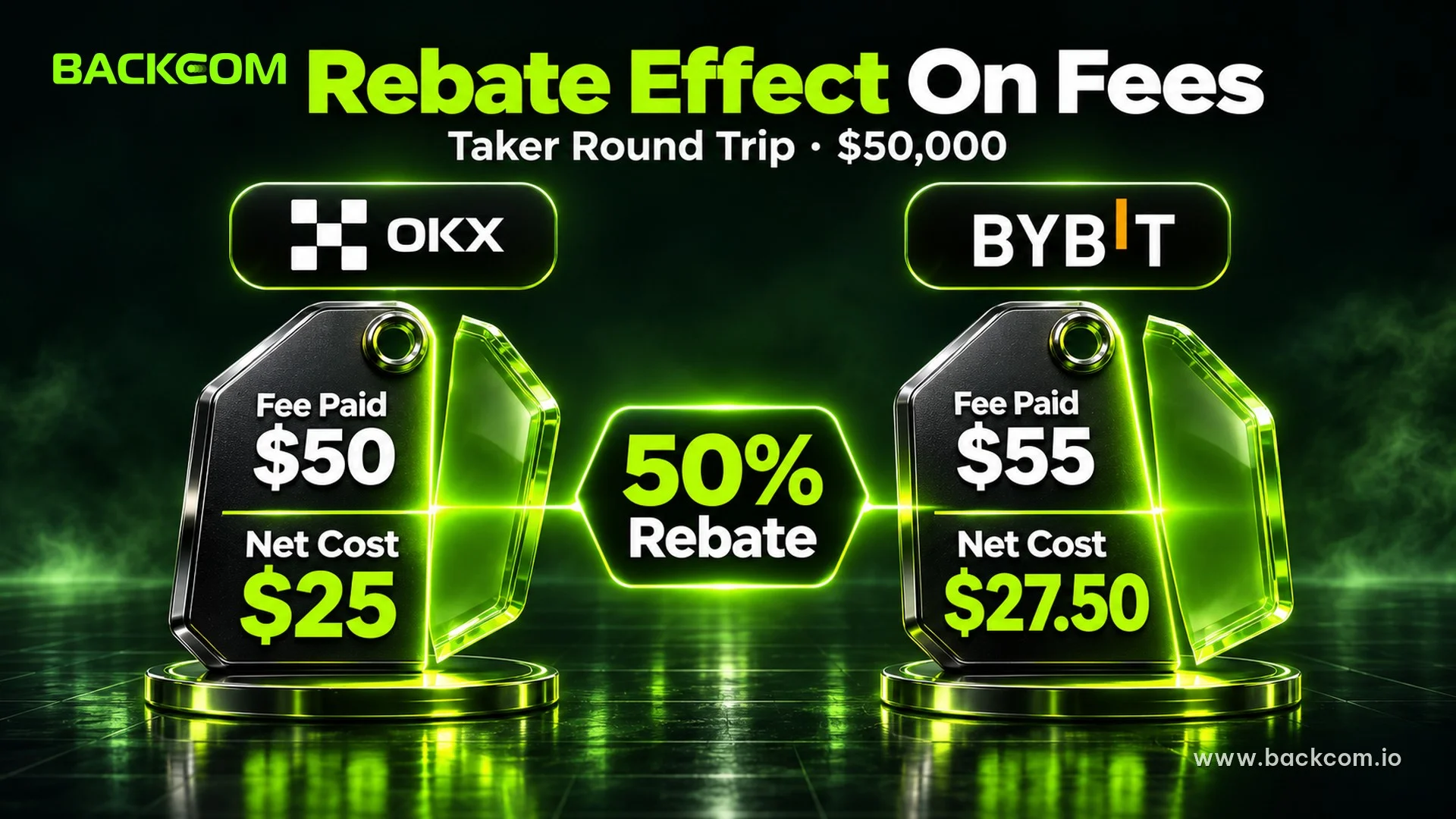
A rebate returns a share of the trading fee you paid, so it shrinks the cost of a trade but never changes the exchange's own schedule. The terms below come from the rebate pages for each exchange on this site, updated on 23 October 2026 and read again on 13 November 2026.
- OKX Rebates: up to 50% of spot and futures fees. OKX credits 20% roughly one to two hours after an order closes, and the partner pays the other 30% every Monday after reconciliation.
- Bybit Rebates: 50% of spot and futures fees, paid by the partner every Monday.
Both programs share the same conditions:
- Registration: you sign up through the program link.
- UID: you link your UID in the rebate account, and each sub-account is linked separately.
- Timing: fees paid before linking are not returned.
- Existing accounts: these usually need a specific process, so read the page before you act.
Apply the 50% to the taker-only round trips above. On OKX, a $50 fee would return up to $25, leaving $25 net. On Bybit, a $55 fee would return $27.50, leaving $27.50 net. The order is the same as before, with OKX slightly ahead, but the gap is $2.50 and the rebate matters more than the exchange. A rebate is a share of a fee, not of your trade or your profit, and it does not reduce funding payments or trading losses. For how these programs differ in general, see our crypto exchange rebate comparison.
You can read the current terms on the OKX rebate page.
Backcom.io is an independent introducing broker (IB/affiliate) of the exchanges it lists, including OKX and Bybit; rebates are paid from the commission the exchange pays Backcom.io. See the risk disclaimer for details. A rebate is not a reason to open an account, deposit funds or trade more than you planned.
7. Cheapest Fees OKX Or Bybit: How Do You Choose?
The cheapest fees OKX or Bybit can offer depend on your own trading style, so treat a difference of a few dollars as a tie-breaker, not a verdict. A short checklist helps:
- Mostly spot limit orders: OKX's lower base maker fee gives it a small edge.
- Mostly futures market orders: OKX's 0.0500% taker rate beats Bybit's 0.0550%, by a small margin.
- Reaching VIP 1: OKX asks for $5,000,000 of 30-day futures volume against $10,000,000 on Bybit. At that tier OKX is cheaper for makers (0.0160% against 0.0180%) and Bybit is cheaper for takers (0.0400% against 0.0450%).
- Holding overnight: compare funding rates on the contract you trade, because funding can exceed fees.
- Everything else: liquidity, supported products, withdrawal options and regulation. See our reviews of OKX and Bybit for the non-fee side, and our Binance vs Bybit comparison for a third option.
None of this is a ranking. Fee level is one input, and leverage and position size will decide your result long before a fraction of a basis point does. Before you size any trade, read how to calculate your liquidation price.
Frequently Asked Questions (FAQ) About OKX Vs Bybit Fees
Is OKX Cheaper Than Bybit?
On the base futures schedule OKX is slightly cheaper for takers, 0.0500% against 0.0550%, and equal for makers at 0.0200%. On spot, OKX charges 0.0800% to makers against 0.1000% on Bybit. The gaps are small, and rebates and funding can outweigh them.
What Are The OKX And Bybit Futures Fees At VIP 1?
OKX lists 0.0160% maker and 0.0450% taker for futures at VIP 1, with entry at $100,000 in assets or $5,000,000 in 30-day futures volume. Bybit lists 0.0180% maker and 0.0400% taker, with entry at $100,000 in assets or $10,000,000 in 30-day derivatives volume.
Do OKX And Bybit Charge A Funding Fee?
Yes, on perpetual contracts. Funding is a payment between long and short holders, and neither side's fee schedule includes it. OKX settles every 8, 4, 2 or 1 hours depending on the instrument, while Bybit commonly uses 8 hours and some contracts settle more often. Always read the next settlement time on the contract page.
Can A Rebate Make One Exchange Cheaper?
With the same 50% rate on both, it halves the gap rather than reversing it: a taker-only $50,000 round trip nets $25 on OKX and $27.50 on Bybit in our example. Rebate terms depend on registration through a program link and a linked UID.
Conclusion: OKX Vs Bybit Fees In Practice
OKX is slightly cheaper than Bybit on base futures taker fees and on spot maker fees, and the two are level in several other places. The largest saving comes from using maker orders and avoiding unnecessary funding, not from switching exchanges. Read the live fee page for each contract, work out the full round trip, and treat any rebate as a modest cost reduction rather than a reason to trade more.
Disclaimer: This content is compiled by Backcom.io for information only and is not investment advice. Crypto assets and leveraged futures are volatile and you can lose your capital. Fees, VIP thresholds and rebate terms can change, and rules differ by country of residence. Check the current terms and your local regulations before you register or trade.
Was this article helpful?
Join The Backcom.io Community
Get the latest on trading rebates, trading tips, and broker deals — and connect with thousands of traders worldwide.

Backcom App
Track Your Rebates Every Day
Every rebate is visible by broker and by day. Manage your wallet and withdrawals in one place.
Open Backcom App