Crypto Exchange Rebate Comparison: How Fee Rebate Programs Work And What To Check

A crypto exchange rebate comparison starts with one question: where does the money come from, and what do you have to do to receive it? A rebate is a share of the trading fees you pay that comes back to you, and programs differ a lot in who pays, how often and for which products. In this article, Backcom.io explains how fee rebate programs work, compares the published terms of two exchanges side by side, and lists what to check before you rely on any number.
What Is A Crypto Exchange Rebate?
A crypto exchange rebate is a partial refund of the trading fees you pay on an exchange, returned to you as cash or stablecoins after your trades are processed. You may also see it called crypto trading fee cashback or a fee rebate. The idea is simple: every spot or futures trade has a fee, and a rebate returns a percentage of it.
Three details decide whether a rebate is useful:
- The percentage: the share of your fee that comes back, for example 30% or 50%.
- The base: the rebate is a share of fees, not of your trade size and not of your profit.
- The condition: most programs only work if your account is linked to the program from the start.
A rebate lowers the cost of trading. It does not change whether a strategy makes or loses money, and it applies to winning and losing trades alike.
Where Rebate Money Comes From
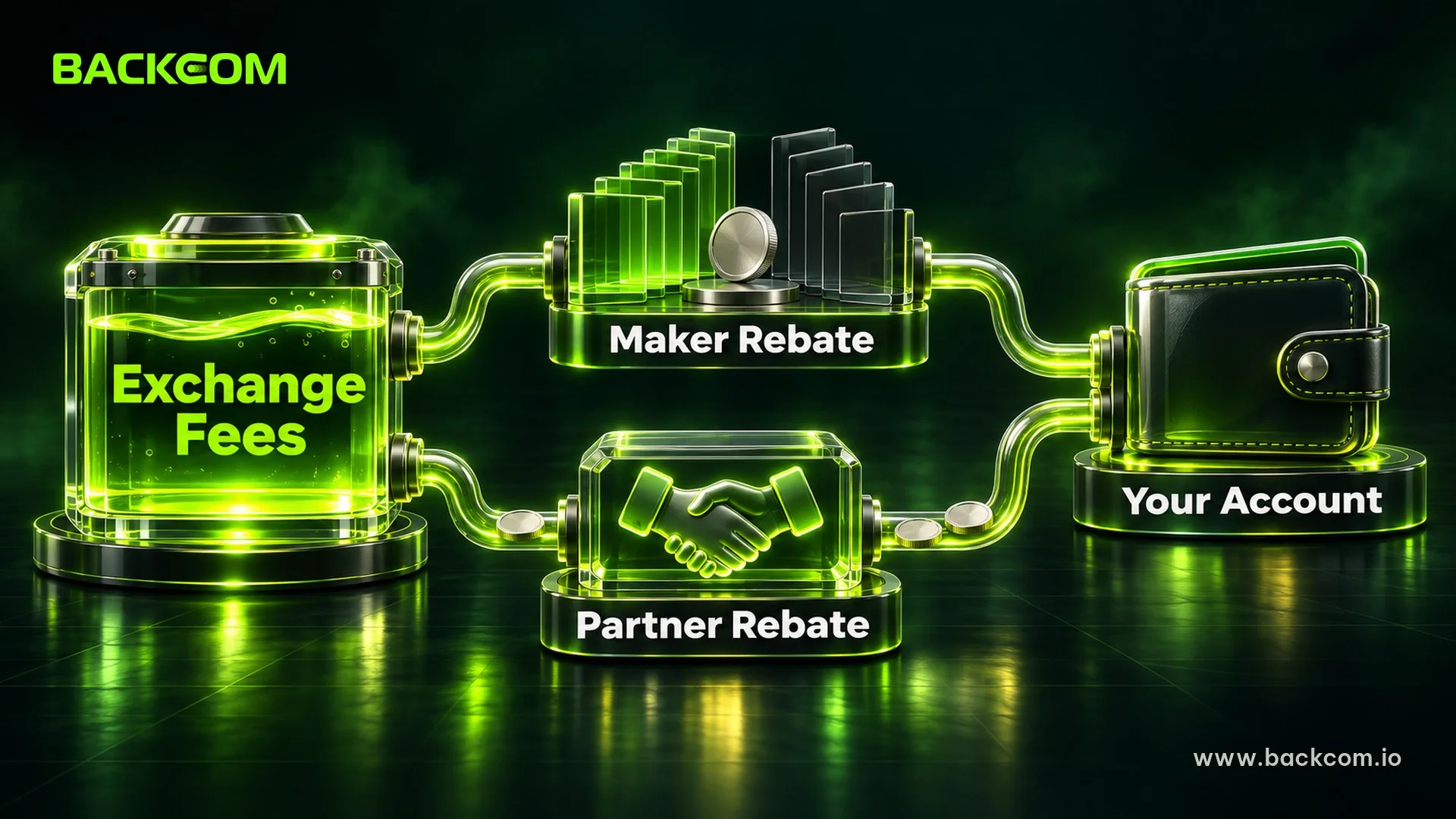
Rebate money comes from the fees an exchange earns, and it reaches you through one of two routes: a maker rebate or a referral-based fee rebate. The two are easy to confuse, so it helps to separate them.
Maker Rebates On The Exchange
Most exchanges use a maker-taker fee model. Makers add resting limit orders to the order book and usually pay a lower fee. Takers remove liquidity with market orders and pay a higher fee. At high volume tiers, some venues even pay makers a small negative fee. Deribit's 2020 market-structure research notes that on the BTC/USD perpetual markets of BitMEX and Deribit the taker fee was then 0.075% while the maker rebate was 0.025% (maker-taker fees on crypto exchanges).
Current fee schedules may differ. This kind of rebate depends on your order type and your 30-day volume tier. It is built into the exchange's own fee schedule, and every account on that tier receives it.
Fee Rebates Through An Introducing Partner
A second kind of program returns part of your fee because your account was registered through an introducing partner. The exchange pays the partner a commission on the fees your account generates, and the partner passes a share back to you. The amount, the schedule and the conditions are set by the partner and the exchange, not by the maker-taker tier.
This is the type of program compared in the next section. Because these terms are published by the partner, they can change, so always read the current page before you register.
Crypto Exchange Rebate Comparison: Binance And Bybit Side By Side
The table below lists the terms the partner publishes for two exchanges. It compares how the programs are structured, not which exchange is better, because the two have different fee schedules, products and licences.
| Item | Binance | Bybit |
|---|---|---|
| Rebate share of your fees | Up to 30% | 50% |
| Paid by | The introducing partner | The introducing partner |
| Products covered | Spot and futures, one combined rate | Spot and futures, one combined rate |
| Payout day | Every Monday | Every Monday |
| Minimum rebate or volume | None | None |
| Linking step | Register through the program link, then link your UID in the partner's app | Register through the program link, then link your UID in the partner's app |
| Sub-accounts | Each UID linked separately | Each UID linked separately |
| Existing accounts | Depends on account history; Binance does not allow changing an existing referrer | Register a new account with a new email, then link the UID |
Reference summary of the published terms, as at 4 November 2026 (exchange pages updated 23 October 2026). Terms can change, so check the current exchange page before you register.
Two points stand out. First, the headline percentage is only one input: Binance shows "up to" 30% while Bybit shows 50%, but the rebate is a share of a fee, so the final amount also depends on the fee rate you pay. Second, the practical rules (linking, sub-accounts, existing accounts) are nearly identical, which is why the checklist later in this article matters more than the percentage.
For a wider look at how the two exchanges differ in fees, products and safety, read our Binance vs Bybit comparison.
How To Calculate Your Crypto Trading Fee Cashback
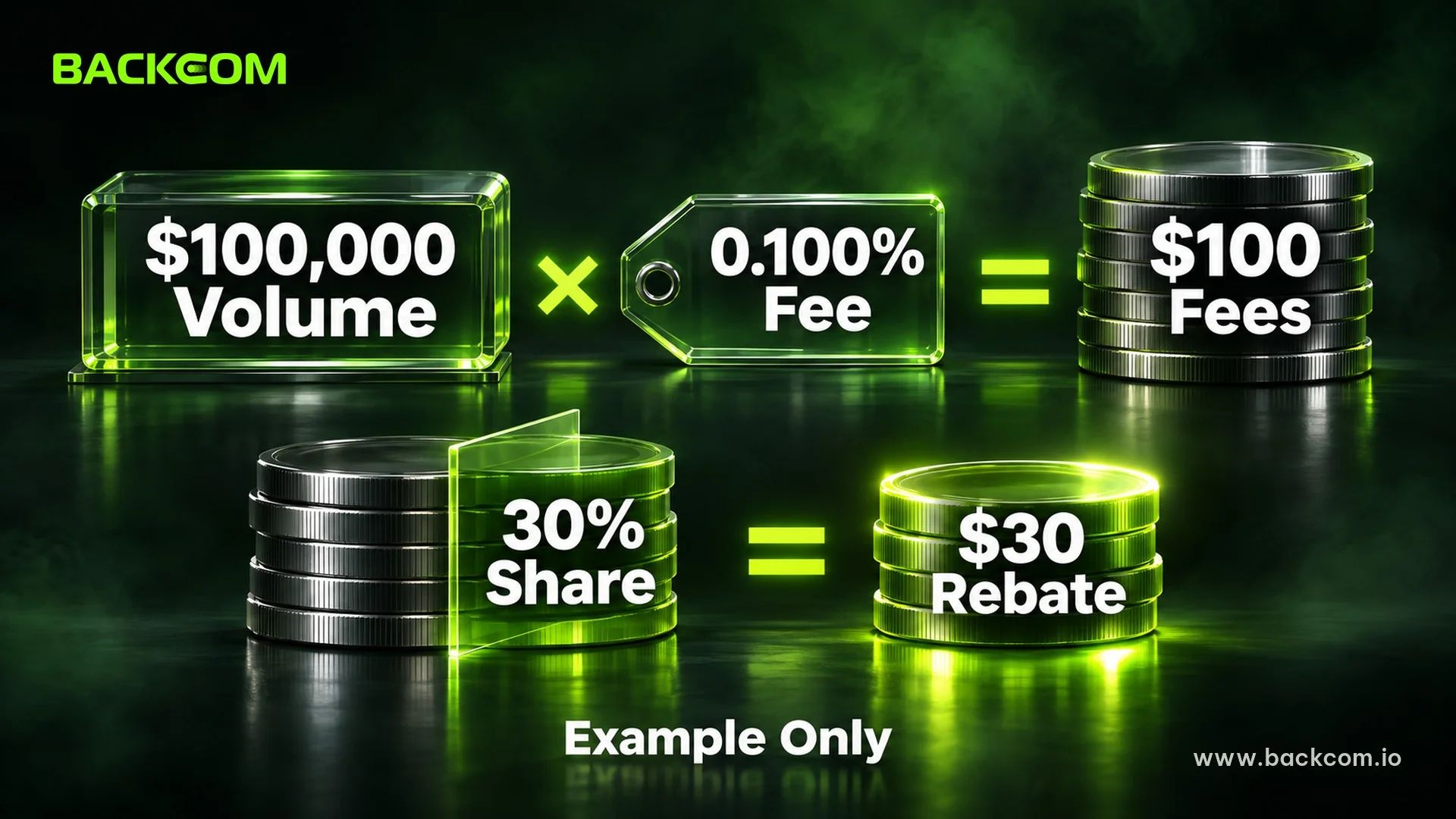
You can estimate a rebate with one formula, using your own fee rate rather than a headline number.
Rebate = Trading volume × Fee rate × Rebate share
Binance lists a regular (VIP 0) spot fee of 0.100% for both maker and taker orders, with a discount when you pay fees in BNB (Binance fee schedule, checked 4 November 2026). Here is a worked example built on that rate, for illustration only:
| Step | Calculation | Result |
|---|---|---|
| Monthly spot volume | Assumed | $100,000 |
| Fees paid at 0.100% | $100,000 × 0.100% | $100 |
| Rebate at 30% (top of an "up to 30%" range) | $100 × 30% | up to $30 |
| Rebate at 50% (a share some programs publish, same assumed fee) | $100 × 50% | $50 |
| Net fees after a 30% rebate | $100 − $30 | $70 |
The example is a simple illustration, as at 4 November 2026, with an assumed volume and the Binance VIP 0 spot fee of 0.100%. It is not a forecast, and your own fee tier, order types and rebate share will change the result.
Notice what the example shows. On $100,000 of volume, a rebate returns at most a few tens of dollars. It reduces a cost, which is useful for an active trader, but it is small next to the price move of a single leveraged position. Compare it with other costs too: slippage on a market order can easily exceed the whole rebate.
7 Things To Check Before You Compare Crypto Trading Rebates
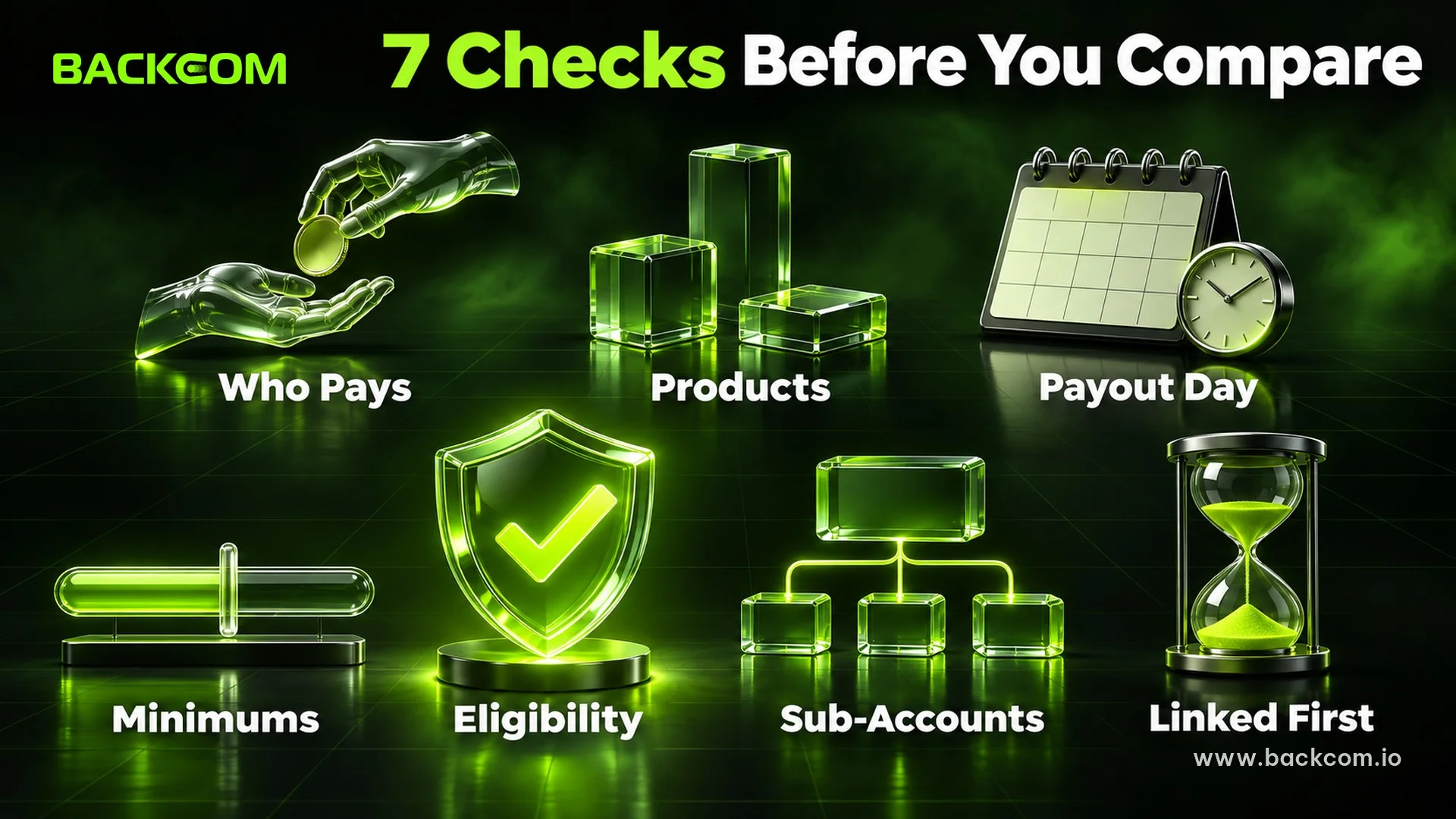
The most reliable way to compare rebate programs is to check the same seven conditions on each one. A high percentage with a hard condition can be worth less than a lower percentage you can actually use.
- Who pays the rebate. Some programs pay part of the rebate from the exchange and part from a partner, on different schedules. Know which part arrives when.
- Which products are covered. Check whether spot, USDT futures and coin-margined futures are all included, and whether they share one rate or have separate rates.
- The payout schedule. Daily, weekly and monthly payouts affect your cash flow.
- Minimums and limits. Look for a minimum volume, minimum payout, cap or time limit.
- Whether your account qualifies. Exchanges generally allow one referrer per account. An account opened earlier is usually tied to another referrer and cannot simply be switched.
- Sub-accounts. A new sub-account does not always inherit the rebate. Each UID may need to be linked separately.
- Retroactivity. Rebates usually cannot be added after trades have been made, so the account has to be linked before the first trade.
If you plan to trade perpetual contracts, also read how funding rates work. Funding payments are a separate cost, and fee rebates normally do not cover them.
Why A Bigger Rebate Does Not Mean A Cheaper Exchange
A larger rebate percentage does not make an exchange cheaper, because the rebate is calculated on a fee, and the fee itself differs from one exchange to another. To compare real cost, put the numbers in the same order every time:
- Base fee rate: your maker and taker rates at your volume tier.
- Rebate share: the percentage returned, after conditions.
- Net fee: fee minus rebate, per $1,000 or $100,000 of volume.
- Other costs: spread, slippage, funding, withdrawal fees and network fees.
An exchange with a 50% rebate on a higher fee can still cost more than an exchange with a 30% rebate on a lower fee. Spreads and depth matter too, especially on smaller trading pairs. Fee schedules also change, so a comparison that was true last quarter may not hold today.
For an example of a full fee breakdown on one exchange, see this guide to trading fees across spot, futures and VIP tiers. The method is the same for any platform.
Risks And Limits Of Fee Rebates

A rebate is a small discount, and it comes with limits that are easy to overlook.
- It can encourage overtrading. A rebate pays only when you trade, so it can nudge you to trade more than your plan says. Never raise your volume to earn more rebate.
- It does not reduce market risk. Leveraged crypto positions can lose more than a few fee refunds. Our guide to how to calculate liquidation price shows how fast a position can be closed.
- Terms can change. Both the exchange and the partner can change fees, rebate shares or conditions.
- Eligibility depends on where you live. Crypto exchanges restrict some countries, and rules and taxes on rebates differ by country of residence. Check the accepted-country list for your KYC country and ask a tax adviser how rebates are treated.
- Counterparty risk remains. A rebate does not make an exchange safer. If you are still choosing a platform, start with its licences, security record and withdrawal history, and read about account security settings first.
How To Check Your Eligibility For A Rebate
If you want to see whether a program fits your trading, start by reading the current terms for one exchange and checking the seven conditions above. For example, the Bybit rebate page lists the rate, payout day and linking steps in one place.
Backcom.io is an independent introducing broker (IB/affiliate) of the exchanges it lists, including Binance and Bybit; rebates are paid from the commission the exchange pays Backcom.io. See the risk disclaimer for details. A rebate is not a reason to open an account or to trade more than you planned.
Frequently Asked Questions (FAQ) About Crypto Exchange Rebates
Are Crypto Exchange Rebates Real?
Yes, when the program is run by a registered partner of the exchange and the exchange pays a commission on fees. The rebate is a share of that commission, so it is real but limited to a percentage of your fees. It only appears if your account is correctly linked and the exchange confirms the trades, so verify the rate and the payout record before you rely on it.
How Much Can I Get Back From Crypto Trading Fees?
Only a share of the fees you actually pay. With a 0.100% fee and $100,000 of monthly volume, fees are $100, and a 30% rebate returns up to $30. Your result depends on your fee tier, the products you trade, the rebate share and the conditions of the program, so use the formula in this article with your own numbers.
Can I Add A Rebate To An Existing Exchange Account?
Usually not. Exchanges generally allow one referrer per account, and an account opened earlier is often tied to another referrer. Some exchanges allow a limited change for very new or inactive accounts, but the rules differ. Read the exchange's own referral terms and the program page before you change anything on an account that holds funds.
What Are The Best Crypto Exchange Rebates?
There is no single answer, because the best crypto exchange rebates for one trader may be poor for another. Judge a program by net cost for your own volume, products and fee tier, then by conditions, payout schedule and the exchange's licences and security record. A headline percentage on its own is not a ranking, and any list that ranks programs without showing its criteria should be treated with caution.
Is A Higher Rebate Percentage Always Better?
No. The percentage applies to a fee, and fees differ by exchange, product and volume tier. Compare the net fee after the rebate, then add spreads, slippage, funding and withdrawal costs. Also weigh licences, security and the products you need, because a small saving is not worth a platform that does not fit your trading.
Conclusion: Compare Net Cost, Not Headlines
A good crypto exchange rebate comparison looks at who pays, which products are covered, how often you are paid and whether your account can qualify at all. The percentage matters, but it is only one input next to the fee rate, spreads and the exchange's reliability. Use the formula above, check the seven conditions, and treat any rebate as a small reduction in cost rather than a source of profit.
Disclaimer: This content is compiled by Backcom.io for information only and is not investment advice. Crypto assets are volatile and you can lose your capital. Rebate terms and exchange fees can change, and rules differ by country of residence. Check the current terms and your local regulations before you register or trade.
Was this article helpful?
Join The Backcom.io Community
Get the latest on trading rebates, trading tips, and broker deals — and connect with thousands of traders worldwide.

Backcom App
Track Your Rebates Every Day
Every rebate is visible by broker and by day. Manage your wallet and withdrawals in one place.
Open Backcom App