Is Bitget Legit? Regulation, Security And Fees Reviewed

Is Bitget legit? Based on the public record, Bitget is a large, long-running exchange that publishes monthly proof-of-reserves reports and says it keeps a separate protection fund, but its regulatory picture differs by country and several of its strongest claims come only from Bitget itself. In this Bitget review, Backcom.io walks through regulation, security, fees and withdrawal risks, so you can judge the platform on checkable facts rather than reputation.
Is Bitget Legit? The Short Answer
Bitget is a real, operating exchange with no public finding that it is a scam, but "legit" is not the same as "regulated everywhere" or "risk free". Three questions decide whether it fits you:
- Is the company real? Bitget runs public fee pages, an academy and monthly reserve reports.
- Is it licensed where you live? This depends on your country, and it is the point most reviews skip.
- Can you verify its claims? Reserve ratios and fund sizes are published by Bitget, so independent checks matter.
No exchange can be called safe in absolute terms. A fair verdict is a list of facts, a list of open questions and a plan to keep your own risk small.
Bitget Regulation: What Is Verified And What Is Not
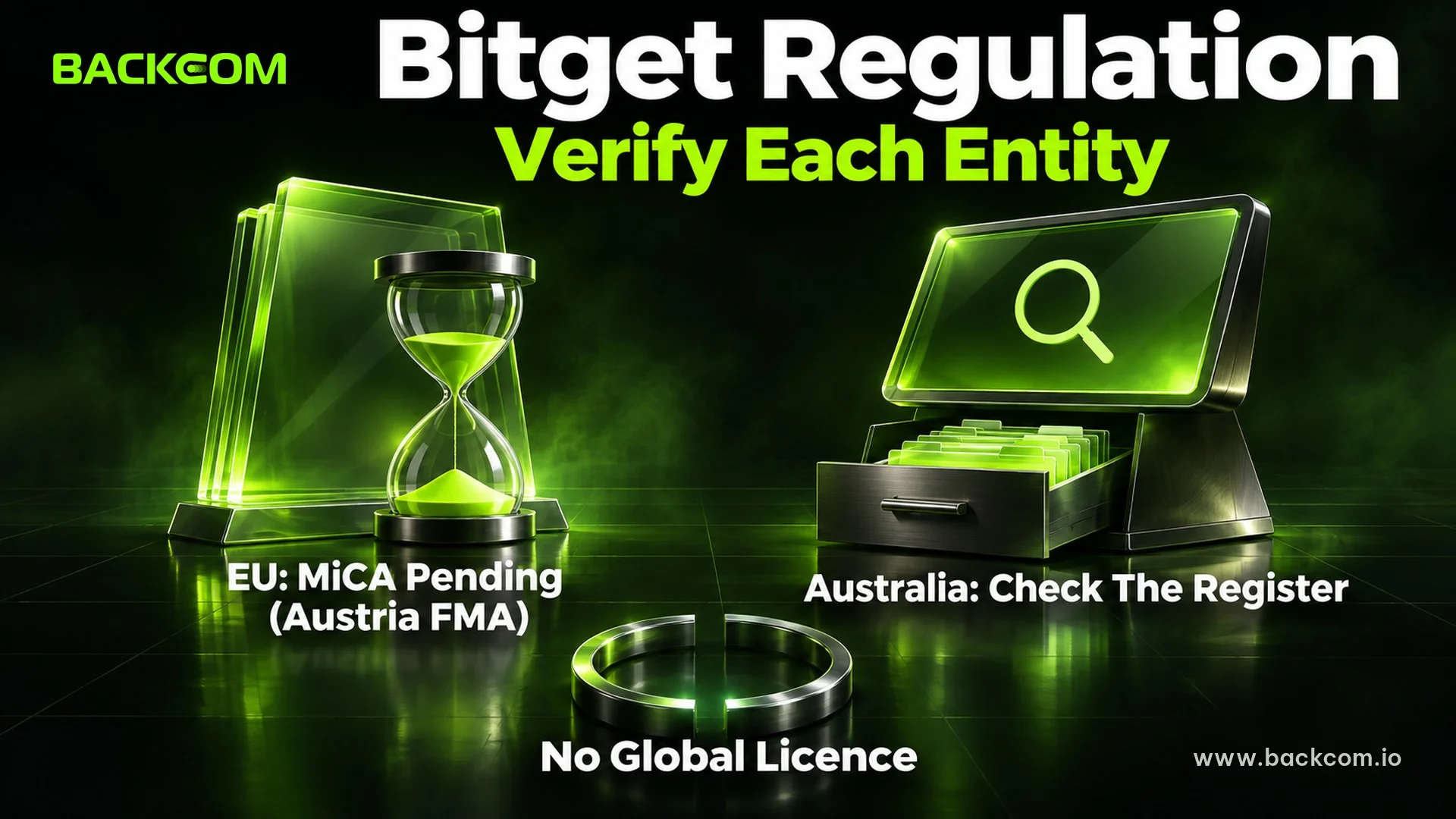
Bitget regulation is not one global licence; it is a set of registrations and authorisations that apply to specific entities and regions. Many lists of Bitget licences online come from review sites, not from regulator registers. This article states only what it could tie to a public source, so verify each point yourself.
| Region | What the public record shows | How to verify |
|---|---|---|
| European Union | National crypto registrations predate MiCAR, and national transition periods ended on 1 July 2026. Bitget EU applied to Austria's Financial Market Authority (FMA) for a MiCAR authorisation, announced in June 2026. Reports in July 2026 described it as pending, and we found no approval | ESMA registers and the FMA register |
| Australia | Not verified in this review | AUSTRAC public register of digital currency exchange providers |
| Other countries | No single global licence is published; access follows Bitget's own restricted-country list | Bitget terms and your KYC country |
Reference summary of public information, as at 5 November 2026. Licences and registrations change, so check the registers before you act.
Two cautions apply. First, many of these are anti-money-laundering registrations, not approval of an exchange's financial safety. Second, a registration held by a regional entity covers that entity's customers only. Read the user agreement to see which legal entity serves your account.
Also check the accepted and restricted countries list for your KYC country. Rules and taxes on crypto differ by country of residence, so ask a local adviser about your own position.
Is Bitget Safe? Proof Of Reserves And The Protection Fund
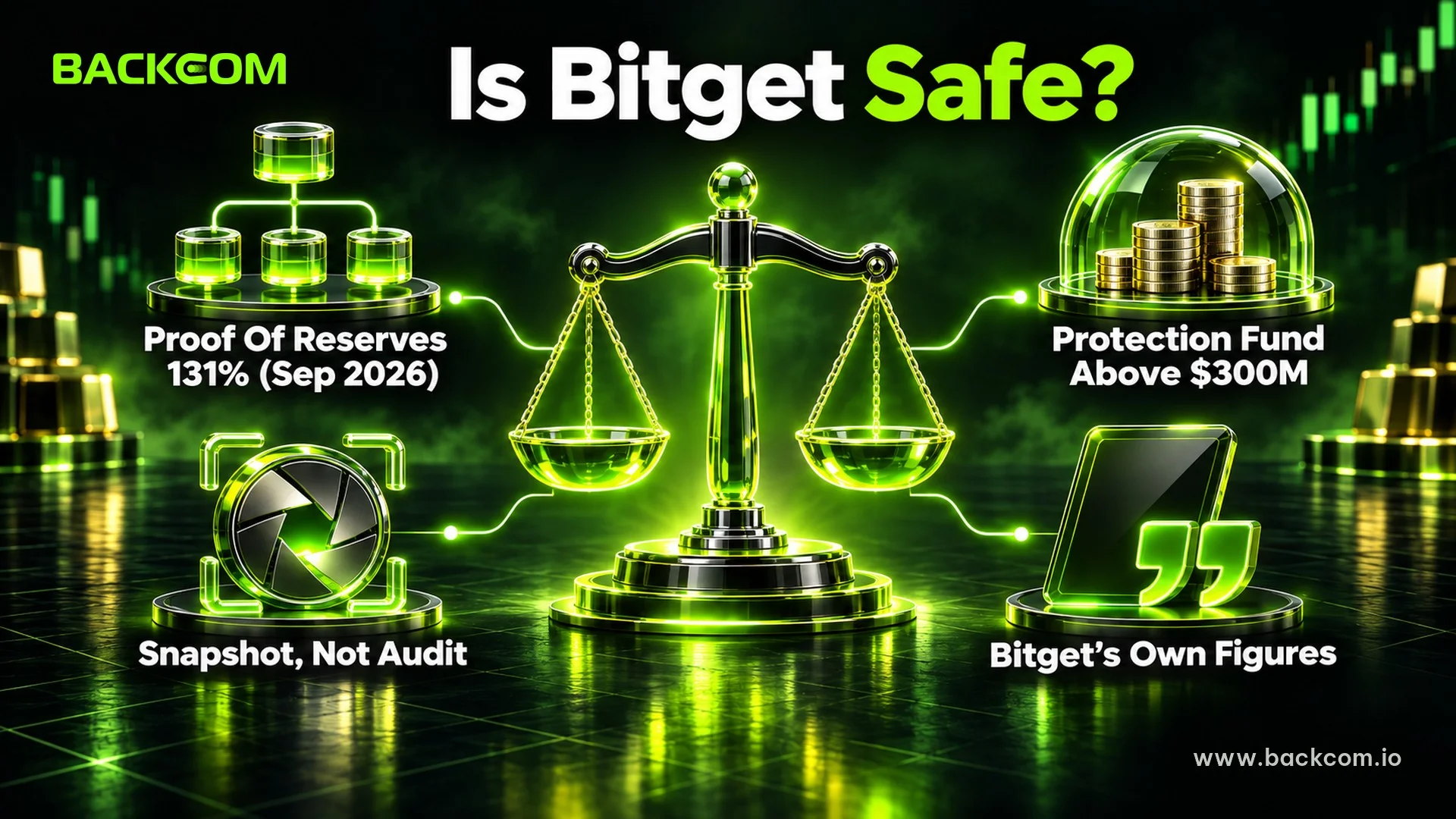
Safety has two parts: what the exchange discloses about its assets, and what backstop exists if something fails. Both matter for a fair Bitget review.
Bitget Proof Of Reserves
Bitget publishes a monthly proof-of-reserves report that uses a Merkle tree, a method that lets each user check that their balance is included in the total of customer liabilities. Bitget's 47th proof-of-reserves update, with a snapshot dated 29 September 2026 and covering 19 assets, showed a 131% total reserve ratio (Bitget announcement). The per-asset breakdown is on Bitget's proof of reserves page. Bitget also offers an open-source MerkleValidator tool so you can confirm your own user ID is included.
Read the number with care. The ratio is Bitget's own figure, the report coverage we saw does not name an auditor, and earlier reports showed different ratios, such as 169% in February 2026, so the ratio moves from month to month.
Proof of reserves is a snapshot, not a full audit. It compares listed assets with liabilities at one point in time and does not show loans or off-platform obligations. Treat it as a positive transparency step, not a guarantee of solvency.
The Protection Fund
Bitget says it holds a separate Protection Fund, kept apart from user deposits. Its September 2026 update says the fund started at $300 million and that Bitget will keep its valuation above that level (Bitget announcement). These are Bitget's own statements. The live value is shown on Bitget's Protection Fund page. A fund like this is a cushion, not insurance: its terms and payout rules decide whether it would cover you.
For general protection, the settings in our account security checklist apply to any exchange: two-factor authentication, an anti-phishing code and a withdrawal whitelist. We did not verify a major hack history for Bitget in this review, so check Bitget's announcements for any recent incident.
Bitget Review Of Fees: What You Actually Pay
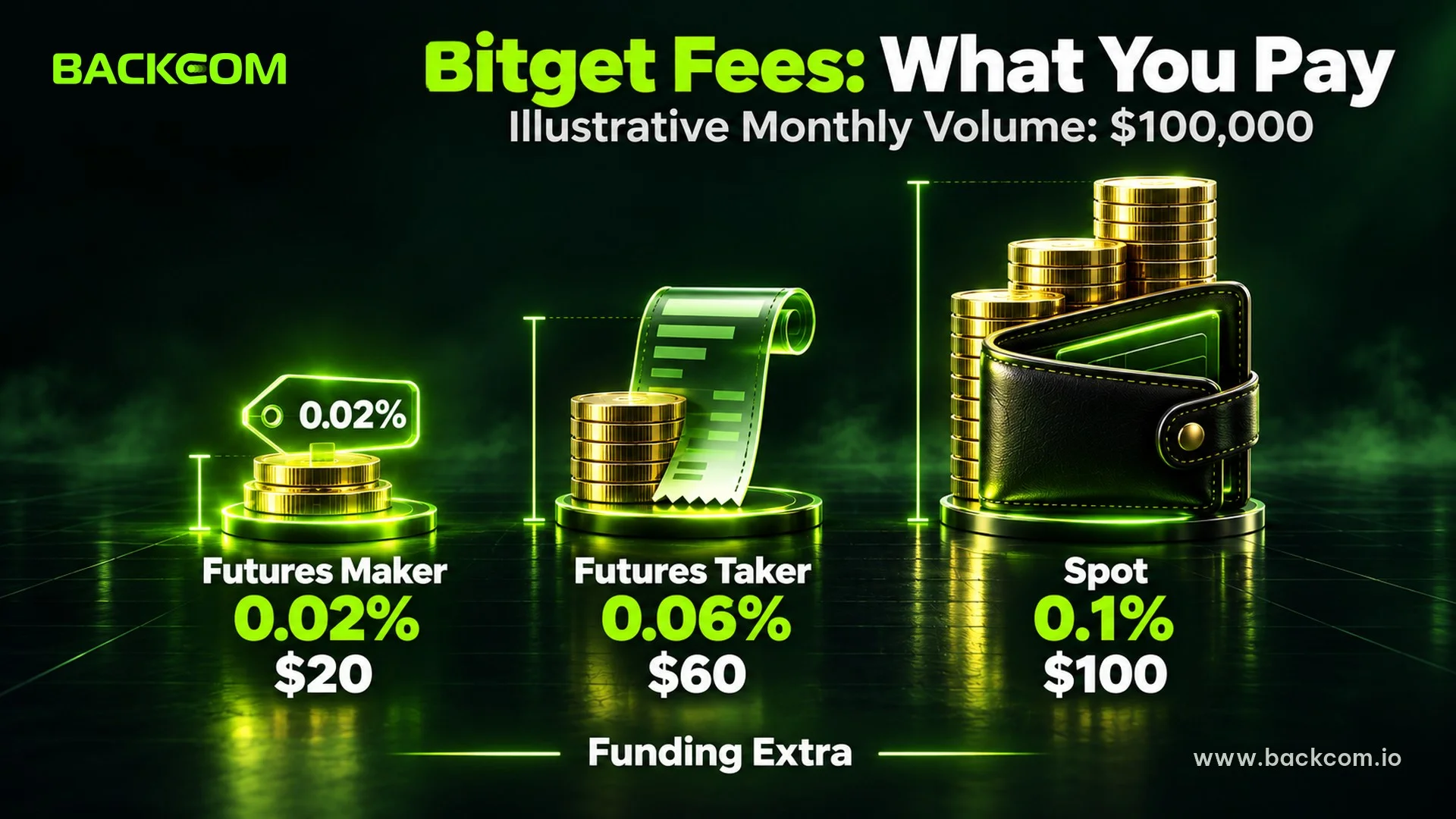
Bitget fees follow a maker-taker model, and the headline rate depends on the product and your volume tier. Bitget's academy lists spot trading at 0.1% for both makers and takers, and futures at 0.02% for makers (resting limit orders) and 0.06% for takers (orders that execute at once). Bitget tells users to check its fee schedule page for the latest rates, and VIP tiers lower them at higher volume.
The practical point is that order type changes your cost. A trader who uses limit orders pays the lower maker rate, while a trader who uses market orders pays the taker rate and also risks slippage. On perpetual contracts, add funding payments, which are charged separately from trading fees. The difference is explained in our guide to maker vs taker fees.
A short worked example, for illustration only, with an assumed $100,000 of monthly volume:
| Product | Assumed fee rate | Fees paid |
|---|---|---|
| Futures, all maker orders | 0.02% | $20 |
| Futures, all taker orders | 0.06% | $60 |
| Spot at the base rate | 0.1% | $100 |
The figures are an assumption, as at 5 November 2026, using published base rates. They are not a forecast, and your VIP tier, discounts and order mix will change the result.
Bitget Withdrawal Problems: What To Check Before You Deposit
Complaints about Bitget withdrawal problems usually fall into a few repeatable categories, and most can be reduced before you deposit. Searching "Bitget withdrawal problems" mainly returns user posts and review sites of mixed quality, so treat individual stories as signals, not proof. We did not verify current complaint volumes.
The common causes on any exchange are:
- Pending KYC or a risk review: a withdrawal can be held while the exchange checks identity or account activity.
- Network congestion or a wrong network: sending a token on the wrong chain can lose it.
- Withdrawal limits and fees: daily limits and per-network fees apply, and they depend on your verification level.
- Account restrictions: an account in a restricted country or one that breaks the terms may be limited.
- Maintenance: short deposit and withdrawal pauses happen on any platform.
A sensible routine reduces these risks. Verify your identity first, make a small test withdrawal, and only then move larger amounts. Keep long-term holdings in your own wallet instead of leaving everything on any exchange. Our guide to deposit and withdrawal safety rules covers the same habits.
Bitget Rebates Through The Partner Program
Bitget Rebates are a share of your trading fees returned to you when your account is registered through the partner program. The program page lists a 50% rebate share on spot and futures fees: 20% credited daily by Bitget and 30% paid every Monday through the partner program, with no minimum volume and no time limit (page updated 23 October 2026, checked 5 November 2026).
Using the example above: $100,000 of taker-only futures volume at 0.06% produces $60 in fees, and a 50% share would return $30. The same volume on spot at 0.1% would produce $100 in fees and a $50 rebate. A rebate is a share of a fee, not of your trade or your profit, and it applies to winning and losing trades alike.
Three conditions matter. The account must be registered through the program link before you trade, each UID, including sub-accounts, has to be linked in your Backcom.io App account, and an existing account is usually tied to another referrer, so a new account with a new email is the usual route. Ask support about your case. To compare programs fairly, read our crypto exchange rebate comparison.
You can read the current terms, linking steps and fee calculator on the Bitget rebate page.
Backcom.io is an independent introducing broker (IB/affiliate) of the exchanges it lists, including Bitget; rebates are paid from the commission the exchange pays Backcom.io. See the risk disclaimer for details. A rebate is not a reason to open an account, deposit funds or trade more than you planned.
How Bitget Compares With Other Exchanges
A fair comparison looks at licences, security record, fees and the products you need, and it does not produce one winner for every trader. We do not rank exchanges here, because there is no common scoring method that covers every user's needs. If you are building a shortlist, our independent reviews of OKX, Bybit and MEXC use the same questions, so you can read them side by side.
Before choosing, it also helps to understand centralized and decentralized exchanges. Bitget is a centralized exchange, so it holds custody of assets you leave on the platform.
6 Checks Before You Use Bitget
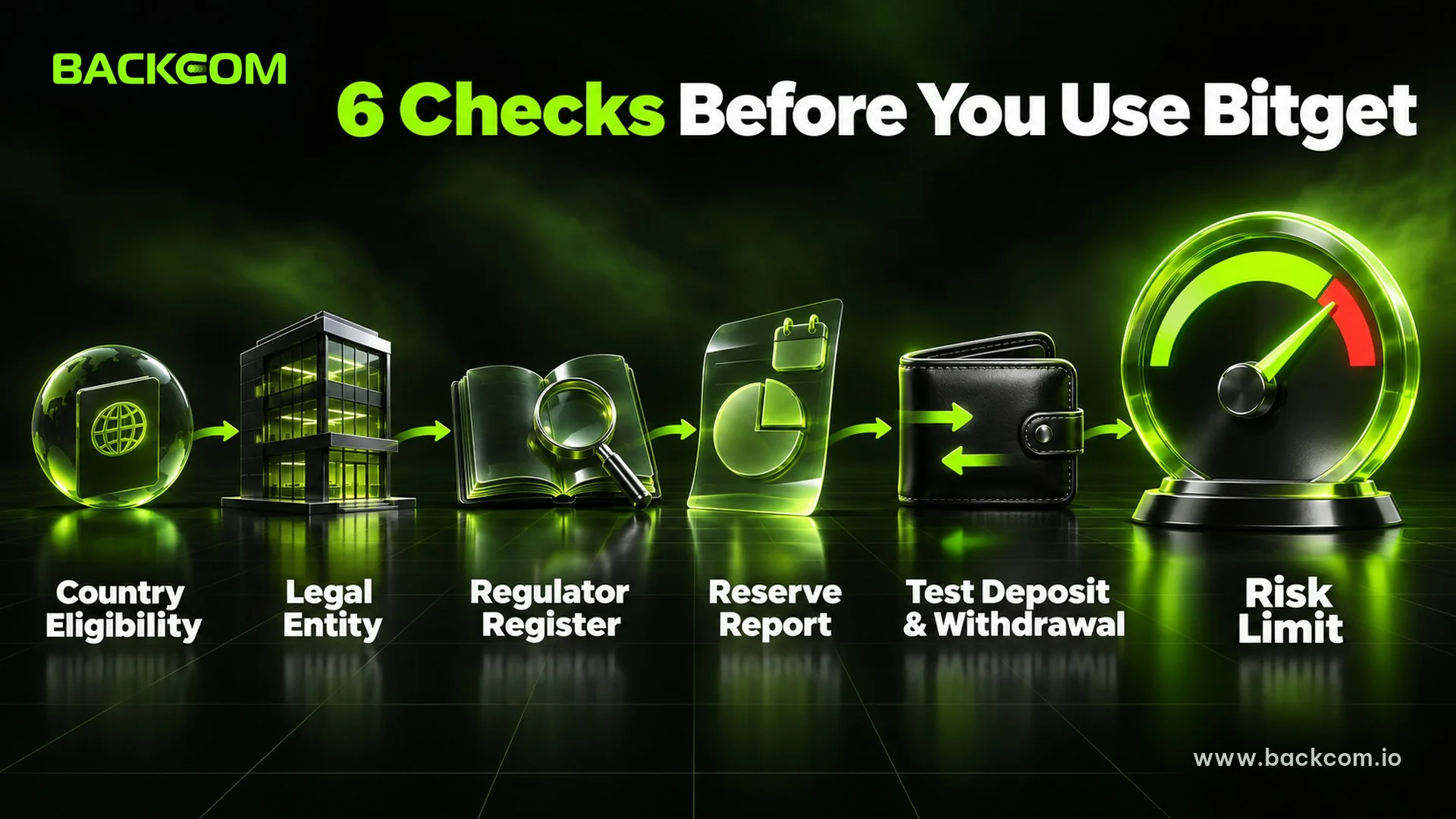
Run the same checklist on any exchange before you deposit.
- Confirm your country is accepted in the Bitget terms for your KYC country.
- Identify the legal entity that serves your account in the user agreement.
- Check that entity's registration on the regulator's own register.
- Read the reserve report and note the date, assets and ratio it covers.
- Test with a small deposit and withdrawal before moving size.
- Set a risk limit: a leveraged position can be closed fast, and our guide to calculating liquidation price shows how to plan one.
Frequently Asked Questions (FAQ) About Bitget
Is Bitget A Scam?
There is no public finding that Bitget is a scam. It publishes monthly reserve reports and a validator tool. That does not remove risk, and licensing depends on your country, so verify the entity and registration that apply to you.
Is Bitget Regulated?
It depends on the region. Bitget EU has applied to Austria's FMA for a MiCAR authorisation, which reports in July 2026 described as pending, and we found no approval as at 5 November 2026. There is no single global licence. Check the regulator's register for your own region.
Is Bitget Safe For Beginners?
Beginners can reduce risk by keeping position sizes small, enabling two-factor authentication, starting with spot trading and avoiding high leverage. Beginners often lose money through leverage and wrong-network transfers, not through the exchange itself. Never deposit money you cannot afford to lose.
Can I Withdraw My Money From Bitget?
Withdrawals are normally available once your account is verified, subject to limits, network fees and any risk review. Delays happen on every exchange. Test with a small amount first, use the correct network, and contact Bitget support if a withdrawal is held for long.
How Much Do Bitget Fees Cost?
Published base rates are 0.1% for spot, and 0.02% maker and 0.06% taker on futures, with VIP discounts at higher volume. Your cost also includes spreads, slippage and funding, so compare the net cost for your own trading style and check the live fee page.
Conclusion: Is Bitget Legit?
Bitget looks like a real and established exchange, but the right question is whether its licences, reserves and fees fit your situation. It publishes monthly reserve data and says it keeps a protection fund, yet the figures are self-reported and its EU MiCAR application was still pending in the sources we found. Verify the entity and registration for your country, test withdrawals with a small amount, and treat any rebate as a small cost reduction, not a source of profit.
Disclaimer: This content is for information only and is not investment advice. Crypto assets are volatile and you can lose your capital. Licences, fees and rebate terms can change, and rules differ by country of residence. Check the current terms and your local regulations before you register or trade.
Was this article helpful?
Join The Backcom.io Community
Get the latest on trading rebates, trading tips, and broker deals — and connect with thousands of traders worldwide.

Backcom App
Track Your Rebates Every Day
Every rebate is visible by broker and by day. Manage your wallet and withdrawals in one place.
Open Backcom App