Crypto Position Size Calculator: How To Calculate Position Size In Futures


A crypto position size calculator answers one question before every trade: how many coins or contracts can you open without losing more than you planned if the stop is hit? Most account blowups on futures do not come from a bad entry. They come from a position that was too large for the distance to the stop. This guide shows the formula, three worked examples with illustrative numbers, and how fees, slippage and leverage change the answer. In this article, Backcom.io keeps the arithmetic simple enough to check with a basic calculator.
What Is Position Size In Crypto Futures?
Position size is the amount you trade, measured in coins, contracts or notional value (coins multiplied by price). It is not the same as the margin you post. A 1,000 USDT position at 10x leverage needs only 100 USDT of margin, yet it moves your account by the full 1,000 USDT exposure.
That distinction is why leverage does not tell you how risky a trade is. Risk depends on two things: the size of the position and how far price must travel to reach your stop. If you need a refresher on the mechanics, read what leverage means in crypto trading first.
Forex traders size in lots instead of coins, as explained in lot size in forex. Position sizing works backwards. You decide what you are willing to lose, then you let the stop distance decide the size. The size is an output, not a feeling.
Risk Per Trade Crypto Traders Use: The 1% Rule
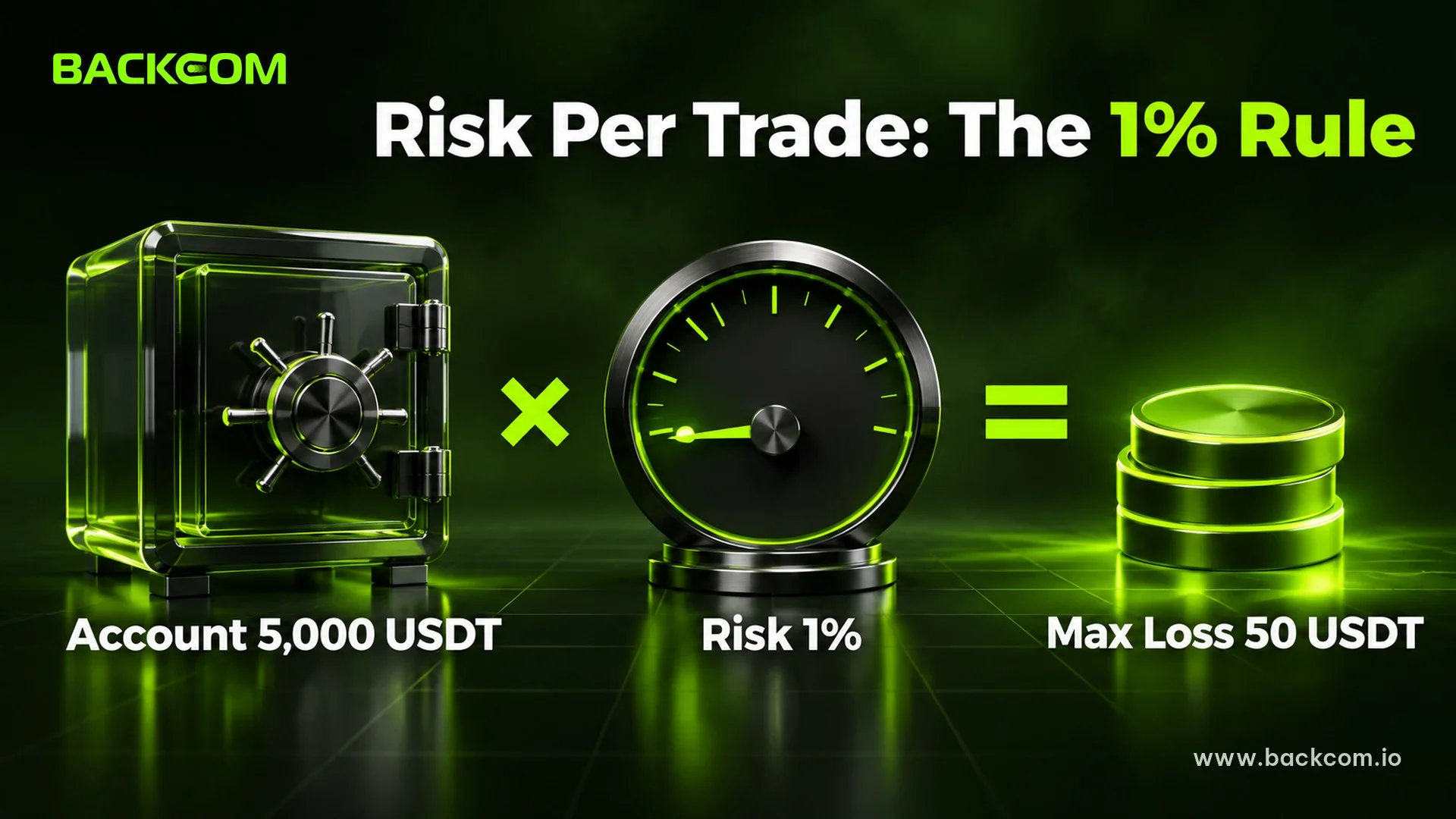
Risk per trade crypto traders choose is the share of the account they accept losing if one stop is hit. A common starting point is 1%. According to the Binance Academy guide to position size, the 1% rule caps the loss, not the position: a trade can be much larger than 1% of your account as long as the stop limits the loss to 1%.
The rule exists because losses compound against you. The table below shows the account drawdown after ten losing trades in a row at different risk levels.
| Risk Per Trade | Loss After 10 Straight Stops | Balance Left From 5,000 USDT |
|---|---|---|
| 0.5% | 4.9% | 4,756 USDT |
| 1% | 9.6% | 4,522 USDT |
| 2% | 18.3% | 4,085 USDT |
| 5% | 40.1% | 2,994 USDT |
Illustrative arithmetic: each loss is a percentage of the remaining balance, so the total is 1 minus (1 minus risk) to the power of 10. Real results depend on your win rate and costs.
At 1% you can survive a long losing streak and still trade. At 5% the same streak removes about 40% of the account, and recovering that needs a gain of roughly 67%. For a wider view of sizing across markets, see the 1% rule for forex money management.
The Position Size Formula, Step By Step
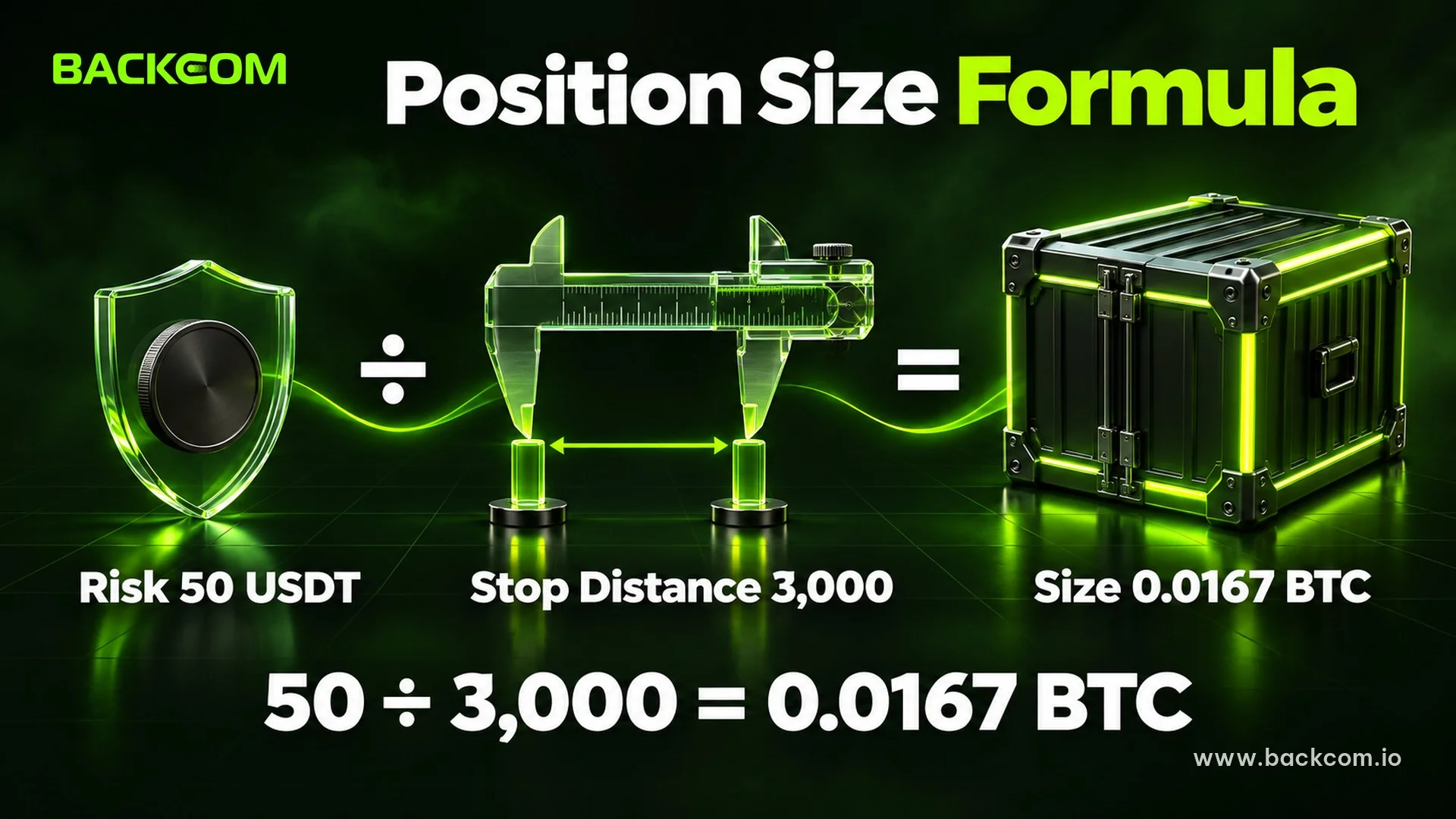
The position size formula divides your money at risk by the loss per coin if the stop is hit:
Position size = (Account balance × Risk %) ÷ |Entry price − Stop price|
The result is in coins. Multiply by the entry price to get the notional value. Follow these steps:
- Set the risk amount: account balance multiplied by your risk percentage.
- Mark the stop: place it at a level that invalidates your idea, not at a distance you can afford.
- Measure the distance: the absolute gap between entry and stop, in price units.
- Divide: risk amount divided by the distance gives the size in coins.
- Check the margin: notional value divided by leverage must fit your free balance.
Notice the order. The stop comes before the size. If you pick the size first and then squeeze the stop to fit, the stop no longer reflects the market.
Worked Example: A Long Position On BTC
Assume a 5,000 USDT account, 1% risk, and a long entry on BTC at 100,000 USDT with a stop at 97,000 USDT. These prices are illustrative.
- Risk amount: 5,000 × 1% = 50 USDT.
- Stop distance: 100,000 − 97,000 = 3,000 USDT per BTC, which is 3%.
- Position size: 50 ÷ 3,000 = 0.0167 BTC.
- Notional value: 0.0167 × 100,000 = about 1,667 USDT.
If the stop fills exactly at 97,000, the loss is 0.0167 × 3,000 = 50 USDT. The same answer comes from dividing the risk amount by the stop percentage: 50 ÷ 0.03 = 1,667 USDT.
The margin you post is a separate choice. At 5x leverage you would lock about 333 USDT, at 10x about 167 USDT. Both give the same 50 USDT risk, because the stop and the size did not change.
Stop Loss Position Size: Wider Stops Mean Smaller Positions
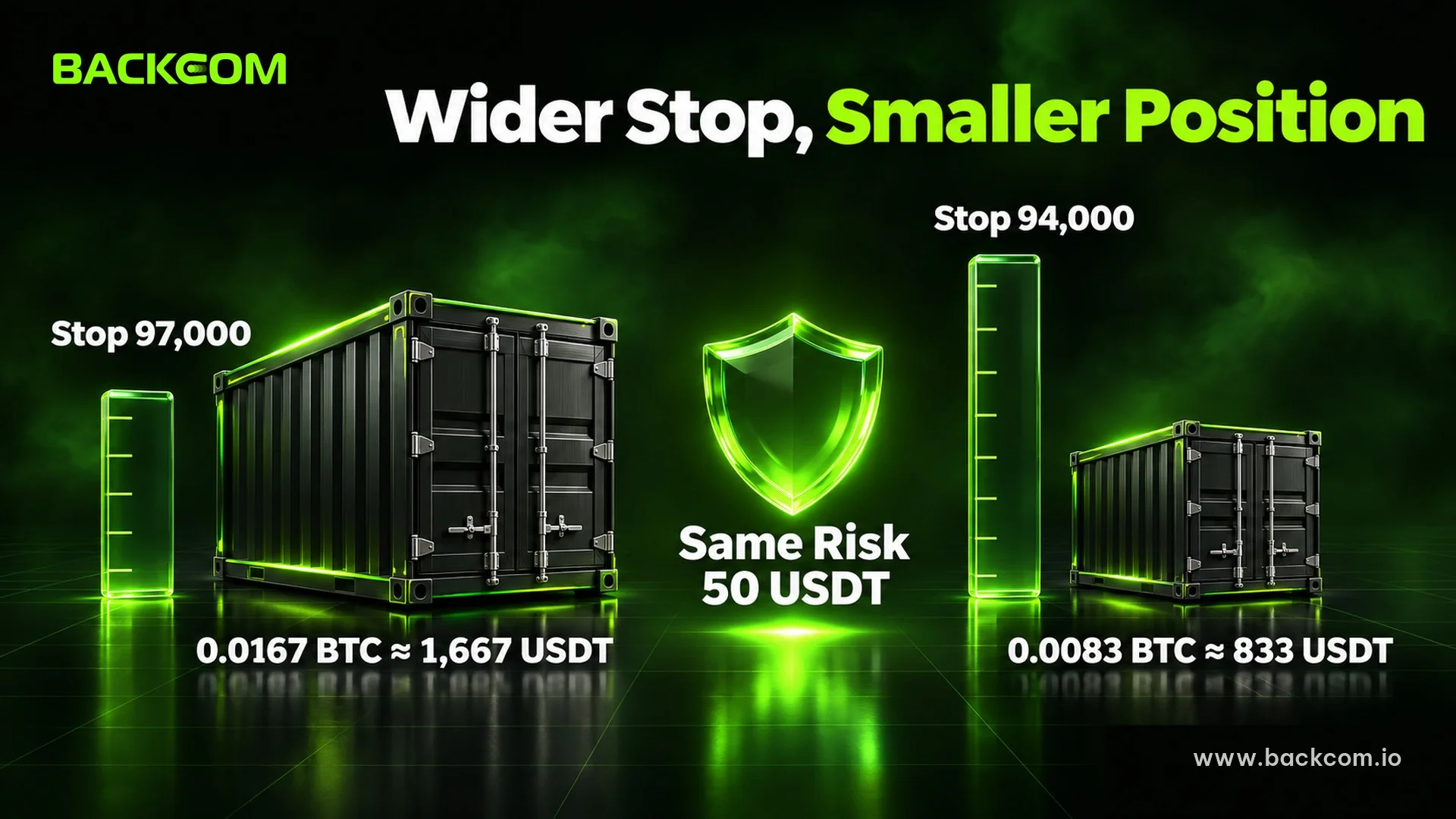
Stop loss position size moves in the opposite direction to stop distance. Double the distance and you halve the position. Keep the BTC example above but widen the stop to 94,000 USDT:
- Stop distance: 6,000 USDT, which is 6%.
- Position size: 50 ÷ 6,000 = 0.0083 BTC.
- Notional value: about 833 USDT.
The dollar risk is still 50 USDT, but the exposure is half as large. This is the point many beginners miss: a wider stop is not riskier if the size shrinks with it. A tight stop with an oversized position is the dangerous combination.
For the distance itself, some traders use a volatility measure instead of a fixed percentage. A stop set at two times the average true range, for example, adapts to quiet and busy markets. Our guide to the ATR indicator for stop loss and lot size explains the calculation. To see how stop-market orders can fill worse than the trigger, read what slippage means in crypto.
Worked Example: A Short Position On An Altcoin
The formula works the same way for shorts, and for coins priced in cents. Assume a short entry at 2.00 USDT with a stop at 2.10 USDT, a 5,000 USDT account and 1% risk.
- Risk amount: 50 USDT.
- Stop distance: 2.10 − 2.00 = 0.10 USDT per coin.
- Position size: 50 ÷ 0.10 = 500 coins.
- Notional value: 500 × 2.00 = 1,000 USDT.
Here the stop is 5% away, so the notional value is smaller than in the BTC case. A volatile coin with a wide stop naturally gets a small position.
Fees And Slippage: Adjust The Loss Budget
Real losses are larger than the stop distance suggests, because fees and slippage add to them. Account for both before you click.
Fees. Futures exchanges charge a fee on the entry and another on the exit. Suppose the taker fee is 0.05% each way (an illustrative rate; check your own tier and read maker vs taker fees in crypto). On the BTC example, the fee per BTC is about 100,000 × 0.0005 + 97,000 × 0.0005 = 98.5 USDT. Add that to the stop distance:
Adjusted size = 50 ÷ (3,000 + 98.5) = 0.0161 BTC
The notional value falls from about 1,667 to about 1,614 USDT. The difference looks small, yet it keeps the full loss, fees included, near your 50 USDT limit.
Slippage. A stop-market order fills at the next available price, which can be worse than the trigger. Suppose the BTC stop fills 200 USDT lower at 96,800. The loss on 0.0167 BTC becomes 0.0167 × 3,200 = about 53 USDT before fees, roughly 7% above the planned 50. Slippage rises in thin books and fast candles, so keep a margin of safety on volatile coins.
Crypto Futures Risk Management: Leverage And Liquidation
Crypto futures risk management has a hard boundary that spot trading does not: liquidation. If price reaches your liquidation level before your stop, the exchange closes the position and you lose the margin, not just your planned 50 USDT.
On Binance Futures, liquidation is triggered when the mark price reaches your liquidation price, as stated in the Binance Futures liquidation protocols. Your stop may trigger on the last price instead, so the two can diverge in fast markets. Leave a clear buffer between the stop and liquidation, and read the rules of the exchange you use.
Two checks keep the stop in charge:
- Stop before liquidation: the stop price must sit on the safe side of the liquidation price, with room for slippage. Learn the calculation in how to calculate liquidation price.
- Margin mode: cross margin shares your whole balance across positions, while isolated margin limits the loss to the margin assigned. The trade-offs are covered in cross margin vs isolated margin.
Leverage should follow from the size, not the other way round. In the BTC example the position is 1,667 USDT on a 5,000 USDT account, so even 1x leverage would carry it. Higher leverage only reduces the margin locked, and it also moves liquidation closer to your entry. If you hold several positions at once, remember that their risks add up: three trades at 1% each can lose 3% together when the market moves as one.
Common Position Sizing Mistakes
These errors appear again and again in futures accounts:
- Sizing by leverage: choosing "20x" first and calling that a plan. Leverage is not risk.
- Moving the stop after entry: widening it to avoid a loss turns a 1% risk into an unplanned 3%.
- Ignoring fees and slippage: the real loss is always larger than distance times size.
- Averaging down without recalculating: adding to a loser raises the total risk beyond the original budget.
- Sizing every trade the same: a fixed coin amount ignores that stop distance changes from setup to setup.
- Risking too much after a loss: raising the risk percentage to win it back is how streaks become blowups.
Write the risk amount, stop price and size down before you enter. A short checklist beats memory when the market is moving fast.
A Quick Pre-Trade Checklist
Run through these five lines before every order:
- Risk amount: balance multiplied by your fixed percentage, written as a number.
- Stop price: the level where the idea is wrong, placed before you look at size.
- Size: risk amount divided by stop distance plus estimated fees.
- Liquidation: confirmed to sit beyond the stop with a buffer for slippage.
- Total exposure: all open trades together stay inside your overall risk limit.
Frequently Asked Questions (FAQ) About Crypto Position Size
How Do I Use A Crypto Position Size Calculator?
Enter your account balance, risk percentage, entry price and stop price. The calculator returns the size in coins and the notional value. You can reproduce it by hand: risk amount divided by the gap between entry and stop. Always check that the margin fits your free balance and that liquidation sits beyond your stop.
Is 1% Risk Per Trade Too Low For Crypto?
Not for most traders. Crypto moves fast, so stops get hit often, and a small risk percentage keeps a losing streak survivable. Some experienced traders risk less, others slightly more. There is no number that guarantees profit, and a higher percentage mainly increases drawdowns.
Does Leverage Change My Position Size?
No. The size comes from risk amount and stop distance. Leverage only changes how much margin the exchange locks and how close the liquidation price sits. A 1,667 USDT position carries the same risk at 3x or at 10x, but the higher setting leaves less room before liquidation.
Should I Include Fees In The Calculation?
Yes. Fees on entry and exit add to every loss, and futures fees apply to the full notional value. Add the estimated fee per coin to the stop distance, as in the adjusted example above, so the total loss stays inside your budget.
Conclusion: Let The Stop Decide The Size
Position sizing turns a vague plan into a number. Pick your risk per trade, place the stop where the idea fails, divide, and then adjust for fees and slippage. A wider stop means a smaller position, and leverage is only a margin setting. To go deeper on exits, read our guide to crypto stop loss types and placement, and keep liquidation beyond your stop at all times.
Disclaimer: This content is compiled by Backcom.io for information only and is not investment advice. Crypto and leveraged futures carry a high risk of loss, and all prices and fees in the examples are illustrative. Check current rules on your exchange and in your country of residence.
Was this article helpful?
Join The Backcom.io Community
Get the latest on trading rebates, trading tips, and broker deals — and connect with thousands of traders worldwide.

Backcom App
Track Your Rebates Every Day
Every rebate is visible by broker and by day. Manage your wallet and withdrawals in one place.
Open Backcom App