Crypto Stop Loss Explained: Types, Placement And Common Mistakes


A crypto stop loss is a standing instruction that closes your position when the market moves against you by a set amount. It sounds simple, yet most traders discover its limits only after a fast candle fills them far from the price they chose. This guide explains how the main stop types differ, where to place a stop on futures, and why slippage can turn a planned loss into a bigger one. In this article, Backcom.io uses worked examples with illustrative numbers so you can check the arithmetic yourself.
What Is A Crypto Stop Loss And Why Do Traders Use It?
A stop loss is a conditional order: it sits dormant until the market reaches a trigger price, then sends an order to close the position. Until that moment it does nothing, and it does not guarantee where the exit will fill.
Traders use stops for three practical reasons:
- Defined risk: you decide the maximum loss before you enter, not while the price is falling.
- Less emotion: the exit happens by rule, so you are not tempted to hope, widen the stop or average down.
- Time: crypto trades around the clock, and a stop works while you sleep.
New to the market? Start with our beginner guide to crypto. A stop is not insurance. It is a tool that limits damage in normal conditions and can fail in extreme ones. Leveraged positions make this more important, because a small price move is a large percentage of your margin. If you are new to that mechanic, read what leverage means in crypto trading first.
Most exchanges place the stop on their own servers. That matters because a stop stored on the exchange keeps working if your phone dies or your connection drops, whereas an alert on your screen does not.
Stop Loss Vs Stop Limit Crypto: Which Order Type Should You Use?
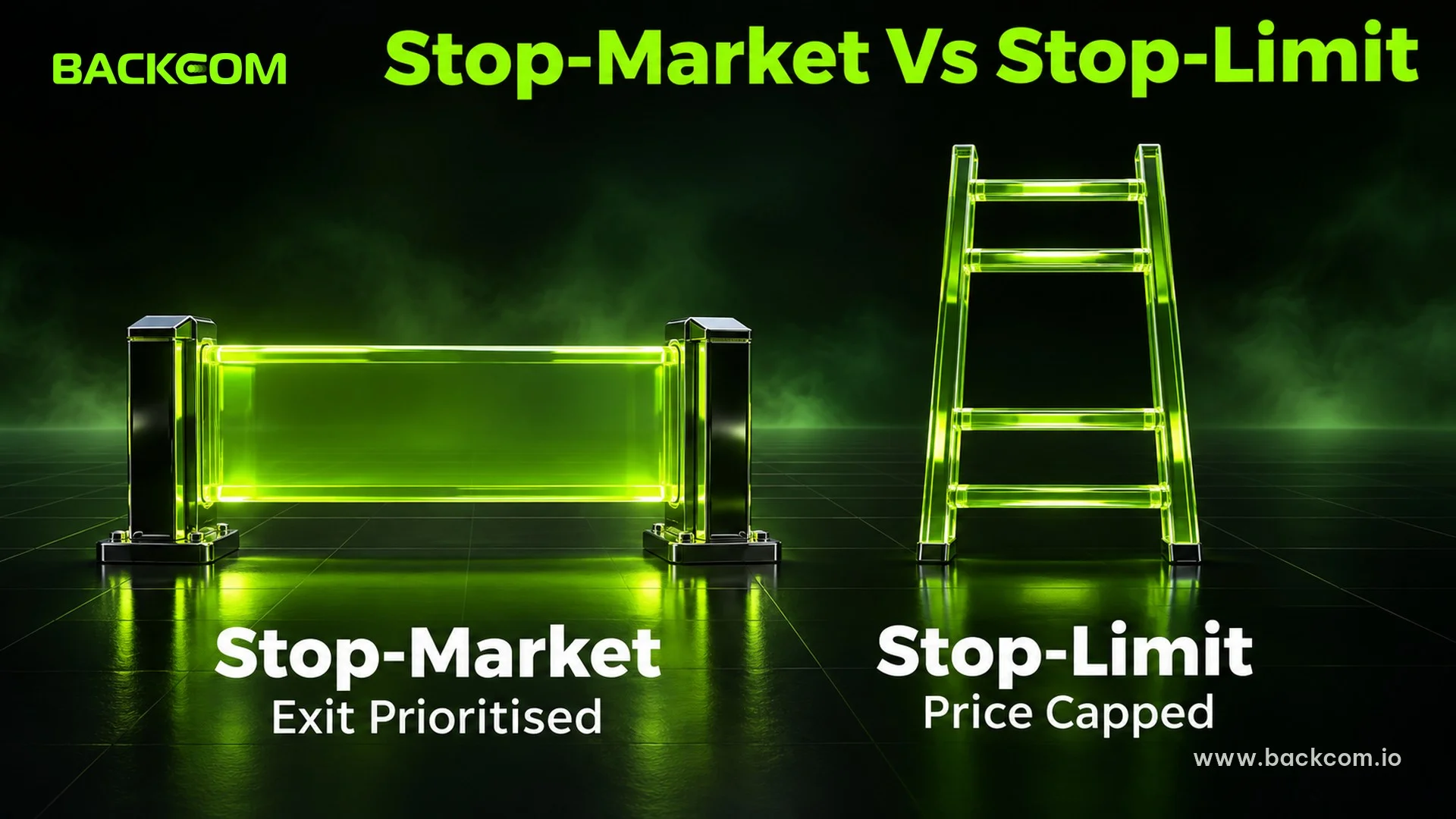
The stop loss vs stop limit crypto question comes down to one trade-off: do you want a certain exit or a certain price? You cannot have both when the market moves fast.
Stop-Market: Certain Exit, Uncertain Price
A stop-market order turns into a market order once the trigger price is touched. It takes whatever liquidity is available, so the position closes almost immediately. The cost is slippage: the fill can land away from your trigger when the order book is thin or the price is jumping.
Stop-Limit: Certain Price, Uncertain Exit
A stop-limit order has two prices: the stop price that activates it, and the limit price that caps the worst fill. According to the Binance support explanation of stop-limit orders, the order is placed at the limit price or a better price once the stop price is reached, and a limit order does not guarantee execution.
That last point is the danger. If price gaps through your limit and keeps going, the order simply rests unfilled while the loss grows.
| Feature | Stop-market | Stop-limit |
|---|---|---|
| Becomes | Market order | Limit order |
| Exit guaranteed | Yes, if liquidity exists | No |
| Fill price guaranteed | No | Limit price or better |
| Main risk | Slippage | No fill in a fast move |
| Typical use | Protecting a leveraged position | Illiquid pairs, calm markets |
This table summarises how the two order types are generally defined. Names and options differ by exchange, so check the order form before you trade.
A Worked Example With Illustrative Numbers
Say you buy 0.1 BTC at 100,000 USDT and set a stop trigger at 97,000 USDT. The planned loss is 3,000 × 0.1 = 300 USDT.
- Stop-market: price drops fast and fills at 96,700. The loss is 3,300 × 0.1 = 330 USDT, 10% above plan.
- Stop-limit with a 96,800 limit: price gaps from 97,100 to 96,500. Your sell at 96,800 or better never fills, and the position stays open at a loss that keeps growing.
For a stop whose main job is to cap risk on a leveraged position, many traders accept slippage rather than the risk of no exit. That is a judgement, not a rule, and it depends on how liquid the pair is. For the order types you will meet on a platform, see our overview of forex order types on MT5, which uses the same logic.
Trailing Stop Crypto: How A Stop Follows The Price
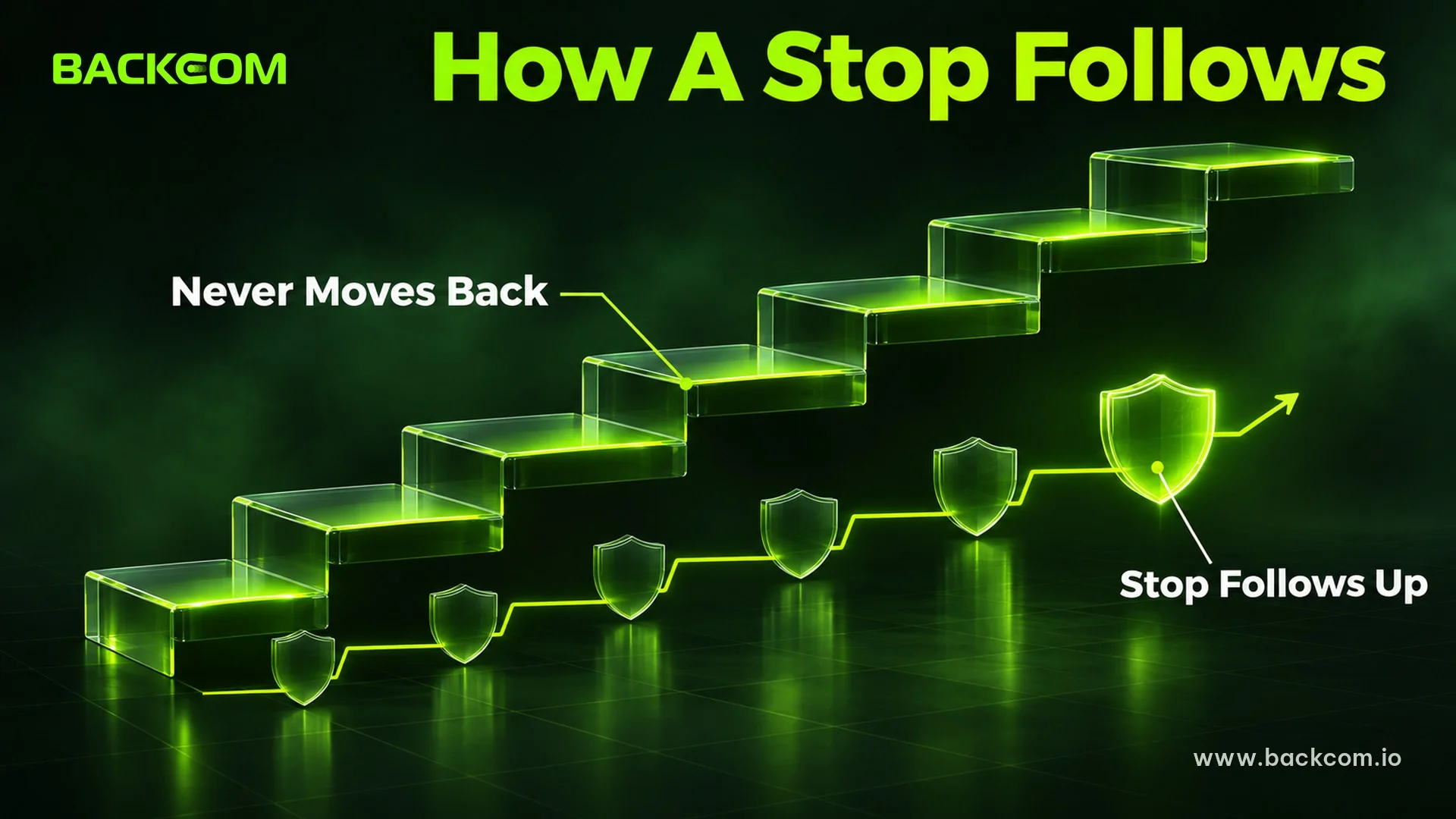
A trailing stop moves in your favour and never moves back. For a long position it sits a set distance below the highest price reached, so it locks in more profit as the trade runs.
The Binance support page on trailing stops describes two settings: an activation price and a callback rate. Both conditions must be met before the order triggers: the market must reach the activation price, and then pull back from its peak by at least the callback rate. The page gives a callback range of 0.01% to 20%.
Here is an illustrative case. You are long from 100,000 with a 2% callback and an activation price of 104,000.
- Price rises to 108,000, so the trailing stop is active.
- The trigger level is 108,000 × 0.98 = 105,840.
- If price then falls to 105,840, a sell order fires, locking in about 5.8% from entry before costs.
- If price instead climbs to 112,000, the trigger rises to 109,760.
The trade-off: a tight callback exits on normal noise, while a loose one gives back a large part of the gain. There is no universal setting, so test it against the volatility of the pair you trade. If you use MetaTrader, the same idea is covered in what a trailing stop is and how to set it on MT5.
Stop Loss Placement Futures Traders Can Defend
Stop loss placement on futures has two parts: the price level, and the position size that makes that level affordable. Getting only the first part right is the most common planning error.
Place The Stop Where The Idea Is Wrong
A good stop sits at the invalidation point: the price at which your reason for entering no longer holds. Examples include below a swing low for a long, or beyond the level a breakout was supposed to hold.
Avoid round numbers and obvious levels where many other stops cluster. Place the stop a little beyond them, because crowded levels are where price often spikes through before reversing.
To add a volatility buffer, many traders use the Average True Range (ATR). A common version is entry minus 2 × ATR for a long. If a hypothetical daily ATR is 2,400 USDT, the stop sits 4,800 below entry, at 95,200 from a 100,000 entry. Our guides on setting a stop by invalidation point and ATR and on the ATR indicator show the method in detail.
Size The Position From The Stop
Pick the amount you are willing to lose first, then work backwards. The standard formula is:
Position size = Account risk ÷ Stop distance
Take an illustrative 5,000 USDT account risking 1%, which is 50 USDT. With entry at 100,000 and a stop at 97,000, the stop distance is 3%. The position size is 50 ÷ 0.03 ≈ 1,667 USDT of notional value.
At 10x leverage that needs about 167 USDT of margin; at 20x it needs about 83 USDT. The risk stays 50 USDT either way, because the stop and the size decide the loss, not the leverage setting. Fees add a little: at an assumed 0.05% taker rate, closing 1,667 USDT costs about 0.83 USDT. Our position size calculator can check the maths.
Keep The Stop Inside Your Liquidation Price
On perpetual futures the stop must trigger before liquidation, or it is useless. A 25x isolated long has a liquidation price roughly 4% below entry before maintenance margin and fees are applied. Once those are included, the real level sits somewhat closer to entry, so a stop 3% away leaves only a thin margin. A wider stop on high leverage can be hit by liquidation first.
If the stop is too wide for your leverage, lower the leverage or the size rather than tightening the stop into noise. See how to calculate liquidation price and the difference between cross and isolated margin for how the exchange computes it.
Stop Loss Slippage Crypto: Why You Get Filled Worse Than Planned
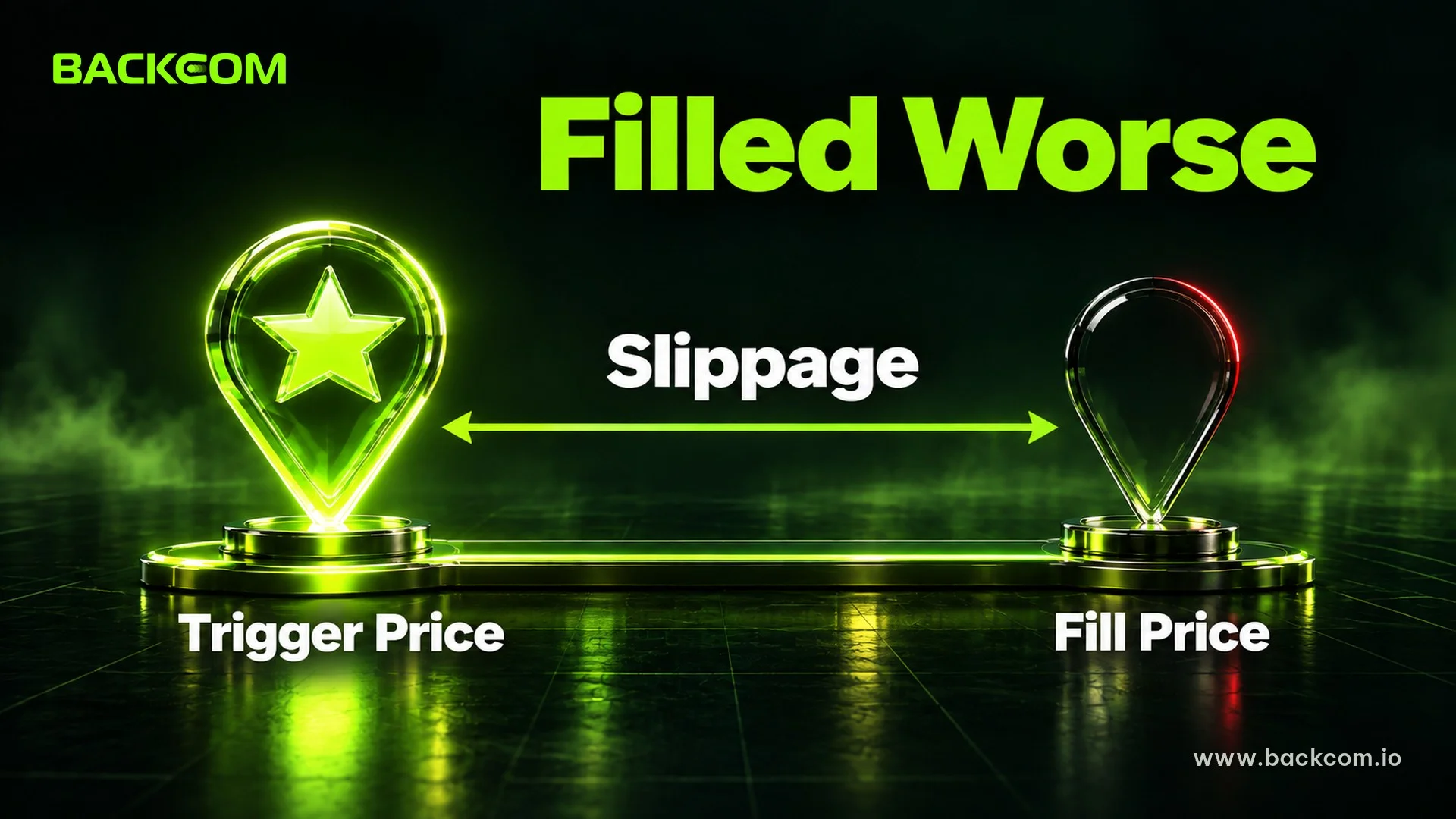
Stop loss slippage in crypto is the gap between your trigger price and the price that fills. It grows when the order book is thin, when volatility spikes, or when your order is large compared with nearby liquidity. A full explanation is in what slippage is in crypto trading.
Three habits reduce the damage:
- Trade liquid pairs: major pairs have deeper books, so a stop-market order moves the price less.
- Keep size modest: a large order walks through several price levels.
- Avoid known event windows: major data releases and exchange maintenance often come with wide spreads.
Check Which Price Triggers The Stop
Futures exchanges usually offer more than one trigger price type, such as last traded price, mark price or index price. The Bybit Help Center on take profit and stop loss explains that you can choose the reference price for each order.
The choice matters because liquidation is generally based on the mark price. A stop triggered by the last price can miss a sharp wick that lifts the mark price into liquidation, while a stop on the mark price follows the same price that decides liquidation. Neither removes slippage once the order is sent. Read your exchange's rules for the exact definitions, since they differ.
Common Crypto Stop Loss Mistakes To Avoid
Most stop loss failures come from a few repeatable errors:
- Stop too tight: a stop inside normal volatility is hit by noise, then price turns in your original direction.
- No stop at all: "I will watch it" fails the first time you sleep, work or lose connection.
- Moving the stop further away: widening a stop after entry turns a planned loss into an open-ended one.
- Using stop-limit as the only protection: a gap past the limit leaves the position open.
- Ignoring size: a sensible stop with an oversized position still produces a large loss.
- Forgetting liquidation: on high leverage the exchange may close you out before your stop is touched.
One more point: a stop controls loss per trade, but it does not make a strategy profitable. A stop placed without a reason, taken repeatedly, simply loses small amounts often.
Frequently Asked Questions (FAQ) About Crypto Stop Loss
Is A Stop Loss Guaranteed To Fill At My Price?
No. A stop-market order is guaranteed to try to exit but not at a set price, so slippage is possible. A stop-limit order controls the worst price but may not fill at all. Neither order type offers both a guaranteed exit and a guaranteed price in a fast market.
Should I Use A Stop-Market Or A Stop-Limit Order?
It depends on your priority. If the position must close to cap risk, as with leverage, stop-market is common. If you trade a thin pair and care about price, stop-limit gives control but risks no fill. Check how your exchange labels each type before using it.
What Percentage Should My Crypto Stop Loss Be?
There is no correct percentage. Place the stop at the point where your trade idea is wrong, often with an ATR buffer, then size the position so that distance costs only a small share of your account, such as 1%. A fixed percentage ignores the volatility of the pair.
Can A Stop Loss Fail On Futures?
Yes. It can fill worse than planned during fast moves, fail to trigger if you chose a reference price that lags the mark price, or be overtaken by liquidation on high leverage. Keep the stop well inside your liquidation price and size conservatively.
Conclusion: Plan The Stop Before The Entry
A crypto stop loss works best as part of a plan, not as a last-minute reaction. Choose the order type for the job, place the stop at the point where your idea is wrong, size the position from that distance, and keep the stop inside your liquidation price. Accept that slippage and gaps exist, and size so that a bad fill is survivable.
Disclaimer: This content is compiled by Backcom.io for information only and is not investment advice. Crypto trading, especially with leverage, carries a high risk of loss. Examples use illustrative numbers, and order types and fees differ by exchange, so check the rules of your platform before trading.
Was this article helpful?
Join The Backcom.io Community
Get the latest on trading rebates, trading tips, and broker deals — and connect with thousands of traders worldwide.

Backcom App
Track Your Rebates Every Day
Every rebate is visible by broker and by day. Manage your wallet and withdrawals in one place.
Open Backcom App