What Is An Altcoin? Why The Biggest Crypto Moves Rarely Come From Bitcoin

Bitcoin is the symbol of the crypto market: the asset that leads the trend and by far the largest by market value. Yet the sharpest swings in crypto, up and down, rarely come from Bitcoin today, because it now behaves more like a store of value. So what is an altcoin, and why do the biggest moves in crypto usually come from altcoins?
In this article, Backcom.io explains what altcoins are, how Bitcoin's role has changed, how altcoin season works and why the features that create big moves also create big losses.
What Is An Altcoin?
An altcoin (short for "alternative coin") is any cryptocurrency that is not Bitcoin. In other words, every crypto project launched after Bitcoin counts as an altcoin, from layer-one platform coins and application tokens to meme coins.
Altcoins are created for different reasons: to fix a limitation of Bitcoin, to extend what a blockchain can do, or to serve a specific need inside the crypto ecosystem. Bitcoin focuses on being a decentralised store of value. Altcoins usually target faster transactions, smart contracts, DeFi, NFTs, gaming or new economic models.
By nature, altcoins are more experimental than Bitcoin. That is exactly why their price ranges are wider in both directions, and why they often produce the outsized moves seen in each growth phase of the crypto market. If you are still learning the basics, our beginner guide to crypto covers how coins, wallets and blockchains fit together.
Why Bitcoin Rarely Delivers The Outsized Moves It Once Did

Bitcoin once grew thousands of times over in its early years, but that pattern is very unlikely to repeat. As the largest crypto asset by market value, every strong rally now needs an enormous amount of new money, which is hard to attract in a short time.
Bitcoin's role has also changed. Instead of a vehicle for fast speculation, it is increasingly treated as a store of value, similar to gold in traditional markets. Large investors, institutions and funds buy Bitcoin mainly to preserve capital, not to chase multiples.
As a result, Bitcoin tends to rise more slowly, more steadily and with less volatility than altcoins. That makes it the foundation of the crypto market, but it also means it is no longer where traders look for sudden gains within a short cycle.
Why The Biggest Crypto Moves Tend To Come From Altcoins
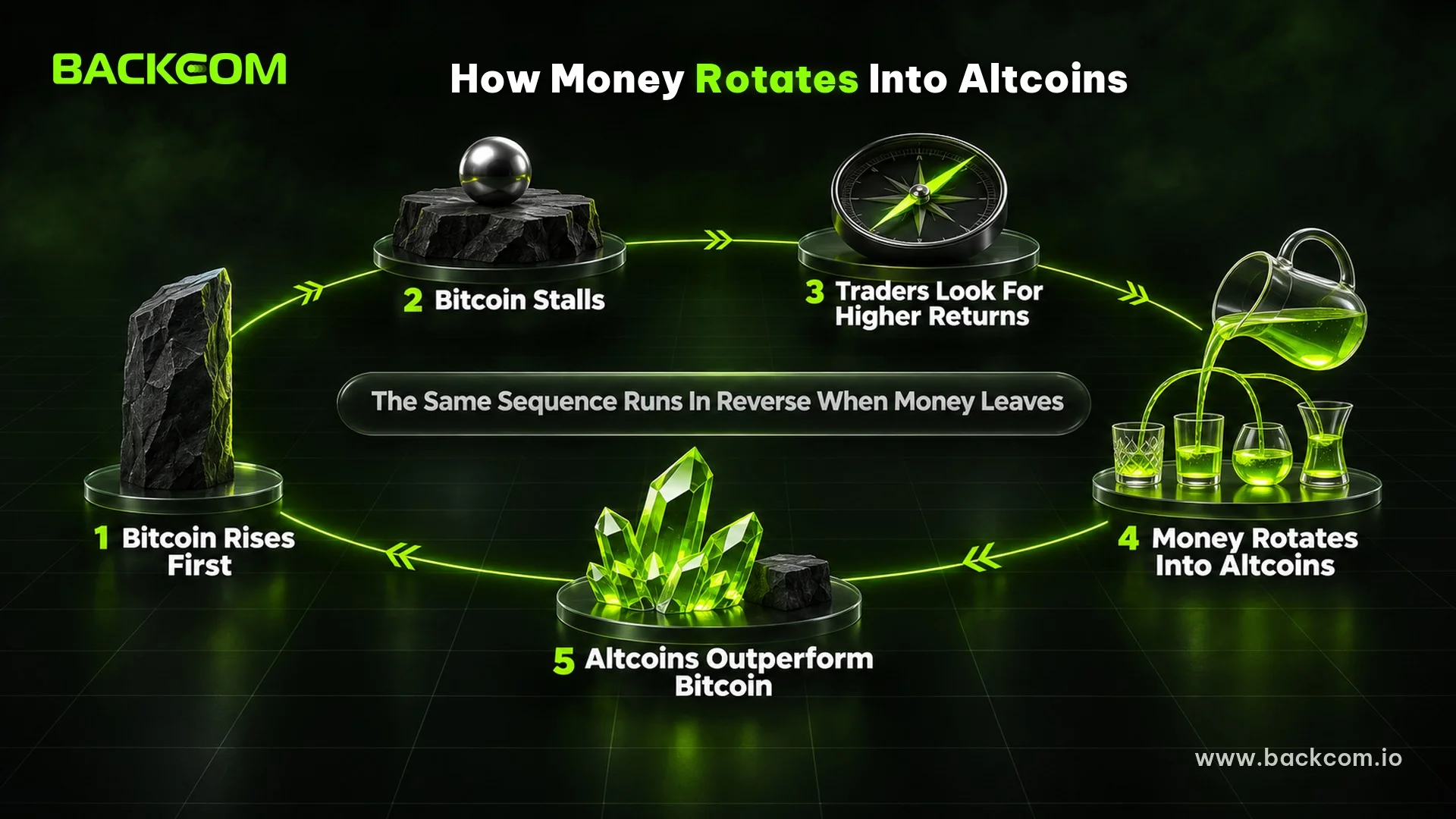
Altcoin rallies do not appear at random. They usually follow a clear sequence of money flows through the crypto market:
- Bitcoin rises first. Large and institutional money flows into Bitcoin, pushes the price up and sets the market trend.
- Bitcoin stalls. At high prices, its sheer size limits further gains and the price starts moving sideways.
- Traders look for higher returns. Gains from Bitcoin look less attractive, and speculative money starts leaving BTC.
- Money rotates into altcoins. Smaller altcoins can rise quickly, especially groups with a clear market narrative.
- Altcoins outperform Bitcoin. A broad group of altcoins beats Bitcoin's return over the same period, which is what the Altcoin Season Index measures.
This rotation has shown up in several past cycles, but it does not repeat on a schedule. The same sequence also runs in reverse: when money leaves, altcoins usually fall faster and further than Bitcoin.
What Is Altcoin Season (Altseason)?
Altcoin season, or altseason, is the period when altcoins become the centre of the market and the best returns no longer revolve around Bitcoin. Bitcoin is still the foundation, but it is not the asset delivering the most attractive gains.
At its core, altcoin season reflects a change in risk appetite. When the market turns euphoric, money is willing to leave safer assets and accept higher volatility in exchange for the chance of larger gains. Altcoins, being smaller and more speculative, are the natural destination for that capital.
Altcoin season is not a rally for every altcoin, though. Gains concentrate in the groups whose story fits the market at that moment, while the rest can be left behind. That makes altseason both a period of big opportunity and a test of selection and discipline.
How The Altcoin Season Index Measures It
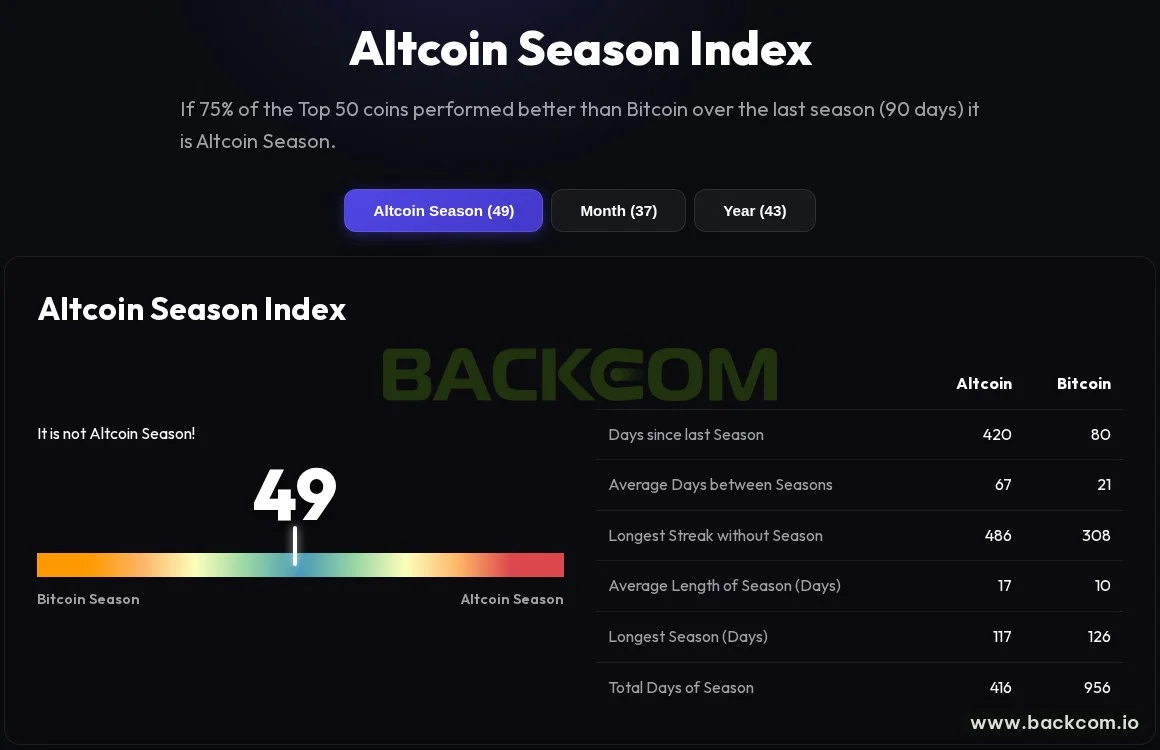
The most quoted gauge is the Altcoin Season Index from Blockchaincenter. It calls Altcoin Season when at least 75% of the top 50 coins outperform Bitcoin over the last 90 days, excluding stablecoins and asset-backed tokens such as wrapped Bitcoin. A reading of 25 or below is labelled Bitcoin Season, and anything in between is neutral.
| Altcoin Season Index reading | Label on the index | What it means |
|---|---|---|
| 75 to 100 | Altcoin Season | At least 75% of the top 50 coins beat Bitcoin over 90 days |
| 26 to 74 | Neutral | Performance is mixed between Bitcoin and altcoins |
| 0 to 25 | Bitcoin Season | Most of the top 50 coins lag Bitcoin over 90 days |
Index thresholds and reading as published by Blockchaincenter on 20 November 2026. The value changes daily, so check the live page before drawing conclusions. On that date the index stood at 49, "not Altcoin Season".
The Altcoin Risks Most Traders Underestimate
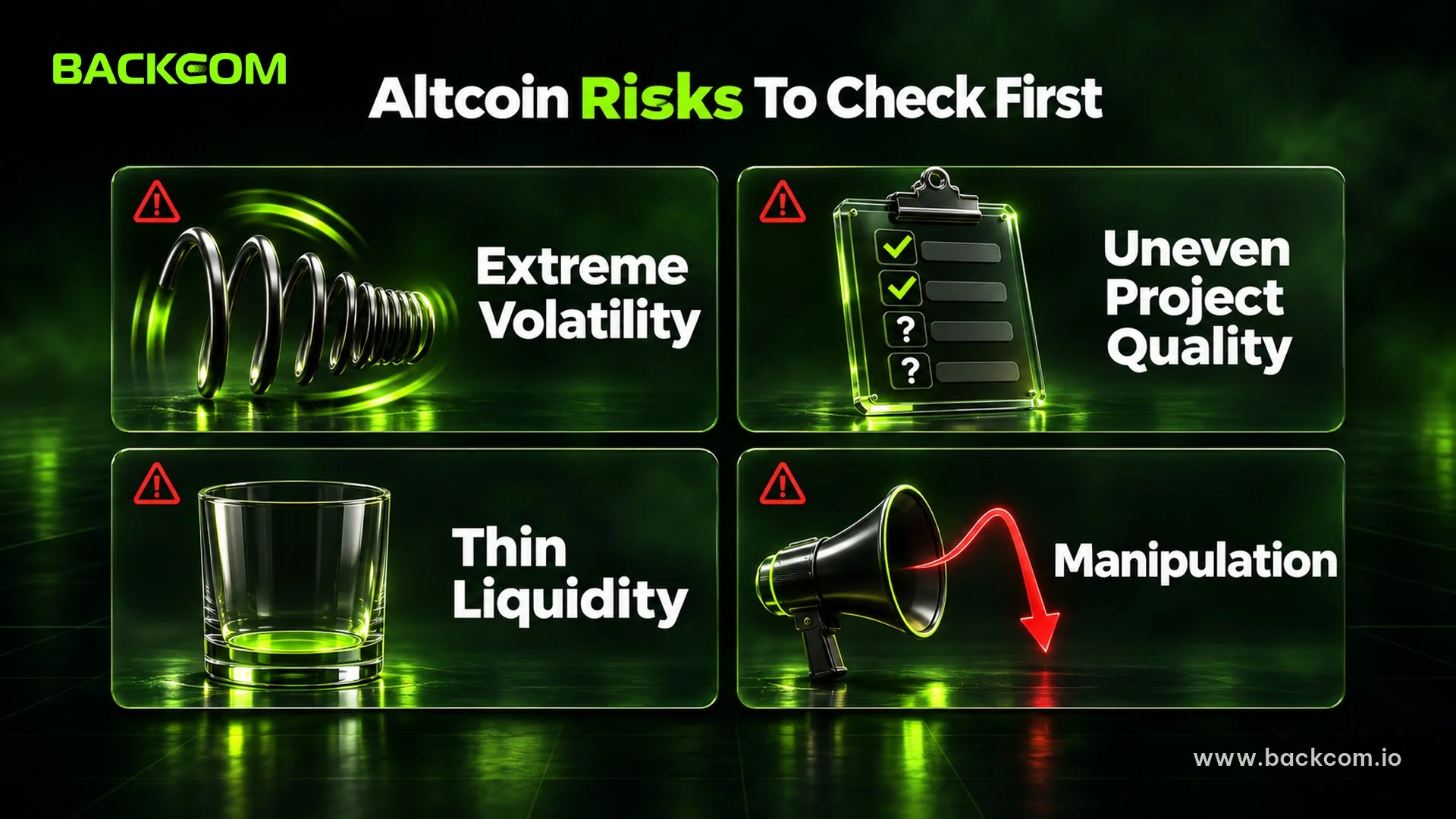
Altcoins attract traders with the chance of large gains, but the risk comes from how the market works, not only from the projects themselves. Most altcoins rise on money flow and expectations, so when sentiment turns, prices can fall very fast and very deep.
The core altcoin risks to face honestly:
- Extreme volatility: altcoins can spike quickly and collapse just as quickly when money leaves.
- Uneven project quality: many coins exist only because of a trend and have little long-term value.
- Thin liquidity: in a falling market it can be hard to exit at a reasonable price, as explained in our guide to liquidity and slippage in crypto.
- Manipulation: small caps are the usual target of pump-and-dump schemes and fake projects, so the red flags in how to avoid crypto exchange scams apply here too.
Beyond the market itself, the biggest risk is trader behaviour. Buying late out of FOMO, never taking profit and hoping for "one more multiple" turn paper gains into losses once the cycle ends. Altcoins only make sense with a clear plan and strict discipline.
Risk Rules Traders Use When They Trade Altcoins
Altcoin trading is usually approached as a cycle play, not a long-term hold. None of the rules below makes an altcoin safe or recommends buying any token. They are ways traders limit the damage:
- Keep altcoins a small, defined slice of the portfolio, sized so that losing most of it would not change your plans.
- Check liquidity before any trade: thin volume makes it hard to exit at a fair price.
- Avoid chasing vertical moves. Entries after a near-vertical rally carry the highest risk of buying the top.
- Write the exit plan in advance, with partial take-profit levels and a stop loss, instead of waiting for the "perfect" top.
In practice, following money flows, narratives and market moves with on-chain tools such as Arkham Intelligence, and checking sentiment on the Fear & Greed Index, saves time and helps avoid emotional decisions.
The most important part of any altcoin plan is knowing when to step aside. When altcoins rally across the board, good news is everywhere and everyone expects "one more leg", risk is usually at its highest. The goal is not to catch the final spike but to leave the market while gains are still in hand.
Frequently Asked Questions (FAQ) About Altcoins
Is Ethereum An Altcoin?
Yes. By definition every cryptocurrency that is not Bitcoin is an altcoin, so Ethereum (ETH), Solana (SOL) and XRP all belong to this group. Many analysts still put ETH and other large caps in a separate bucket, because their volatility and liquidity are very different from small-cap altcoins. Stablecoins such as USDT are technically altcoins too, but they aim to hold a fixed value, as covered in what is a stablecoin.
How Do Bitcoin Dominance And The Altcoin Season Index Signal Altseason?
Traders watch two gauges. Bitcoin dominance is Bitcoin's share of total crypto market value. When it falls, money is usually moving toward altcoins, but dominance also falls when stablecoins gain share during sell-offs, so check it alongside the index. The Altcoin Season Index from Blockchaincenter calls altseason when at least 75% of the top 50 coins, excluding stablecoins and asset-backed tokens, beat Bitcoin over 90 days. On 20 November 2026 the index read 49, so it was not altseason.
How Do Traders Limit Their Exposure To Altcoin Risk?
There is no safe level of exposure to a volatile asset. Traders who take part usually decide in advance how much they could lose without changing their plans, check liquidity before entering, and write down the exit and stop loss before any trade. Position sizing is covered in our crypto position size calculator guide.
Conclusion: Altcoins Amplify The Cycle In Both Directions
Bitcoin and altcoins are not opposites. They play different roles in the same market cycle. Bitcoin holds value and leads the trend, but when the market turns euphoric, the largest moves rarely happen in the safest asset.
Altcoins can outperform Bitcoin, but only for traders who understand the risk, read the timing and follow a clear plan. Not everyone who buys altcoins wins. Those who understand cycles, manage position size and take profit with discipline are the ones who keep their results.
The key question is not "Bitcoin or altcoins?" but when each one fits the market you are in, so decisions rest on cycles and money flow rather than luck.
Disclaimer: This content is compiled by Backcom.io for information only and is not investment advice. Altcoins are highly volatile and can lose most of their value, and nothing here is a recommendation to buy or sell any token.
Was this article helpful?
Join The Backcom.io Community
Get the latest on trading rebates, trading tips, and broker deals — and connect with thousands of traders worldwide.

Backcom App
Track Your Rebates Every Day
Every rebate is visible by broker and by day. Manage your wallet and withdrawals in one place.
Open Backcom App