Binance Loans In 2026: A Smart Way To Unlock Liquidity Or A Liquidation Trap?


Binance Loans let you borrow crypto against crypto you already hold, so you can raise liquidity without selling a position you want to keep. In a volatile market that sounds attractive, but behind the convenience sit floating interest, a loan-to-value (LTV) ratio that moves with every price tick and an automatic liquidation process that not every borrower fully understands.
In this article, Backcom.io looks at Binance Loans neutrally as at 20 November 2026: how each loan type works, what it really costs and where the risk lies, so you can judge whether a loan would be a liquidity tool or a liquidation trap for you.
What Are Binance Loans And How Do They Work?
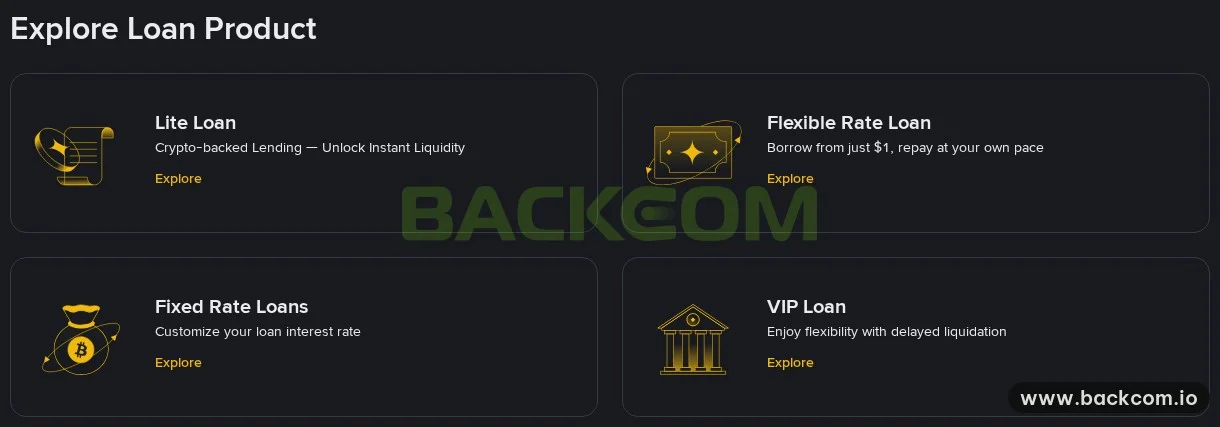
Binance Loans is the crypto lending service on Binance: you pledge assets such as BTC, ETH, BNB or stablecoins as collateral and borrow another asset, most often USDT or USDC, instead of selling. It is a centralised (CeFi) product inside your Binance account, and its terms are set by Binance rather than negotiated. For the basics, see our beginner guide to crypto.
What Borrowing On Binance Really Means
A loan does not create new profit. It turns part of the value you already hold into temporary liquidity. As a borrower you:
- keep your exposure to the collateral while it is pledged
- receive borrowed funds you can trade, hold or use elsewhere
- pay interest and carry liquidation risk if the loan is poorly managed.
Binance does not ask what you do with the money. It controls its own risk through the LTV ratio and an automatic liquidation process.
How Binance Loans Work In 2026
Binance's Flexible Loan FAQ, updated on 28 April 2026, describes the flexible product as an isolated, overcollateralized, open-term loan. In practice, four elements drive every loan:
- Collateral: assets you pledge, each with its own initial LTV.
- Borrowed asset: usually a stablecoin, with other coins available depending on the product.
- Floating interest: on flexible loans, interest accrues every minute based on the current rate.
- Automatic risk control: the system tracks LTV continuously and acts without waiting for you.
The Basic Loan Flow
- Pledge an asset as collateral.
- Choose the asset and amount to borrow.
- The system sets the initial LTV and the applicable rate.
- As prices move, the LTV rises or falls with the value of the collateral.
- If the LTV crosses the safety thresholds, you get a margin call and then liquidation.
That makes Binance Loans disciplined by design, and unforgiving of mistakes.
Binance Loan Types And Interest Costs
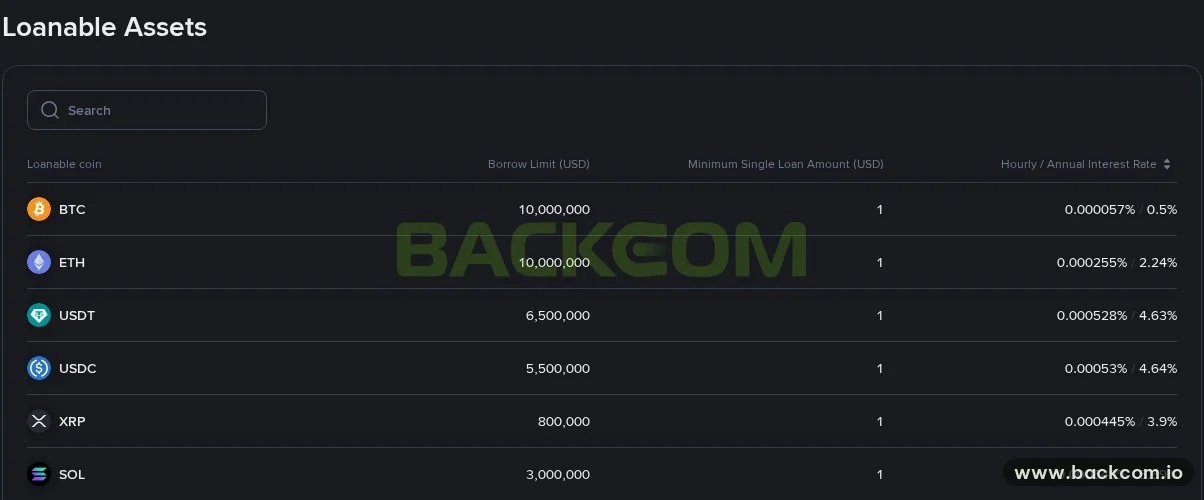
Each Binance loan type charges interest differently and carries a different risk, which is why a loan that "looked cheap" can end up expensive.
| Feature | Flexible Rate Loan | Fixed Rate Loan |
|---|---|---|
| Term | Open, repay any time | Fixed, 30 to 180 days |
| Interest | Floating, accrues every minute | Fixed, charged upfront when the loan is paid out |
| Initial LTV | Depends on the collateral | 72% |
| Margin call LTV | 85% | 77% |
| Liquidation LTV | 91% | 91% |
Figures from Binance's Flexible Loan and Fixed Rate Loan FAQs and the Binance Loans page, as at 20 November 2026. Thresholds and rates can change, so check the loan screen before borrowing.
Flexible Rate Loan
The flexible rate loan is the core product. You can borrow and repay at any time, and interest accrues on the outstanding amount at a rate that updates with supply and demand. The FAQ uses a 65% initial LTV for USDT collateral as an example, issues a margin call at 85% and fully liquidates at a hard cap of 91%. This type suits short-term liquidity needs better than long open-ended borrowing.
Fixed Rate Loan
The fixed rate loan locks the rate for a set term, which makes the total cost easy to calculate. According to Binance's Fixed Rate Loans FAQ, updated on 6 May 2026, interest is charged in advance and is not refunded if you repay early or are liquidated. If the loan is not repaid by expiry, a late fee applies every hour at three times the hourly equivalent of the rate, and collateral is liquidated once the loan is more than 24 hours overdue.
VIP Loan
VIP Loan is aimed at large accounts. The Binance Loans page lists higher limits, more assets and delayed liquidation for VIP levels 1 to 9, with flexible interest accruing hourly. The same page also lists a Lite Loan with a fixed 30-day term and a one-time upfront service fee instead of interest.
Margin Borrowing Is A Different Product
Many people say "borrowing on Binance" when they mean margin borrowing: funds borrowed automatically inside a margin account for a leveraged position. Borrowing, leverage and price swings act together there, so it is a trading tool, not a safe way to raise liquidity.
The Real Costs Of A Binance Loan
Binance's loan pages do not list an opening or monthly maintenance fee for flexible loans, and you can repay them early. Borrowers still face several costs:
- interest that changes over time on flexible loans
- the opportunity cost of collateral that is locked
- capital pressure when the LTV rises and you have to add collateral
- a 2% liquidation fee on the borrowed amount, plus selling collateral at a bad moment.
As a simple illustration with a hypothetical 8% APR, borrowing 5,000 USDT for 30 days costs about 32.88 USDT in interest (5,000 × 8% × 30 ÷ 365).
If you trade with borrowed funds, trading fees add to the bill on every entry and exit, as our guide to Binance futures fees shows.
LTV And Liquidation Risk On Binance Loans
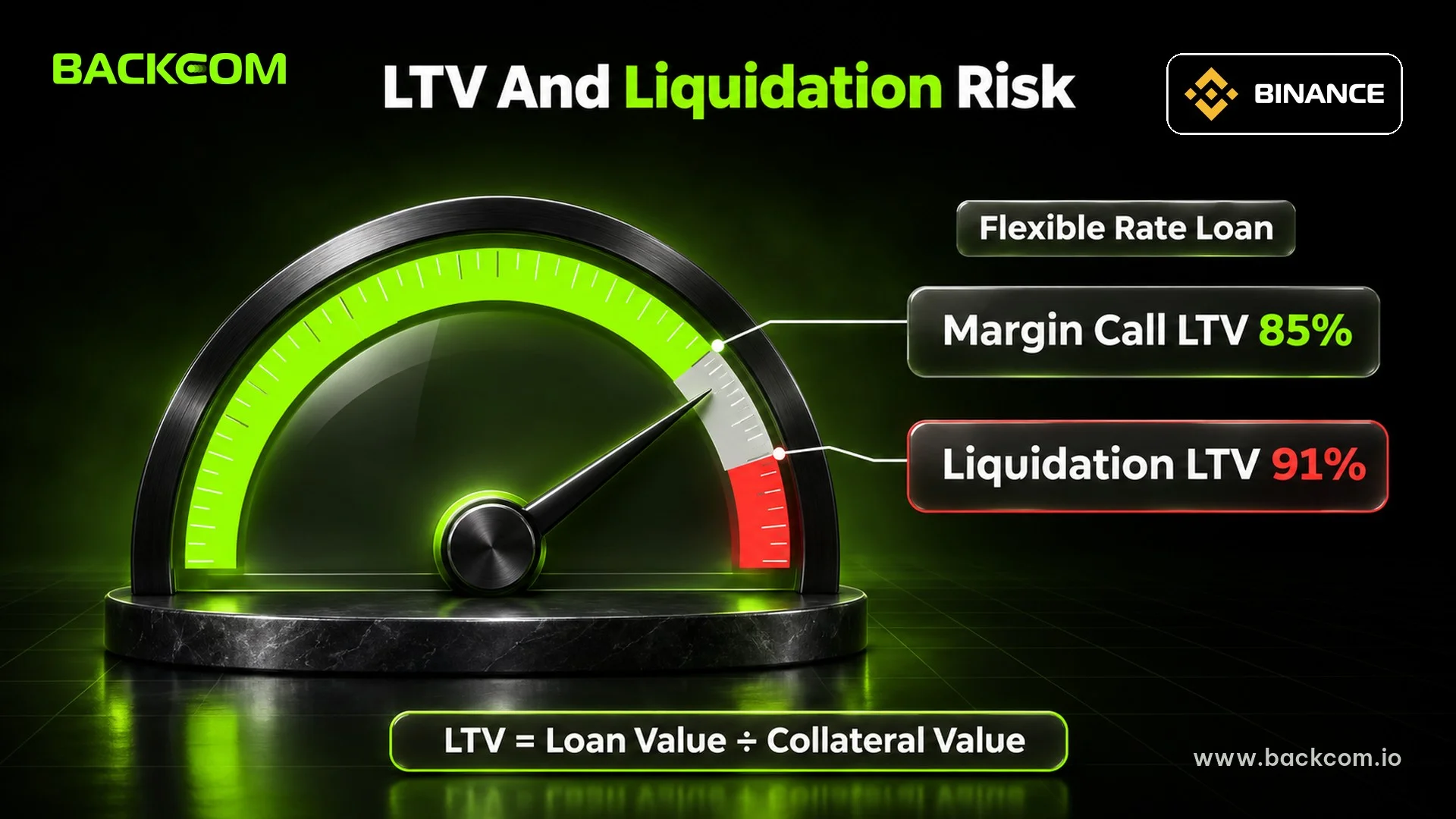
With Binance Loans, the interest rate is not the biggest risk. What decides whether a loan survives is the LTV, the ratio the system uses to trigger liquidation, and most stories of lost collateral start with ignoring it.
What Is LTV And How Is It Calculated?
LTV is the value of your loan divided by the value of your collateral:
LTV = loan value ÷ collateral value × 100%
Borrow 5,000 USDT against 10,000 USDT of BTC and your starting LTV is 50%. The LTV is not fixed: when the collateral price falls, the LTV rises even if you do nothing, and accrued interest pushes it up slowly over time.
The LTV Levels That Matter
Every loan has three thresholds:
- Initial LTV: the maximum allowed when you open the loan. Borrowing close to it leaves a thin safety margin.
- Margin call LTV: you get a warning and should add collateral or repay part of the loan.
- Liquidation LTV: the system sells collateral automatically, without asking you.
A warning does not guarantee you will have time to react. In a fast market, the LTV can move from the margin call level to liquidation in minutes, and once liquidation starts you can no longer adjust the LTV or repay that order.
How Liquidation Works
When the LTV reaches the liquidation level, Binance sells collateral at the market price to repay the loan and charges the liquidation fee. You do not control the selling price, which usually leads to:
- selling at a poor price when the market is falling fast
- losing a large share of the collateral even on a modest loan
- a chain reaction if the borrowed funds were also used for leveraged trades.
The table below shows how far the collateral can fall before each threshold on a flexible loan backed by 10,000 USDT of collateral, ignoring accrued interest:
| Starting LTV | Loan amount | Margin call at 85% when collateral is worth | Liquidation at 91% when collateral is worth |
|---|---|---|---|
| 50% | 5,000 USDT | 5,882 USDT (about 41% lower) | 5,495 USDT (about 45% lower) |
| 65% | 6,500 USDT | 7,647 USDT (about 24% lower) | 7,143 USDT (about 29% lower) |
Calculated from the 85% and 91% thresholds in Binance's Flexible Loan FAQ as at 20 November 2026.
On a fixed rate loan opened at its 72% initial LTV, the 77% margin call arrives after a fall of only about 6.5%, and liquidation at 91% after about 21%.
Why Borrowers Get Liquidated From A "Safe" Starting LTV
Four mistakes come up again and again:
- borrowing close to the maximum LTV to "make the most" of the collateral
- pledging volatile assets such as small altcoins with thin liquidity
- not watching the LTV in real time
- using the loan for high-risk positions, which doubles the pressure on the LTV.
A 15–20% drop in a crypto asset is ordinary, and at a high starting LTV that is enough to trigger liquidation. Our guides on calculating liquidation price and crypto margin calls apply the same logic to leveraged trades.
Should You Use Binance Loans In 2026?
Whether to use Binance Loans in 2026 has no single answer. A loan is not bad in itself, but it is not a safe default either. Its value depends on the market, on what the money is for and on how well you can control the LTV.
How Market Conditions Affect The Decision
Several features of the current market make borrowing harder:
- prices still swing sharply
- borrowing rates react quickly to supply and demand
- liquidations happen fast and can feed each other, as described in our explainer on liquidation cascades.
When Borrowing Can Make Sense
A loan can be reasonable when all of these apply:
- you need short-term liquidity and do not want to sell a long-term holding
- you understand the LTV thresholds, margin call and liquidation
- the collateral is liquid, such as BTC, ETH or a major stablecoin
- you have a plan to repay, or to add collateral if the market turns against you.
In those cases a loan is a neutral financial tool that creates no profit but can support a capital plan. If you want other traders' views before deciding, the Backcom.io community on Telegram is open for discussion.
Frequently Asked Questions (FAQ) About Binance Loans
What Is The Liquidation LTV On Binance Loans?
Binance's Flexible Loan FAQ sets a margin call at 85% and a hard-cap liquidation LTV of 91%, as at 20 November 2026. Fixed rate loans use 72% initial, 77% margin call and 91% liquidation. A 2% liquidation fee applies to the borrowed amount.
Can I Repay A Binance Flexible Loan Early?
Yes. A flexible rate loan has an open term, so you can repay at any time, using the borrowed asset or part of your collateral. Fixed rate loans are different: their interest is charged upfront and is not refunded if you repay early, so the cost is the same whether you repay on day one or at expiry.
Does My Collateral Keep Earning Rewards?
According to Binance's Flexible Loan FAQ, pledged assets that are eligible continue to earn Simple Earn Flexible rewards, which are added to the collateral position. Those rewards do not remove liquidation risk, because the LTV still follows the market price of the collateral.
Are Binance Loans Available In Every Country?
No. The products, assets and limits you see depend on your country of residence and on the Binance entity that holds your account. Check the loan screen and the service terms for your region before borrowing.
Conclusion: Liquidity Tool Or Liquidation Trap?
Binance Loans are not a way to make profit but a way to turn holdings into liquidity, with risk attached. Interest is the visible cost, while the real danger lies in the LTV mechanism and automatic liquidation. Choosing the right loan type and keeping the LTV well below the thresholds matter far more than comparing rates.
A loan fits people with a clear plan: why they borrow, for how long and what they will do if the market turns. If the plan is to borrow on impulse or to hold onto a losing position, not borrowing is usually the safer choice.
Disclaimer: This content is compiled by Backcom.io for information only and is not investment or lending advice. Crypto loans can lead to the loss of your collateral, product terms can change at any time, and availability depends on your country of residence.
Was this article helpful?
Join The Backcom.io Community
Get the latest on trading rebates, trading tips, and broker deals — and connect with thousands of traders worldwide.

Backcom App
Track Your Rebates Every Day
Every rebate is visible by broker and by day. Manage your wallet and withdrawals in one place.
Open Backcom App