Binance Futures Fees: Maker, Taker, Funding And BNB Discount Explained


Binance futures fees come down to one trading fee charged on every fill, a funding payment on perpetual contracts that you pay or receive depending on your side, and a fee discount you can unlock by paying in BNB. In this article, Backcom.io walks through the published USDⓈ-M rates, shows how the BNB discount and the VIP system change them and works through the cost of a $50,000 round trip. All figures come from Binance's own help pages and announcements as at 12 November 2026, and Binance can change them, so check the live fee page before you trade.
1. What Does Binance Charge On Futures Trades?
Binance charges three kinds of fees on USDⓈ-M futures: a commission on each execution, a funding payment while you hold a perpetual position and an insurance clearance fee if a position is liquidated. Many beginners only look at the first one.
According to the Binance futures fee help article, the three fees work like this:
- Commission fee: charged every time an order is executed, calculated on the notional value. The rate depends on whether you are a maker or taker and on your VIP level.
- Funding fee: exchanged between long and short holders at each settlement. Binance says it does not charge a service fee on funding.
- Insurance clearance fee: charged when a position is forcibly liquidated, as a portion of the assets held against that position.
The first two are costs you can plan for. The third is a penalty for running out of margin, which is why position sizing matters more than any fee tier. For a wider comparison of derivatives and spot costs, see our guide to spot vs futures trading in crypto.
2. What Is The Binance Futures Maker Taker Fee?
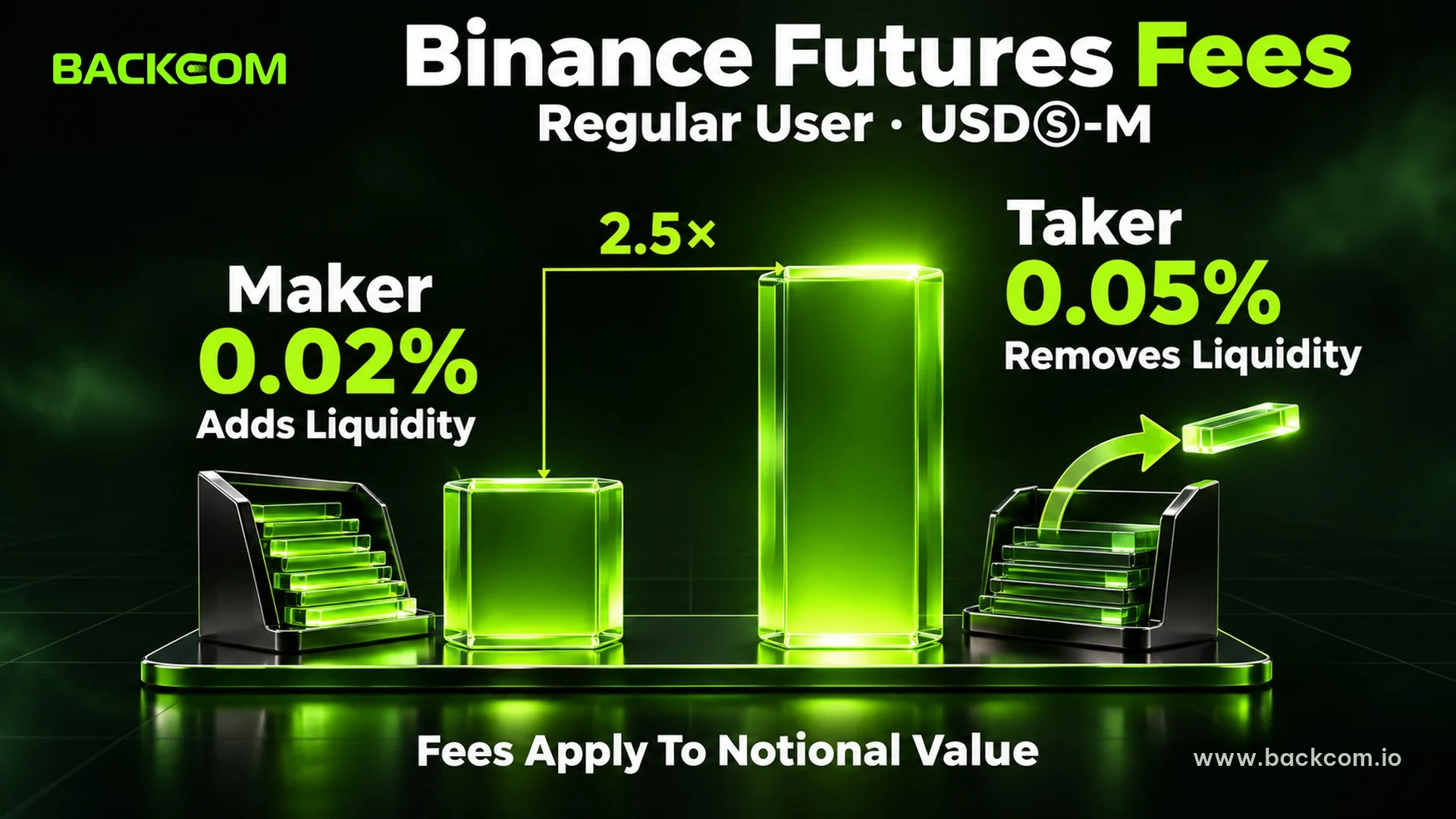
For a regular user, the Binance futures maker taker fee on USDⓈ-M contracts is 0.02% for makers and 0.05% for takers. Binance's fee structure article uses exactly these rates in its worked examples.
Here is how the two sides differ:
- Maker: a limit order that rests on the order book and fills later, adding liquidity.
- Taker: a market order, or a limit order priced to fill straight away, removing liquidity.
At the regular level the taker rate is 2.5 times the maker rate. A trader who always enters and exits with market orders pays 2.5 times as much per fill as one who always rests limit orders. The catch is that a resting order may never fill. Our explainer on maker vs taker fees in crypto covers how to choose between them.
Binance calculates the fee with a simple formula:
Trading Fee = Position Value × Fee Rate, where Position Value = Contract Size × Execution Price
In Binance's official example, a market buy of 1 BTC at 10,104 USDT has a position value of 10,104 USDT and a taker fee of 5.052 USDT. A limit sell of 1 BTC at 11,104 USDT carries a maker fee of 2.2208 USDT. Because the fee is charged on notional value and not on your margin, higher leverage never reduces the fee. It only lets you open a larger position with the same capital, and the fee grows with it.
3. How Does The Binance BNB Fee Discount Work?
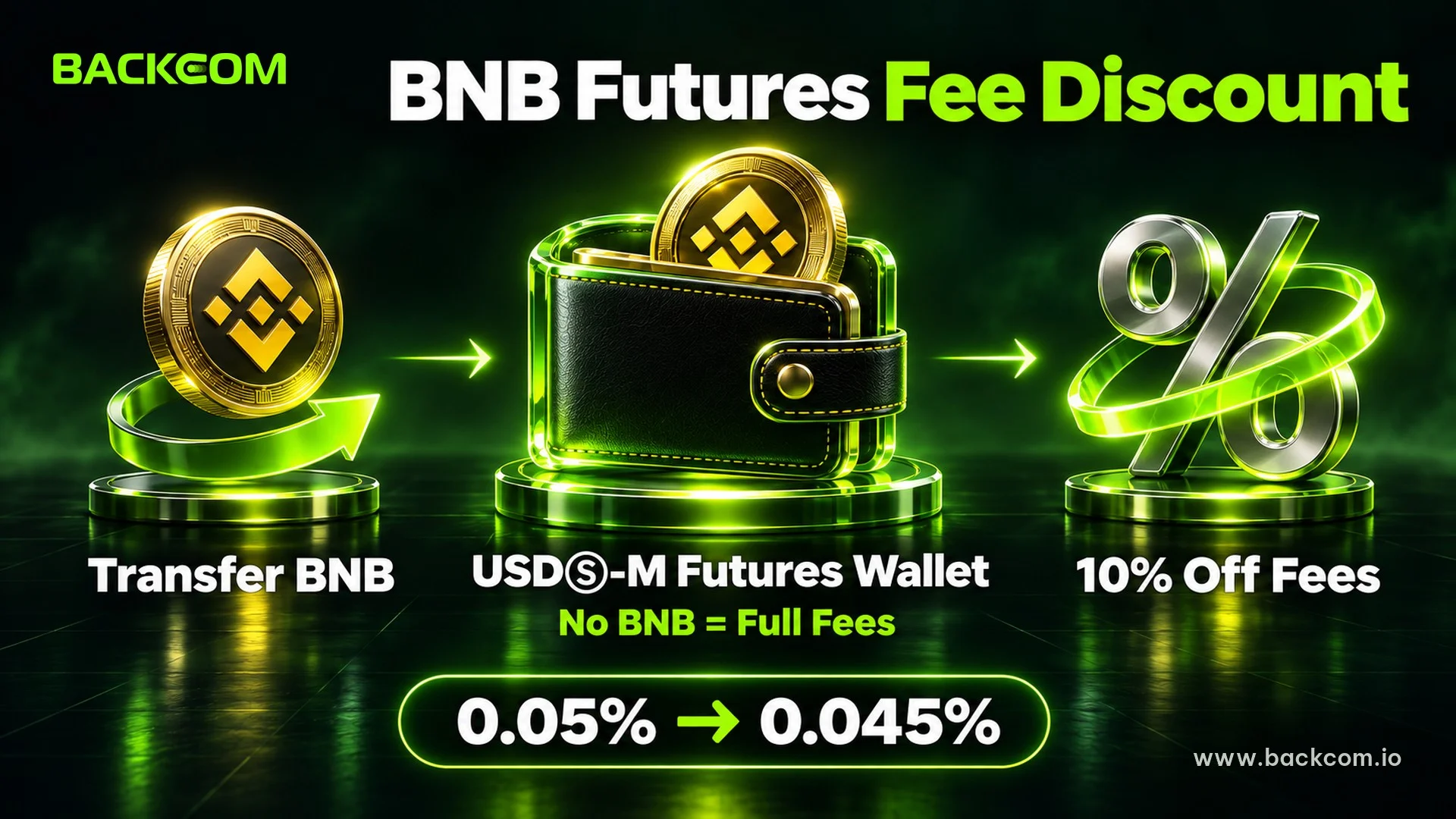
Paying futures fees in BNB gives a 10% discount on standard USDⓈ-M trading fees, but only if the BNB sits in your USDⓈ-M Futures wallet. Binance states that if the BNB balance is insufficient, the system deducts USDT instead and the discount does not apply.
In practice this means:
- Transfer BNB into the futures wallet. Holding it in your spot wallet does not unlock the discount.
- Keep a buffer. If the BNB runs out mid-session, fees silently switch to USDT at the full rate.
- Know the size of the gain. A 10% discount turns a 0.05% taker rate into 0.045% and a 0.02% maker rate into 0.018%.
A 10% cut is small, and BNB is a volatile asset. Buying it purely to save a few dollars of fees adds price risk that can outweigh the saving. The discount is a convenience for traders who already hold BNB, not a reason to buy it.
4. How Do Binance VIP Fee Levels And The Taker Program Lower Fees?
Binance VIP fee levels lower futures fees as your trading volume or holdings rise, and the futures volume requirement for each tier is five times the spot requirement. The same fee structure article says futures fee tiers mirror the spot tiers but are generally lower. The exact VIP rates and thresholds sit in the live USDⓈ-M fee rate table, which renders only in the browser. We could not read that table in text form for this article, so we do not copy VIP numbers here. Treat any third-party table with caution, because we found sources that disagree with each other.
On top of the VIP system, Binance runs a Taker Program for very large traders. Under the announcement effective 12 August 2025:
- Eligibility: at least 100,000,000 USDT of futures volume over the last 30 days to apply.
- Review: weekly, with tier changes effective on Tuesdays at about 07:00 UTC.
- Discounts: 10%, 14% or 18% off the taker fee, depending on your share of weekly USDⓈ-M taker volume.
- Stacking: Binance says the discount applies on top of the BNB discount and the VIP tier rates.
For nearly all retail traders, this program is out of reach. The practical levers are order type and holding time, not tiers.
5. How Does The Binance Funding Fee Work?
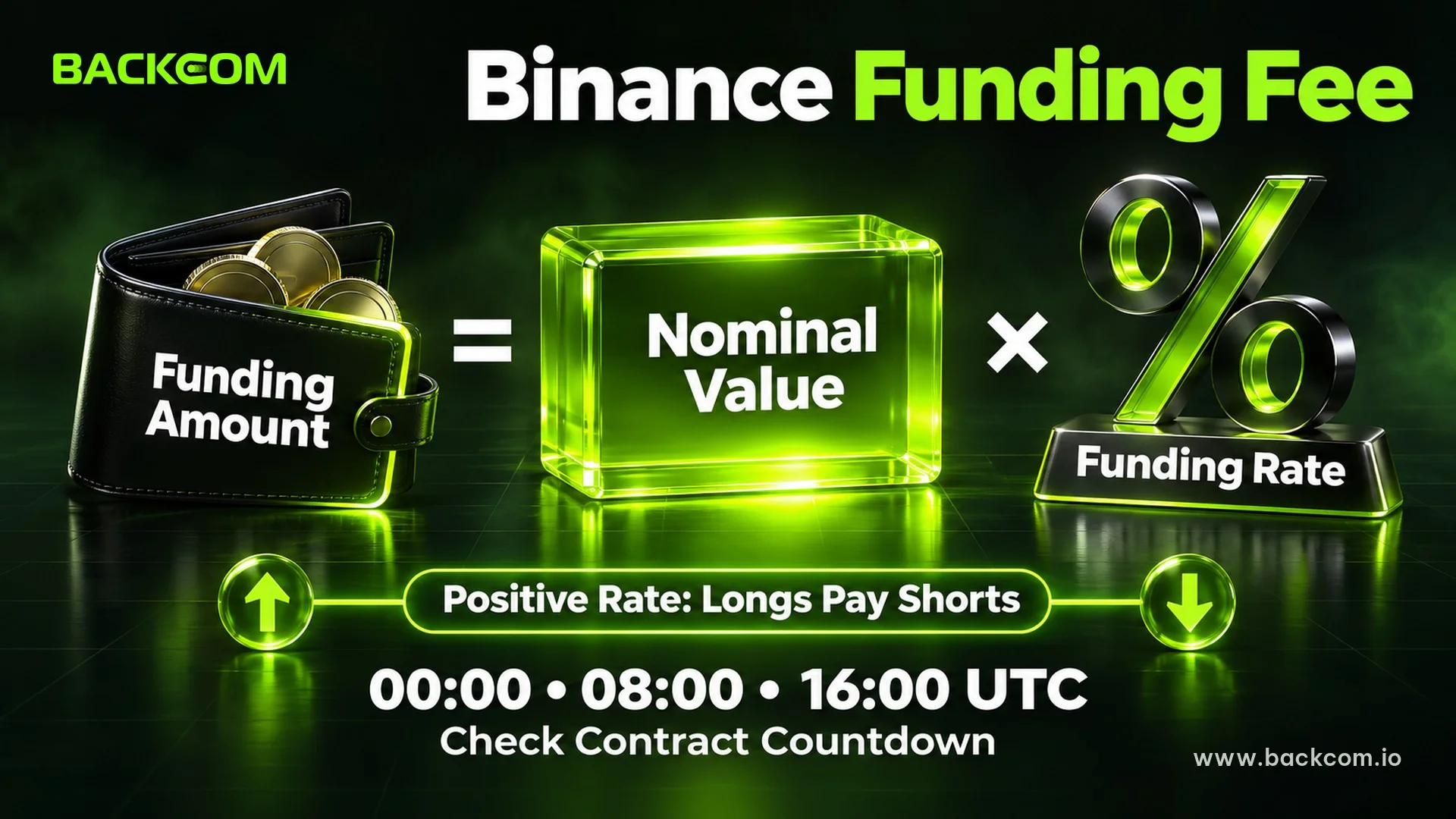
The Binance funding fee is a periodic payment between long and short holders of a perpetual contract, designed to keep the contract price close to the underlying price. Binance takes no cut. The money moves directly between traders on opposite sides.
From the Binance funding rate article:
- Default timing: every 8 hours, at 00:00, 08:00 and 16:00 UTC. Binance may change the interval for a contract during extreme volatility, and the fee help article notes that some pairs settle every 4 hours.
- Formula: Funding Amount = Nominal Value of Positions × Funding Rate, where the nominal value is mark price × contract size.
- Direction: when the rate is positive, longs pay shorts, so a short holder receives the payment. When it is negative, the direction reverses.
- Early exit: if you close the position before the funding time, you neither pay nor receive anything.
Because the interval differs by contract, check the funding countdown on the contract you trade instead of assuming 8 hours. For the mechanism in detail, read our guide to the funding rate and how to calculate funding fees.
6. Worked Example: What Does A $50,000 Round Trip Cost?
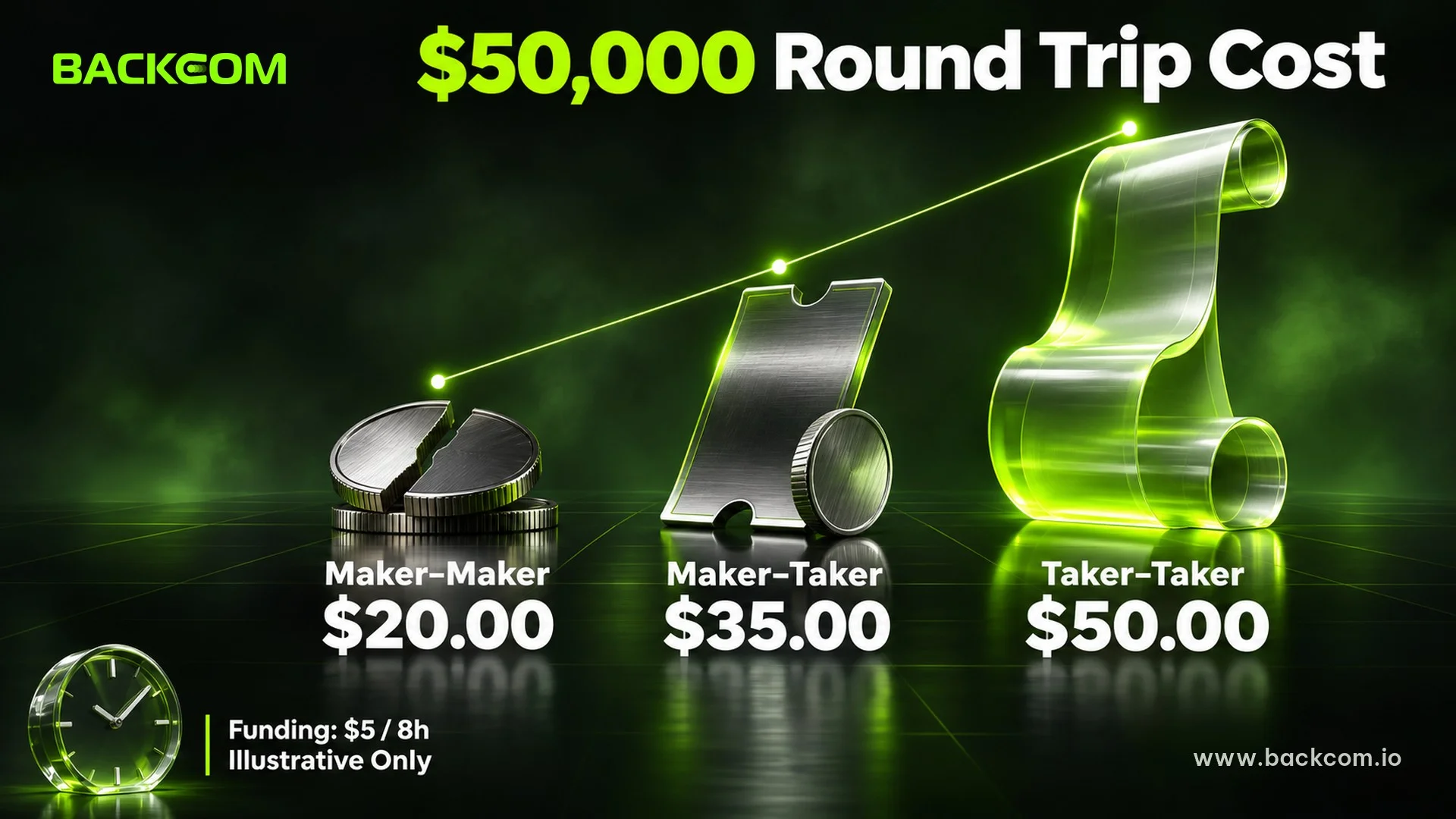
A round trip is one entry plus one exit, so the commission is charged twice. Take an assumed position with a notional value of $50,000 at the regular-user rates. The numbers are for illustration only.
| Scenario | Fee Rates Applied | Total Commission | With 10% BNB Discount |
|---|---|---|---|
| Maker entry, maker exit | 0.02% + 0.02% | $20.00 | $18.00 |
| Maker entry, taker exit | 0.02% + 0.05% | $35.00 | $31.50 |
| Taker entry, taker exit | 0.05% + 0.05% | $50.00 | $45.00 |
Figures are calculated from the published regular-user rates as at 12 November 2026. They exclude spread, slippage and funding, and your result will differ.
Now add funding. Assume a funding rate of 0.01% per 8-hour period, a number chosen only to show the arithmetic. On $50,000 of notional, one settlement costs $5 if you are on the paying side. Holding through three settlements in a day costs $15, a third of the taker-taker commission. A position that stays open for days can therefore pay more in funding than in commissions, while one closed before the next settlement pays none.
Before you size a position, also check the margin mode. The choice between cross and isolated margin decides how much of your account is exposed, and a position that gets liquidated adds the insurance clearance fee on top of the loss. For worked fee maths on other contracts, see our futures fee calculation examples, and our guide to calculating liquidation price shows how to find your risk level before you enter.
7. How Do Binance Rebates Change The Cost?
Binance Rebates are a share of the trading fees you pay that comes back to you when your account is registered through a partner link. On this site's Binance rebate page, updated on 23 October 2026 and checked again on 12 November 2026, the listed rebate is up to 30% of trading fees on spot and futures, paid every Monday, with no minimum volume and no time limit.
Using the table above at the full 30% rate: the $50 taker-taker round trip would return $15, leaving a net commission of $35. The $20 maker-maker round trip would return $6, leaving $14. A rebate is a share of a fee, not of your trade or your profit, and it applies to winning and losing trades alike. It does not cover funding payments or losses. Binance's own pages do not say whether a partner rebate combines with the BNB discount, so do not assume the two add up.
The conditions listed on the page are:
- New accounts: register through the program link or code before your first trade, because rebates usually cannot be added retroactively.
- UID linking: link your UID in your rebate dashboard so trades are tracked, and link each sub-account separately.
- Existing accounts: Binance does not allow changing an existing referrer, so ask our team about your case before you assume you qualify.
You can read the current terms and use the fee calculator on the Binance rebate page.
Backcom.io is an independent introducing broker (IB/affiliate) of the exchanges it lists, including Binance; rebates are paid from the commission the exchange pays Backcom.io. See the risk disclaimer for details. A rebate is not a reason to open an account, deposit funds or trade more than you planned.
8. How Can You Pay Less On Binance Futures Without Taking More Risk?
Lowering costs means changing how you trade, not trading more. These habits cut fees on any perpetual futures exchange:
- Use limit orders when the setup allows it, since a regular-level maker fill costs 40% of a taker fill.
- Avoid frequent small trades, because each round trip pays two commissions.
- Check the funding rate before holding overnight, especially on a crowded contract.
- Keep BNB in the futures wallet only if you already hold it, and do not buy it just for the discount.
- Compare net cost, not just the headline rate. Our reviews of Gate trading fees and OKX trading fees show how to read a schedule the same way, and the Binance vs Bybit comparison puts the two largest venues side by side.
None of these is a promise of lower total cost, because markets move against you faster than fees ever will.
Frequently Asked Questions (FAQ) About Binance Futures Fees
What Are The Binance Futures Maker And Taker Fees?
For a regular user on USDⓈ-M futures, the maker fee is 0.02% and the taker fee is 0.05%. VIP level and the BNB discount can lower them. Funding payments and slippage are separate costs, so check the live fee page before you trade.
Does Binance Charge A Funding Fee?
Yes, on perpetual contracts. Funding is usually settled every 8 hours at 00:00, 08:00 and 16:00 UTC, and some pairs differ. Binance does not take a cut of it. If you close before a settlement time, you neither pay nor receive funding.
How Much Is The Binance BNB Discount On Futures?
Binance gives a 10% discount on standard USDⓈ-M futures commissions paid in BNB. The BNB must be in your USDⓈ-M Futures wallet. If the balance runs out, USDT is deducted at the full rate and the discount does not apply.
Do Higher Leverage Levels Change The Fee?
No. The fee is charged on position value, which is contract size times execution price. Higher leverage only lets you open a larger position with the same margin, so the commission rises with the position size, not with the margin you put up.
Can I Get Binance Fees Back?
A partner program can return a share of the fees you pay. This site's Binance rebate page lists up to 30% on spot and futures as at 12 November 2026, subject to registering through the link and linking your UID. It does not cover funding payments or trading losses.
Conclusion: What Binance Futures Fees Really Cost
Binance futures fees look small at the headline level, but your real cost depends on order type, holding time and how much leverage you carry. A $50,000 round trip costs between $20 and $50 in commissions at the regular-user rates, and funding adds a separate charge only when you hold through a settlement. Read the live fee table, check the funding interval of the contract you trade and treat any discount or rebate as a small cost reduction, not a source of profit.
Disclaimer: This content is compiled by Backcom.io for information only and is not investment advice. Crypto assets and leveraged futures are volatile and you can lose your capital. Fees, discounts and rebate terms can change, and rules differ by country of residence. Check the current terms and your local regulations before you register or trade.
Was this article helpful?
Join The Backcom.io Community
Get the latest on trading rebates, trading tips, and broker deals — and connect with thousands of traders worldwide.

Backcom App
Track Your Rebates Every Day
Every rebate is visible by broker and by day. Manage your wallet and withdrawals in one place.
Open Backcom App