Spot Vs Futures Trading In Crypto: Differences, Costs And Risks


Spot vs futures trading is the first real choice a crypto trader makes after opening an exchange account. Spot means you buy the coin itself and own it. Futures means you trade a contract on its price, usually with leverage, and you never hold the coin. The two products sit side by side in the same app, yet they carry very different costs and risks. In this article, Backcom.io compares them on ownership, leverage, fees, funding, liquidation and suitability, using simple numbers you can check yourself. Every figure in the examples is illustrative.
1. Spot Trading Meaning: What Is Spot Trading In Crypto?
Spot trading meaning: you pay the full price now and receive the actual coin in your account. If you buy 0.01 BTC on the spot market, you own 0.01 BTC until you sell it, send it elsewhere or lose access to it.
That simple structure has clear consequences:
- Full ownership: the coin is in your account or wallet, so you can hold it, transfer it or use it where the platform allows.
- No leverage by default: according to Robinhood Learn on spot and futures crypto, spot involves no leverage, because you pay the full purchase price upfront.
- Only one direction: you make money when the price rises, and you lose when it falls.
- No expiry and no forced exit: a price drop hurts your balance, but nobody closes the position for you.
The main risks are price declines and custody. If you keep coins in your own wallet, protecting the keys is your job. If you leave them on an exchange, you rely on that exchange. Our guide to centralized vs decentralized exchanges explains the trade-off.
2. Futures Trading Meaning: What Is Futures Trading In Crypto?
Futures trading meaning: you trade a contract whose value follows the price of a coin, and you settle in profit or loss rather than in the coin. Robinhood's guide puts it plainly: you do not own the actual cryptocurrency when trading futures.
Most retail crypto futures are perpetual contracts. They have no expiry date, and a funding mechanism keeps their price close to the spot price. Traditional futures contracts do expire and are settled in cash, as the same Robinhood guide notes. For the mechanics of perpetuals, read what perpetual futures trading is in crypto.
Three features define the product:
- Leverage: a small deposit, called margin, controls a much larger position. That magnifies gains and losses alike. See what leverage means in crypto trading.
- Long and short: you can bet on a falling price as easily as a rising one.
- Margin rules: if losses eat too much of your margin, the exchange can close the position automatically. This is called liquidation.
The risks are therefore different in kind, not only in size. Losses can reach your whole margin quickly, and in some account setups they can exceed your deposit.
3. Spot Vs Futures Trading: Key Differences Side By Side

The spot vs futures trading question is easiest to answer in a table. This one covers the points that matter most to a new trader.
| Spot | Futures (perpetual) | |
|---|---|---|
| What you get | The actual coin | A contract on the coin's price |
| Leverage | None by default | Yes, set by you within exchange limits |
| Direction | Long only | Long or short |
| Forced closure | No | Yes, liquidation at the margin limit |
| Ongoing charges | None while you hold | Funding payments while you hold |
| Maximum loss | The amount you paid | Margin, and sometimes more depending on setup |
| Best known for | Buying and holding | Short-term trading and hedging |
This table summarises the general concepts. Product names, limits and rules differ by exchange and by country, so check your platform before trading.
Two rows deserve extra attention. Ongoing charges are easy to miss: a spot position costs nothing to hold, while a leveraged perpetual can slowly drain margin through funding. Forced closure is the other: on spot, a bad week is a paper loss you can sit through, while on futures the same week can end the trade for you.
4. Futures Fees Vs Spot Fees: What Does Each Really Cost?
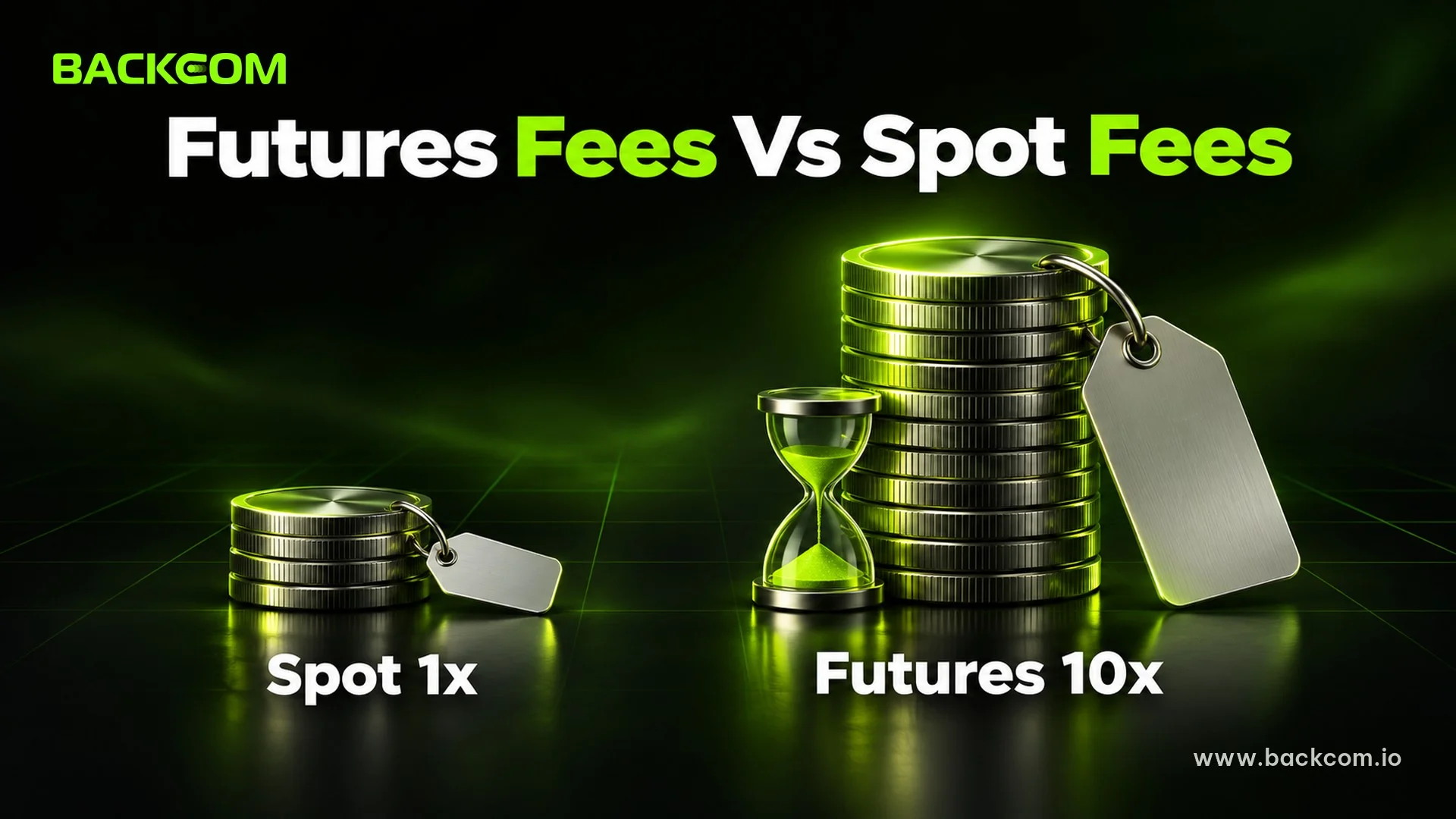
Futures fees vs spot fees cannot be compared by the headline rate alone, because the rate applies to different amounts. Spot fees apply to the coins you buy. Futures fees apply to the full contract value, which is your margin multiplied by your leverage.
According to the Binance fee schedule, a regular user at VIP 0 pays 0.100% maker and 0.100% taker on spot, checked on 11 November 2026. Binance's futures fee FAQ gives a USDⓈ-M futures example of 0.02% maker and 0.05% taker, but labels those rates hypothetical and says fees vary by VIP level and can change. Use the figures below only as a teaching example, and look up the live table for your own account.
Take 1,000 USDT of your own money, and assume taker orders on both sides:
| Spot | Futures at 10x | |
|---|---|---|
| Position value | 1,000 USDT | 10,000 USDT |
| Taker fee rate | 0.10% | 0.05% |
| Fee to open | 1.00 USDT | 5.00 USDT |
| Fee to open and close | 2.00 USDT | 10.00 USDT |
| Fee as share of your 1,000 USDT | 0.2% | 1.0% |
Illustrative rates for teaching. Real fees depend on the exchange, VIP level, order type and any fee-discount tokens.
The futures rate is half the spot rate, yet you pay five times as much. The reason is simple: leverage multiplies the position the fee is charged on. A trader who opens and closes often at high leverage can spend a visible share of the account on fees alone. Choosing maker orders helps on both products, and maker vs taker fees in crypto shows how.
For fee breakdowns of single exchanges, see Gate trading fees and MEXC trading fees, which both separate spot and futures rates.
5. How Do Funding Rates Change The Cost Of Futures?
Funding is the extra cost that only perpetual futures have. According to the Binance funding rate FAQ, funding is a periodic payment between long and short holders that keeps the contract price near the spot index. It is exchanged every 8 hours by default, at 00:00, 08:00 and 16:00 UTC, and Binance says it does not take a fee on these payments. When the rate is positive, longs pay shorts. When it is negative, shorts pay longs. You only pay or receive if you hold a position at the funding time.
An example with an assumed rate of +0.01% per 8 hours, on a 10,000 USDT long:
Funding per interval = Position value × Funding rate = 10,000 × 0.01% = 1.00 USDT
- Per day: three intervals, so about 3.00 USDT.
- Per week: about 21.00 USDT, if the rate never changes.
That is small next to a 10,000 USDT position, but large next to 1,000 USDT of margin if you hold for weeks. Funding rates change with market conditions and can stay positive or negative for long periods. Our guide to what the funding rate is and how to calculate funding fees walks through the formula.
Spot has no funding. That is one reason spot suits long holding periods and futures suits shorter ones.
6. How Risky Is Futures Compared With Spot? A 10% Drop Example
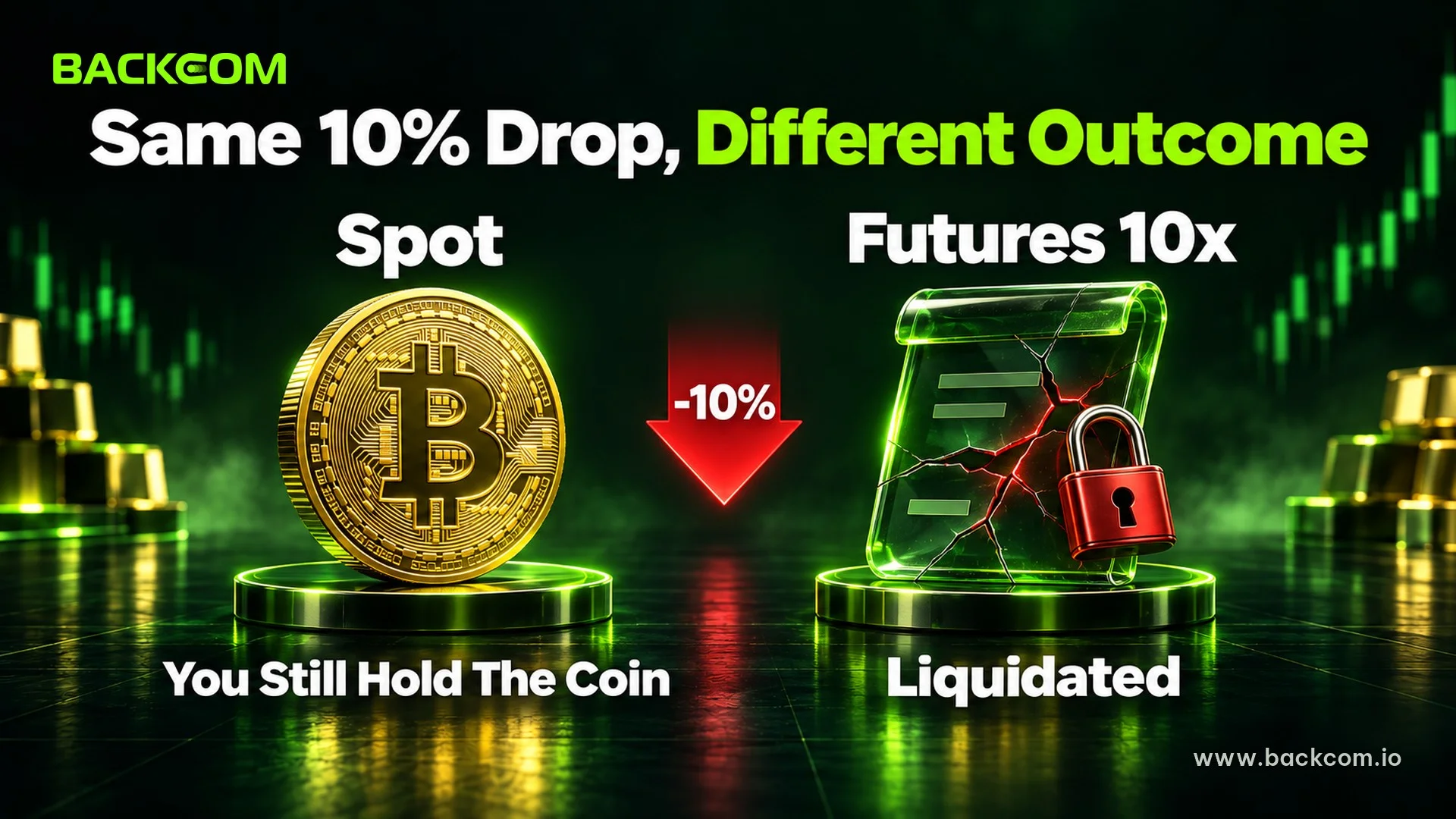
The sharpest difference between the two is what a falling price does to you. Take a 1,000 USDT account and a BTC price of 100,000 USDT.
| Scenario | Spot | Futures 10x long |
|---|---|---|
| Position | 0.01 BTC (1,000 USDT) | 0.1 BTC (10,000 USDT) |
| Price falls 10% to 90,000 | Value 900 USDT, loss 100 USDT | Loss 1,000 USDT, margin gone |
| What happens next | You still hold the coin | The position is liquidated at about this level |
| Price then recovers to 100,000 | Back to 1,000 USDT | Nothing left to recover |
Simplified example that ignores fees, funding and exact maintenance margin. On a long, the real liquidation price sits above 90,000 because exchanges require a maintenance margin, so the position closes before the price has fallen a full 10%.
The same market move produces a 10% loss on spot and a full loss on futures. Spot also lets you wait for a recovery, while a liquidated futures position is closed whatever the price does next. To see how the real liquidation level is computed, follow our guide to how to calculate liquidation price. For the early warning stage, read crypto margin call explained.
Lower leverage narrows the gap. At 2x, the same 10% fall costs about 20% of margin, and the liquidation price is far away. The risk comes from the leverage you choose, not from the word "futures". The Cross vs isolated margin setting also decides how much of your account is exposed.
7. Spot Or Futures For Beginners: Which Should You Start With?

Spot or futures for beginners has a practical answer for most people: start with spot. It has fewer moving parts, no liquidation, no funding and no margin settings to get wrong. Robinhood's guide lists margin calls, forced liquidation and losses beyond your initial investment among the key risks of futures, and none of these apply to a plain spot purchase.
Use this checklist to decide whether you are ready for futures:
- You can explain liquidation: you know how your liquidation price is calculated and where it sits.
- You size from your stop: you decide the loss first and work out the position size afterwards, as shown in our position size guide.
- You use a stop loss: you understand how crypto stop losses work, including slippage in fast moves.
- You can afford the whole margin: the money in the trade is money you could lose in full.
- You have tested with small size: your first leveraged trades are tiny and low leverage.
If any of these is missing, stay on spot a while longer. Newer to the market itself? Start with the beginner guide to what crypto is.
8. When Does Futures Make Sense, And When Does Spot Win?
Neither product is better in general. They solve different jobs.
Spot fits when you:
- want to hold a coin for months or years without monitoring margin;
- plan to move coins to a wallet or use them for staking or payments, where the platform allows it;
- prefer a loss that is limited to the price move, with no forced exit.
Futures fits when you:
- want to trade short moves in both directions;
- need to hedge a spot holding, for example by opening a short while you keep the coins;
- are comfortable managing leverage, stops and liquidation distance.
Many experienced traders use both: spot for the long-term core, small futures positions for hedging or tactical trades. The point is to match the tool to the task, and to treat leverage as a risk setting rather than a way to speed up growth.
Frequently Asked Questions (FAQ) About Spot Vs Futures Trading
Is Futures Trading Riskier Than Spot Trading?
Usually yes, because of leverage and liquidation. On spot, the most you can lose is what you paid. On futures, a small price move against a leveraged position can wipe out your margin, and some setups allow losses beyond it. Low leverage and strict stops reduce the gap but do not remove it.
Can I Lose More Than I Deposit In Crypto Futures?
It depends on the exchange and account type. Robinhood's guide notes that futures losses can potentially exceed your initial investment. Many exchanges use isolated margin and liquidation engines to cap losses, but fast markets can still cause gaps. Read your platform's rules on negative balances before trading.
Are Futures Fees Higher Than Spot Fees?
Per trade, usually yes in money terms, even when the percentage rate is lower. The fee applies to the full contract value, so 10x leverage means 10 times the fee base. Funding payments add a running cost on perpetuals. Spot has no funding.
Do I Own The Coin When I Trade Futures?
No. You hold a contract that tracks the price, not the underlying coin. You cannot withdraw it to a wallet. If you want to own the coin, buy it on the spot market.
Conclusion: Learn Spot First, Treat Futures As A Risk Tool
Spot vs futures trading comes down to ownership versus exposure. Spot gives you the coin, no forced exit and no ongoing charges. Futures gives you leverage, short selling and flexibility, at the price of funding, higher fees on larger positions and liquidation. For most beginners, spot is the safer place to learn. If you move to futures, keep leverage low, size positions from your stop, and check the exchange's live fee and margin tables first.
Disclaimer: This content is compiled by Backcom.io for information only and is not investment advice. Crypto trading, especially with leverage, carries a high risk of loss, including the loss of all your margin. Examples use illustrative numbers, and fees, margin rules and liquidation methods differ by exchange, so check your platform's rules before trading.
Was this article helpful?
Join The Backcom.io Community
Get the latest on trading rebates, trading tips, and broker deals — and connect with thousands of traders worldwide.

Backcom App
Track Your Rebates Every Day
Every rebate is visible by broker and by day. Manage your wallet and withdrawals in one place.
Open Backcom App