OKX Trading Fees: Maker, Taker, Funding And VIP Tiers Explained

OKX trading fees depend on three things: the product you trade, whether your order is a maker or a taker, and your VIP tier. For a regular account on OKX's global framework, spot costs 0.08% for makers and 0.10% for takers, and perpetual futures cost 0.02% and 0.05%. In this article, Backcom.io walks through each fee type, the tier thresholds, funding payments and a worked cost example, so you can estimate what you will actually pay before you trade.
OKX Trading Fees At A Glance
OKX charges a fee on every filled order, and the rate changes with the product, the order type and your 30-day volume or asset balance. Five points cover most of what a new user needs:
- Spot and futures have different rates: futures rates are lower per trade, but you also pay funding while a position is open.
- Makers pay less than takers: a resting limit order adds liquidity and earns the lower rate.
- Tiers use volume or assets: you qualify for a VIP tier by meeting either threshold, not both.
- Funding is not a trading fee: it moves between traders, and OKX does not keep it.
- Rates can change: OKX updates its fee framework from time to time, so confirm your live rate in your account.
The figures below come from OKX's own help pages, checked on 8 November 2026: the Global Fee Framework update and the Trading Fee Rules FAQ. Fees differ by region and account type, so the number in your account is the one that counts.
OKX Maker Taker Fees: Spot And Futures Base Rates
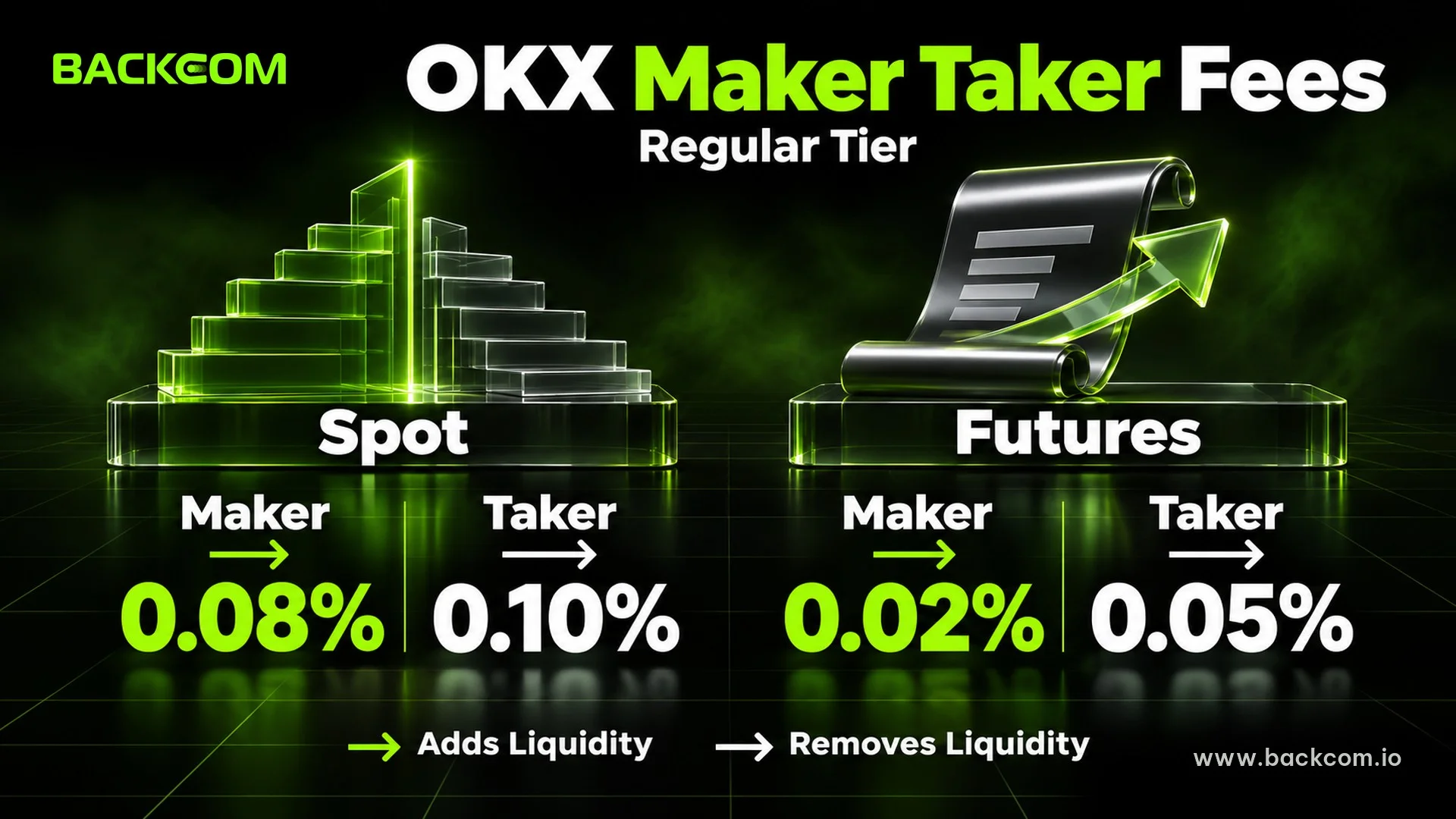
OKX maker taker fees follow the same logic as most exchanges: a maker adds an order to the book and waits, and a taker removes liquidity with an order that fills at once. If you are new to the idea, our guide to maker vs taker fees explains it in more detail.
OKX's global fee framework lists these rates for a regular user, meaning an account below the first VIP threshold:
| Product | Maker | Taker | Notes |
|---|---|---|---|
| Spot, standard pairs | 0.080% | 0.100% | Same rate for the top-10, mid-tier and other pair groups |
| Spot, zero-fee pairs | 0.000% | 0.000% | Listed stablecoin pairs such as USDC-USDT |
| Perpetual futures and futures | 0.020% | 0.050% | Same for both pair groups at this tier |
| Options | 0.030% | 0.030% | Regular user rate |
Reference rates for the OKX global framework, as at 8 November 2026. They can change, and your own rate depends on your region and tier, so check "My trading fees" in your account before you trade.
Two details save money. First, spot fees are taken from what you receive: a taker who buys 1 BTC at a 0.1% rate pays 0.001 BTC and receives 0.999 BTC. Second, forced liquidation uses the taker rate of your tier, so a liquidated position costs more than a planned exit.
OKX Futures Fees: How The Cost Is Calculated
OKX futures fees are charged on the full contract value of your fill, not on the margin you put up. For a USDT-margined perpetual, the fee equals the fee rate multiplied by the contract value, and it is settled in USDT when the order fills. For a crypto-margined contract, the fee is settled in the traded coin.
This is where leverage changes the picture. A trader who opens a $10,000 position with $1,000 of margin pays the fee on $10,000, which is ten times the amount a spot-style calculation on the margin would suggest. Because fees apply when you open and again when you close, a round trip costs two fees. Our guide to cross margin vs isolated margin shows how margin mode affects the rest of the risk, and the liquidation price guide covers the downside.
A short worked example, for illustration only. A trader opens a $10,000 perpetual position and closes it later:
- As a taker both ways: 0.05% × $10,000 = $5 to open, plus $5 to close, so $10 in total.
- As a maker both ways: 0.02% × $10,000 = $2 to open, plus $2 to close, so $4 in total.
- Mixed (maker in, taker out): $2 + $5 = $7.
The gap looks small per trade. It adds up for anyone who trades often, which is why order type is the first cost lever to check.
OKX Fee Tiers: VIP Levels, Volume And Asset Thresholds
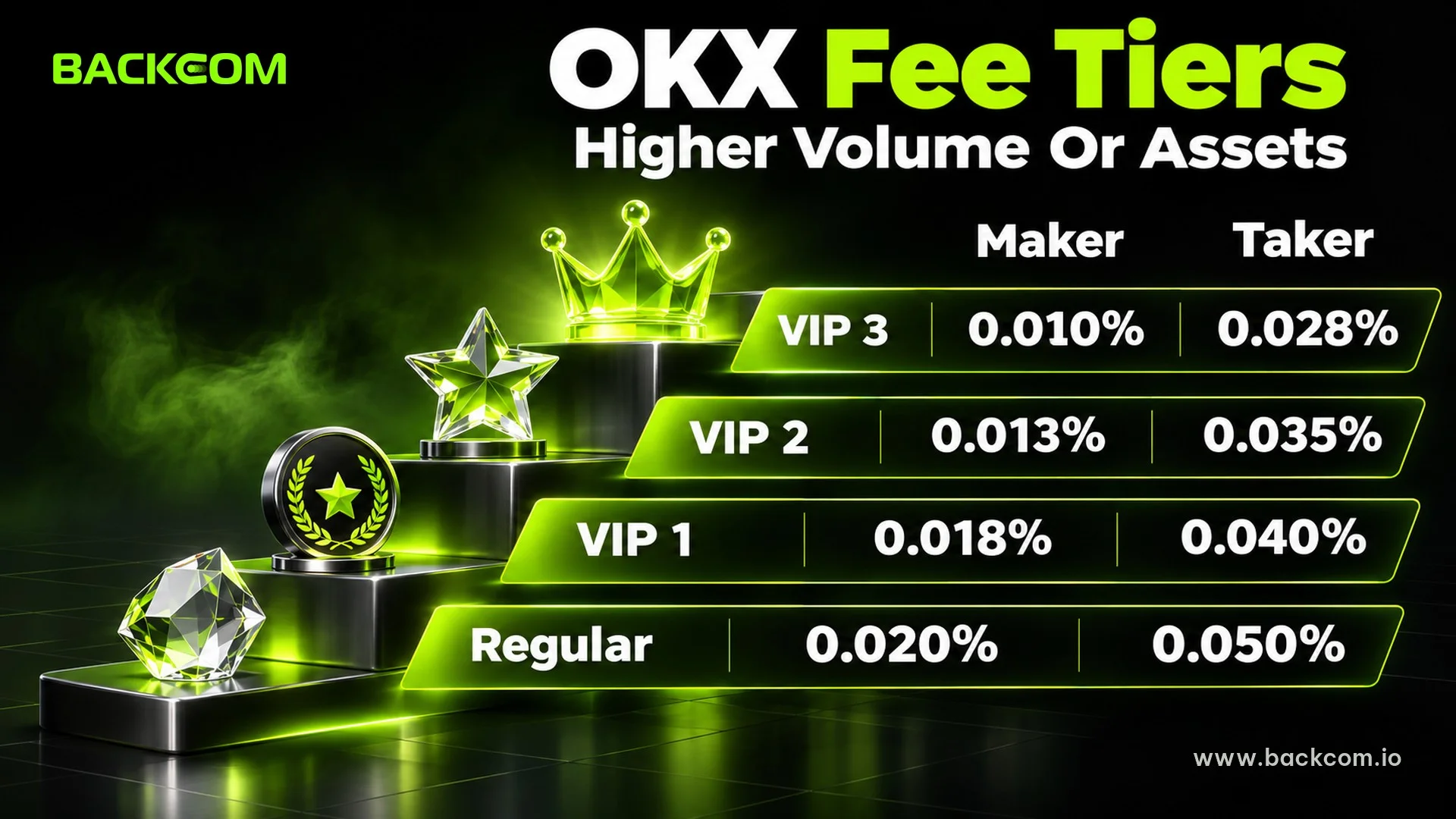
OKX fee tiers reduce your rates as your 30-day trading volume or your asset balance rises. You need to meet only one of the two requirements. The asset test is measured in USD value, and the volume test uses your trailing 30 days.
The first tiers of the futures schedule, taken from OKX's global framework, look like this:
| Tier | Asset or 30-day futures volume (USD) | Maker | Taker |
|---|---|---|---|
| Regular user | Below 100,000 assets and below 10 million volume | 0.0200% | 0.0500% |
| VIP 1 | 100,000 assets or 10 million volume | 0.0180% | 0.0400% |
| VIP 2 | 250,000 assets or 50 million volume | 0.0130% | 0.0350% |
| VIP 3 | 500,000 assets or 100 million volume | 0.0100% | 0.0280% |
Spot tiers use a lower volume bar. VIP 1 spot starts at 1 million USD of 30-day volume, VIP 2 at 5 million and VIP 3 at 10 million, with the same asset thresholds as above. At the top of the futures schedule (VIP 7 and higher), makers can receive a negative rate, which means the exchange pays a small amount for adding liquidity.
Reference thresholds as at 8 November 2026, from OKX's published framework. OKX can change tiers, so confirm the current table on the OKX help centre.
The practical reading is simple. A retail trader who opens a few positions a month will stay in the regular tier, and VIP discounts matter mainly for high-volume accounts. Do not trade more just to reach the next tier: the extra fees can outweigh the saving. For a comparison with another exchange's structure, see our breakdown of Gate trading fees.
OKX Funding Rate: The Cost Outside The Fee Table
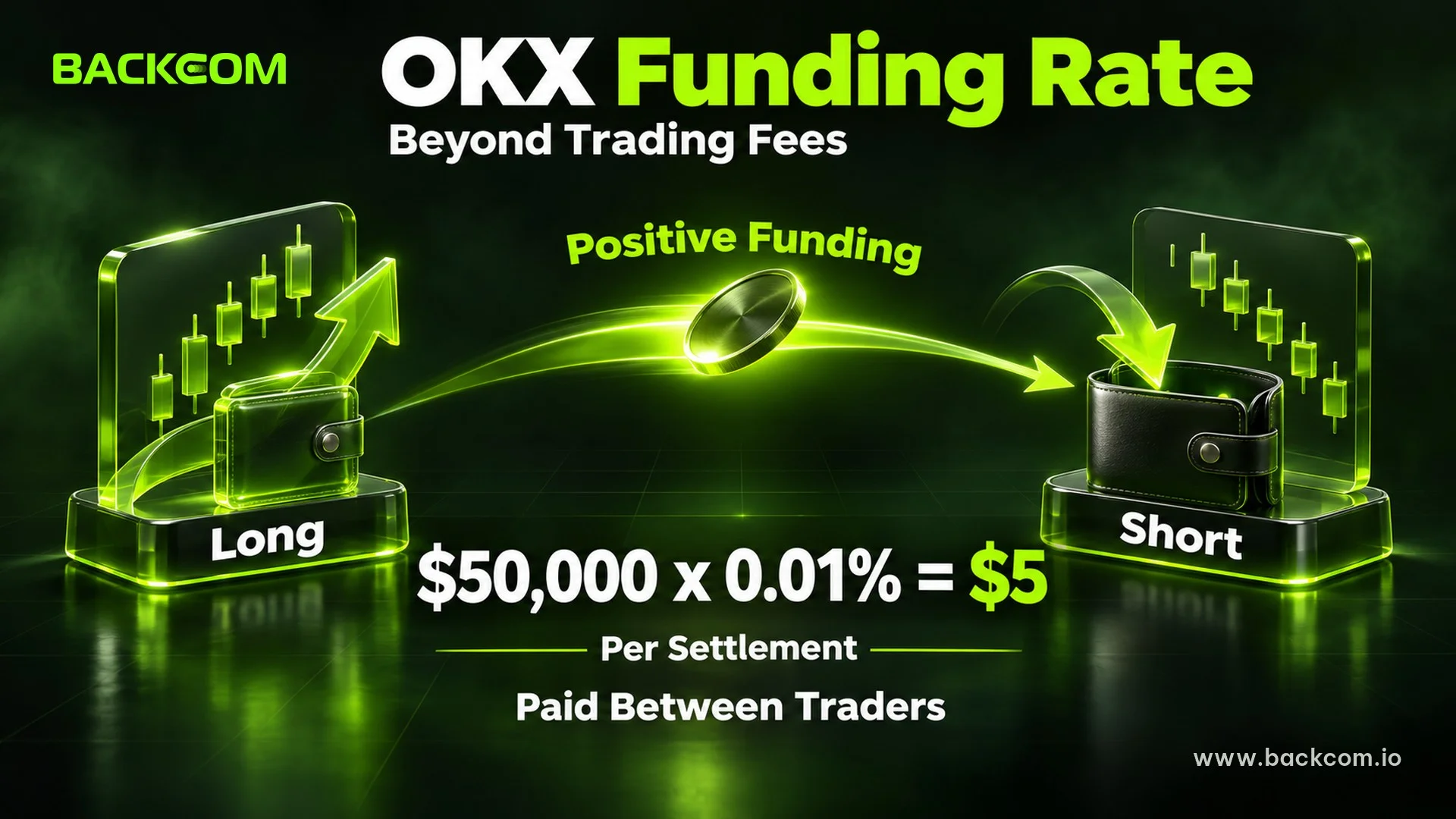
The OKX funding rate is a periodic payment between long and short traders on perpetual contracts, and it is separate from trading fees. When the rate is positive, longs pay shorts; when it is negative, shorts pay longs. OKX does not take a cut. Funding is charged only if you hold the position at the settlement time, and the interval is 8, 4, 2 or 1 hours depending on the instrument.
The calculation is the position value multiplied by the funding rate. Assume a $50,000 long position and a funding rate of 0.01% at one settlement (an assumption, not a forecast): the payment is $5. At three settlements a day, a position held for a week would pay about $105 if the rate stayed the same, which is more than the $50,000 position's entry fee at the taker rate ($25). Funding can also flip direction and pay you, so it is a variable cost, not a fixed one. Our guide on how funding rates work and how to calculate them covers the formula in depth.
If your balance cannot cover a funding payment, OKX deducts it from the position margin. For short holding periods, funding is usually small. For positions held for days or weeks, it can become the largest cost line.
What $100,000 Of Volume Costs On OKX
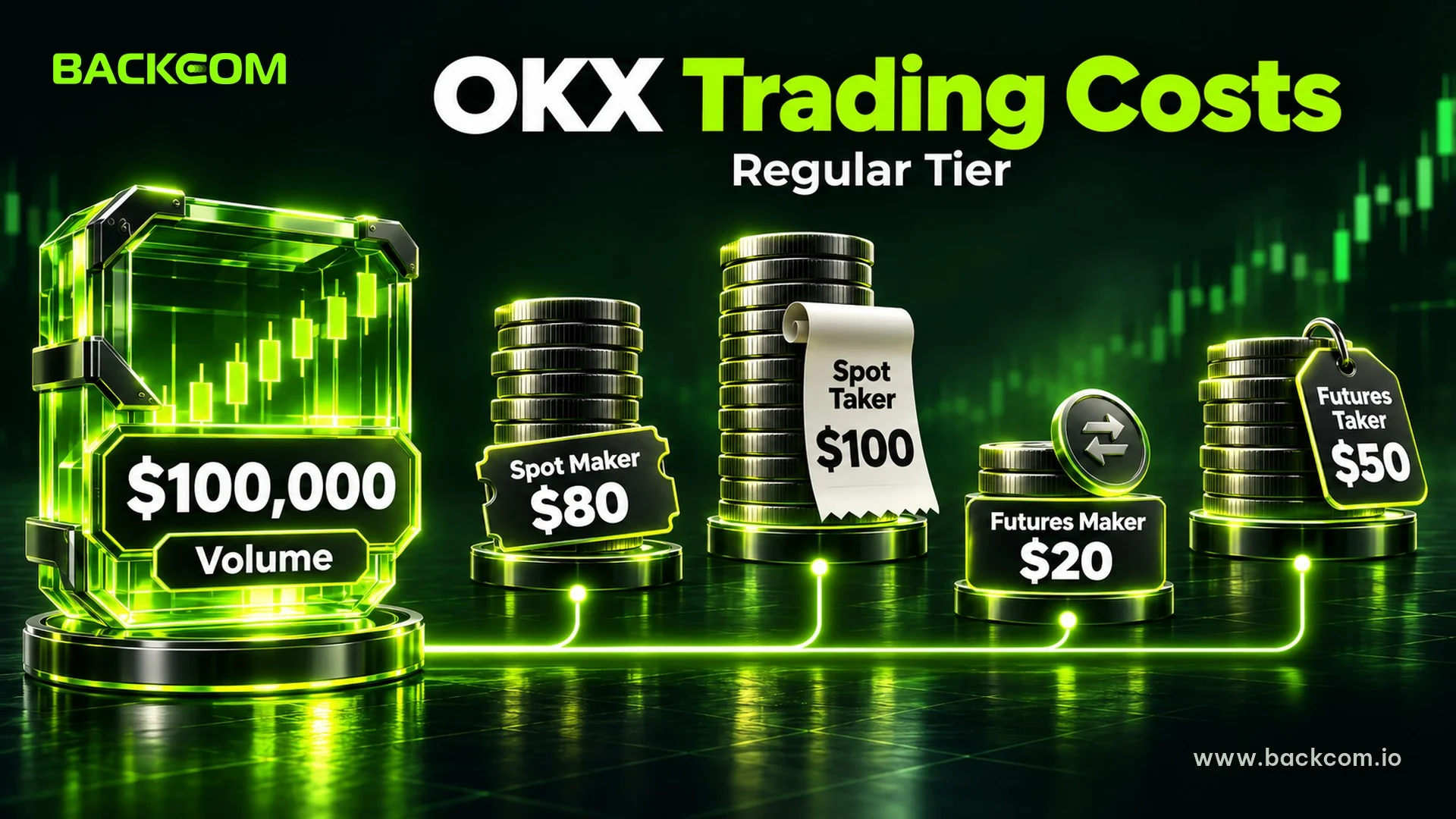
The clearest way to compare OKX trading fees is to apply the base rates to one volume figure. This example uses $100,000 of monthly volume and the regular-tier rates above.
| Scenario | Rate | Fees paid |
|---|---|---|
| Spot, all maker orders | 0.080% | $80 |
| Spot, all taker orders | 0.100% | $100 |
| Perpetual futures, all maker orders | 0.020% | $20 |
| Perpetual futures, all taker orders | 0.050% | $50 |
The figures are an assumption, as at 8 November 2026, using published base rates. They are not a forecast, and your tier, region and order mix will change the result.
Notice what the table leaves out. Fees are not the whole cost of a trade: the spread and slippage on a market order can exceed the fee on thin pairs, and funding adds to futures costs. The cheapest rate on paper is not always the cheapest trade.
OKX Rebates Through The Partner Program
OKX Rebates are a share of the fees you pay, returned to you when your account is linked to the partner program. The program page shows up to 50% of spot and futures fees back: 20% credited by OKX about 1–2 hours after an order closes, and a further 30% paid every Monday to your rebate wallet in the app (page checked 8 November 2026).
Using the example above, $100,000 of taker-only futures volume produces $50 in fees, and the full 50% would return up to $25. The same volume as spot takers produces $100 in fees and up to $50 back. A rebate is a share of a fee, not of your trade or profit, and it applies to winning and losing trades alike. It lowers your cost; it does not change the risk of the position.
Two conditions apply. A new account should be registered through the program link before the first trade, and an existing account has to be linked and approved by OKX. Each UID, including sub-accounts, is linked separately. You can read the current terms and linking steps on the OKX rebate page.
Backcom.io is an independent introducing broker (IB/affiliate) of the exchanges it lists, including OKX; that second portion is funded from the commission the exchange pays Backcom.io. See the risk disclaimer for details. A rebate is not a reason to open an account, deposit funds or trade more than you planned.
How To Pay Less On OKX Without Taking More Risk
Lower fees come from how you trade, not from chasing discounts. Five habits make the biggest difference:
- Use limit orders when you are not in a hurry, so you pay the maker rate.
- Avoid frequent small trades on pairs where the spread is wide.
- Check funding before you hold a perpetual overnight, and compare it with the fee you would save.
- Use zero-fee pairs when you only need to swap between listed stablecoins.
- Read your own rate under "My trading fees" after any change in region, tier or account type.
For a view of the exchange itself rather than its fees, our OKX legitimacy review covers regulation, security and withdrawal checks.
Frequently Asked Questions (FAQ) About OKX Fees
How Much Are OKX Trading Fees?
For a regular account on the global framework, spot is 0.08% maker and 0.10% taker, and perpetual futures are 0.02% maker and 0.05% taker. Your own rate depends on your region and tier, so check "My trading fees" in your account.
Does OKX Charge Fees For Both Opening And Closing A Trade?
Yes. A fee applies to each filled order, so a futures round trip pays once to open and once to close. If the exchange liquidates your position, the liquidation fill uses the taker rate of your tier.
What Is The Difference Between The Fee And The Funding Rate?
The trading fee goes to the exchange when an order fills. The funding rate is a periodic payment between longs and shorts on perpetual contracts, and OKX does not keep it. You pay or receive funding only if you hold the position at settlement.
How Do I Reach A Higher OKX VIP Tier?
You meet either the 30-day trading volume threshold or the asset balance threshold for the tier. For futures, VIP 1 starts at 10 million USD of 30-day volume or 100,000 USD of assets. Reaching a tier only by trading more can cost more than it saves.
Are OKX Fees The Same In Every Country?
No. OKX operates under different entities and publishes separate fee frameworks for regions such as the United States. Use the fee page shown for your country and the figure inside your account.
Conclusion: What Do OKX Trading Fees Really Cost?
On OKX, the fee table is only part of the cost: order type, tier, funding and slippage together decide what a trade costs you. At the regular tier, a futures maker pays 0.02% and a taker 0.05%, and spot costs 0.08% and 0.10%. Use limit orders where you can, watch funding on long holds, and read your live rate before you size a position. Treat any rebate as a small cost reduction, never as a reason to trade more.
Disclaimer: This content is compiled by Backcom.io for information only and is not investment advice. Crypto assets are volatile and leveraged products can lose your whole margin. Fees, tiers and rebate terms can change, and rules differ by country of residence. Check the current terms and your local regulations before you register or trade.
Was this article helpful?
Join The Backcom.io Community
Get the latest on trading rebates, trading tips, and broker deals — and connect with thousands of traders worldwide.

Backcom App
Track Your Rebates Every Day
Every rebate is visible by broker and by day. Manage your wallet and withdrawals in one place.
Open Backcom App