What Is Liquidity In Crypto And Why It Changes Your Slippage And Fees


What is liquidity in crypto? It describes how easily you can buy or sell a coin at a price close to the one on your screen. Two traders can click "buy" on different coins at the same moment, and one gets a clean fill while the other pays noticeably more. In this article, Backcom.io explains crypto market liquidity, how order book depth and spread work, why low liquidity crypto costs more, and how liquidity and trading fees combine into your real cost.
What Is Liquidity In Crypto?
Liquidity in crypto is the ease with which an asset can be bought or sold without moving its price much. Binance Academy defines it in nearly the same words, and it also notes that in illiquid markets traders may have to accept a price well away from what they expected.
Think of a busy market stall against a stall that sells one rare item a week. At the busy stall, many buyers and sellers are always present, so prices stay steady. At the quiet stall, one large order changes the price for everyone.
Liquidity is not a single number. It shows up in three places:
- Spread: the gap between the best price a buyer offers and the best price a seller asks.
- Depth: how much volume is waiting at prices near the current one.
- Activity: how often the coin trades, which tells you whether orders find a counterparty quickly.
A liquid market usually has a tight spread, a deep book and steady activity. An illiquid market has a wide spread, a thin book and long gaps between trades.
Order Book Depth And Liquidity: How Does The Order Book Show It?
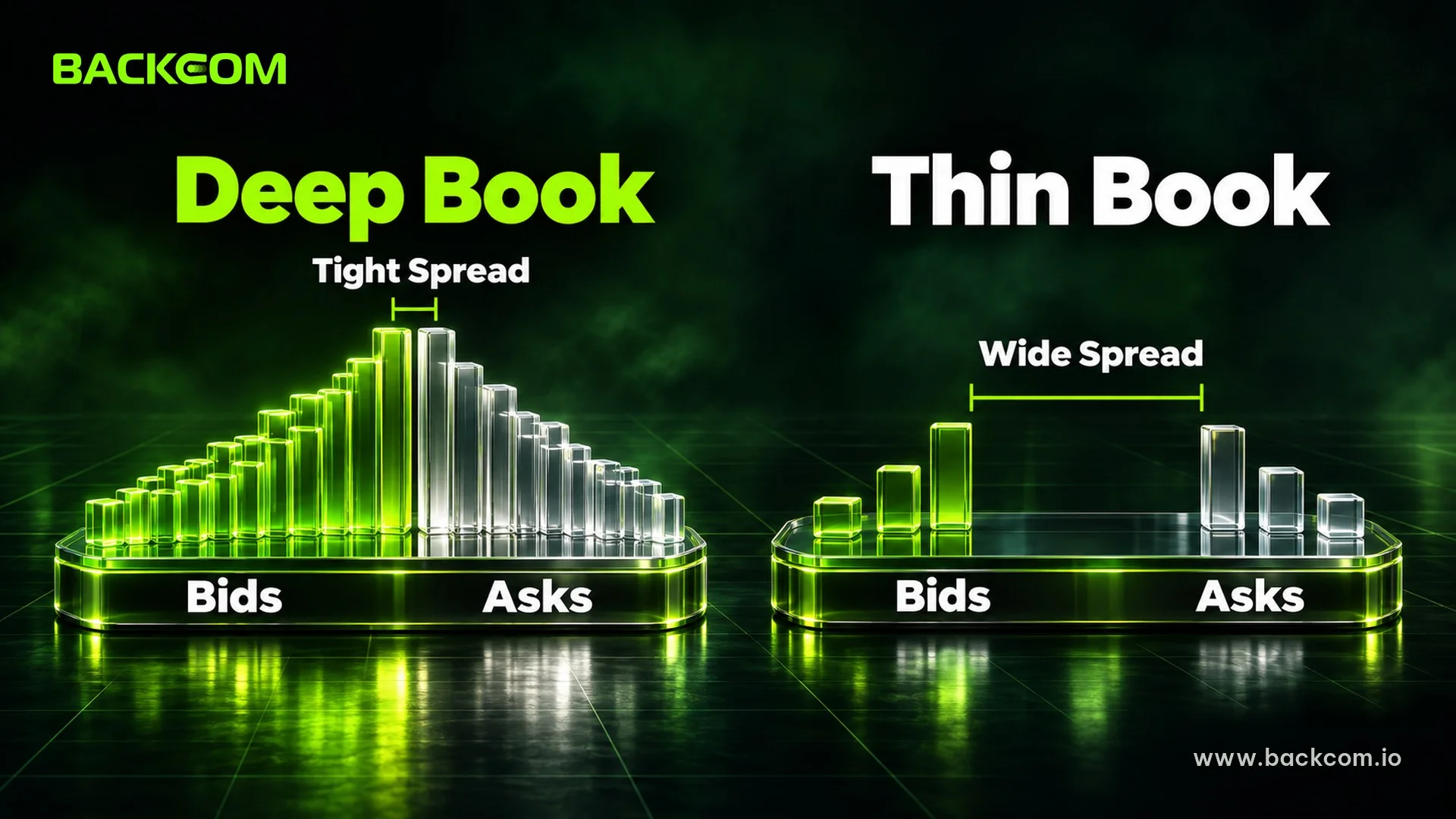
The order book is a live list of all open buy orders (bids) and sell orders (asks), sorted by price, and it is the most direct view of liquidity on an exchange. Every limit order you place that is not filled at once sits in this list until someone takes it. That is why order book depth and liquidity are so closely linked. Our guide to crypto order types explains how limit and market orders behave differently here.
When you place a market order, you do not trade at "the price". You work through the book, taking the cheapest asks first and then the next ones up. A thin book runs out of cheap asks quickly, so each extra unit costs more.
Here is how the three signals read on a typical screen:
| Signal | Liquid market | Illiquid market |
|---|---|---|
| Spread | Very tight, a few hundredths of a percent | Wide, often several tenths of a percent or more |
| Depth near the price | Large volume within 1% of the mid price | Small volume, gaps between price levels |
| Trade frequency | New trades every second | Minutes between trades |
Compare these signals only for the same trading pair on the same exchange, because depth differs from one venue to the next.
What Is Market Depth And Why Does It Matter?
Market depth is the amount of buy and sell volume resting in the order book within a set distance of the mid price. Data provider Kaiko builds its liquidity research on this idea. Its liquidity concentration report works from order book data covering all bids and asks within 10% of the mid price, so analysts can compare depth at several distances.
Depth answers a question that price alone cannot: how big an order can the market absorb before the price moves? A coin can show a tight spread and still have very little behind it. The best bid and ask may hold only a handful of units each.
Crypto Market Liquidity: Which Measure Matters Most?
Spread, depth and volume each measure a different part of liquidity, so no single one is enough on its own. Traders often look only at 24-hour volume because it is easy to find. That habit can mislead.
Volume shows what has already traded, while depth shows what is available to trade right now. Kaiko's 2023 report found that one large exchange's share of market depth fell from 42% to 30.7% while its share of volume rose, which suggests a zero-fee programme lifted volume more than resting liquidity. Volume can be inflated by activity that adds no real depth.
Use each measure for what it does best:
- Spread: best for small orders, since you cross it every time you trade.
- Depth: best for larger orders, because it shows how far the price moves as you size up.
- Volume: best as a sanity check that a market is alive, not as proof it is deep.
The practical rule is simple. Check the spread first, then look at depth at the order size you plan to trade, and treat volume as background.
What Is Slippage And How Does Liquidity Cause It?

Slippage is the difference between the price you expected and the average price you actually received, and thin liquidity is its main cause. Our dedicated guide to slippage in crypto trading covers ways to reduce it. This section shows where it comes from.
Take a market buy of 10 units. The tables below use made-up prices to show the mechanics. The best ask is 100.00 in both cases, and slippage below is measured from that best ask.
| Ask price | Deep book: units available | Thin book: units available |
|---|---|---|
| 100.00 | 5 | 1 |
| 100.02 | 5 | none |
| 100.50 | none | 2 |
| 101.20 | none | 3 |
| 102.00 | none | 4 |
In the deep book, your order takes 5 units at 100.00 and 5 at 100.02. The total cost is 1,000.10, so the average price is 100.01, which is 0.01% above the best ask.
In the thin book, it takes 1 unit at 100.00, 2 at 100.50, 3 at 101.20 and 4 at 102.00. The total cost is 100 + 201 + 303.6 + 408 = 1,012.60, so the average price is 101.26, which is 1.26% above the best ask.
The order size was identical. Only the depth changed, and the slippage grew more than a hundredfold.
Average fill price = Total cost of all units bought ÷ Number of units bought
Slippage also works against you when you sell. A market sell eats the bids from the top down, so a thin bid side pushes your average sale price lower.
Liquidity And Trading Fees: How Does One Change The Other?
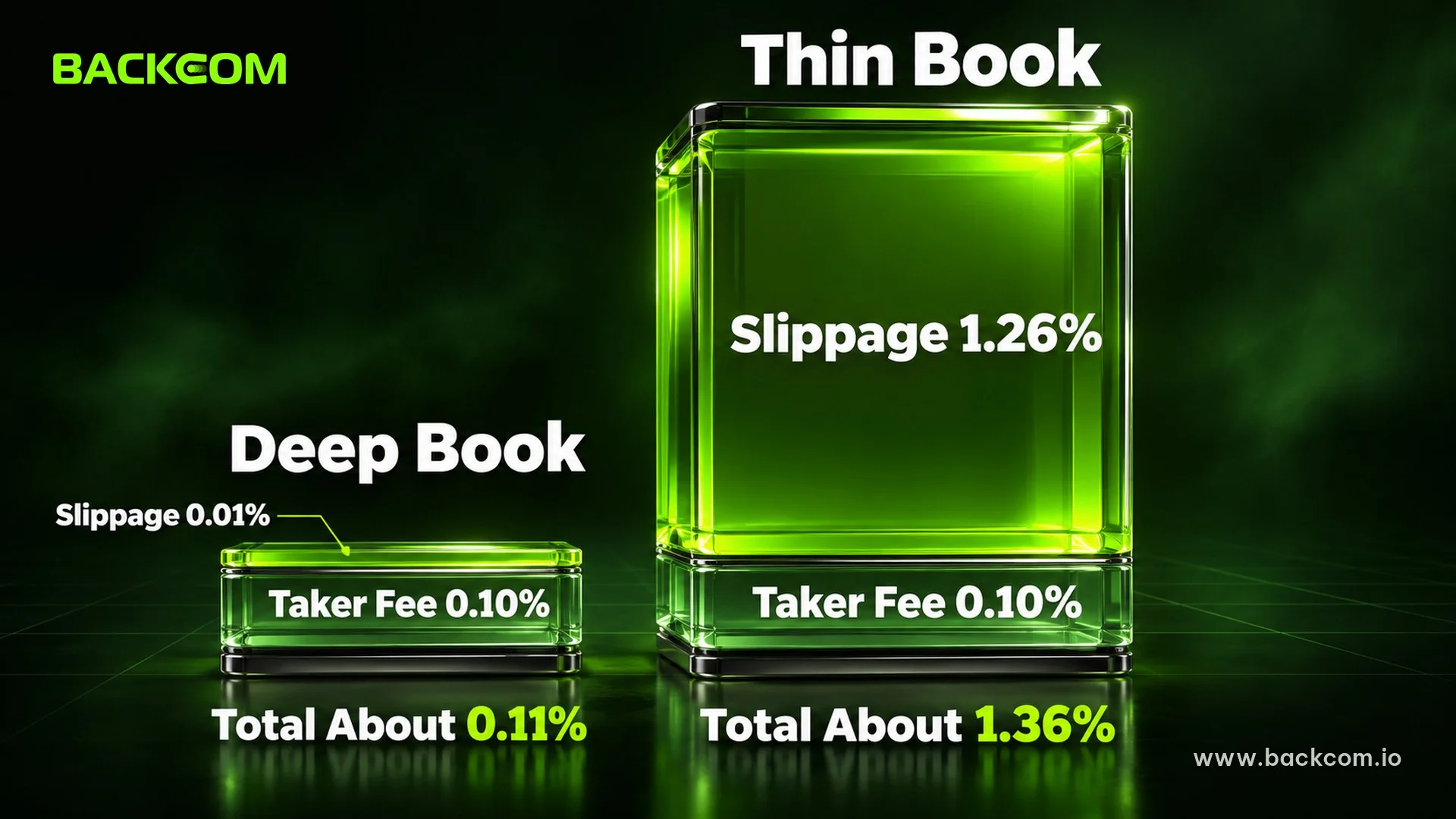
Liquidity does not change the fee rate on your account, but it changes your total cost, because spread and slippage are costs on top of the fee. The fee schedule is only one of three layers.
Add the layers together for the example above, assuming an illustrative taker fee of 0.1%:
| Cost layer | Deep book | Thin book |
|---|---|---|
| Slippage vs best ask | 0.01% | 1.26% |
| Taker fee (example) | 0.10% | 0.10% |
| Total cost to enter (excluding spread) | about 0.11% | about 1.36% |
Then remember that you also pay to exit. Every round trip crosses the spread twice, plus fees twice. A trader who enters and leaves a thin market often can lose more to liquidity than to any fee line on the exchange's page.
Total trading cost = Fee + Spread cost + Slippage
This is why comparing only fee percentages across exchanges can be misleading. Our guide to maker vs taker fees shows how limit orders can lower the fee layer, and a limit order also protects you from slippage because it never fills at a worse price than the one you set.
What Are The Low Liquidity Crypto Risks?
Low liquidity crypto is any coin or trading pair where the order book is thin enough that a modest order moves the price. Small-cap tokens, new listings and obscure pairs fall into this group most often. The low liquidity crypto risks go beyond slippage.
The main ones are:
- Wide spreads: you lose a larger slice of every trade the moment you enter.
- Price manipulation: a small amount of money can push the price, so sudden spikes and drops are easier to cause.
- Trapped positions: when you want to sell, there may not be enough bids at a reasonable price.
- Stop orders that fill badly: a stop that triggers in a thin book can execute far from the trigger price.
- Forced exits in leveraged trades: a thin book can turn a small move into a liquidation at a worse price than you planned.
Liquidity also changes quickly. A market that is deep on a calm afternoon can thin out during a sharp move, because market makers pull their orders when volatility rises. Late-night hours and holiday weekends can also leave books thinner than usual.
Is A Low Price Or A Small Market Cap A Sign Of Low Liquidity?
No, price per coin says nothing about liquidity, and market capitalisation is only a rough guide. A coin priced at a fraction of a cent can be very liquid on a major pair, while an expensive coin can be hard to trade on a small exchange. Always look at the order book of the specific pair you plan to trade.
How To Check Crypto Liquidity Before You Trade
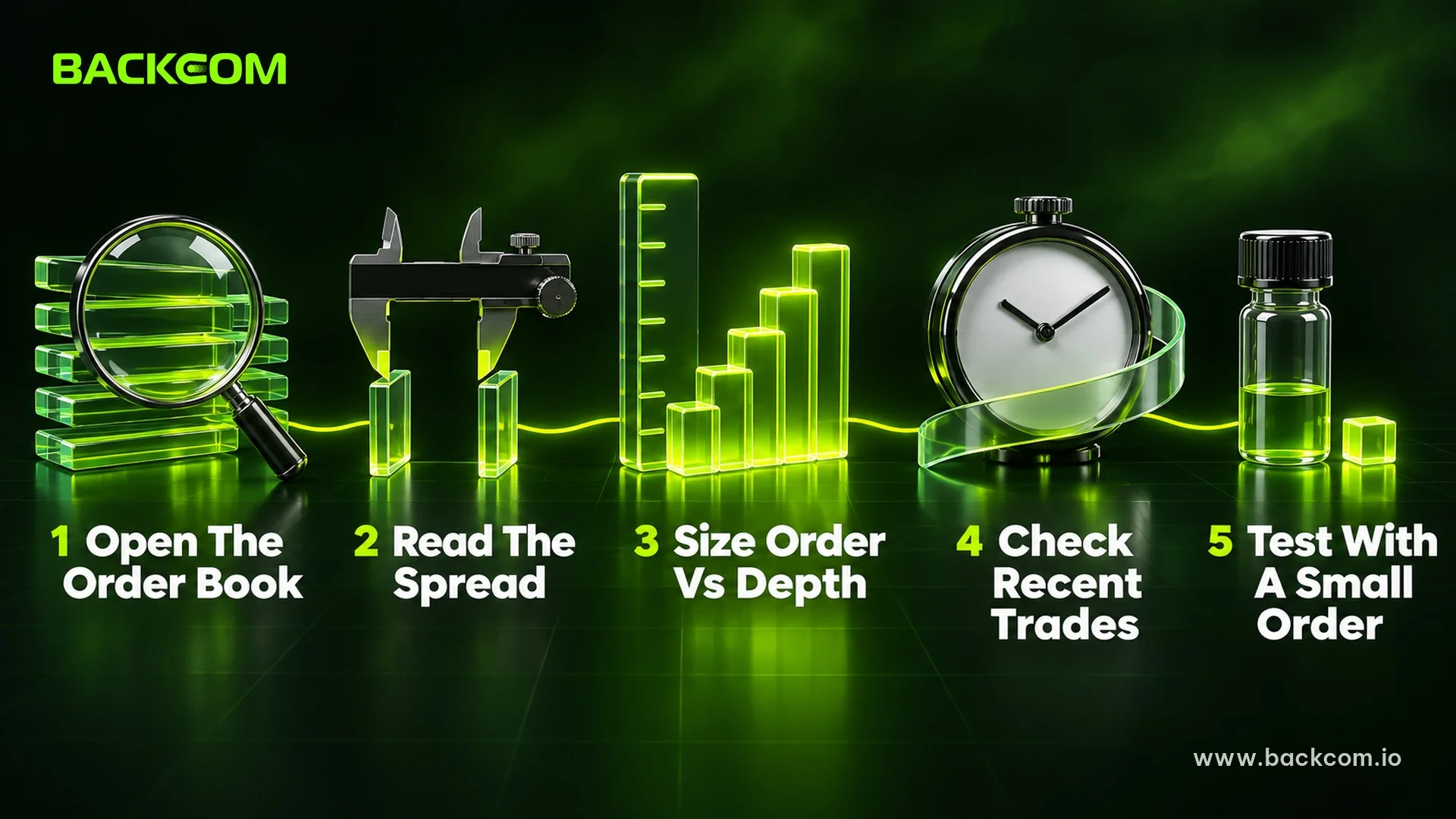
You can check liquidity in a few minutes by looking at the pair's order book, spread and recent trades before you place an order. The exact screens differ by platform, but the logic stays the same.
Follow this order:
- Open the pair's order book. Look at how many levels sit within 1% of the mid price and how large each level is.
- Read the spread. Divide the gap between best bid and best ask by the mid price. A gap of 0.04 on a 100.00 price is 0.04%.
- Size your order against depth. Add up the volume on the ask side (for a buy) until it reaches your size, then note the last price you would touch.
- Check recent trades. A tape with frequent, varied trades suggests a living market.
- Test with a small order. If the market allows it, compare a small fill with the displayed price before you scale up.
If the last price in step 3 is far from the best ask, the fill will drift. Split the order into smaller pieces, use a limit order, or choose a more liquid pair. For a broader introduction to how coins and markets work, see our beginner guide to what crypto is.
How Can You Trade Smarter In Thin Markets?
The best protection in a thin market is to control your price instead of accepting whatever the book offers. These habits help:
- Use limit orders: you set the worst price you will accept.
- Split large orders: smaller pieces let the book refill between fills.
- Trade liquid pairs: major pairs with stablecoins usually have deeper books. See how stablecoins work before you pick a quote currency.
- Avoid leverage: thin books and leverage magnify each other's risks.
- Watch the clock: quiet hours often mean thinner books and wider spreads.
None of these removes the risk. They only reduce the chance that liquidity turns a small mistake into a large loss.
Frequently Asked Questions (FAQ) About Crypto Liquidity
Is High Trading Volume The Same As High Liquidity?
No. Volume counts trades that already happened, while liquidity also depends on how much is resting in the order book right now. A coin can have high volume and a thin book. Check depth at your own order size, not only the 24-hour volume figure.
Why Does The Same Coin Have Different Liquidity On Different Exchanges?
Each exchange has its own order book, its own market makers and its own users. Orders on one platform do not appear on another, so depth and spread can differ even for the same pair. Kaiko's research tracks how market depth is split across venues for this reason.
Does Low Liquidity Mean A Coin Is A Scam?
Not by itself. Many legitimate small projects have thin books. Low liquidity does mean higher costs and a greater risk of manipulation, so it calls for smaller positions and more care, and it is one more reason to research the project before trading.
How Much Slippage Is Normal?
It depends on the pair and your order size. On deep major pairs, small orders often fill within hundredths of a percent of the best price. On thin pairs, one percent or more is not unusual for a large market order. Always compare against the depth you see.
Conclusion: Treat Liquidity As Part Of Your Trading Cost
Liquidity is the ease of trading near the displayed price, and it shows up in the spread, the order book depth and the trade activity of each pair. Thin books turn market orders into expensive fills, which is why slippage can outweigh the fee line on an exchange page. The same coin can be liquid on one venue and thin on another.
A good habit is to check the order book before you trade, compare your order size with the depth, and use limit orders whenever the market is thin. If you want to go deeper, read our guides on slippage and maker and taker fees.
Disclaimer: This content is compiled by Backcom.io for information only and is not investment advice. Crypto assets are volatile and carry a risk of total loss. The prices in the worked examples are illustrative, so check the live order book of your own pair before you trade.
Was this article helpful?
Join The Backcom.io Community
Get the latest on trading rebates, trading tips, and broker deals — and connect with thousands of traders worldwide.

Backcom App
Track Your Rebates Every Day
Every rebate is visible by broker and by day. Manage your wallet and withdrawals in one place.
Open Backcom App