Does A Rebate Increase Spread? 3 Ways To Check Your Real Trading Cost


Many traders hesitate to use an IB link because of one practical worry: is the rebate quietly built into the spread? The question does a rebate increase spread is a fair one, because trading cost decides how much you keep after every order.
The short answer is that a rebate does not raise spread by itself, since it is paid out of the commission a broker gives its introducing partner. But whether an IB link adds hidden cost depends on the type of link, and some brokers offer high-rebate links with extra spread built in.
In this article, Backcom.io will show:
- where rebate money comes from and why that flow does not touch the broker's price feed;
- when your real cost can rise even though the rebate is genuine;
- three ways to check spread, run a tiny test trade and work out your real cost after the rebate.
1. Does A Rebate Increase Spread? Where The Rebate Money Comes From
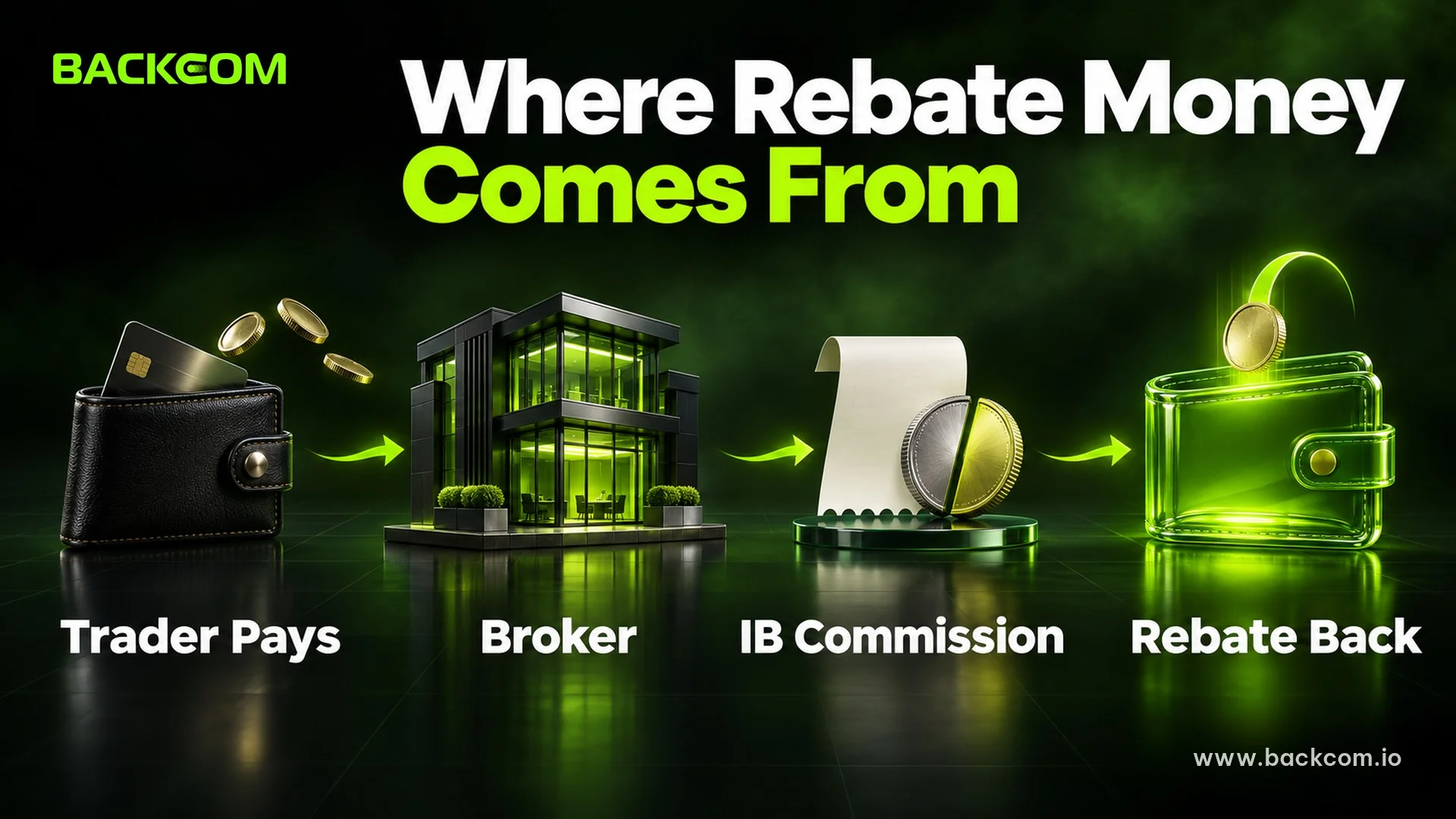
Does a rebate increase spread is really a question about the source of funds. Spread is the gap between the buy and sell price quoted by the broker. A rebate is a share of the commission the broker pays to the introducing partner, passed back to you. The two sit at different steps of the money flow.
The flow usually runs in four steps:
- The trader closes an order and pays spread and commission to the broker.
- The broker sets aside part of that revenue as IB commission for the introducer.
- The introducer passes a share back to the trader, based on lots closed.
- The rebate lands in the trading account or wallet on the published schedule.
In this model, the broker has already priced the spread before any commission is shared. A rebate is not an extra fee you pay, so there is no technical reason for it to push spread up. According to the NFA, an introducing broker solicits or accepts orders but does not accept money or other assets from customers to support those orders. Client funds stay with the broker, not with the IB.
The full explanation of where rebate money comes from is in is forex cashback legit, so this guide stays on cost.
The Exness page on this site states the same principle: linking through a partner does not change spread, leverage or other trading conditions on the account. That is the page's own statement, not independent verification, which is why you should know how to measure it yourself in the sections below.
Keep in mind that this principle holds for standard links, not for every type of link. The next section explains why.

Forex rebate hidden costs appear when a link carries its own spread setting. With a standard link, spread is the listed spread of the account type. With a high-rebate link, there may be extra spread in exchange for a larger rebate.
The HFM and Vantage pages on this site currently show two such cases:
| Broker / link type | Spread per broker page | Gold rebate per lot |
|---|---|---|
| HFM No Markup | Normal | USD 12 |
| HFM Markup 1 | SP43, own spread | USD 18 |
| Vantage Standard | Normal | USD 10 |
| Vantage Standard — High Rebate link | 32–36, own spread | USD 18 |
Based on the /en/broker/hfm and /en/broker/vantage pages as at 17 November 2026 (table updated 16 November 2026, rebate rates effective from 1 October 2026). Rebates and spreads may change, so check again before choosing a link.
The table shows that a higher rebate comes with a different spread setting. The pages also say each link has its own spread and that the rebate in the table is quoted on gold (XAUUSD). So the right question is not "does a rebate raise spread" but "is the extra rebate larger than the extra spread".
Separate two situations:
- Standard link (Normal): the rebate is a pure cost reduction, because spread stays at the listed level.
- High-rebate link with its own spread: the rebate is larger but the spread cost is different, so the gap must be worked out before you choose.
Take HFM on gold: Markup 1 pays USD 6 more per lot than No Markup. If the extra spread on Markup 1 equals USD 4 per lot, you still gain USD 2. If it equals USD 7 per lot, you lose USD 1 compared with No Markup. The figures 4 and 7 are assumptions to show the arithmetic, not HFM measurements.
Vantage works the same way: the Standard High Rebate link pays USD 8 more per lot than the Normal link on gold, so its extra spread must cost less than that for the link to pay off. Account-by-account maths is in raw spread vs standard account real cost.
To compare rebate levels across all brokers, see the forex rebates by broker page.
The three checks below work for both kinds of link.
3. Check 1: Check Spread With An IB Link By Measuring It Directly
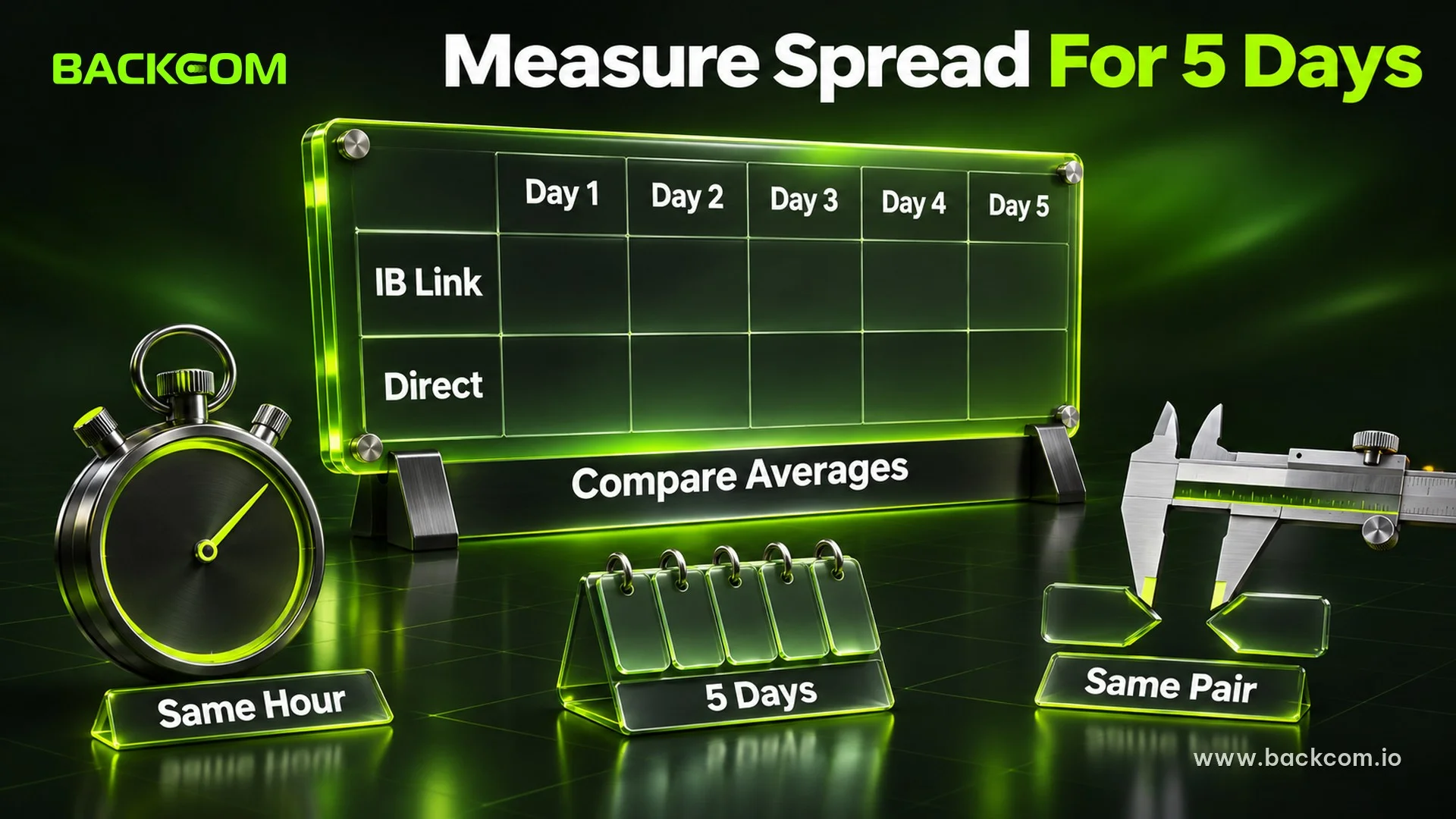
To check spread with an IB link, start with the number MT5 actually displays. The simplest method is to measure spread on the same pair, at the same time of day, before and after the account is linked to the introducer.
Steps on MT5:
- Open the Market Watch window, right-click and switch on the Spread column.
- Pick one fixed pair, for example EURUSD or XAUUSD.
- Record the spread at the same time on 5 trading days, preferably in the London or New York session when the market is calm.
- Avoid the 15 minutes around major news and the weekly open, when spread widens sharply.
- Repeat the same routine after the account is linked, then compare the two logs.
If you open a new account instead, compare with the published spread for that exact account type on the Exness page of this site. The Exness page lists Standard from 0.2 pip, Pro from 0.1 pip and Raw Spread and Zero from 0 pip plus commission. These are "from" spreads, meaning the lowest level, not what you always get.
Three cautions keep the measurement honest:
- Compare the same account type. Standard and Raw Spread cannot be compared directly because commission sits outside spread.
- Do not treat a demo account as an absolute benchmark, since demo can use a different price source and widening behaviour.
- One reading means nothing. Spread moves constantly, so take many readings and use a range.
The most reliable result is when both logs fall in the same range. If spread after linking is clearly higher at every calm hour, ask the introducer which type of link you are on. The mechanics of spread are covered in what is forex spread.
4. Check 2: Place A 0.01 Lot Test Trade To See The Cost Of One Round Trip
The real cost of a trade shows at the moment it opens. Right after the fill, the closing price sits on the unfavourable side of the opening price by exactly the spread, so the starting profit or loss is close to the cost of the round trip.
A quick routine:
- Choose the pair and account type you want to test.
- Open one 0.01 lot order with no stop loss or take profit.
- Note the profit or loss right after the fill, plus the Commission column if the account charges one.
- Close the order at once and note the final result.
- Compare it with the hand calculation in Check 3.
On EURUSD, 1 pip on 1 lot is worth USD 10, so 1 pip on 0.01 lot is USD 0.10. If the test order shows a loss of about USD 0.10 right after the fill, spread at that moment is about 1 pip. The test costs a few cents but gives you a real number instead of an advertised one.
Two points to remember:
- A test trade measures one moment only. Repeat it a few times at different hours and take the average.
- The rebate does not show up instantly. Rebates are calculated on closed orders and paid on a schedule, so the MT5 result does not yet include it.
The second point matters. The MT5 figure is the cost before rebate, and the rebate is added afterwards. That is why Check 3 is needed to put the two parts together.
5. Check 3: Calculate The Real Cost After Forex Rebate Per Lot
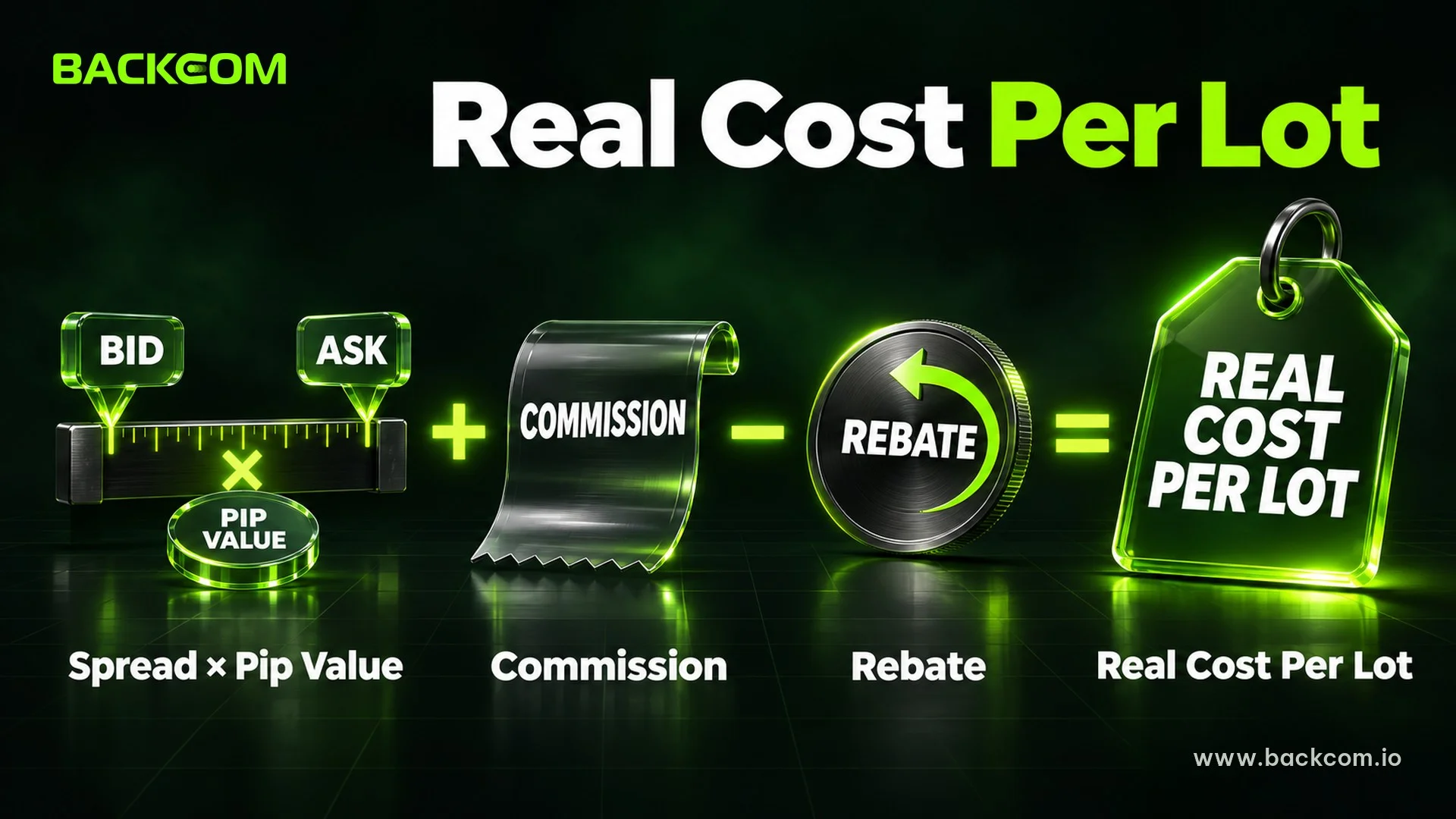
The real cost after forex rebate is the money you actually lose per lot once the rebate is deducted. It is the only number that allows a fair comparison between account types and link types.
The formula is:
Real cost per lot = Spread × Pip value + Commission − Rebate
Commission is counted per round trip, adding the opening and closing sides. The Exness page lists Raw Spread commission of up to USD 3.5 per lot per side, so up to USD 7 per round trip.
Example for Exness on EURUSD, using rebates on this site's Exness page as at 17 November 2026 and an assumed spread for illustration:
| Account type | Assumed spread | Commission per round trip | EURUSD rebate per lot | Real cost per lot |
|---|---|---|---|---|
| Standard | 1.0 pip = USD 10 | 0 | USD 3.20 | USD 6.80 |
| Raw Spread | 0.1 pip = USD 1 | up to USD 7 | USD 0.87 | up to USD 7.13 |
Based on the /en/broker/exness page as at 17 November 2026. Rebates, spreads and commissions may change, so check again before applying them.
The two results are close, and that is the point: a rebate lowers cost but does not reverse the fee structure of each account type. The 1.0 pip spread is only an assumption. Take your real spread from Checks 1 and 2 and put it into the formula.
For a trader doing 20 lots a month, the USD 0.33 gap per lot between the two rows is only about USD 6.6 a month. If the real spread is 1.5 pips instead of 1.0, Standard cost rises by USD 5 per lot, or USD 100 across 20 lots. Real spread matters more than the rebate.
To apply this quickly, follow this order:
- Take your real spread from Check 1 or Check 2 and convert it to USD per lot.
- Add one round-trip commission if the account charges one.
- Subtract the rebate for the right account type and symbol.
- Repeat for another account or link and pick the option with the lower real cost.
Rebate rates by broker are in forex broker rebate rates per lot, and monthly maths is in the forex rebate calculator.
6. Does Forex Cashback Increase Spread When The Market Moves Fast?
Does forex cashback increase spread when big news hits is a common worry, because spread often widens quickly then. The cause of the widening is the market, not the rebate.
Spread widens when liquidity thins. Familiar moments include:
- US jobs data and central bank rate decisions;
- the weekly open and the handover between sessions.
An account with an IB link and an account without one both see this, so do not conclude that the link caused the spike just because spread was wide during news.
To tell them apart, compare spread at the same time of day on quiet days. If spread rises only around the news and returns to normal, that is market movement. If it stays high at every quiet hour, that is the signal to recheck your link type or account type.
It is also worth checking the legal entity behind the account. For brokers licensed in the UK, you can search the FCA Register. In the United States, the regulator for intermediaries is the CFTC.
Frequently Asked Questions (FAQ) About Rebates And Spread
Does A Forex Rebate Increase Spread?
No, not on a standard link. The rebate comes from the IB commission the broker pays the introducer, while spread is quoted by the broker separately. Some high-rebate links carry extra spread, so check the link type before you register. The safe approach is to measure spread before and after linking, then work out real cost with the formula in Check 3.
Only if the link carries its own spread setting. The HFM and Vantage pages of this site currently show that high-rebate links have a different spread from Normal links. When you meet such a link, compare the extra rebate with the extra spread. If the extra rebate is smaller, the high-rebate link is actually more expensive than the standard one.
How Do I Know If My Spread Is Unusually High?
Compare it with your own account history and the broker's published level. Log spread at the same hour over 5 days, avoid news times, and compare with the published spread for your account type. Small, fluctuating gaps are normal. A large gap that lasts through every quiet hour is worth raising with your introducer and the broker's support.
Does A Rebate Lower My Real Cost?
Yes, if it is paid correctly and spread is unchanged. Real cost per lot is spread plus commission minus the rebate. But a rebate does not turn a losing strategy into a winning one, and you should not increase volume just to earn more rebate.
Conclusion: Check Before You Choose A Link
The question does a rebate increase spread has a clear answer in principle: the rebate comes from IB commission, so it does not push spread up by itself. What needs checking is the link type, because a high-rebate link can carry extra spread. Traders should look at three things together: real spread, commission and rebate.
The routine is to measure spread with the Spread column in MT5, run one 0.01 lot test trade to see the cost of a round trip, and then put the numbers into the real-cost formula. These three steps take under an hour and let you choose a link with numbers instead of promises.
To look at specific brokers and rebate levels, see the Exness, HFM or Vantage pages, or register on the rebate sign-up page. Backcom.io is an independent introducing broker (IB/affiliate) of the brokers; rebates are paid from the commission the broker pays Backcom.io — see the risk disclaimer.
Disclaimer: This content is compiled by Backcom.io for information and reference only and is not investment advice, a trading recommendation or tax or legal advice. Trading forex and gold on leverage is high risk and you may lose all your capital. Broker rebates, spreads and conditions can change, so check the broker's page again before you decide.
Was this article helpful?
Join The Backcom.io Community
Get the latest on trading rebates, trading tips, and broker deals — and connect with thousands of traders worldwide.

Backcom App
Track Your Rebates Every Day
Every rebate is visible by broker and by day. Manage your wallet and withdrawals in one place.
Open Backcom App