What Is Proof Of Reserves On A Crypto Exchange And How To Read It


What is proof of reserves on a crypto exchange? It is a published check that shows whether an exchange holds at least as many assets as it owes to its customers. After several platforms failed in 2022, users stopped taking "your funds are safe" on trust and started asking for evidence. In this article, Backcom.io explains proof of reserves, how a Merkle tree works, how to read a reserve ratio, how to verify your own balance and what the method cannot prove.
What Is Proof Of Reserves On A Crypto Exchange?
Proof of reserves (PoR) is a method that lets an exchange show that the assets it controls on the blockchain cover the balances it has promised to customers. The idea is simple. An exchange is not a bank vault with your coins in a labelled box. It keeps a database of what each customer is owed and a set of wallets that hold the actual coins.
A PoR report compares the two sides. The first side is the liabilities, meaning the sum of all customer balances. The second side is the reserves, meaning the coins held in wallets the exchange can prove it controls.
Three terms appear in nearly every report:
- Reserves: the on-chain assets the exchange says it holds.
- Liabilities: the balances customers could ask to withdraw.
- Reserve ratio: reserves divided by liabilities, shown as a percentage.
A ratio of 100% means the exchange holds exactly what it owes. Anything above that is a cushion. Anything below it is a shortfall.
Proof Of Reserves Explained: Why Exchanges Publish It
Proof of reserves exists because a centralised exchange holds your assets in custody, so you carry the risk that it cannot give them back. When you deposit coins, you swap a private key you control for a promise in a ledger. Our guide to centralized vs decentralized exchanges shows why that trade-off matters.
Exchanges began publishing PoR in a wave at the end of 2022. On 16 December 2022, CNBC reported that the accounting firm Mazars had paused its proof-of-reserves work for crypto clients. In February 2023, Binance added zk-SNARK proofs to its reserve system, and other platforms followed with their own versions.
Today the main reasons exchanges publish a report are:
- Trust: to show customers that balances are covered at a given moment.
- Competition: to answer the question "is this exchange safe?" before a rival does.
Publishing a report is a good sign, but it is only one signal. Our review of Gate and its proof of reserves shows how this fits next to licences, fees and security history.
How Does Merkle Tree Proof Of Reserves Work?
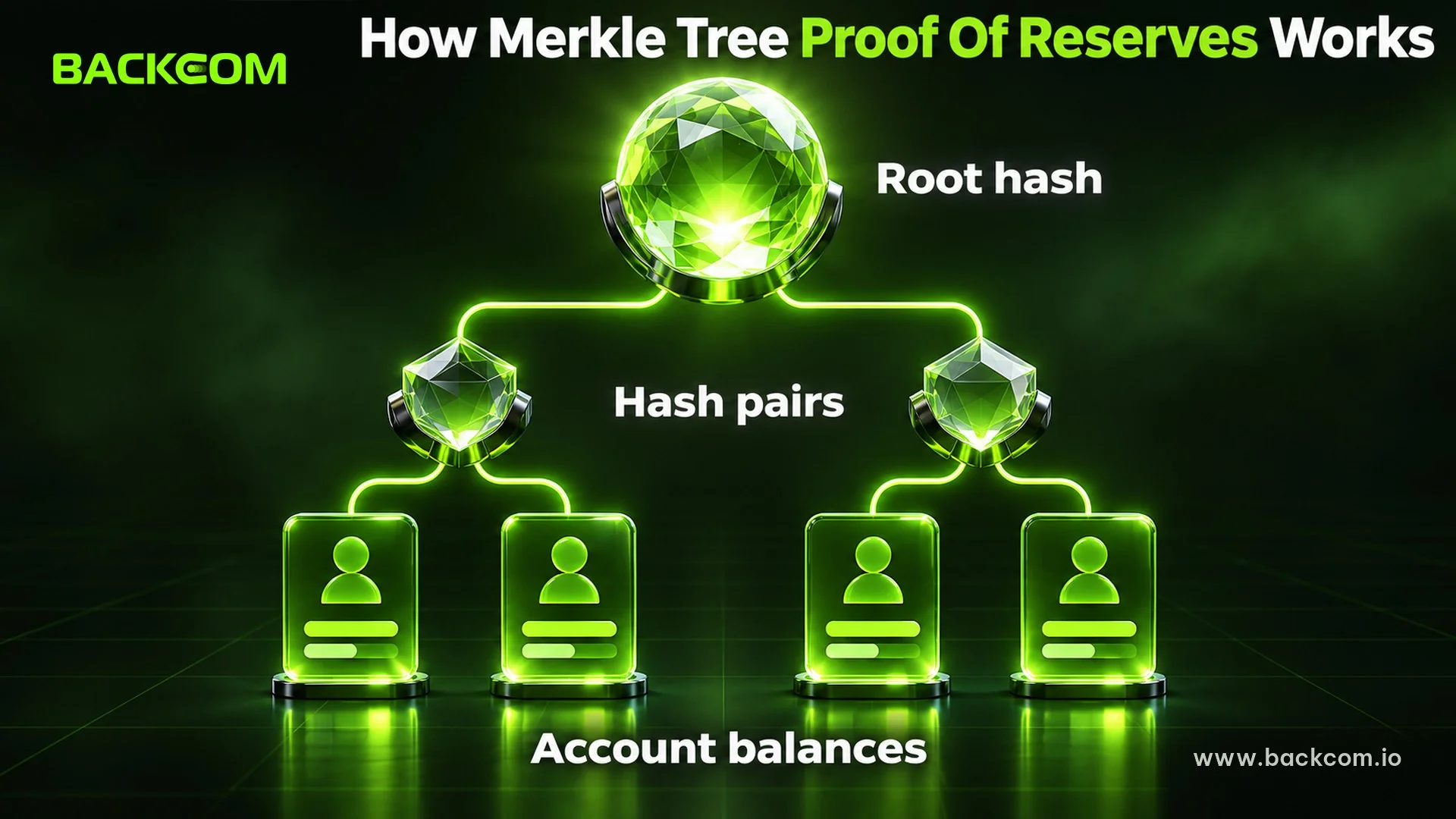
A Merkle tree is a structure that turns a long list of account balances into one short fingerprint, called the root hash. The root changes if any single balance in the list changes. That property lets an exchange publish one number that stands for every customer account, without revealing who owns what.
The process follows five steps:
- Snapshot: the exchange freezes every customer balance at a chosen time.
- Leaf: each account becomes a leaf, built from a hashed user ID and the balance.
- Pairing: leaves are hashed together in pairs, then those results are paired again.
- Root: the process repeats until one hash remains. That is the Merkle root.
- Publication: the exchange publishes the root and the total, so anyone can check them.
Binance describes this on its proof of reserves page: each leaf is based on a hashed user ID and balance, and the root changes if any account ID or balance changes. Kraken's proof of reserves page says an independent third-party accountant takes an anonymised snapshot of client balances and aggregates it into a Merkle tree.
What Do Zero-Knowledge Proofs Add?
Zero-knowledge proofs are extra mathematics that let an exchange prove facts about the tree without exposing individual accounts. Binance says its zk-SNARK circuit checks three things for each leaf. The balance must be included in the total, the net balance must be at least zero, and the update of the Merkle root must be valid.
The second check matters more than it looks. Without it, an exchange could hide a gap by adding fake accounts with negative balances that cancel out real ones. OKX describes a similar design on its proof of reserves page, using zk-STARK proofs for the total, the non-negative rule and inclusion of every account.
What Is An Exchange Reserve Ratio?
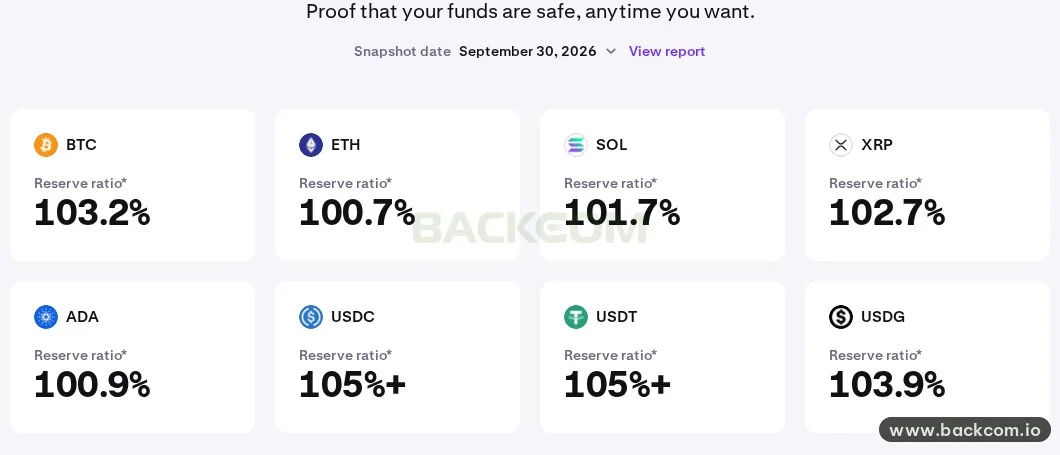
An exchange reserve ratio is the value of assets held divided by the value of customer balances, calculated separately for each coin. A single combined number would hide problems, because a surplus in one coin does not repay a shortfall in another.
Kraken shows the ratio per asset. For its snapshot dated 30 September 2026, the page lists 103.2% for BTC, 100.7% for ETH, 101.7% for SOL, 102.7% for XRP and 105%+ for USDC and USDT.
When you read a ratio, keep these points in mind:
- Above 100%: the exchange claims more assets than customer balances for that coin.
- Exactly 100%: every balance is covered, with no cushion for errors or moves in price.
- Below 100%: the report shows a gap, which needs an explanation.
- Per coin: check the coins you actually hold, not only the headline figure.
OKX reports ratios from 100% to 108% depending on the asset in its 49th report. A ratio that stays slightly above 100% over many reports is more reassuring than one that appears once.
Reserve ratios are snapshots, so check the date and compare several reports before drawing a conclusion.
How To Verify Proof Of Reserves Step By Step
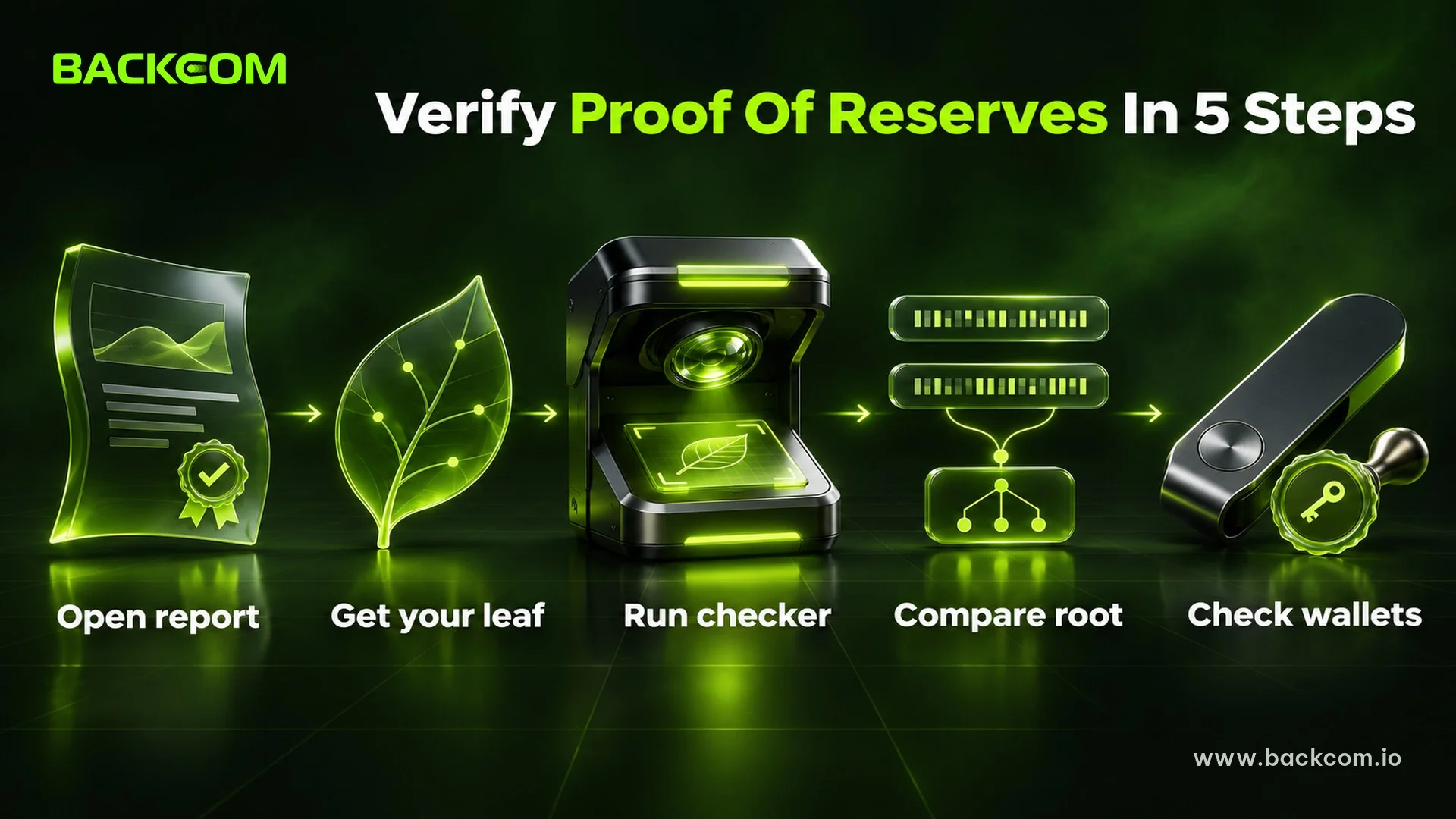
You verify proof of reserves by checking that your own balance sits inside the published Merkle tree and that the exchange controls the wallets it names. The exact menus differ by platform, but the logic is the same everywhere.
Follow this order:
- Open the report. Find the proof of reserves page and pick the snapshot date you want to check.
- Get your leaf. Log in and download your own record. Kraken calls it a Merkle Leaf ID and Binance a Merkle Leaf with a Record ID.
- Run the checker. Use the exchange's open-source tool or the auditor's tool. Binance's help article on Merkle tree verification describes downloading the tree and running a verification script on it.
- Compare the root. The root your tool computes must match the root in the published report.
- Check the wallets. Look for signed messages that prove the exchange controls the addresses, then compare on-chain balances with the totals.
Step 5 is the one most users skip, and it is the one that links the report to real coins. Technical users can also read the open-source code that OKX and Binance publish for their systems.
Where Should You Start If You Are A Beginner?
Start with your own record, because it is the quickest check and proves that the exchange counted you. If your balance is missing from the tree or does not match your account, treat that as a serious warning. After that, read the headline ratio and the date. For safer habits on the account itself, see our security checklist for exchange accounts.
What Proof Of Reserves Does Not Prove
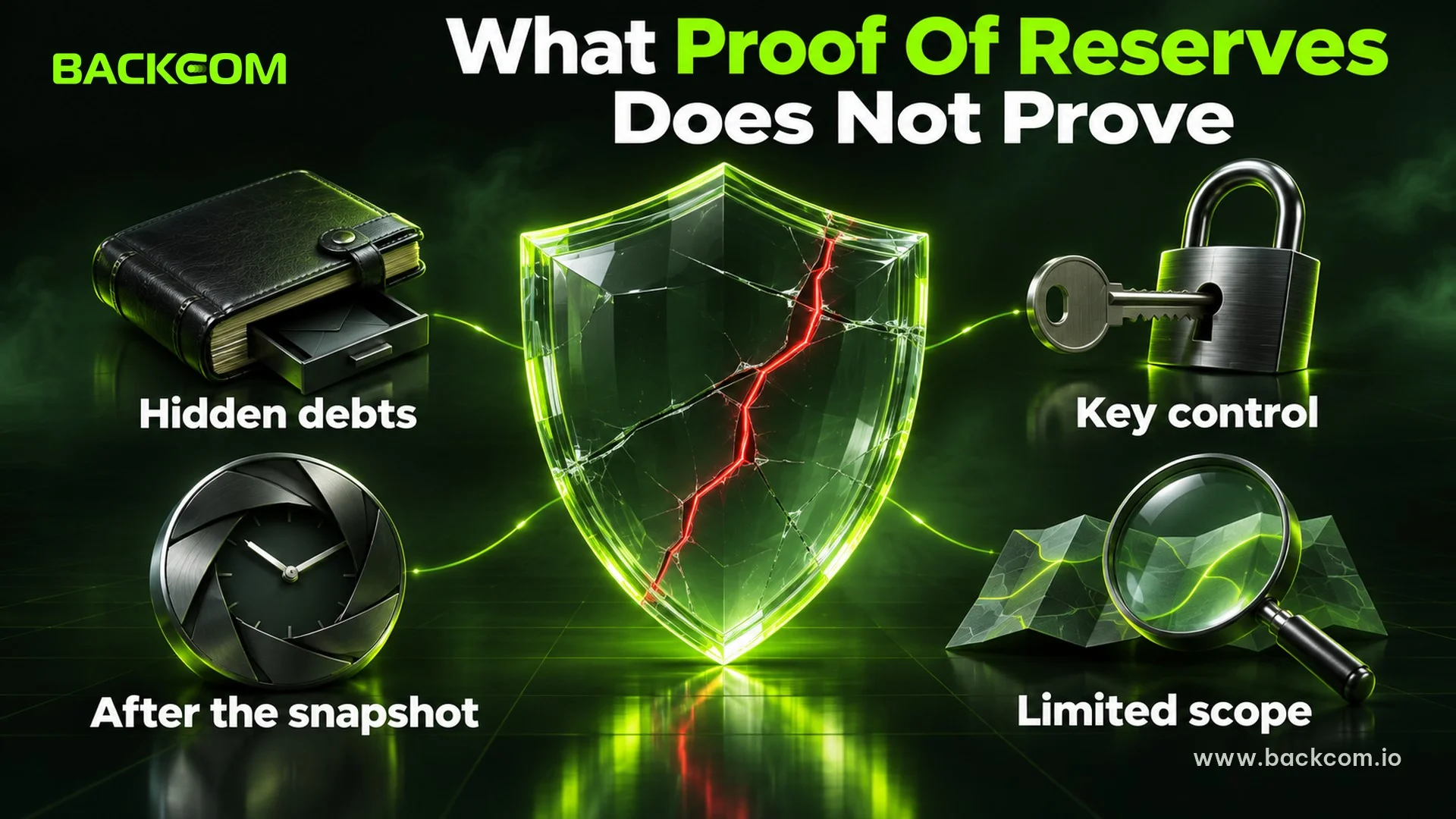
Proof of reserves proves that assets existed at one moment, not that an exchange is solvent, well run or safe for the long term. The limits are real, and honest exchanges state them.
The main gaps are:
- Liabilities beyond customer balances: a report may not show loans, debts or other obligations. News coverage in December 2022 noted that the Mazars report for Binance did not show liabilities for its lending arm.
- Hidden encumbrances: Kraken's page says its review cannot detect hidden encumbrances such as borrowed funds.
- Key control: the same page says the review cannot prove exclusive control of private keys.
- Time: coins can move after the snapshot. Kraken notes that its review cannot account for changes after that date.
- Scope: a report may cover only some coins. The Mazars report for Binance covered only bitcoin.
Mazars said in 2022 that its reports "do not constitute either an assurance or an audit opinion". They reported limited findings on agreed procedures at a point in time. Treat any PoR report the same way: useful evidence, not a guarantee.
How Is Proof Of Reserves Different From An Audit?
A full audit tests financial statements, controls and obligations, while proof of reserves tests one narrow claim about assets. Some exchanges commission both, which gives more reassurance than either alone. A report written by the exchange itself, with no outside accountant, deserves the least weight.
Red Flags When You Read A Proof Of Reserves Report
A red flag is anything that makes a report harder to check than it should be. Look for these signs:
- No verification tool: you cannot check your own record.
- Stale or irregular dates: reports appear rarely or stop without explanation.
- Only one headline number: there is no ratio per coin.
- No signed wallet proof: addresses are listed but ownership is not shown.
- Missing auditor details: nobody outside the exchange reviewed the work.
None of these proves wrongdoing alone. Together they show an exchange that asks you to trust it more than it lets you verify it. Our guide to crypto exchange scams lists other warning signs worth checking before you deposit.
Frequently Asked Questions (FAQ) About Proof Of Reserves
Is Proof Of Reserves The Same As A Financial Audit?
No. Proof of reserves is a narrow check of assets against customer balances at a chosen time. A financial audit examines statements, controls and liabilities over a period. Mazars described its crypto reports as agreed-upon procedures rather than an assurance opinion, so a PoR report should be read as partial evidence.
Does A Reserve Ratio Above 100% Mean My Funds Are Safe?
It means the exchange claims to hold more of that coin than it owes at the snapshot date. It does not rule out hidden debts, later withdrawals or weak security. Compare several reports over time, check the coins you hold and treat the ratio as one input among many.
How Often Should An Exchange Publish Proof Of Reserves?
There is no universal rule. Some exchanges describe their reports as regular, and OKX says it publishes them periodically. A steady schedule with consistent methods and a clear date on each report is a better sign than a single report that is never updated.
Can I Verify Proof Of Reserves Without Technical Skills?
Yes, for the basic check. Most exchanges let you download your own record and paste it into a checker, and several offer a self-check page. The deeper wallet check is harder, but you can read the auditor's summary and the per-coin ratios without writing code.
Conclusion: Use Proof Of Reserves As One Check, Not The Only One
Proof of reserves shows whether an exchange holds the assets it owes, but only at one moment and only for the coins and balances in scope. A Merkle tree lets you check that your own account was counted. Per-coin reserve ratios show the size of the cushion, and signed wallet proofs link the report to real coins. Limits remain: debts may be hidden, keys may not be proven and balances can change after the snapshot.
Use PoR together with licences, security history and withdrawal experience. A good habit is to check your record once, read the date and ratios, and keep only the amount you are ready to leave on a platform. If you are new to the field, start with our beginner guide to what crypto is and read how stablecoin reserves raise the same trust questions.
Disclaimer: This content is compiled by Backcom.io for information only and is not investment advice. Crypto assets are volatile and carry a risk of total loss. Figures quoted come from the exchanges' public pages and may change, so check the latest report before you rely on them.
Was this article helpful?
Join The Backcom.io Community
Get the latest on trading rebates, trading tips, and broker deals — and connect with thousands of traders worldwide.

Backcom App
Track Your Rebates Every Day
Every rebate is visible by broker and by day. Manage your wallet and withdrawals in one place.
Open Backcom App