Daily Loss Limit Forex: How To Set A Max Daily Loss Before You Blow Your Account


Most traders do not blow an account with one bad trade. They blow it with one bad day that gets stretched by a string of revenge trades. A daily loss limit forex rule sets the maximum amount you accept losing in one day. Once the day's losses reach that figure, you close the platform and open no new trades until the next session.
A daily limit is different from a stop loss. A stop loss protects one position, while the daily limit protects the person sitting in front of the screen.
In this article, Backcom.io explains how to choose the max daily loss, work out the dollar amount on a $1,000 account, handle open trades and add a weekly cap so the rule is actually usable.
1. Daily Loss Limit Forex: What It Is And How It Differs From A Stop Loss
A daily loss limit is the largest loss, set as a percentage of equity or a fixed amount, that a trader allows in a single trading day. When the day's combined losses hit that level, trading stops until the next day, even if the market still looks full of opportunities.
The rule blocks a losing streak, not a single losing trade. One loss is a normal cost of any method. Five losses in a row within one session usually mean the trader has left the plan.
It sits alongside tools you probably already know:
- Stop loss: caps the loss on one trade, placed at the point where the trade idea is invalidated.
- The 1% rule: caps the amount risked per trade when you size the lot.
- Maximum drawdown: caps the decline of the whole account over weeks or months.
- Daily loss limit: caps the combined loss across one day.
The first three are covered in forex money management and the 1% rule, how to set a stop loss and what drawdown is. The daily limit is the missing layer between per-trade rules and total drawdown.
2. How Much Should Your Max Daily Loss Be?

There is no single max daily loss that fits everyone. A practical method is to set the daily cap at 2 to 3 times your risk per trade. A trader risking 1% per trade would cap the day at about 2–3%, which allows two or three full losses.
The reason for keeping the multiple small is the recovery maths. The deeper the loss, the larger the gain needed to get back to even, and the curve rises faster than most people expect.
Gain needed to break even = Loss ÷ (1 − Loss)
| Loss versus capital | Gain needed to recover |
|---|---|
| 2% | 2.04% |
| 3% | 3.09% |
| 5% | 5.26% |
| 10% | 11.11% |
| 20% | 25.00% |
| 50% | 100.00% |
This is pure arithmetic and does not depend on any broker or strategy.
A 3% loss needs only about 3.09% to recover, while a 20% loss already needs 25%. A daily cap around 2–3% keeps the trader in the zone where one normal good day can repair the damage.
There are three ways to pick the exact figure:
- A multiple of per-trade risk: risk 0.5% and cap the day at 1.5%, or risk 1% and cap it at 3%.
- A number of consecutive losses you can accept: if you want to stop after three losses, the cap is three times your risk per trade.
- Your own journal: look at the worst losing day of the last three months and set the cap below it.
The third method needs real data, so traders without a journal should start with the first one. Backcom.io does not give one fixed number for every account, because the right level depends on capital and strategy.
3. How To Calculate A Daily Loss Limit On A $1,000 Account
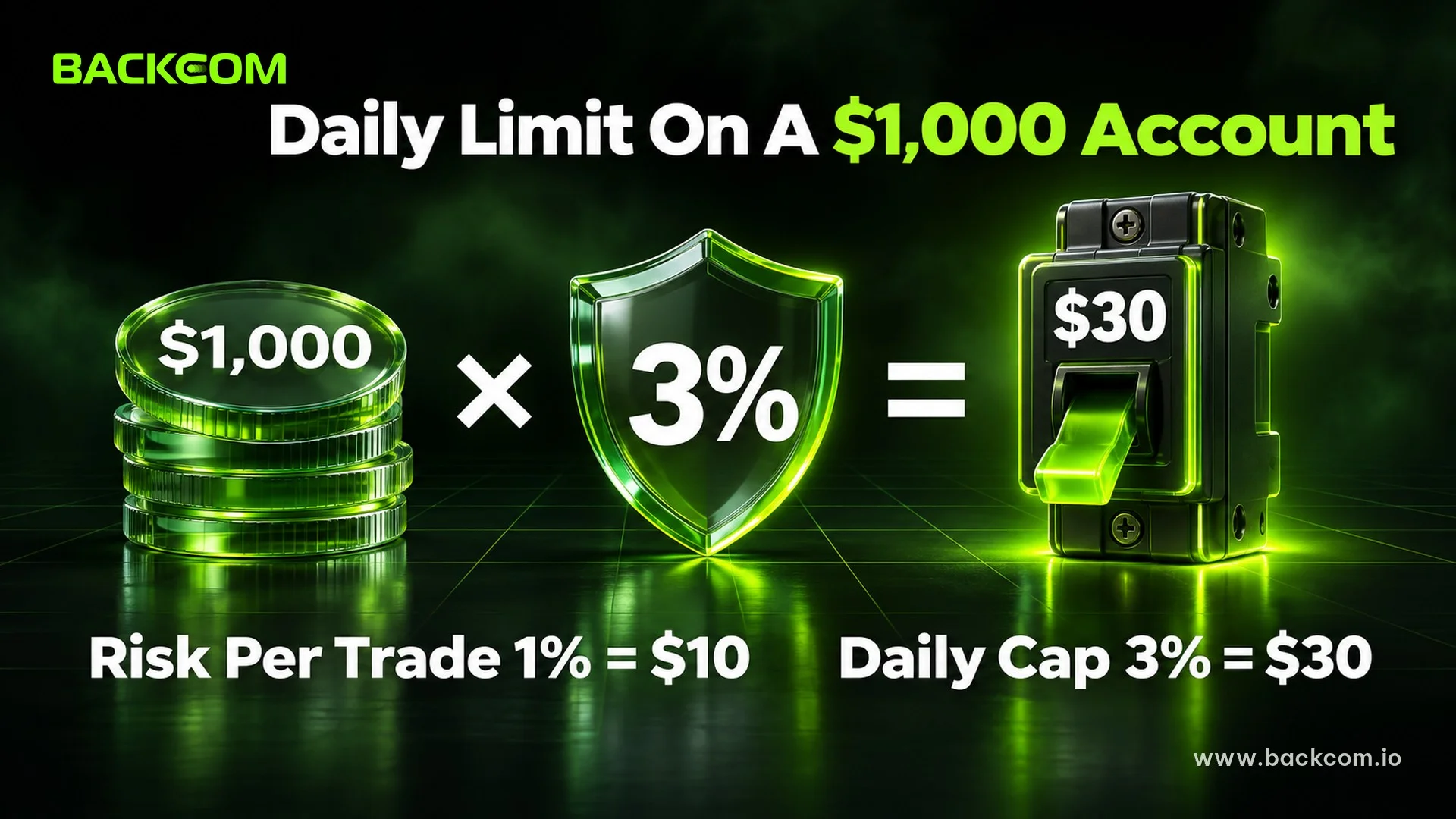
An example makes the rule concrete. Assume a trader starts the day with $1,000, risks 1% per trade and caps the day at 3%.
Daily loss limit ($) = Starting-day capital × Daily limit percentage
On those numbers the daily limit is 1,000 × 3% = $30, and the risk per trade is 1,000 × 1% = $10. The trader may take up to three full losses and then stop.
| Risk per trade | Risk in dollars | 2% daily cap ($20) | 3% daily cap ($30) |
|---|---|---|---|
| 0.5% | $5 | 4 losing trades | 6 losing trades |
| 1% | $10 | 2 losing trades | 3 losing trades |
| 2% | $20 | 1 losing trade | 1 losing trade ($10 left over) |
Figures are based on $1,000 of capital at the start of the day and only illustrate the arithmetic.
The last row is a warning. Risking 2% per trade under a 3% daily cap leaves room for only one loss, because a second loss takes the day to 4% and breaks the cap.
Once you have the dollar figure, write it at the top of your session next to the starting capital. To size a lot for $10 of risk, you can use the position size calculator.
Try a sample day: lose $10, win $15, then lose three trades of $10 each. The day stands at −$25, only $5 from the cap. That is the moment to ask whether the next trade is part of the plan or just an attempt to get even.
4. Balance Or Equity? Do Open Trades Count?

This question decides whether the rule really stops the losses. Balance only reflects closed trades, while equity includes the floating profit and loss of open positions. An open trade that is down $40 is still a $40 loss, even though the balance has not changed.
FTMO Academy also states that the firm's daily limit is based on equity, not only on closed results, so floating P/L, commissions and swaps all count. Read it directly: FTMO Academy on Maximum Daily Loss.
So measure the daily limit with equity against a start-of-day reference. It takes three steps:
- Record starting equity: take a screenshot or write the number in your journal before the first trade.
- Work out the stop level: subtract the dollar limit, for example 1,000 − 30 = $970.
- Set an alert: use a platform alert, a phone timer or a note beside the screen, and close all trades when equity hits $970.
Choose one fixed reset time for your trading day, such as 00:00 broker server time, and use the same one every day so you never "reset" the rule after a bad day.
If trades are open when the cap is hit, the safest approach is to close everything. If you keep one, it must carry a stop loss placed beforehand and the total risk must stay inside the cap. Never move a stop further away and never open another trade to win it back, because both turn a hard rule into a soft one.
Traders using high leverage should also read margin call versus stop out to see where the broker's limit sits compared with your own.
5. How Big Should The Weekly Max Loss Rule Be, And When Do You Stop Trading At A 2% Loss?
A weekly max loss rule is usually set at two to three times the daily cap, which means 6–9% when the daily cap is 3%, and a 2% level works as an early warning to cut lot size before stopping completely. A daily limit is not enough if you lose a little every day, because three days ending near a 3% cap already add up to almost 9% in one week.
Pair it with an early warning. You can set a soft level to stop trading at a 2% loss and a hard level at 3%:
- Soft level at 2%: cut lot size, tighten entry conditions, take a break of 30–60 minutes.
- Hard level at 3%: close the platform until the next day.
- Weekly cap of 6%: when it is reached, rest until next week and review the journal.
Some traders also add a limit on consecutive losses, for example stopping after three losing trades even if the total has not reached 3%. If emotion has already kicked in before the cap, revenge trading signs and how to stop helps you spot the early warnings.
6. What To Do When You Hit The Limit: A 5-Step Routine
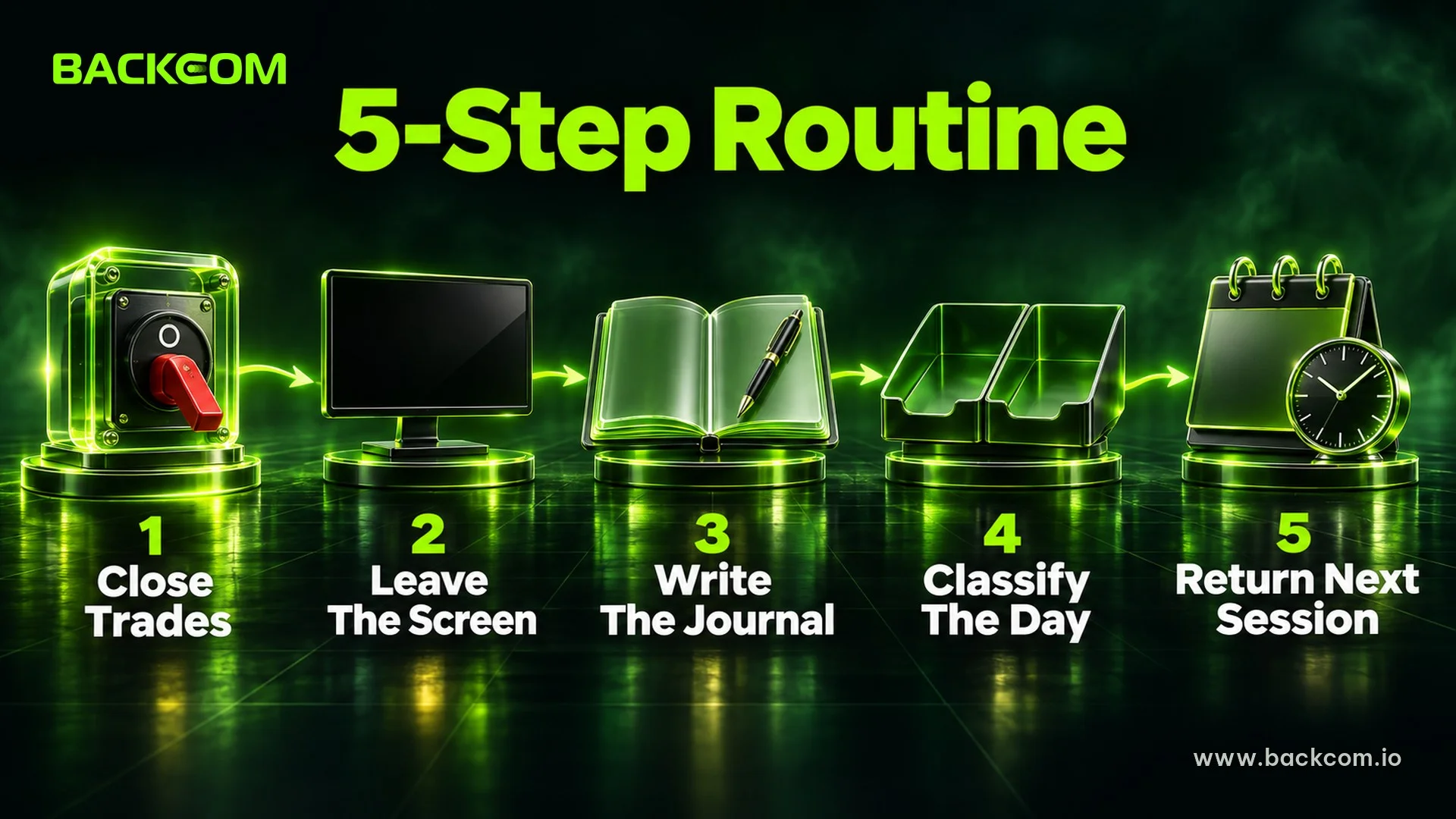
A rule without a routine still gets broken. The moment the cap is hit is when the urge to win it back is strongest, so write the steps in advance and follow them in order.
Limit hit → Close trades → Leave the screen → Write the journal → Review next day
- Close all trades: or follow the plan you wrote earlier, without weighing it again on the spot.
- Leave the screen: shut the platform and walk away for at least 30 minutes.
- Write the journal at once: record the trades, the reason for entry, how you felt and which trade broke the plan.
- Classify the losing day: was it the method (the market did not suit the setup) or behavior (entries outside the plan)?
- Return only next session: no demo trades to "fix the feeling" and no small trades to scratch the itch.
A losing day caused by the method is a normal cost. A day caused by behavior needs a new rule, such as a lower maximum number of trades per day. Traders with several accounts should measure the limit on the combined capital of all accounts, because switching accounts after hitting the cap is just a way around the rule.
7. Why Traders Break The Limit And How To Block It In Advance
Most breaches come from the same few causes, and knowing them helps you design a rule that is harder to break.
Reason 1: The rule lives in your head, not on paper. An unwritten rule gets reinterpreted while you are losing, so write today's dollar cap at the top of your journal or stick it beside the screen.
Reason 2: The cap is too tight for the risk per trade. As the table in section 3 shows, a 3% cap with 2% risk per trade holds only one loss, so it is easily broken. Reduce the lot size instead of dropping the rule.
Reason 3: "Just one more trade." This is the opening line of most long losing streaks, so the rule should say it plainly: when the cap is hit, there is no last trade.
Reason 4: Trading costs are ignored. Spread and commission add up inside the day's loss, so a trader who places many short trades reaches the cap faster than expected.
Some brokers run rebate programs that reduce the cost per lot, but a rebate is not a reason to place more trades and is not counted to offset the daily cap. You can compare conditions on the forex broker comparison page. Backcom.io is an independent introducing broker (IB/affiliate) of the brokers listed there, and rebates are paid from the commission the broker pays it. See the risk disclaimer.
8. How A Prop Firm Daily Loss Limit Differs From Your Own
Prop firms apply this rule as a mandatory condition. The firm's limit is set and enforced by the firm, while a personal limit is set and enforced by the trader.
According to FTMO's Trading Objectives page, checked on 16 November 2026, the Maximum Daily Loss is 3% of the Initial Simulated Capital for the 1-Step program and 5% for the 2-Step program. The limit is recalculated at 00:00 CE(S)T (23:00 UTC in winter, 22:00 UTC in summer) as the balance at that time minus the maximum amount, and equity must not fall below that level.
Read it directly: FTMO Trading Objectives.
| FTMO program | Maximum Daily Loss | Recalculated |
|---|---|---|
| 1-Step | 3% of initial simulated capital | 00:00 CE(S)T |
| 2-Step | 5% of initial simulated capital | 00:00 CE(S)T |
Rules checked on 16 November 2026. A firm can change its rules, so confirm them before buying a challenge.
The practical lesson for prop traders is to set a personal limit below the firm's limit to leave a buffer. With a 5% firm cap, a personal cap of 2–3% means a bad day is stopped by your own rule before it reaches the firm's line. See also prop firm risk management.
Frequently Asked Questions (FAQ) About The Daily Loss Limit In Forex
What Percentage Should A Daily Loss Limit Be?
There is no single right level, but many traders choose 2–3% of capital, equal to two or three times the risk per trade. New traders should start lower and adjust after three months of journal data.
Is The Daily Loss Limit Based On Balance Or Equity?
Use equity, because equity includes floating profit and loss. If you only watch the balance, you can hold a deeply negative trade while the rule stays untriggered.
What If A Trade Could Still Recover When I Hit The Limit?
Decide the answer before you start losing. The safest option is to close everything when the cap is reached. If you keep a trade, it must carry a stop loss placed beforehand that is never moved further away.
Do I Need A Weekly Loss Limit Too?
Yes, especially if you tend to lose a little on many days in a row. A weekly cap is usually two to three times the daily cap, for example 6–9% when the daily cap is 3%. When it is hit, rest until next week and review your journal.
Does A Prop Firm's Daily Limit Replace My Own?
No. The firm's limit is a condition for keeping the account, while your own limit is a protective layer inside it. Set the personal cap below the firm's cap to keep a buffer.
Conclusion: Set Your Daily Loss Limit Before The First Trade
A daily loss limit forex rule works when you look at three things together: the risk per trade, a daily cap measured in equity and a stop routine written in advance. Remove any one of them and the rule gets reinterpreted exactly when you are losing.
The next steps are to choose your risk per trade, multiply it by two or three to get the daily cap, convert it to a dollar figure and write it down before the session. Then add a weekly cap and an early 2% warning. If you need the lot-size groundwork first, start with forex money management and the 1% rule.
Disclaimer: This content is compiled by Backcom.io for information only and is not investment advice, a trading recommendation or financial advice. Forex and CFD trading carries a high level of risk and you can lose all your capital. The numerical examples are only illustrations of the arithmetic.
Was this article helpful?
Join The Backcom.io Community
Get the latest on trading rebates, trading tips, and broker deals — and connect with thousands of traders worldwide.

Backcom App
Track Your Rebates Every Day
Every rebate is visible by broker and by day. Manage your wallet and withdrawals in one place.
Open Backcom App