What Is A Short Squeeze In Crypto And How Does It Happen


A short squeeze is what happens when a rising price forces traders who bet on a fall to buy back their positions, and that forced buying pushes the price higher still. In crypto the effect is sharper than in most markets, because leveraged perpetual futures liquidate positions automatically and trading never stops. In this article, Backcom.io answers the question of what is a short squeeze in crypto by walking through the steps that create one, the funding rate and open interest signals traders watch, a worked leverage example and the habits that lower your risk.
What Is A Short Squeeze In Crypto?
A short squeeze in crypto is a rapid price rise driven by short sellers closing losing positions. Short sellers profit when the price falls, so a rally hurts them. When the loss grows too large, they either close the trade by buying the asset back or the exchange does it for them through liquidation. Both actions are buy orders, and buy orders lift the price.
The key point is that the buying is not a choice, because a trader who thinks Bitcoin is a good long-term hold buys by preference while a squeezed short buys since the alternative is losing the whole margin. That is why squeezes can move price far more than the news that started them.
Two terms help here:
- Short position: a bet that the price will fall, opened by borrowing or by selling a futures contract.
- Covering: buying back the position to close it. Forced covering is what the market calls "squeezing".
A long squeeze is the mirror image, where falling prices force leveraged longs to sell and that selling pushes the price lower. If you want the downside version in detail, our guide to how crypto liquidations work shows how the trigger price is calculated.
| Item | Short Squeeze | Long Squeeze |
|---|---|---|
| Who is forced out | Traders betting on a fall | Traders betting on a rise |
| Forced action | Buy back the position | Sell the position |
| Effect on price | Pushes price up | Pushes price down |
| Typical trigger | A rally into crowded shorts | A drop into crowded longs |
How Does A Crypto Short Squeeze Happen Step By Step?
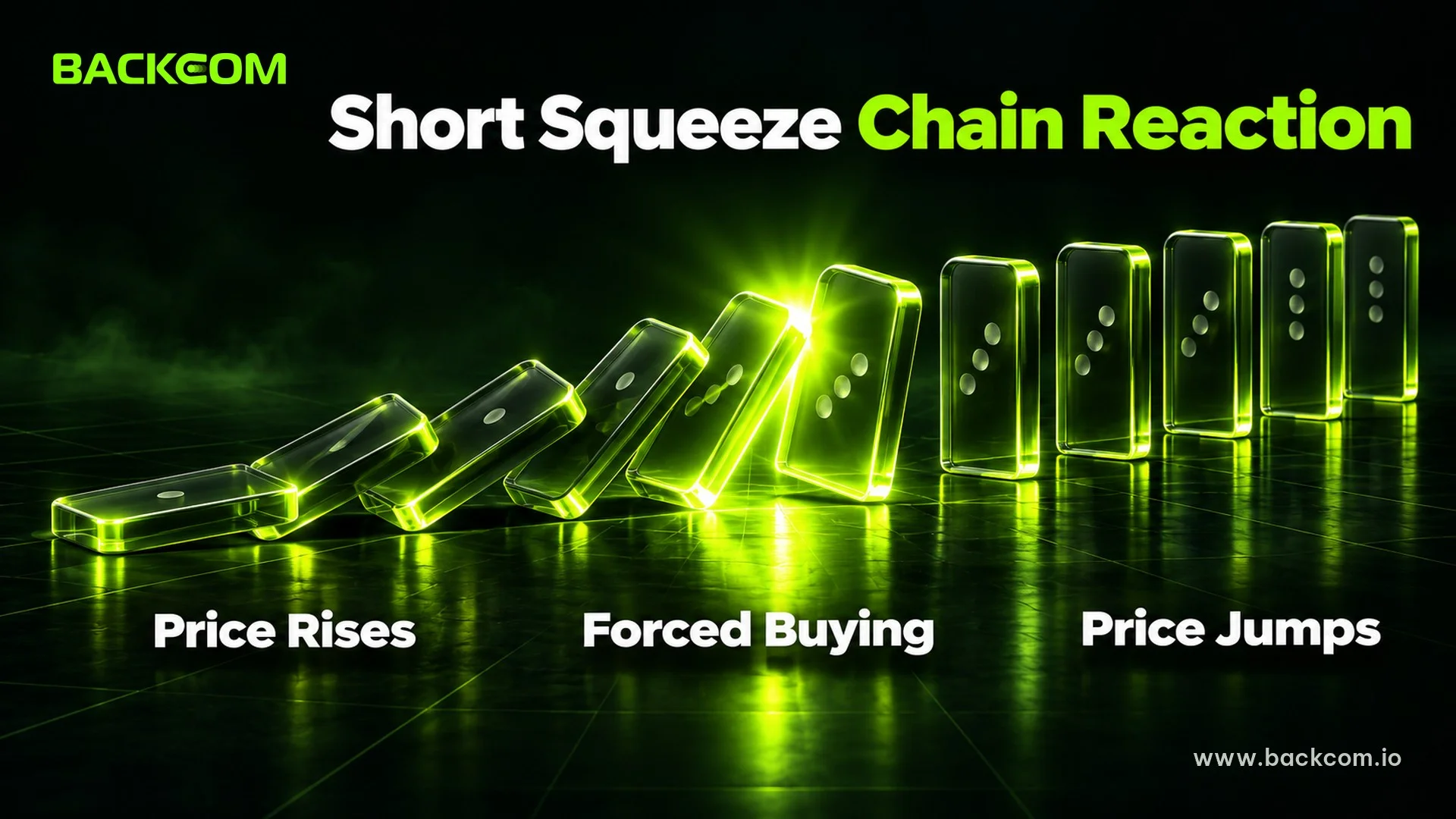
A crypto short squeeze usually needs three ingredients: many shorts in the same asset, thin liquidity, and a catalyst. According to Binance Academy, the catalyst can be positive news, large buying or simply a bounce after a decline. The sequence tends to run like this:
- Shorts build up. Traders open short positions, often with leverage, so the market is leaning in one direction.
- A catalyst lifts the price. It might be news, a large buy order or a small bounce that nobody expected.
- The first stop-losses and liquidations trigger. Shorts with the least margin are closed first, and each closure is a market buy.
- Price jumps further. Because the order book above the price is thin, each buy order moves the price more than it normally would.
- The next group of shorts is hit. Their liquidation prices are now in range, so the loop repeats.
- Buying exhausts. The squeeze ends when the shorts at risk have been cleared and no more forced buyers remain.
A related chain reaction happens on the way down for longs. We cover that pattern separately in our guide to margin calls and maintenance margin.
A Worked Example With Leverage
Numbers make the mechanism concrete. The figures below are illustrative, not a forecast.
Suppose Bitcoin trades at $100,000 and a trader opens a $10,000 short with 10x leverage. The margin is $1,000. A 10% rise to $110,000 would cost $1,000, wiping out that margin. Because exchanges require a maintenance margin, liquidation arrives slightly earlier, at roughly $109,000 to $109,600 (about 9% to 9.6%) depending on the platform's rules. Binance Academy gives a similar rule of thumb: about 8% to 10% for a 10x short and 16% to 20% for 5x.
Now imagine many traders opened similar shorts. When the price touches the first liquidation levels, the exchange buys back those positions at market, and that buying pushes the price into the next cluster of liquidation levels, and so on. The traders did not choose to buy at the top, because the margin rules chose for them.
Higher leverage means a closer liquidation price, so high-leverage shorts are the first fuel for a squeeze. If you are new to the mechanics, read what leverage is in crypto trading before you open any leveraged position.
Why Do Crypto Markets Squeeze So Easily?

Crypto markets squeeze easily because of leverage, constant trading and uneven liquidity. Each of the three makes forced buying more likely and more violent.
- High leverage is available. Derivatives platforms offer leverage that can liquidate a position on a move of a few percent.
- Markets never close. Crypto trades 24 hours a day, so a squeeze can happen at any hour. Binance Academy notes that squeezes during low-liquidity weekend hours can be especially severe.
- Small coins have thin books. Smaller altcoins with high derivatives open interest relative to spot volume are particularly exposed.
- Perpetual futures dominate. These contracts have no expiry, so crowded positions can sit open for weeks. Our guide to perpetual futures in crypto explains why.
Thin liquidity matters most. When few sell orders sit above the current price, each forced buy has to reach higher to find a seller. That gap between the price you expect and the price you get is called slippage, and our article on slippage in crypto shows how to measure it.
How Does A Funding Rate Short Squeeze Signal Work With Open Interest?

A funding rate short squeeze signal comes from perpetual futures, where the funding rate keeps the contract price close to the spot price. When the funding rate is negative, shorts pay longs. Binance's funding rate FAQ explains the payment as the nominal position value multiplied by the funding rate, normally exchanged every 8 hours.
Here is the cost in numbers. A trader holding a $10,000 short pays $5 per interval when the rate is -0.05%, which is $15 a day across three intervals. A deeply negative rate therefore tells you two things: many traders are short, and holding that position is getting more expensive. For the full mechanics, see our funding rate guide.
Open interest adds the second clue. It counts the total value of open contracts. Rising open interest with flat or falling prices suggests new positions are being opened, and if funding is negative at the same time, those new positions are likely shorts. Our article on how to read open interest shows how to track it.
| Signal | What It May Suggest | Caution |
|---|---|---|
| Deeply negative funding | Shorts are crowded and paying to hold | Funding can stay negative for long periods |
| Rising open interest, flat price | New positions are being added | Could be longs or shorts |
| Long/short ratio skewed to shorts | Crowded short side | Ratios differ by data provider |
No single indicator is conclusive. A crowded short side makes a squeeze possible, not certain. Many crowded trades unwind slowly with no spike at all.
What Happened In A Real Short Squeeze Bitcoin Example?
A well-documented short squeeze Bitcoin episode took place in April 2021. Cointelegraph reported on 26 April 2021 that Bitcoin rose from about $47,000 to above $53,000 in a short span, a gain of roughly 12% in one day. About $150 million in short positions were liquidated within hours, and funding rates across major exchanges were low but still positive beforehand, below 0.01%, according to the data the article cited.
Three lessons stand out from that event:
- The move was fast, since a 12% rise in a single day is large for an asset of Bitcoin's size.
- The funding signal was visible beforehand, because sub-neutral funding hinted at crowded shorts, though it did not predict the date of the spike.
- Figures differ by source, so liquidation totals vary between data providers and any headline number should be treated as approximate.
Squeezes are not limited to Bitcoin. They also hit altcoins, where thinner order books make the effect larger in percentage terms.
How To Avoid Short Squeeze Damage As A Trader

How to avoid short squeeze risk comes down to position sizing and leverage. You cannot predict the catalyst, but you can control how much a spike costs you.
- Use low leverage. Binance Academy calls conservative sizing and low leverage the most effective protection. Lower leverage puts your liquidation price further away.
- Be careful shorting a crowded trade. If funding is already deeply negative and open interest is high, the cost of being wrong rises.
- Do not rely only on stop-losses. In a squeeze, a stop becomes a market buy and can fill at a poor price because of slippage. Our guide to crypto order types explains the difference between stop and limit orders.
- Know your margin mode. Isolated margin limits the loss to one position, while cross margin can draw on your whole balance. Compare them in cross margin vs isolated margin.
- Understand where losses end. Some platforms keep an insurance fund for liquidations that cannot be closed at the bankruptcy price. See what an insurance fund is.
If you are on the other side of the trade, the same logic applies, because holding longs into a squeeze can feel profitable while the move can reverse as quickly as it started once the forced buying stops. Take profit rules and risk limits matter for both sides.
Frequently Asked Questions (FAQ) About Crypto Short Squeezes
Is A Short Squeeze Good Or Bad For Bitcoin?
It depends on your position. For holders it can mean a sudden gain, and for short sellers it means forced losses. Because the rise is driven by forced buying rather than lasting demand, price can fall back quickly once the shorts have been cleared. Treat it as a volatility event, not a trend signal.
How Long Does A Short Squeeze Last?
There is no fixed length. Many squeezes last minutes to a few hours, ending when the shorts at risk have been liquidated and forced buying dries up. Larger ones can run for days if new catalysts keep arriving. The duration depends on liquidity, leverage and how many shorts remain open.
Can You Predict A Short Squeeze?
Not reliably. Negative funding, rising open interest and skewed long/short ratios can show that shorts are crowded, but they do not tell you when a catalyst will arrive, and many crowded trades unwind without a spike. Use these signals to judge risk, not to time entries.
Is A Short Squeeze The Same As A Liquidation Cascade?
They overlap but are not identical. A short squeeze describes the rise driven by shorts buying back. A liquidation cascade is the general chain reaction of forced closures on either side. A short squeeze is one kind of cascade, with shorts being forced to buy.
Conclusion: Treat Crowded Shorts As A Risk Signal
A short squeeze is a feedback loop: price rises, shorts are forced to buy, and the buying lifts price further. In crypto, leverage, 24/7 trading and thin order books make that loop faster. Funding rates and open interest can show when shorts are crowded, but no signal fixes the timing. The practical defence is simple: use lower leverage, size positions so a spike does not end your account, and do not rely on stop-losses alone. For a wider picture of how crypto works, start with our beginner guide to crypto.
Disclaimer: This content is compiled by Backcom.io for information only and is not investment advice. Leveraged crypto trading carries a high risk of loss, including the loss of your whole margin. Figures in the examples are illustrative and not a forecast.
Was this article helpful?
Join The Backcom.io Community
Get the latest on trading rebates, trading tips, and broker deals — and connect with thousands of traders worldwide.

Backcom App
Track Your Rebates Every Day
Every rebate is visible by broker and by day. Manage your wallet and withdrawals in one place.
Open Backcom App