What Is Unrealized PnL Crypto: Meaning, Formula And Futures Examples


Unrealized PnL is the profit or loss on a position that is still open, measured at the current price but not yet locked in by closing the trade. It is the number that flashes green or red on your futures screen, and it changes with every tick until you exit. Many beginners treat it as money in the account, which is where most of the confusion starts. In this article, Backcom.io explains what is unrealized PnL crypto exchanges show, how the formula works for linear and inverse contracts, and what the number leaves out.
1. What Is Unrealized PnL Crypto Traders See On An Open Futures Position?
Unrealized PnL (unrealized profit and loss) is the gain or loss a futures position would show if it were valued right now, while the position is still open. The word "unrealized" means nothing has been settled: no closing order has filled, so the figure can still grow, shrink or flip sign.
Exchanges usually calculate it against a reference price, not the last trade. OKX writes the long formula as face value × contracts × multiplier × (mark price − average open price), and Gate gives the same structure for its contracts (OKX help, Gate help).
Three inputs drive the number:
- Entry price. The average price at which the position was opened.
- Mark price. The exchange's fair-value reference, not necessarily the last traded price.
- Position size. The number of coins or contracts you hold, and whether you are long or short.
Leverage does not appear in the dollar formula. It only changes how much margin you post, which matters later when you read the percentage. If you are new to the product itself, our guide to perpetual futures in crypto explains how these contracts work, and the beginner guide to crypto covers the basics before that.
2. Unrealized PnL Vs Realized PnL: What Changes When You Close?
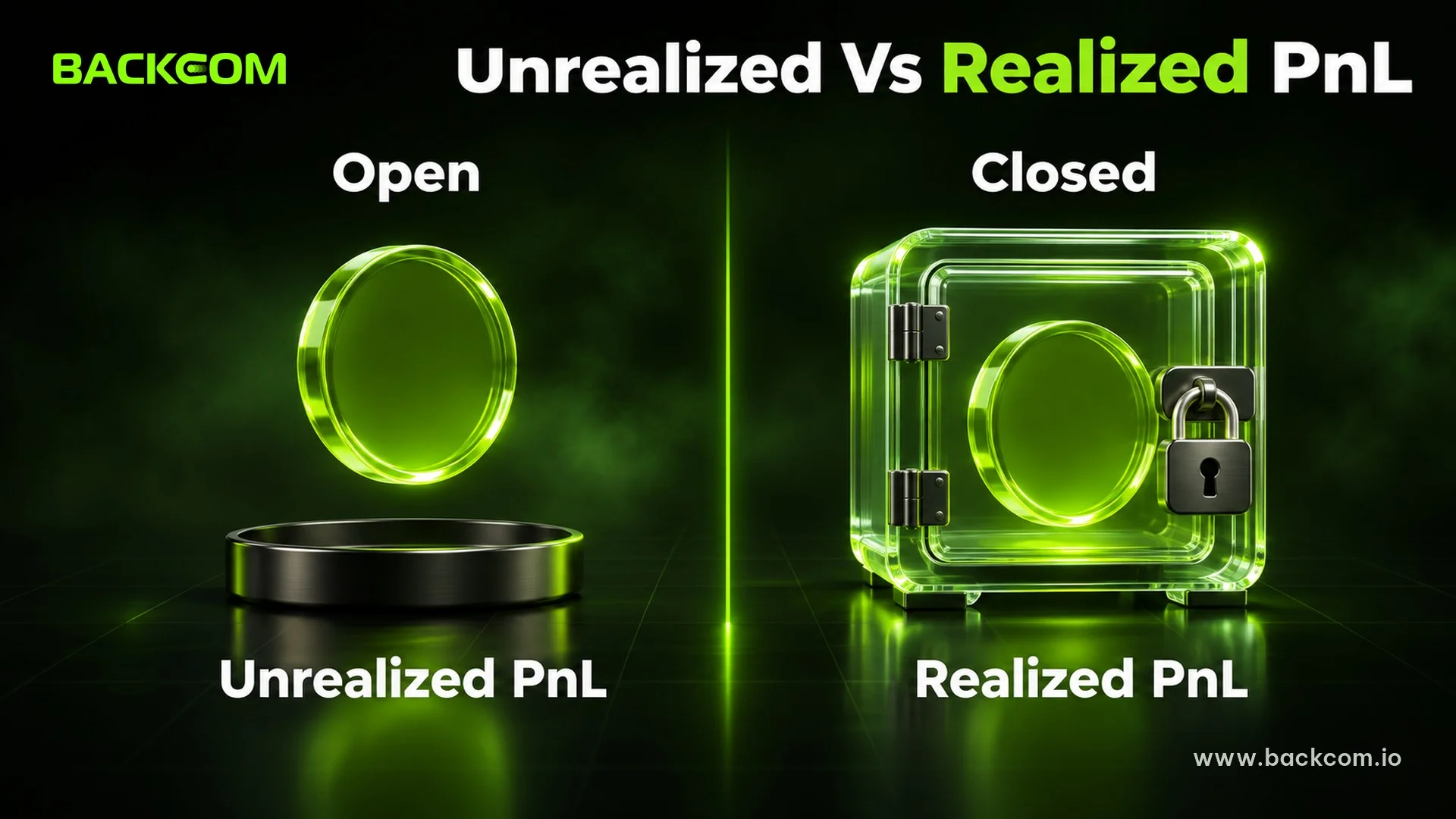
Unrealized PnL vs realized PnL is the difference between a paper result and a settled one. Unrealized PnL belongs to a position that is still open. Realized PnL is what remains after you close all or part of the position and the exchange books the result.
| Item | Unrealized PnL | Realized PnL |
|---|---|---|
| Position status | Open | Closed, fully or partly |
| Price used | Mark price (on most exchanges) | Actual execution price |
| Changes over time | Yes, with every price update | No, once booked |
| Includes closing fee | No | Yes, usually |
| Can reverse | Yes | No |
The table describes the common pattern. Each exchange sets its own display rules, so check the help page of the platform you use.
Gate states the gap plainly: since unrealized PnL is calculated on the mark price, the displayed figure may differ from the PnL settled when you close the position. It adds that the mark price is for reference only and final PnL depends on the actual execution price. Kraken's formula for realized PnL subtracts total fees, which are the entry fee plus the exit fee (Kraken help).
Closing part of a position realizes only that part. If you close half, half of the result is booked and the rest stays unrealized until you act or the position is liquidated.
3. How To Calculate PnL Futures: Linear And Inverse Contracts
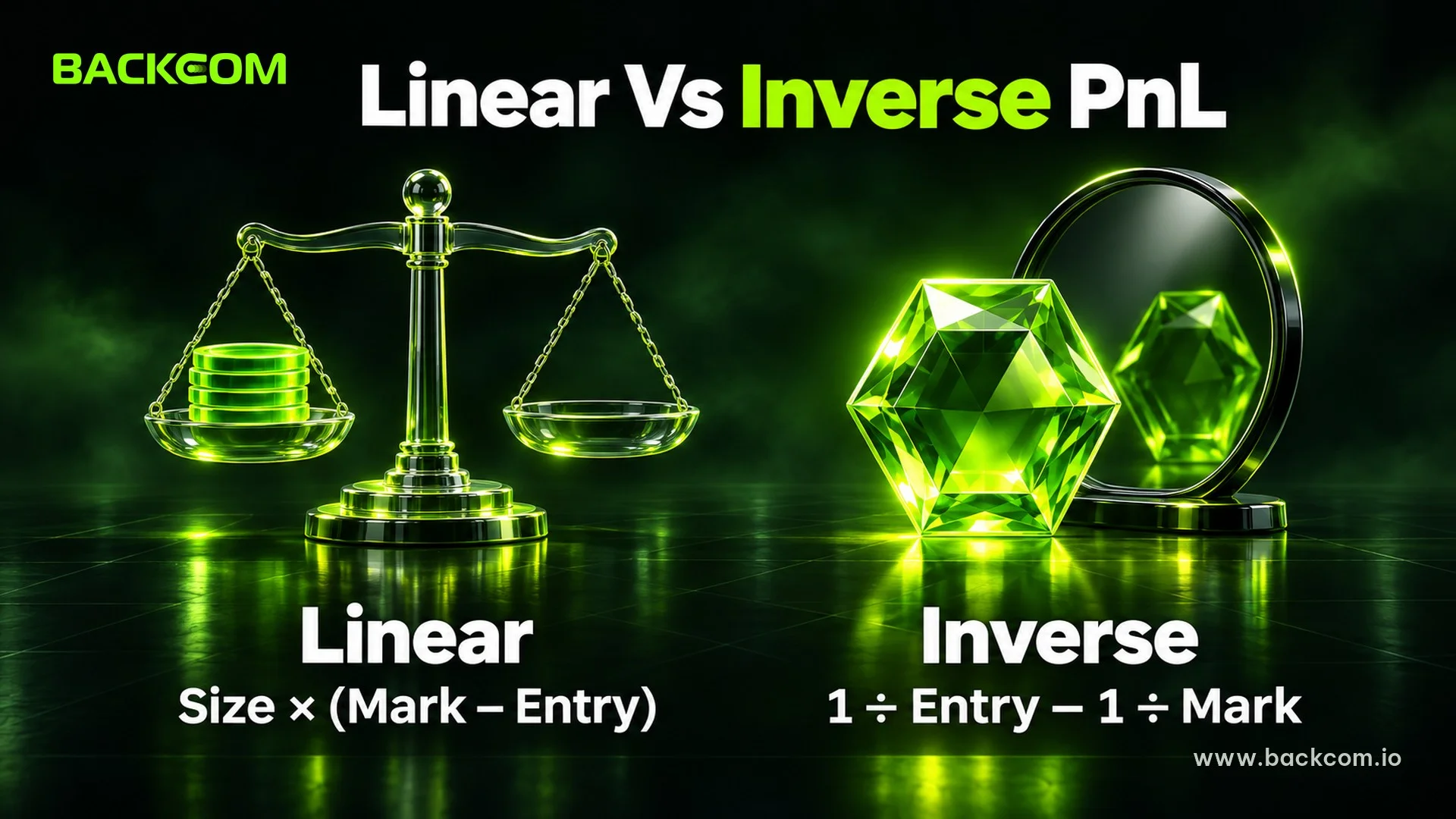
How to calculate PnL futures traders face depends on the contract type. Linear contracts (USDT or USDC margined) are priced and settled in a stablecoin. Inverse contracts (coin margined) are settled in the underlying coin, so the formula uses reciprocal prices.
For a linear contract, the formula is simple:
Long PnL = Size × (Mark Price − Entry Price)
Short PnL = Size × (Entry Price − Mark Price)
Here "size" is the quantity in coins. On exchanges that quote contracts, multiply by face value and the contract multiplier, as the OKX page does.
For an inverse contract, OKX gives the long result as face value × contracts × multiplier × (1 ÷ average open price − 1 ÷ mark price), and the short result with the two terms swapped. The answer comes out in the margin coin.
Worked Example: A Linear BTCUSDT Long
The numbers below are round figures for illustration, not a forecast and not a recommendation. You open a long position of 0.5 BTC on a BTCUSDT perpetual at an entry price of 100,000 USDT. The mark price rises to 104,000.
- Price change: 104,000 − 100,000 = 4,000 USDT per BTC.
- Unrealized PnL: 0.5 × 4,000 = 2,000 USDT.
Now take the same size as a short at the same entry. The result is 0.5 × (100,000 − 104,000) = −2,000 USDT. A long and a short on the same move have equal and opposite results, which is why a rising market feels very different depending on your side.
Worked Example: An Inverse Long
Take an inverse contract with a face value of 1 USD, a position of 10,000 contracts, entry at 100,000 and mark at 104,000. The result is 10,000 × (1 ÷ 100,000 − 1 ÷ 104,000) = about 0.003846 BTC. At 104,000 USD per BTC that equals roughly 400 USD. Notice that the profit is counted in BTC, so its dollar value moves with the coin itself.
4. ROI Crypto Futures: How Leverage Changes The Percentage You See

ROI crypto futures screens show is the unrealized PnL divided by the margin you posted, not by the position value. OKX defines its ratio as P&L divided by initial margin, and most platforms follow the same idea under names like "ROE" or "PnL %".
ROI = Unrealized PnL ÷ Initial Margin
Initial margin equals position value divided by leverage. Using the long above:
- Position value at entry: 0.5 × 100,000 = 50,000 USDT.
- Initial margin at 10x leverage: 50,000 ÷ 10 = 5,000 USDT.
- ROI: 2,000 ÷ 5,000 = 40%.
The price moved only 4%, yet the screen shows 40%. Leverage multiplies the percentage in both directions: a 4% move against you would show −40%. At 20x the same 2,000 USDT gain would sit on 2,500 USDT of margin and read 80%, while a 5% adverse move would erase the whole initial margin before maintenance requirements and fees are even considered.
This is why a big green percentage tells you little by itself. It says how large the result is relative to the margin you posted, not how safe the position is. Our guide to leverage in crypto trading covers the risk in more detail, and the liquidation price guide shows where the position would be closed by force.
5. Why Does Mark Price Make Your Unrealized PnL Differ From The Last Price?

The mark price is a fair-value estimate built to resist manipulation, and unrealized PnL is calculated from it rather than from the last trade. If one large order briefly pushes the last price away from fair value, the mark price absorbs part of the spike so that positions are not marked into profit or loss by a thin print.
Gate describes its mark price as the median of three inputs: a price derived from the index and funding basis, a price derived from the spot index plus a moving average basis, and the latest traded price. It also caps the deviation from the spot index. Methods differ by exchange, and Kraken's help page says its mark price is typically the best bid for longs or the best ask for shorts.
Here is what that does to your 0.5 BTC long, with entry 100,000 and 10x leverage:
| Reference price | Price used | Unrealized PnL | ROI on 5,000 margin |
|---|---|---|---|
| Last traded price | 104,300 | 2,150 USDT | 43% |
| Mark price | 104,000 | 2,000 USDT | 40% |
Both prices are invented for the example. A gap like this explains why your screen can disagree with a chart showing the last price. Liquidation checks also use the mark price, so it is the number that matters when risk is high. For a market-wide figure traders read alongside price, see our guide to open interest in crypto futures.
6. Which Costs Are Missing From Unrealized PnL?
Unrealized PnL does not show the full cost of a trade. It measures price movement against your entry, and several charges sit outside that figure or are applied separately.
- Trading fees. The entry fee is usually taken from the balance when the order fills, so it does not show in unrealized PnL, as Kraken's help page notes. The closing fee only appears once you exit.
- Funding payments. On perpetual contracts, longs and shorts exchange funding at set intervals. Kraken states that funding is not included in realized PnL, so you need to add the payments you made or received to see total return. Our funding rate guide shows how to calculate them.
- Slippage. A closing order can fill away from the mark price, especially in thin markets, as our explanation of slippage in crypto shows.
Take the earlier long and assume, for illustration only, a 0.05% fee on each side. The entry fee is 50,000 × 0.0005 = 25 USDT. Closing 0.5 BTC at 104,000 is a notional of 52,000 USDT, so the exit fee is 26 USDT. If you also paid 10 USDT of funding while holding, the result is 2,000 − 25 − 26 − 10 = 1,939 USDT, not 2,000. Real fee rates depend on your tier and order type; see our guide to calculating futures trading fees and the difference between maker and taker fees.
7. Does Unrealized PnL Change Your Balance, Margin And Liquidation Risk?
Unrealized PnL changes your account equity, but it is not cash. Many exchanges add it to, or subtract it from, your equity when they calculate margin. Whether unrealized profit can be withdrawn, or used to open new positions, depends on the margin mode and the exchange, so read the rules before you count on it.
Losses matter more than gains here:
- Cross margin. One account balance backs all positions, so an unrealized loss on one position can use up margin that supports another.
- Isolated margin. Each position has its own margin, so a loss is limited to what you allocated, plus any top-ups you add.
- Open profits can vanish. Because the figure is not booked, a price reversal can erase it before you close. If a liquidation fills worse than the bankruptcy price, many exchanges use an insurance fund to cover the gap.
A rising unrealized loss also pushes your account toward a margin call. Our explanation of the crypto margin call lists the warning signs. If you want to limit a loss before it grows, see our guide to crypto stop loss orders.
8. How To Build A Simple PnL Calculator Crypto Traders Can Reuse
A PnL calculator crypto traders can trust needs only a handful of inputs and a few lines. You can build it in any spreadsheet in about five minutes, and then check it against the figure on your exchange.
- Enter the side (long or short), size, entry price, mark price and leverage.
- Calculate PnL with Size × (Mark − Entry) for a long, or Size × (Entry − Mark) for a short.
- Calculate initial margin with Size × Entry ÷ Leverage.
- Calculate ROI with PnL ÷ Initial Margin.
- Subtract fees and funding in a separate row to get a net figure.
Use your exchange's calculator as a cross-check, not as your only source, because contract sizes and fee rules differ. If your number and the screen disagree, compare the reference price first, then the fees. For the sizing step before you enter, our crypto position size calculator guide walks through the maths.
Frequently Asked Questions (FAQ) About Unrealized PnL In Crypto
Is Unrealized PnL Real Money?
No. Unrealized PnL is a mark-to-market estimate on an open position, so nothing has been paid or received yet. It affects your account equity and margin, but the profit only becomes yours once the position is closed and the result is realized. A reversal can reduce or erase it first.
Why Does My Unrealized PnL Not Match The Chart?
The exchange usually calculates it from the mark price, while a chart shows the last traded price. The two can differ, especially in fast or thin markets. Your entry price may also be an average of several fills, which shifts the result. Check which price your platform uses before you compare.
Does Unrealized PnL Include Fees And Funding?
Usually not in full. Entry fees are often deducted from the balance at fill and do not appear in the unrealized figure, and funding payments are typically handled separately. To see your true result, subtract all fees and add or subtract funding yourself, or check the realized PnL after closing.
Can Unrealized PnL Cause Liquidation?
Yes. An unrealized loss reduces your equity, and if it falls below the maintenance margin the exchange may liquidate the position. High leverage makes this happen after a smaller price move. Watch the distance between the mark price and your liquidation price, not only the percentage on screen.
Conclusion: Treat Unrealized PnL As A Live Estimate, Not A Result
What is unrealized PnL crypto screens display? It is a live estimate of an open position, built from entry price, size and the mark price. Realized PnL is the settled outcome after the exit, and the gap between them comes from price references, fees, funding and slippage. Leverage inflates the percentage but not the dollar result.
Before you act on a green or red number, check four things: which price the platform uses, how large the position is relative to margin, which costs are missing, and how far the liquidation price sits. Use the formulas above to confirm the figure, and keep size small enough that a reversal does not decide the outcome for you.
Disclaimer: This content is compiled by Backcom.io for information only and is not investment advice. Crypto futures are leveraged products and you can lose more than you expect. All figures in the examples are illustrative, and fee and margin rules differ by exchange, so check the official terms before you trade.
Was this article helpful?
Join The Backcom.io Community
Get the latest on trading rebates, trading tips, and broker deals — and connect with thousands of traders worldwide.

Backcom App
Track Your Rebates Every Day
Every rebate is visible by broker and by day. Manage your wallet and withdrawals in one place.
Open Backcom App