How To Compare Forex Broker Costs: Spread, Commission, Swap And Rebate


Two brokers can both advertise spreads from 0.0 pips, yet the monthly cost for the same trader can differ by a hundred dollars or more, because each broker puts its fees in a different place. Knowing how to compare forex broker costs means putting every fee into the same unit, instead of setting side by side numbers that measure different things.
The real cost of a trade has four parts: the spread, the commission, the overnight swap and the rebate you get back. Each is quoted in its own unit, so the fix is to convert all four into USD per lot and then place the brokers in one table.
In this article, Backcom.io walks through the conversion formulas, a worked example for three hypothetical brokers and a five-step routine for collecting the numbers yourself. It does not rank any broker, because the ranking changes with how you trade.
1. What Do Forex Trading Costs Include? Four Items To Add And Subtract Per Lot
Forex trading costs are everything a trader pays, or gets back, for opening, holding and closing a position, measured per lot of volume. Four items matter most:
- Spread: the gap between the Bid and Ask prices, paid the moment the trade opens.
- Commission: a separate fee per lot, usually charged on Raw or ECN accounts.
- Swap: a credit or debit applied when a position is held past the daily rollover, and it can be negative or positive.
- Rebate: money returned per lot closed, which lowers the real cost.
Slippage, deposit and withdrawal fees and currency conversion charges also exist, but they have no common formula across brokers, so add them yourself if they apply. The guide on slippage in forex explains how to limit the first of these.
What makes comparisons go wrong is units. Spread is quoted in pips or points, commission in USD, swap in points or percent and rebate in USD. The first step is therefore always to choose one common unit.
The easiest unit is USD per lot, since commission and rebate already come in that form. For EURUSD, one lot has a contract size of 100,000 units, so 1 pip is worth about 10 USD per lot. The article on what a pip is in forex shows how to convert pips into money.
The formula used throughout this article is:
Net cost per lot = Spread (USD) + Round-turn commission + Swap cost (positive when charged) − Rebate
Contract size sits in the Specification tab of MetaTrader 5. Read the sources directly: the MetaTrader 5 Market Watch guide and the MetaTrader 5 forex margin calculation page, which uses EURUSD with a contract size of 100,000.
2. Spread And Commission Per Lot: Put Both Into USD
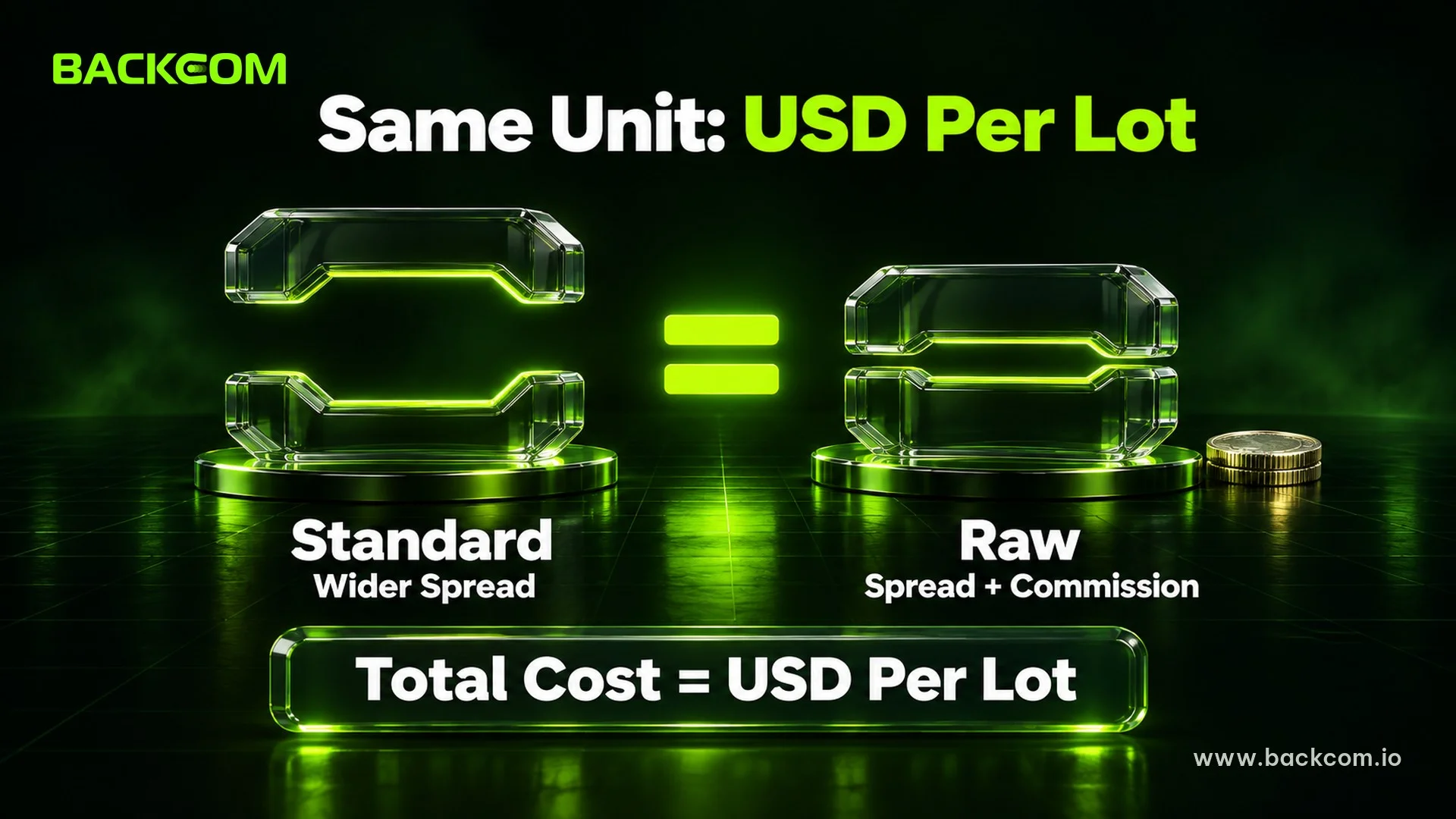
Spread and commission per lot is the step most often misread, because the two account types hide the fee in different places. A Standard account usually charges no commission but has a wider spread. A Raw account has a very tight spread and makes up for it with a commission on each lot.
Convert the spread in three steps:
- Read the average spread of the exact pair you trade, not the "from" figure on an advertising page.
- Convert to pips: on a 5-digit quote, 10 points equal 1 pip.
- Multiply by the pip value per lot, for example 1.0 pip on EURUSD is about 10 USD.
MetaTrader 5 shows the spread in points and marks it "floating" when it moves. What you see is one reading, not the daily average, so record it several times during the Asian session, the European session and around major news.
Commission needs two checks. A broker may advertise the fee per side or round turn, and the round-turn figure is double the per-side one. MetaTrader 5 also lets a broker charge commission in money, in percent or in points, so confirm how it is charged before it goes into the table.
To compare the two account types, use this line:
Trading cost per lot = Spread (pips) × Pip value + Round-turn commission
A worked example on EURUSD, with hypothetical numbers that do not belong to any real broker:
| Hypothetical broker | Account type | Average spread | Round-turn commission | Cost per lot |
|---|---|---|---|---|
| Broker A | Standard | 1.0 pip = 10 USD | 0 USD | 10 USD |
| Broker B | Raw | 0.1 pip = 1 USD | 7 USD | 8 USD |
| Broker C | Raw | 0.5 pip = 5 USD | 6 USD | 11 USD |
Illustration as at 21 November 2026, using hypothetical numbers to show the method. Real spreads, commissions and rebates change over time and must be checked again before you choose an account.
Broker C has a tighter spread than Broker A, yet its commission makes it the most expensive of the three. A deeper look at the two account types is in Raw spread vs Standard account: which costs less per lot, and a list of tight-spread brokers is in low spread forex brokers.
3. Overnight Swap Cost Forex Traders Should Count By Nights Held

Overnight swap cost in forex is the item most often forgotten, since it only appears when a position stays open past the rollover. A day trader who closes everything the same day pays almost no swap. A trader who holds for several days can see swap grow larger than the spread.
Read swap in the Specification tab of MetaTrader 5: right-click the symbol in Market Watch and choose Specification. Four values should be recorded:
- Swap long: the amount applied to Buy positions.
- Swap short: the amount applied to Sell positions.
- Swap type: how it is calculated, such as in points, in the deposit currency or as a percentage of price.
- Contract size: units per lot, used to convert into USD.
The key point is that swap type differs between brokers. A figure of "−6" can mean points at one broker and USD or percent at another, so the two cannot sit side by side until they share a unit. The calculation is covered in swap in forex and the overnight fee.
MetaTrader 5 documentation gives an example where the swap factor is 1 on normal days and 3 when a position rolls from Wednesday to Thursday. That is only an example, since each broker sets its own triple-swap day, so read the triple-swap day for the broker you are considering.
To put swap into the comparison, use:
Swap cost = Swap per night (USD per lot, positive when charged) × Number of charged nights
Charged nights are not calendar days. A Buy opened on Monday morning and closed on Friday afternoon passes the nights of Monday, Tuesday, Wednesday (charged triple) and Thursday, which is 6 charged nights if the broker triples on Wednesday. A simple method is to fix three scenarios for every broker:
- Closed the same day: 0 nights.
- Held through one normal night: 1 night.
- Held from Monday to Friday: 6 charged nights.
Suppose the EURUSD swap long at the three hypothetical brokers is negative 4, 8 and 2 USD per lot per night, meaning the trader is charged 4, 8 and 2 USD. For the same Buy held 6 charged nights, swap cost would be 24, 48 and 12 USD. A 36 USD gap is enough to reverse the cost ranking.
4. Net Cost After Rebate: Where To Subtract The Rebate
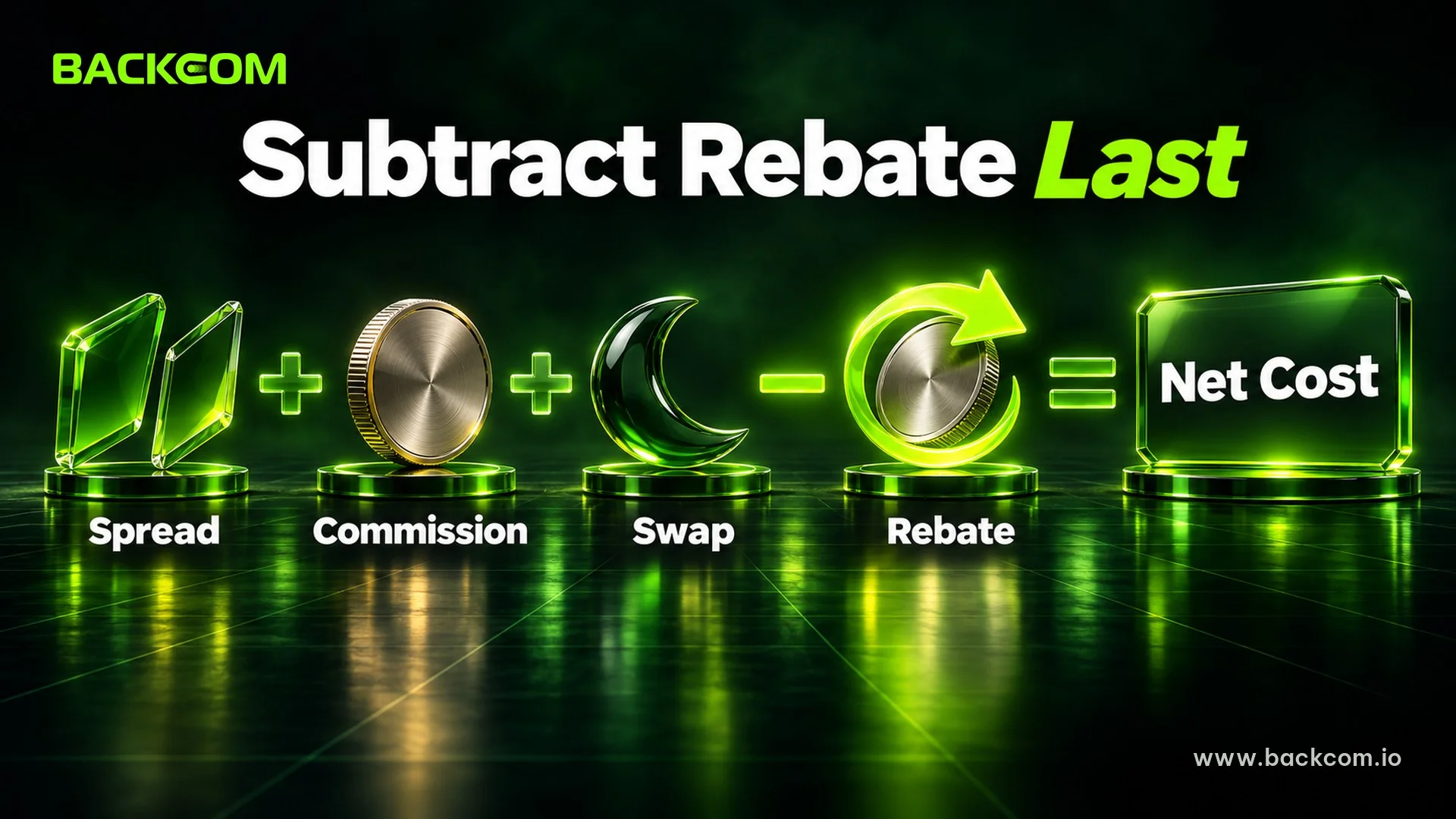
Net cost after rebate is what a trader really pays per lot once spread, commission and swap are added and the rebate is taken off. A rebate is paid in USD per lot closed, winning and losing trades both count and open trades do not yet, so it subtracts straight into the formula with no extra conversion.
Apply the rebate with three rules:
- Subtract only the rebate for the account type you open. Within one broker, Standard and Raw accounts have different rebates.
- Subtract it last, after the gross cost. This shows which broker is cheap because of its spread and which is cheap only because of its rebate.
- Never pick a broker on a high rebate alone. A high rebate sometimes comes with a wider spread, so it only means something next to the gross cost.
Current rates are in the forex rebate per lot table and the list of brokers with rebates. How to rank brokers by cost after rebate is analysed in best forex rebate brokers by net cost.
Continuing the hypothetical example, rebates are 4, 2 and 1 USD per lot for Brokers A, B and C, in this formula:
Net cost per lot = Trading cost + Swap cost (positive) − Rebate
This article shows how to subtract a rebate and does not state the rate of any broker. Backcom.io is an independent introducing broker (IB/affiliate) of the forex brokers it lists, and rebates are paid from the commission the broker pays Backcom.io; see the risk disclaimer.
5. How Does Forex Broker Cost Comparison Change By Trading Style?
Cost rankings change with holding time. For same-day closes Brokers A and B tie at 6 USD, while for a full week Broker C is cheapest at 22 USD. The table applies the three scenarios to the three hypothetical brokers above.
| Scenario (1 lot EURUSD) | Broker A | Broker B | Broker C |
|---|---|---|---|
| Trading cost (spread + commission) | 10 | 8 | 11 |
| Swap, 1 night | 4 | 8 | 2 |
| Swap, 6 charged nights | 24 | 48 | 12 |
| Rebate | −4 | −2 | −1 |
| Closed the same day | 6 | 6 | 10 |
| Held 1 night | 10 | 14 | 12 |
| Held 6 charged nights | 30 | 54 | 22 |
Illustration as at 21 November 2026, USD per lot, hypothetical numbers. Real figures change over time and must be checked again before you choose.
The table gives three different answers:
- Same-day closes: Brokers A and B tie at 6 USD and Broker C costs 4 USD more.
- One night: Broker A is cheapest and Broker B is the most expensive because of its swap.
- A full week: Broker C becomes the cheapest at 22 USD while Broker B climbs to 54 USD.
This is why one ranking for every trader always has a weak point. A scalper trading 20 lots a month would pay 80 USD more at Broker C than at Broker A, while a trader holding for a week would see the opposite.
Pick the scenario closest to your habits and read that line:
- In and out within the day: watch spread, commission and rebate and nearly ignore swap.
- One to two nights: add the swap long or swap short that matches the trade direction.
- Several days: swap can outweigh everything else, so read this line first.
6. How To Compare Forex Broker Costs In 5 Steps
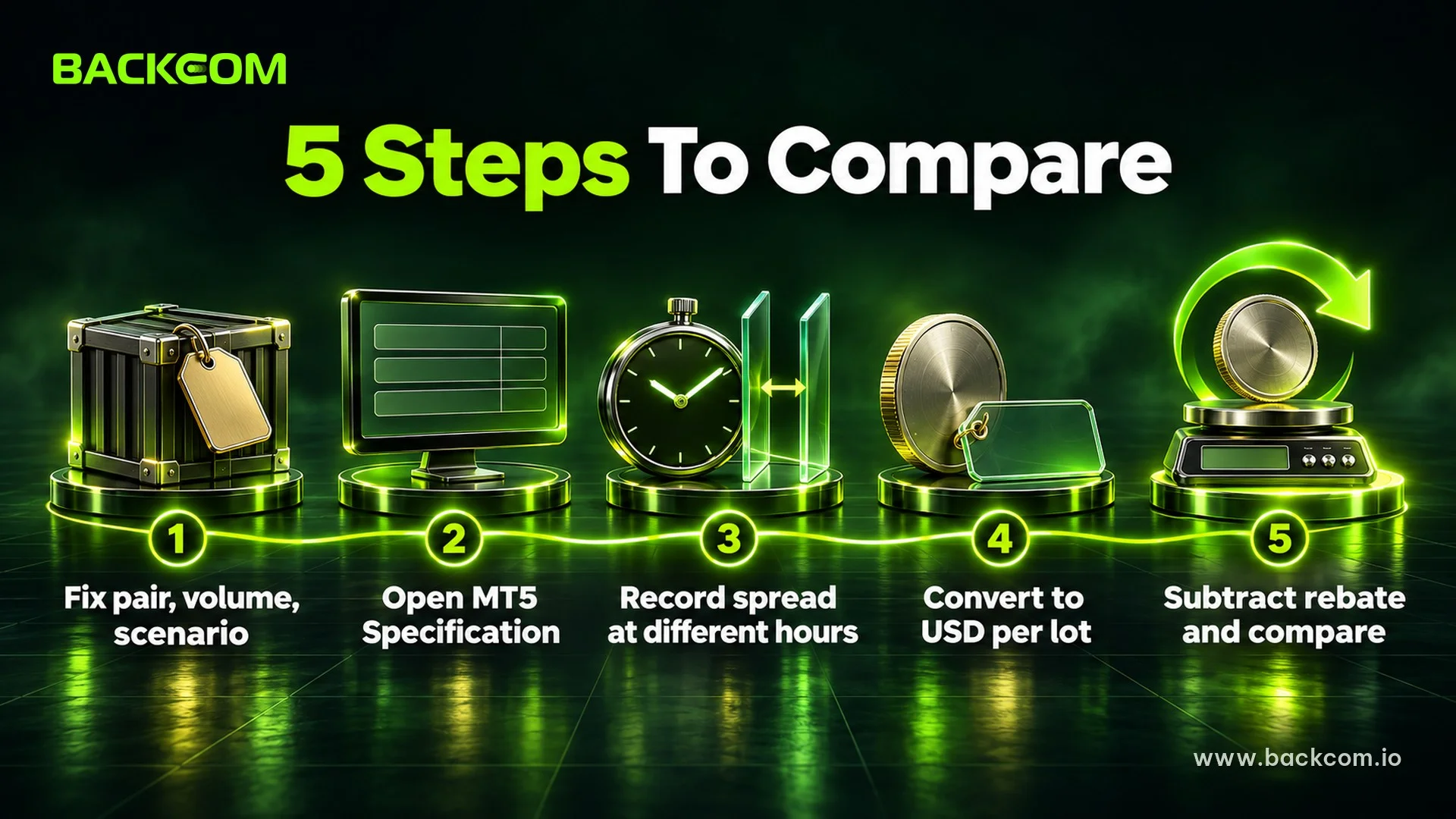
How to compare forex broker costs reliably comes down to repeating one routine for every broker so the numbers can sit side by side. These five steps work on demo and live accounts alike:
- Fix the pair, the volume and the holding scenario. Choose the pair you trade most, such as EURUSD or XAUUSD, one volume such as 1 lot, and one of the 0, 1 or 6 night scenarios.
- Open the MetaTrader 5 Specification on each account. Right-click the symbol in Market Watch, choose Specification, then copy contract size, swap long, swap short, swap type and commission if shown.
- Record the spread several times at different hours. Use at least three time windows, one of them close to major news, and take the average instead of one flattering reading.
- Convert everything to USD per lot. Turn points into USD, put commission on a round-turn basis and convert swap according to the broker's swap type.
- Subtract the rebate for the right account type and compare by scenario. Set the brokers side by side on the 0, 1 and 6 night lines, then choose.
For larger amounts, confirm with a few small live trades that commission and swap are booked as you read them. After cost, other criteria such as licensing and withdrawals decide the final pick, and they are covered in the criteria for choosing a reputable forex broker.
Frequently Asked Questions (FAQ) About How To Compare Forex Broker Costs
Is The Lowest Spread Always The Cheapest Broker?
No. Spread is only one of the four items. In the example above, Broker C has a 0.5 pip spread plus 6 USD commission, which makes 11 USD per lot, more than the 10 USD of Broker A despite the tighter spread. Compare net cost per lot for each holding scenario instead.
What Is The Difference Between Per-Side And Round-Turn Commission?
A per-side fee is charged once, on open or on close, while a round-turn fee is the total of both. A commission of 3.5 USD per side equals 7 USD round turn, so convert everything to round turn to avoid understating the cost by half.
Do I Need To Count Swap If I Only Day Trade?
Not if every position is closed before the broker's daily rollover. One forgotten trade is enough to incur swap, though, so keep the swap long and swap short of the symbols you trade.
Does A Rebate Change The Cost Ranking?
Yes, but the effect depends on the scenario. In the hypothetical example, rebates range from 1 to 4 USD per lot while swap differs by up to 36 USD in the full-week scenario. Treat the rebate as the last adjustment, not the first reason to choose a broker.
Conclusion: Convert Everything To USD Per Lot Before You Choose
The most reliable way to compare forex broker costs is to put spread, commission, swap and rebate into the same USD per lot and then calculate for your own holding habits. Traders need to look at three things together: the account type, the number of nights held and the trade direction.
Build a spreadsheet from the five steps above, fill it with numbers from the Specification tab and run the 0, 1 and 6 night scenarios, then check the rebate for the right account type in the forex rebate per lot table.
Disclaimer: This content is compiled by Backcom.io for information and reference only and is not investment advice, a trading recommendation or tax or legal advice. All figures in the example tables are hypothetical and are used only to illustrate the calculation. Forex trading carries a high level of risk and you may lose all of your capital.
Was this article helpful?
Join The Backcom.io Community
Get the latest on trading rebates, trading tips, and broker deals — and connect with thousands of traders worldwide.

Backcom App
Track Your Rebates Every Day
Every rebate is visible by broker and by day. Manage your wallet and withdrawals in one place.
Open Backcom App