What Is Slippage In Forex? Positive And Negative Slippage, Cost Per Lot And 6 Ways To Reduce It


A trader clicks Buy on gold while the Ask shows 4,200.30, and the order fills at 4,200.60. That gap is slippage in forex and CFD trading: the distance between the requested price and the fill price. It is not a display error, and it does not always hurt you.
In this article, Backcom.io explains what slippage is, why positive and negative slippage both happen, how requotes differ, what the gap costs per lot of gold and six ways to reduce slippage.
What Is Slippage In Forex? Requested Price, Fill Price And Slippage
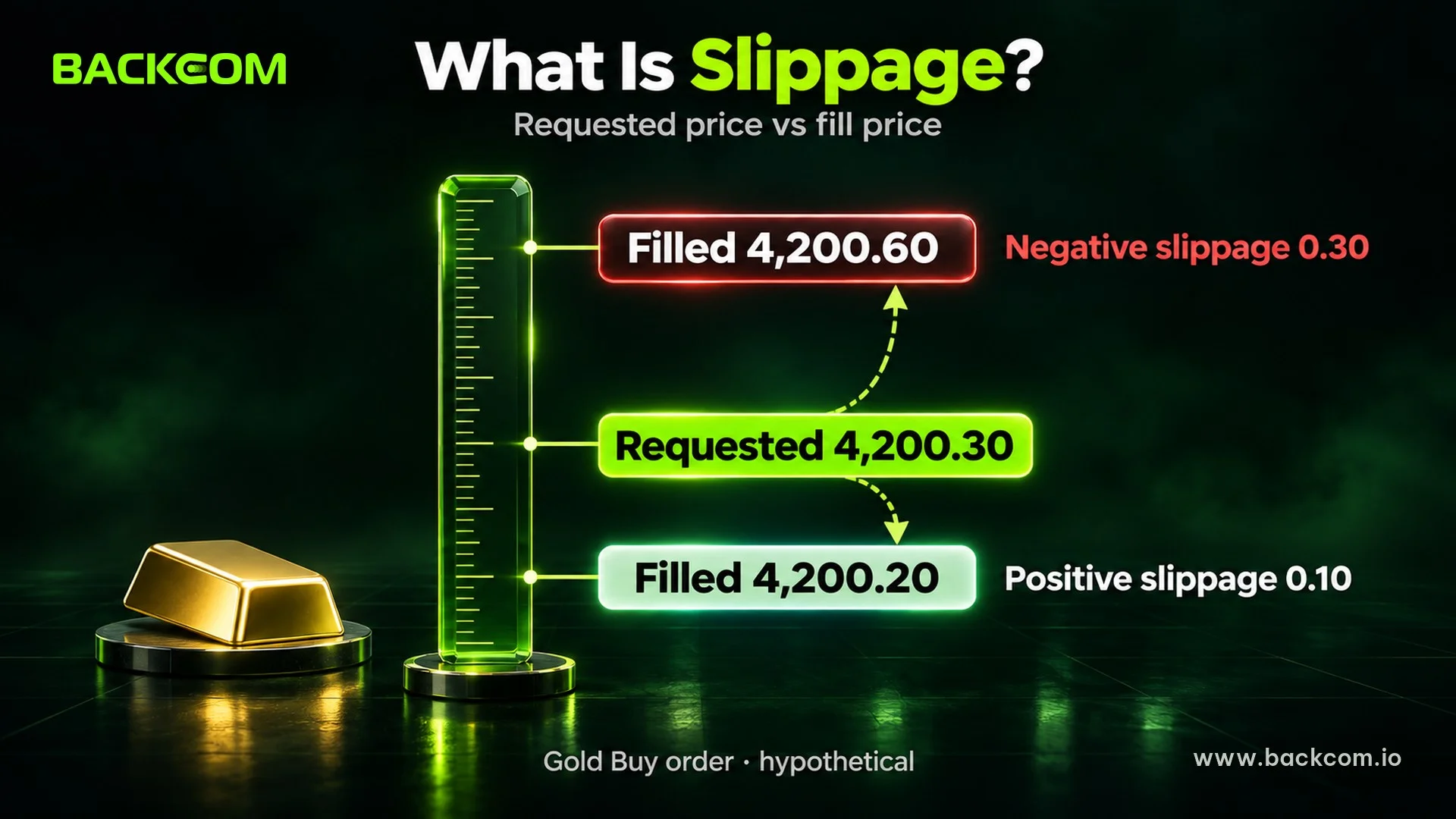
Slippage in forex is the difference between the requested price of an order and the price at which it actually fills. It can be unfavourable, favourable or zero, because price can move in the short delay between the quote and the execution.
Slippage on crypto order books and DEX swaps works differently, as our guide to slippage in crypto explains.
What Is Slippage, And How Is It Different From A Wider Spread?
The NFA explains what slippage is through the time an order takes to reach the broker's system, during which the price can change. According to MetaQuotes, a Buy order is filled at the Ask and a Sell order at the Bid. Keep three things apart when you read a fill price:
- Spread: the Ask minus the Bid at one moment, explained in our guide to what forex spread is.
- Slippage: the difference between the fill price and the requested price, known for certain only after the order fills.
- During news: the spread can widen before you send the order, and the fill can then move further from the price you saw.
Positive And Negative Slippage: Why Fair Execution Works Both Ways
Positive and negative slippage are defined by whether the fill helps or hurts the trader, and the direction depends on the order:
| Order direction | Negative slippage (unfavourable) | Positive slippage (favourable) |
|---|---|---|
| Opening a Buy, against the Ask | Filled above the requested price | Filled below the requested price |
| Opening a Sell, against the Bid | Filled below the requested price | Filled above the requested price |
| Closing a Buy with SL or TP | Filled below the set level | Filled above the set level |
In a hypothetical gold Buy requested at 4,200.30, a fill at 4,200.60 is negative slippage of 0.30 USD/oz, while a fill at 4,200.20 is positive slippage of 0.10 USD/oz.
The NFA requires its forex members in the United States to apply slippage parameters the same way whichever direction the price moves. On 18 September 2013, the CFTC ordered FXDD to pay a total of $2.74 million over asymmetric slippage against customers. ESMA has also treated limits on positive slippage as an issue for best-execution obligations. Source: NFA Interpretive Notice 9064 on slippage in forex trading. These US and EU rules do not bind every broker entity, so read the execution policy of the entity that holds your account.
Why Orders Slip: Latency, News, Liquidity And Order Size
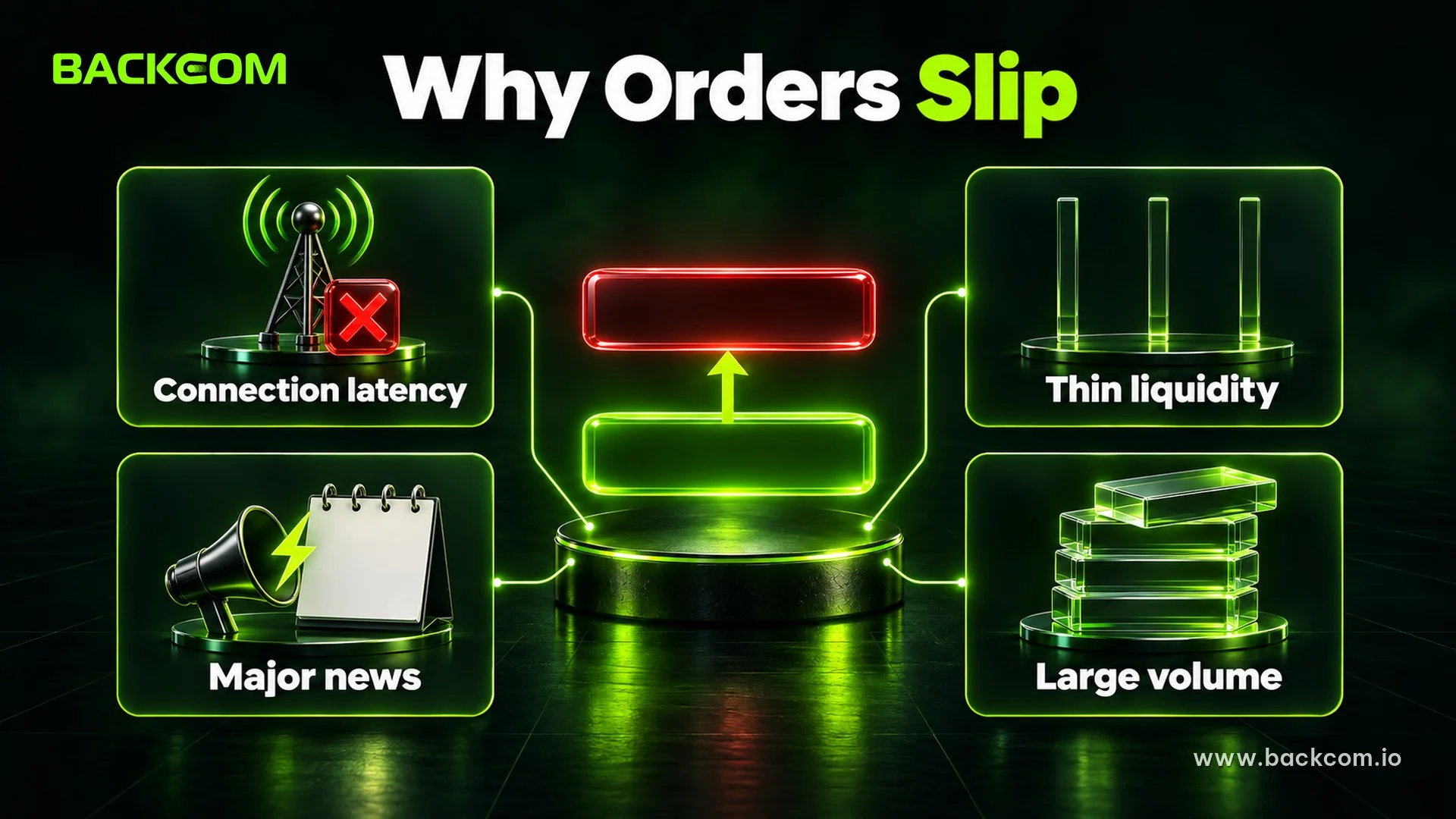
The root of slippage in forex is the delay between quote and execution. Four factors lengthen that delay or let price travel further within it:
- Connection latency: a slow or unstable connection, or a computer far from the broker's server, makes the order arrive later.
- Major news: around NFP, CPI and FOMC releases, price can move fast while the spread widens.
- Thin liquidity: fewer opposing orders at the visible price force the broker to find another level, often around rollover, holidays and the weekly open.
- Large volume: an order bigger than the volume at the best price fills across several levels, moving the average price.
Slippage On News: A Wider Spread And A Worse Fill Together
On a Buy, the Ask may already have risen because the spread widened, and the fill can then land even higher.
Before trading a CPI release, use the checklist in our guide on how to trade CPI news.
Which Orders Slip Most? Execution Modes And Order Types
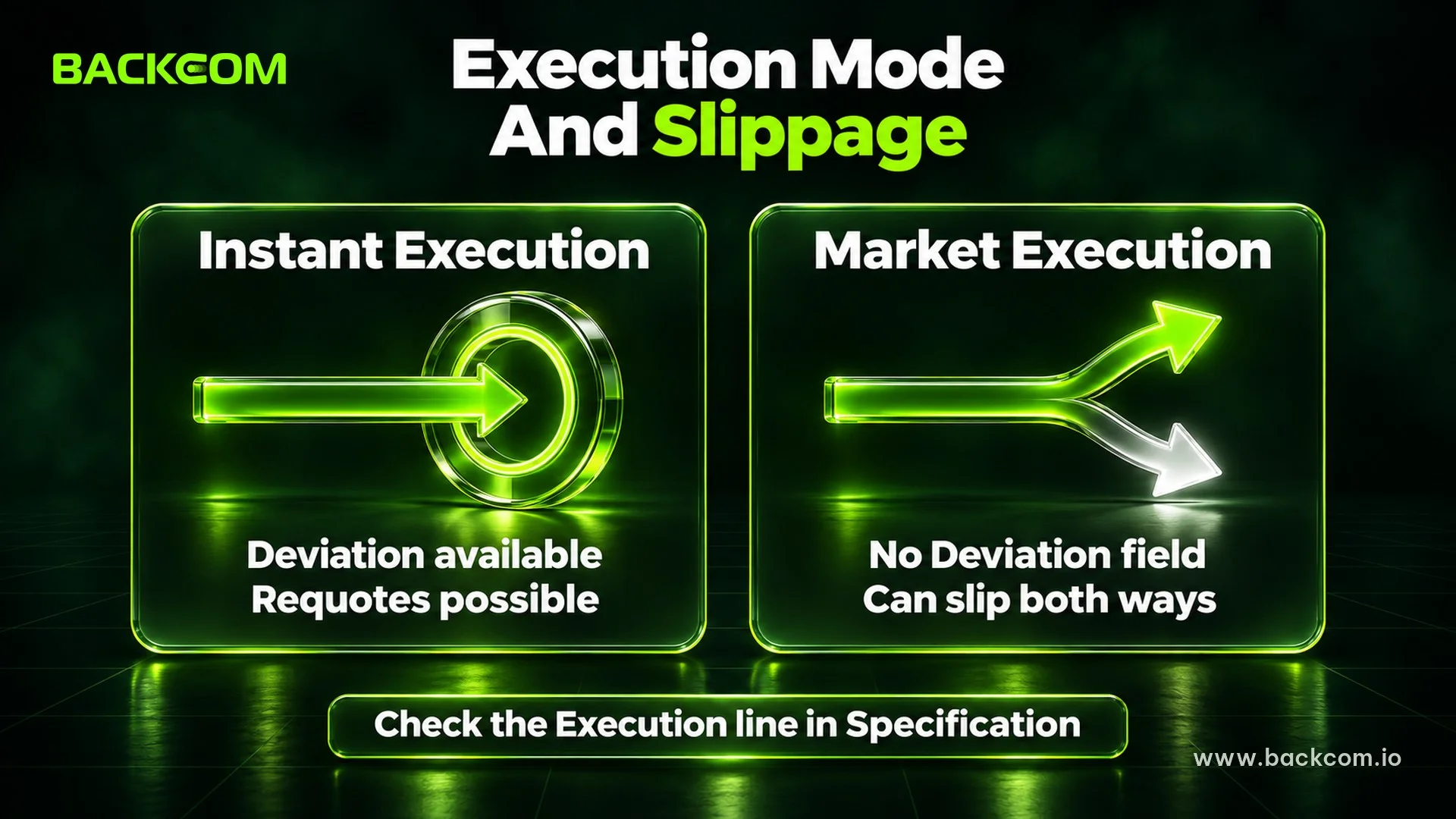
MetaQuotes states that MT5 has four execution modes and MT4 has three, and the broker chooses the mode for each symbol. To check it, right-click the symbol in Market Watch, choose Specification and read the Execution line.
Instant Execution Vs Market Execution: Requote Or Slippage
MetaQuotes sets out how each mode accepts a price:
| Execution mode | How the fill works | Requote | Deviation | If the price changes as you send |
|---|---|---|---|---|
| Instant Execution | At the price sent with the order | Possible | Yes | Within the limit, fills at the new price |
| Request Execution | Asks for a price, trader confirms | Quote held for a few seconds | A field in the MQL5 request | Trader accepts or declines |
| Market Execution | The broker decides the fill price | No | No field to set | Can slip in either direction |
| Exchange Execution | Against opposing orders on the exchange | No | No | Fills at the prices available |
Source: the four execution modes in the MetaTrader 5 help.
Stop, Stop Loss And Limit Orders Under MetaQuotes Rules And Broker Policy
- Market and Stop orders: a Stop order triggers when its condition is met but is not guaranteed to fill at the set price.
- Stop Loss: once triggered, an SL becomes a market order and takes the next available price.
- Limit orders: according to MetaQuotes, a Limit fills at the set price or better but may not fill. IC Markets Global's execution policy, however, says Limit orders can get positive, negative or no slippage.
Source: IC Markets Global's order execution policy. How to place each order is covered in our guide to forex order types in MT5.
Weekend Gaps That Fill A Stop Loss Beyond Its Level
Suppose a trader sells 0.10 lot of XAUUSD with a stop loss at 4,210.00. The market closes around 4,200.00 and reopens with the Ask at 4,215.00. If the position closes around 4,215.00, the slippage is 5.00 USD/oz × 100 oz × 0.10 lot = $50.
Warning: a stop loss gives no protection against a gap if the market never trades at the stop level.
How Slippage Changes Your Real Cost: A 10-Lot Gold Example

To measure slippage in forex, convert the price gap into money. With XAUUSD at 100 oz per lot, every 0.01 USD/oz of slippage equals $1 per lot.
Slippage (USD) = Fill price difference (USD/oz) × 100 oz × Lots
The example uses an IC Markets Raw Spread account: a $2/lot gold rebate (rebate page, 19 October 2026) and a $7/lot round-turn commission (IC Markets Global's specification sheet). Assume a Bid of 4,200.20 and an Ask of 4,200.30, a spread of 0.10 USD/oz or $10/lot. The prices, spread and slippage are all hypothetical.
Cost per lot = Spread + Round-turn commission + Slippage − Rebate
| Scenario (10-lot XAUUSD Buy) | Spread | Commission | Slippage | Rebate | Net cost per lot | Total for 10 lots |
|---|---|---|---|---|---|---|
| Good liquidity, filled at 4,200.30 | 10 | 7 | 0 | −2 | 15 | 150 |
| Filled at 4,200.60, negative 0.30 | 10 | 7 | 30 | −2 | 45 | 450 |
| News: spread 0.40 and negative 0.30 | 40 | 7 | 30 | −2 | 75 | 750 |
| Filled at 4,200.20, positive 0.10 | 10 | 7 | −10 | −2 | 5 | 50 |
Rebate as at 19 October 2026, rechecked on 20 November 2026, commission from IC Markets Global's metals specification sheet. Prices, spreads and slippage are hypothetical, in USD, and not used to rank brokers.
Note: spread and slippage are already inside the fill price, and therefore inside the profit or loss shown in MT5. Use the formula to analyse costs, not to subtract them from Profit again.
With 0.30 USD/oz of negative slippage, the slippage alone costs $300 across 10 lots and triples the net cost from $15 to $45 per lot.
How Much Slippage Wipes Out The Rebate On Each Lot
At the gold position size in the example, just 0.02 USD/oz of negative slippage equals the entire $2/lot rebate. Slippage of 0.30 USD/oz costs $30/lot, which is 15 times the rebate and more than the $17/lot of spread plus commission paid in good liquidity.
Traders who scalp should log slippage on each fill rather than lean on the rebate to estimate total cost.
6 Ways To Reduce Slippage And When Each One Works
Each of these six ways to reduce slippage deals with a different cause.
Avoid The Minutes Around Major News, Rollover And The Weekly Open
US NFP and CPI data are usually released at 12:30 UTC while the US is on daylight saving time, moving to 13:30 UTC after US clocks changed on 1 November 2026. Rollover at 00:00 server time falls at 21:00 UTC on a GMT+3 server, or 22:00 UTC on a GMT+2 server.
- Works when: you choose your entry time and tend to slip around news or quiet hours.
- Limits: it does not protect positions or pending orders already in the market.
Use Limit Orders When You Do Not Need To Enter Immediately
According to MetaQuotes, a Limit order aims to fill at the set price or better. A Stop Limit order on MT5 helps cap the price after the stop condition is triggered.
- Works when: you have a clear price zone and accept missing the trade.
- Limits: the order may not fill, and your stop loss can still slip.
Set Deviation Only When The Symbol Uses Instant Execution
Deviation is the maximum price difference you accept under Instant Execution. For gold quoted to two decimals, 30 points = 0.30 USD/oz, while for three decimals 30 points = 0.030 USD/oz. In a hypothetical two-decimal example, an adverse move of 0.20 USD/oz still fills and costs an extra $20/lot, while a move of 0.45 USD/oz triggers a requote.
On a symbol that uses Market Execution, adjusting Deviation does not stop slippage.
The MT4 help says Deviation applies only to Instant Execution, and the MQL5 documentation shows that Market Execution requests carry no price or deviation field.
- Works when: the Specification shows Instant Execution and you accept requotes or missed trades.
- Limits: too small a Deviation causes requotes, while too large a value allows distant fills.
Source: how MetaTrader 5 handles Deviation and requotes.
Use A VPS Close To The Broker's Server To Cut Latency
MetaQuotes states that a home computer connection can have latency from 100 ms, while its own VPS runs at around 0–5 ms. Our guide to what a forex VPS is explains how to use one with MT5.
- Works when: you run an EA, send many orders or have an unstable home connection.
- Limits: a VPS only reduces connection latency. It does not create liquidity or protect against gaps.
Trade Liquid Hours And Understand Your Account Type
The London and New York overlap runs roughly from 12:00 to 16:00 UTC while the US is on daylight saving time, or 13:00 to 17:00 UTC in winter. Raw and ECN accounts have tighter spreads plus a commission, but a tighter spread is not the same thing as less slippage. Check the Execution line and read our guide to what an ECN account is.
- Works when: the problem is a wide spread and few opposing orders outside peak hours.
- Limits: liquid hours still have major news, and a tight spread does not remove slippage.
Cut Volume And Review Pending Orders Before News And Weekends
Before major news or the weekend, review positions and pending orders, and consider a smaller lot if a trade must stay open.
- Works when: the order is large for the market, or must sit through a gap-prone period.
- Limits: a smaller lot reduces the dollar amount lost, not the slippage in USD/oz.
Frequently Asked Questions (FAQ) About Slippage In Forex
Is There A Forex Broker With No Slippage?
There is no general guarantee of that. NFA Notice 9053 only allows "no slippage" claims if the firm can show that every order from every customer was filled at the quoted price. Faced with a no-slippage claim, read the execution policy and check which entity it covers.
How Do You Measure Slippage On MT4 And MT5?
Compare the fill price with the price you requested. The History or Account History tab shows the fill price, and the Journal helps you match the processing time. For a Buy, use the Ask as the reference, and for a Sell, the Bid. Log the difference after each trade, because the chart does not keep the exact quote you clicked on.
Why Does Take Profit Sometimes Fill Better Than Its Level?
That can be positive slippage. In a hypothetical example, a one-lot EURUSD Buy with a take profit at 1.07260 fills at 1.07265 and earns an extra $5. A stop loss at 1.07260 that fills at 1.07255 loses an extra $5. Record both positive and negative slippage to judge your execution fairly.
Is Slippage A Fee The Broker Charges?
No, it is not a separate fee line like commission. The difference is already inside the fill price and affects profit or loss directly, so fee reports understate the full cost of trading. Compare requested and fill prices yourself across account types.
Is A Requote The Same As Slippage?
Not quite. A requote happens before the order fills, when the broker offers a new price for you to confirm under Instant Execution. Request Execution also has a confirmation step. Slippage means the order has already filled away from the requested price. Market Execution has no requotes, so check the Execution line to tell the two apart.
Conclusion
Understanding slippage in forex helps you read your fills correctly: the requested price and the fill price can differ in both directions. The right fix depends on the cause: latency, news, thin liquidity or order size.
When comparing costs, look up the per-lot forex rebate rates for each broker and set them next to the spread, commission and slippage you have measured. Backcom.io is an independent introducing broker (IB/affiliate) of the brokers listed; rebates are paid from the commission the brokers pay Backcom.io — see the risk disclaimer.
Disclaimer: This content is compiled by Backcom.io for information only and is not investment advice or a trading recommendation. The prices, spreads and slippage in the examples are hypothetical. Execution modes, slippage policies and rebate rates can change by broker, entity and date. Leveraged forex and CFD trading can cause you to lose all of your capital.
Was this article helpful?
Join The Backcom.io Community
Get the latest on trading rebates, trading tips, and broker deals — and connect with thousands of traders worldwide.

Backcom App
Track Your Rebates Every Day
Every rebate is visible by broker and by day. Manage your wallet and withdrawals in one place.
Open Backcom App