Cent Account Rebate In Forex: Is It Paid And How Is It Calculated?

Traders with small capital often open a cent account to test a strategy with real money without taking on large risk. Then a practical question comes up: does a cent account rebate exist, and if it does, how much is it worth? The short answer is that it depends on the broker. Some brokers pay the same percentage as on a standard account, some exclude cent accounts entirely, and some have not published a separate rate.
In this article, Backcom.io will cover four things:
- Which brokers pay a rebate on cent accounts and which do not.
- How a cent lot differs from a standard lot and why the payout shrinks so much.
- The formula for the rebate per lot, with a worked example.
- When to choose a cent account and when to move to standard.
1. Does A Cent Account Get A Forex Rebate, And Which Brokers Pay?
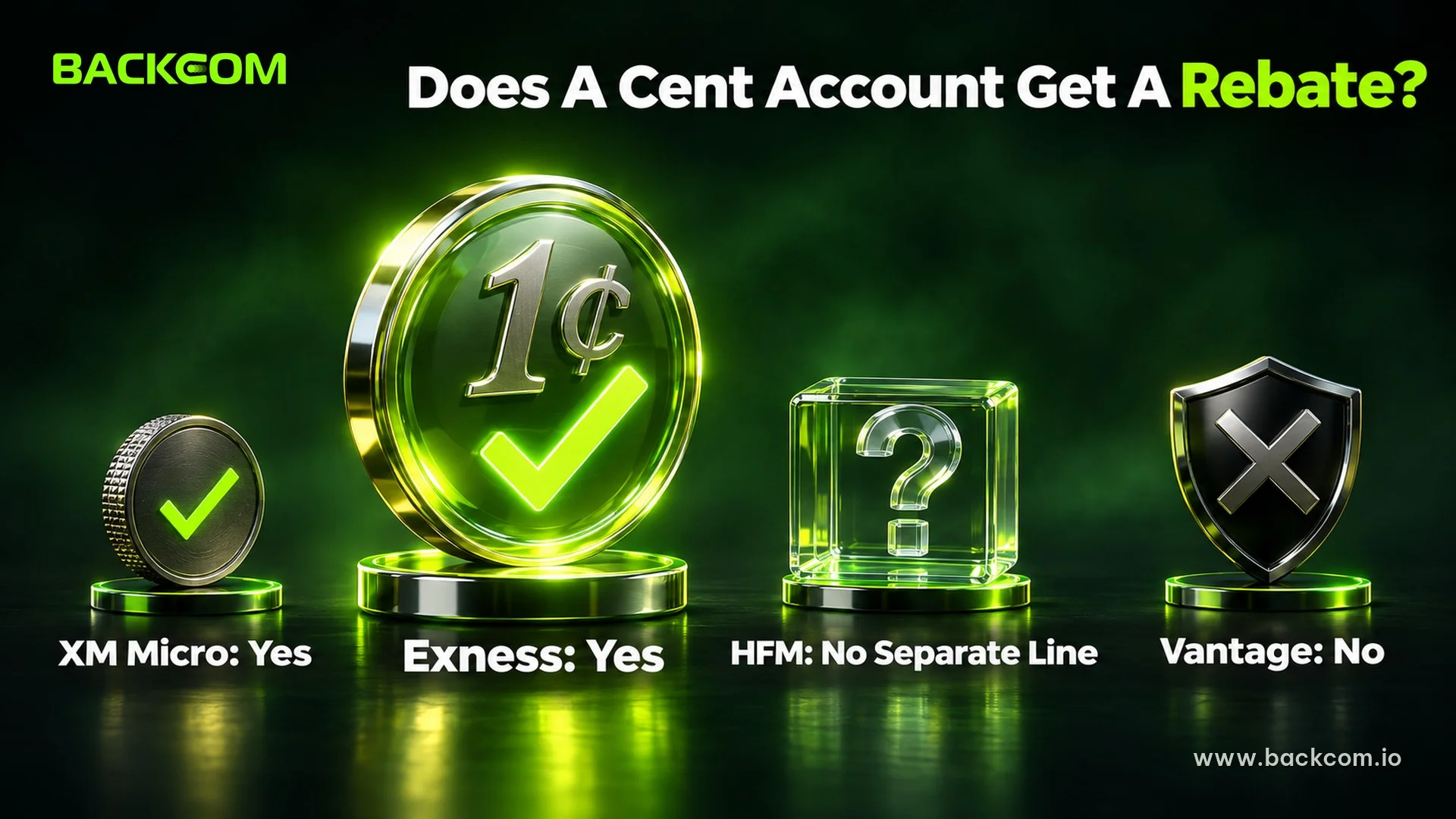
Does a cent account get a rebate is decided by each broker's IB policy, not by the rebate provider. A rebate is a share of the commission that a broker pays to its introducing partner. If the broker pays commission on cent accounts, there is something to pass back. If it does not, there is nothing to share.
The table below shows where four brokers stand on their small account types. The last column is what a trader should do before opening one.
| Broker | Small account type | Rebate | What to do |
|---|---|---|---|
| Exness | Standard Cent | Yes, same percentage of spread as Standard | Read the payout in USC, not USD |
| XM | Micro | Yes, same rate as Standard | Remember one Micro lot is 1/100 of a standard lot |
| HFM | Cent | No separate line in the current rebate table | Ask support before opening the account |
| Vantage | Cent | No | Pick Standard STP, Premium Unlimited or RAW ECN |
Reference: broker pages at 21 November 2026 (Exness, XM, HFM) and the rate table updated 5 November 2026 (Vantage). Broker policies can change, so check again before opening an account.
Note that "yes" at Exness and XM does not mean a large payout. It only means cent trades count toward the programme. The amount you actually receive depends on lot size, which is the subject of the next sections.
For the full per-lot rates, open the forex broker rebate rates table. That table is updated per broker, while this guide only explains how to read the Cent column.
2. What Is A Cent Lot And How Does It Differ From A Standard Lot?
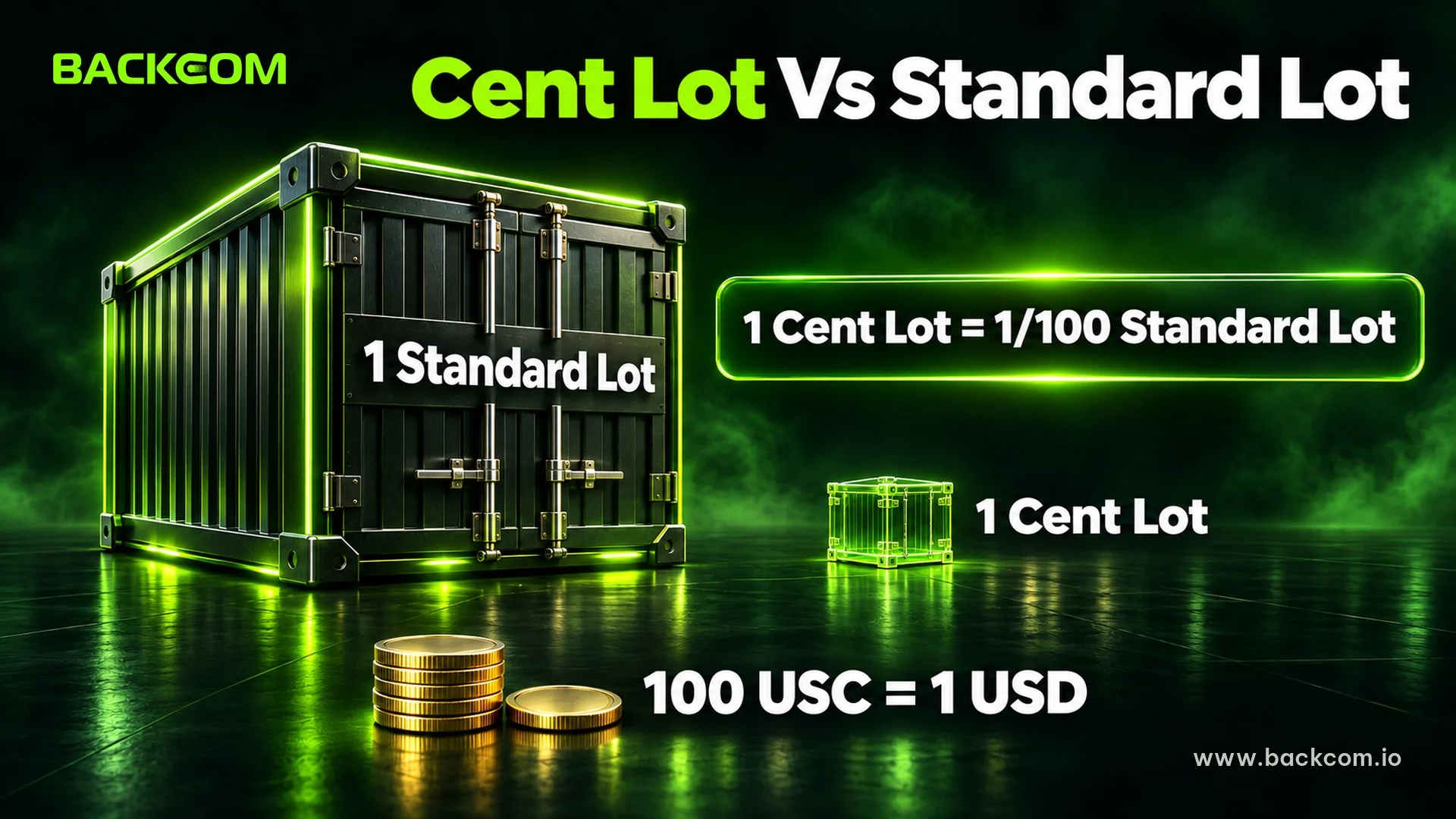
A cent lot is the volume unit of a cent account, roughly 100 times smaller than a standard lot. For currency pairs at Exness Standard Cent and XM Micro, a standard lot is 100,000 units of the base currency, while a cent lot or Micro lot is 1,000 units.
The balance is also counted in smaller units. At Exness, for example, a Standard Cent account is denominated in USC, where 100 USC equal 1 USD. A trader who deposits 10 USD sees 1,000 USC in MetaTrader.
Together these two facts have two consequences:
- The same "1 lot" order on a cent account is worth one hundredth of the same order on a standard account.
- At the same rebate rate per standard lot, a cent account earns exactly 100 times less.
The proof is on the Exness page itself. On 21 November 2026, the Standard Cent column of the rebate table was exactly one hundredth of the Standard column for every symbol, from gold to the major currency pairs. For XM, the broker page states that one Micro lot is 1/100 of a standard lot under the XM Client Agreement, so 100 Micro lots are needed to equal one standard lot for rebate purposes.
Note: this conversion is a common convention, not a universal rule. Before calculating, open the Specification window of your symbol in MetaTrader and read the Contract Size line. The figure there, 1,000 or 100,000, is the most reliable one for your own account.
Further reading: see the definition of a lot on Investopedia. For the basics of lot units, the guide to lot size in forex covers each lot type and how to choose a position size.
3. Cent Account Rebate Per Lot: How Is It Calculated?
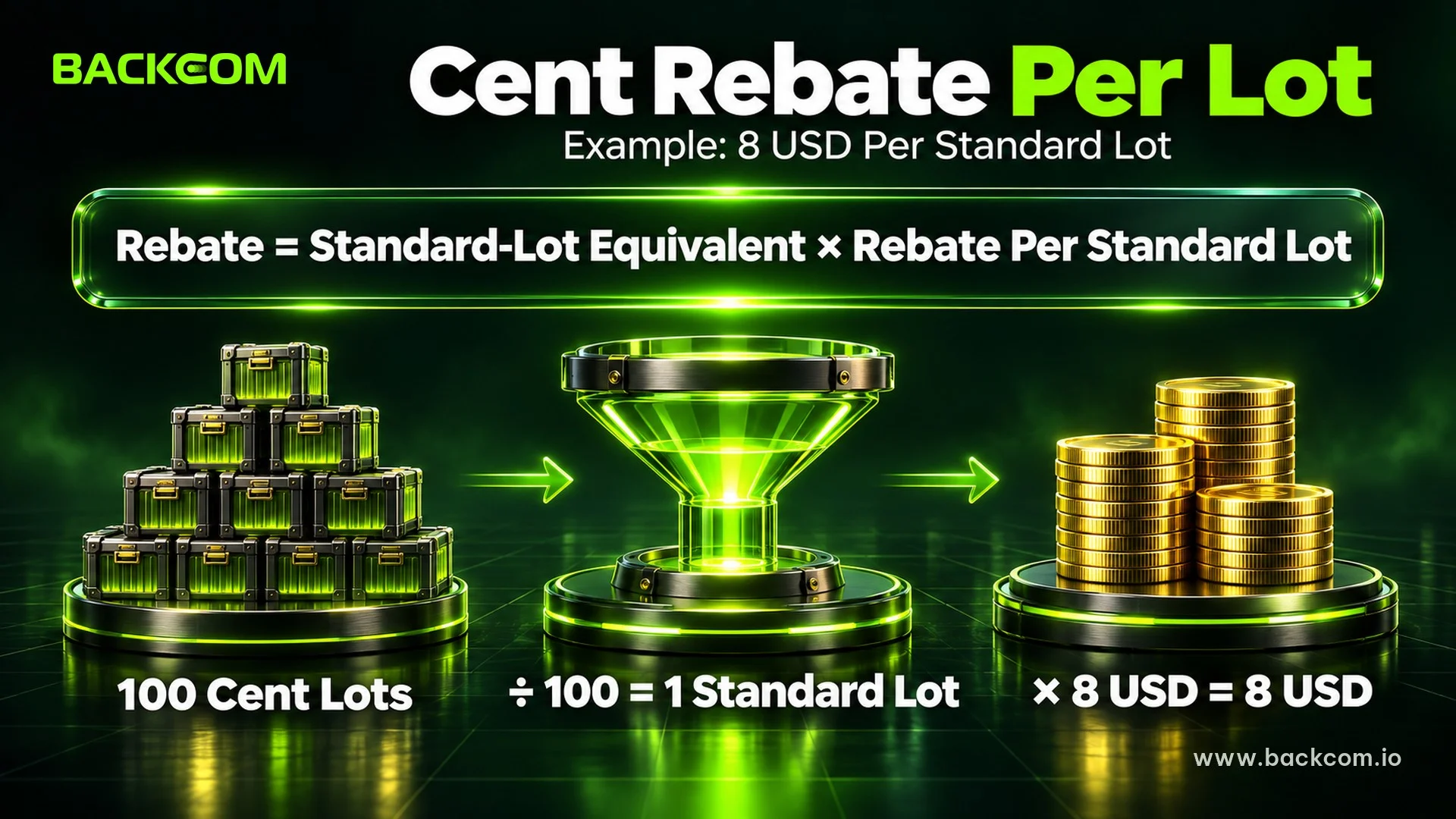
The cent account rebate per lot uses the same formula as any other account. Only the unit conversion differs. The basic formula is:
Rebate = Standard-lot equivalent × Rebate per standard lot
The standard-lot equivalent is the number of cent lots divided by 100. The base formula and how the rebate per lot is set are explained in the guide to what a forex rebate is and how to calculate it per lot, so this section only runs the numbers for a cent account.
Assume a rebate of 8 USD per standard lot. This is a hypothetical figure chosen for easy arithmetic, not any broker's rate. Three traders use the same rate and get very different results:
- Trader A trades 10 standard lots a month on a standard account: 10 × 8 = 80 USD.
- Trader B trades 100 cent lots a month, which is 1 standard lot equivalent: 1 × 8 = 8 USD, or 800 USC.
- Trader C trades 20 cent lots a month, which is 0.2 standard lot equivalent: 0.2 × 8 = 1.6 USD, or 160 USC.
From this example a quick benchmark follows: to earn 8 USD in rebates on a cent account, a trader needs 100 cent lots a month in total. That sounds like a lot, but at 0.01 cent lot per trade it is 10,000 trades.
This leads to a point that is easy to miss. Each 0.01 cent lot trade equals only 0.0001 standard lot, so at the assumed rate it yields about 0.0008 USD. Exness does not pay rebates below 0.01 USD, and the broker page does not say whether that threshold applies per trade or in total. For very small cent trades, check the rebate you actually received in your trading history instead of estimating it.
4. How Does Each Broker Treat Cent Accounts For Rebates?
Each broker names and runs its small accounts differently, so the word "cent" does not mean the same policy everywhere. This section goes broker by broker, following what each broker page currently states. The full list of brokers with rebates is on the forex rebates by broker page.
Exness: Standard Cent Earns The Same Rate, 100 Times Smaller
At Exness, the rebate on Standard and Standard Cent is calculated as a percentage of the average spread, meaning the mean of the spread at open and at close. The full IB commission Exness pays is passed back to the trader, equal to 40% of spread on both account types.
The Standard Cent account has a minimum deposit of 10 USD, spreads from 0.3 pip and no commission. The rebate is credited to the trading account, there is no minimum for withdrawal, and only amounts below 0.01 USD are not paid.
Exness does not count rebates in two cases: accounts opened directly without the partner link, and Copy Trading accounts. Details are on the Exness rebate page.
XM offers a Micro account in place of cent, with a minimum deposit from 5 USD. The broker page states that Micro shares the Standard rebate rate, paid daily at about 01:00–02:00 UTC.
Because one Micro lot is only 1/100 of a standard lot, Micro traders should apply the same factor as in section 3. Current account details are on the XM rebate page.
HFM: No Separate Cent Line Yet
HFM has five account types: Cent, Zero, Pro, Pro Plus and Premium, and Cent has a minimum deposit from 0 USD. However, the current rebate table has lines for Zero and Pro but none for Cent.
For that reason this guide does not state a Cent rate for HFM, and Cent should be treated as not eligible unless support confirms otherwise. A trader planning to use Cent should message support on Telegram or WhatsApp before opening, to confirm whether that account counts. General broker information is on the HFM rebate page.
Vantage: Cent Does Not Earn A Rebate
Vantage pays rebates only on Standard STP, Premium Unlimited or RAW ECN accounts, and Cent earns no rebate. This is the clearest case of the four, so a trader who wants rebates should not open Cent at Vantage. Full conditions are on the Vantage rebate page.
5. Cent Or Standard Account For Rebates: Which Should You Choose?
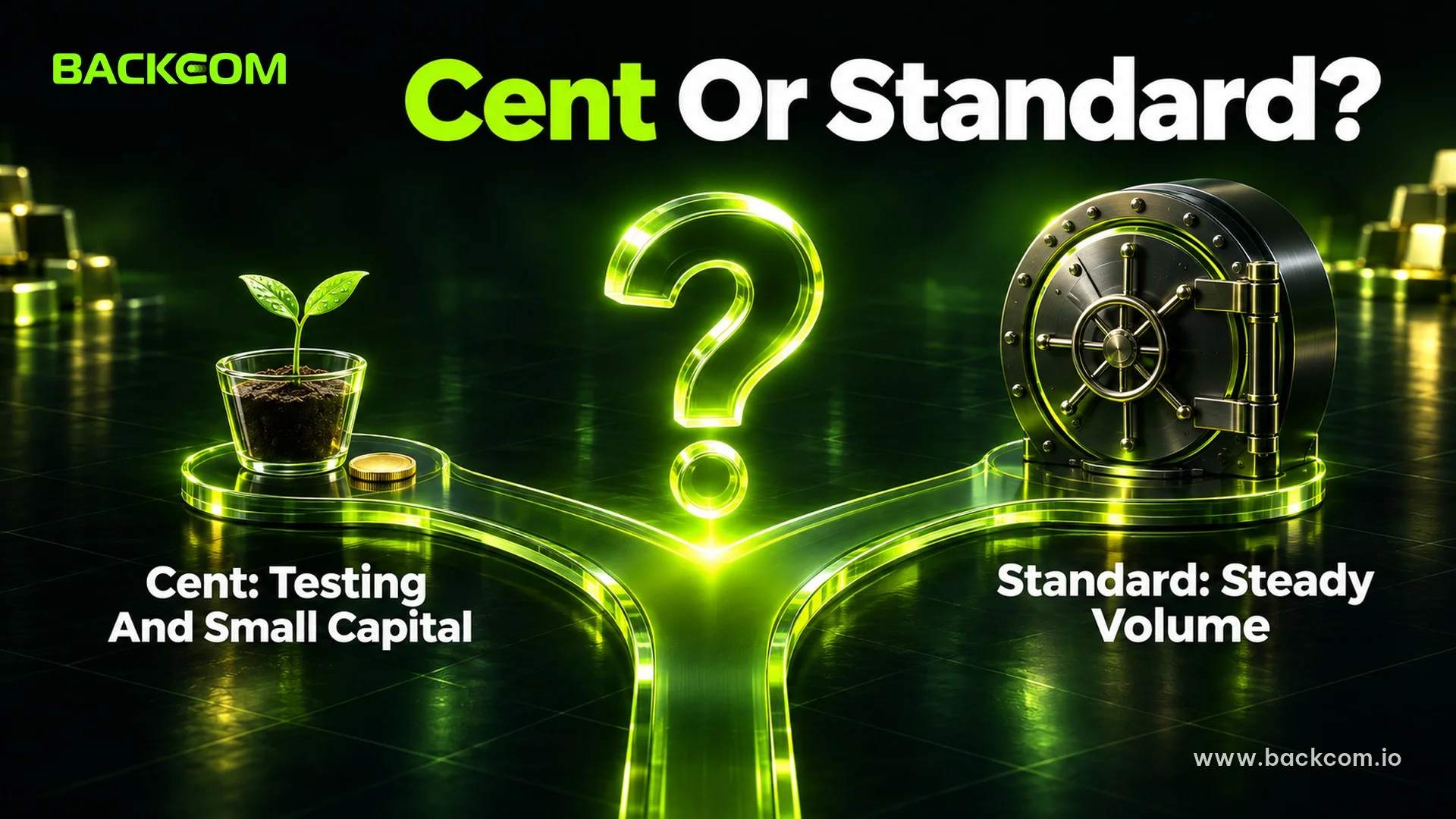
Cent or standard account for rebates is a question to answer with risk first and payout second. A rebate only lowers the cost of each trade. It does not turn a losing strategy into a profitable one, so it should not be the reason to pick an account type.
Since 2018, ESMA has restricted CFDs for retail investors because leveraged products can wipe out capital quickly, even with small lots. For reference, see the ESMA announcement on restricting CFDs.
A cent account makes sense when a trader is in one of these situations:
- Testing a new strategy or EA with real money and wanting each trade to risk only a few cents.
- Just starting out and needing to get used to slippage, wide spreads and the feeling of losing real money.
- Holding capital too small to survive a 0.01 standard lot trade on a volatile symbol such as gold.
A standard account makes more sense when:
- The trader has run steadily for several months and regularly trades 0.01 standard lot or more.
- The strategy opens many trades, so accumulated spread is a real cost.
- The trader wants a rebate large enough to notice in the monthly statement.
A sensible path is to start on cent to test the strategy, then move to standard once volume is large enough. For minimum capital and risk sizing, the guide on how much money to trade forex has a section on cent accounts. Scalpers can also read forex rebates for scalping to work out rebates on many short trades.
For this reason a trader should not open cent just because it says "rebate eligible". If a meaningful rebate is the goal, cent is not the right tool.
6. What Can Cost You The Rebate On A Cent Account?
Even where a broker pays on cent, a few mistakes leave a trader with nothing. They repeat across brokers, and most can be fixed if caught early.
1. Opening the account without the partner link. (See the steps to get a forex rebate.) An account registered directly on the broker's website is not tied to any partner, so there is no commission to pass back. At Exness, an existing account can open a new account with a different email (the recommended route) or ask to change partner, and Exness may refuse that request.
2. Not completing KYC. The broker pages all require KYC with a passport, national ID or driving licence at registration, so complete it before trading.
3. Using Copy Trading. Exness does not apply rebates to Copy Trading accounts, and similar conditions may apply at other brokers.
4. Trades excluded by the broker. Trades that the broker excludes from partner commission under its own terms earn no rebate, even if the trade has closed.
5. Rebates that are too small. Amounts below 0.01 USD are not paid by Exness, so tiny cent trades may produce no rebate even when the account qualifies.
Before opening any small account, a trader should follow three steps:
- Open the broker page and read the line about the account type you plan to use.
- Register through the correct partner link and complete KYC.
- Place a few small trades and compare the rebate received with the calculation in section 3.
To try Exness, a trader can open an Exness account through the partner link. Backcom.io is an independent introducing broker (IB/affiliate) of Exness; rebates are paid from the commission the broker pays Backcom.io, as set out in the risk disclaimer.
Frequently Asked Questions (FAQ) About Cent Account Rebates
Does A Cent Account Get A Rebate?
Yes at Exness and XM, no at Vantage, and HFM has no separate line for Cent. The shared conditions are registering through the correct partner link and completing KYC. The rebate is calculated on cent lots, so it is about 100 times smaller than on a standard account. Read the broker page right before opening, because policies can change.
How Many Standard Lots Is One Cent Lot?
At Exness Standard Cent and XM Micro, one cent lot is about 1/100 of a standard lot, meaning 1,000 units of the base currency instead of 100,000. The exact figure is the Contract Size line in the MetaTrader Specification window. Check that line once per symbol before calculating a rebate.
Which Currency Is The Cent Account Rebate Paid In?
At Exness, the rebate on a Cent account is paid in USC, the same unit as the balance, where 100 USC equal 1 USD. Amounts below 0.01 USD are not paid. For XM, payment is made daily at about 01:00–02:00 UTC, according to the broker page on 16 November 2026.
Should You Open A Cent Account Just To Earn Rebates?
No. At the assumed rate of 8 USD per standard lot, a cent trader needs 100 cent lots a month to earn 8 USD, which is thousands of trades if each is 0.01 cent lot. A rebate should be a side benefit. The real reason to open cent is to test a strategy at low risk.
Conclusion: A Cent Account Rebate Exists, But It Is Small And Broker-Specific
A cent account rebate exists at Exness and XM, does not apply at Vantage and has no separate line at HFM. Traders need to weigh three factors together: whether the broker pays on that account type, how many standard lots a cent lot converts to, and whether the payout clears the broker's minimum amount.
The practical steps are to read the broker page, check Contract Size in MetaTrader, run the formula from section 3 and only then choose the account type. To compare rebate rates across brokers first, see the forex broker rebate rates table.
Disclaimer: This content is compiled by Backcom.io for information only and is not investment advice or a trading recommendation. Trading forex and CFDs carries a high risk of losing money, rebates do not offset losses, and broker policies can change at any time.
Was this article helpful?
Join The Backcom.io Community
Get the latest on trading rebates, trading tips, and broker deals — and connect with thousands of traders worldwide.

Backcom App
Track Your Rebates Every Day
Every rebate is visible by broker and by day. Manage your wallet and withdrawals in one place.
Open Backcom App