How Much Money To Trade Forex? Minimum Deposit, Cent Accounts And Risk Rules


Ask ten traders how much money to trade forex is enough and you will hear two opposite answers: "$5 is enough" and "you need thousands to be serious." Both are half right, because the amount a broker lets you deposit and the amount that keeps you alive through a losing streak are two different numbers.
That is why can you trade forex with $100 has no simple yes or no. It depends on the account type, the smallest lot size and how much of your balance you are willing to lose on one trade.
In this article, Backcom.io walks through what traders should know before the first deposit:
- What the minimum deposit for forex really means, and how it differs from the capital you need to manage risk.
- The Exness and XM minimum deposit figures, plus HFM, as last checked.
- Lot sizes for $100, $500 and $1,000 accounts, with worked numbers.
- When a forex cent account makes sense, and four common mistakes.
1. How Much Money To Trade Forex: A Question About Deposits Or About Risk?
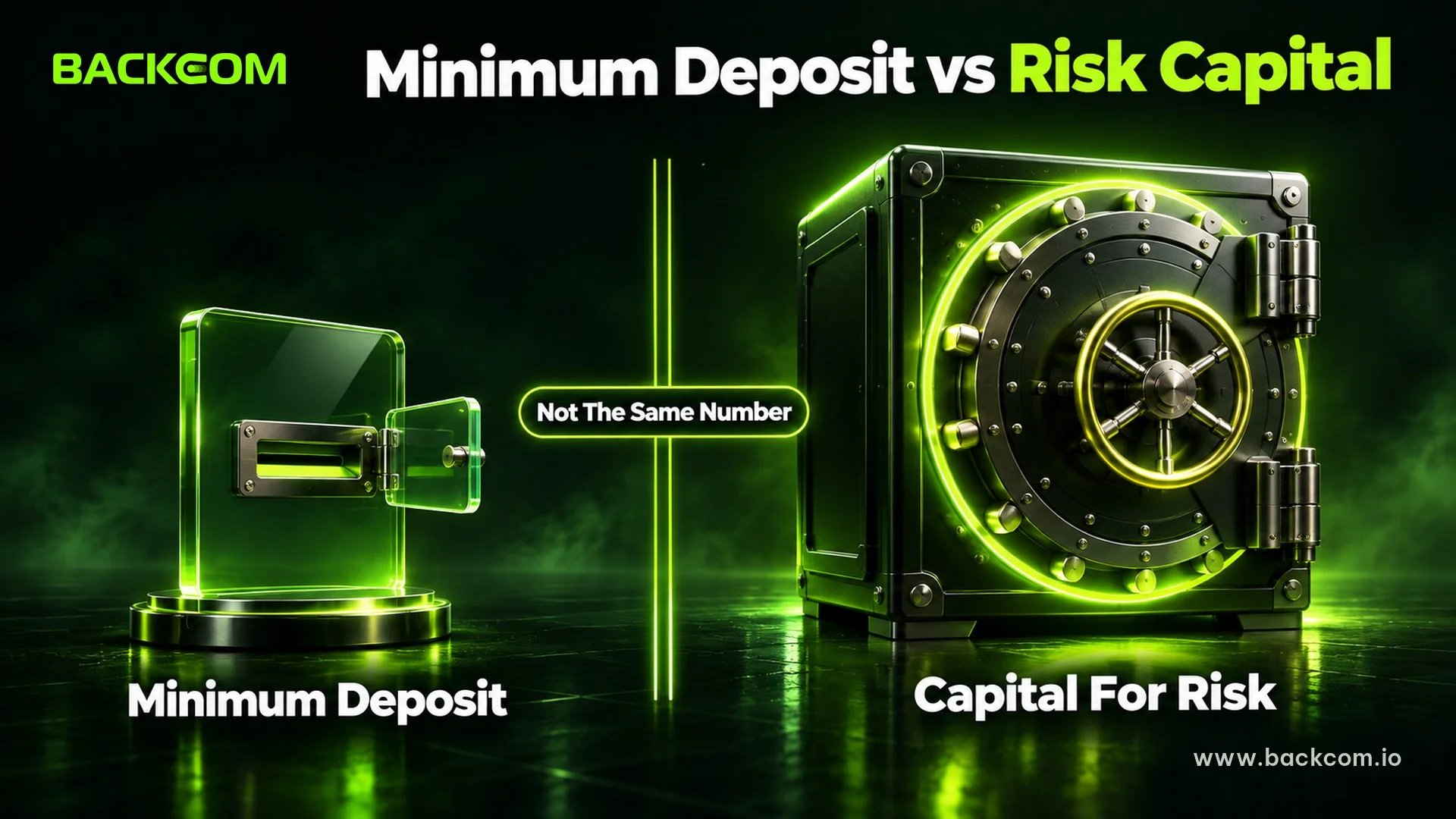
How much money to trade forex? Technically, just enough to open the smallest position your broker allows, usually 0.01 lot. In practice, enough that a single losing trade costs no more than 1–2% of the account.
Three different numbers are all called "capital":
- Minimum deposit: the amount a broker requires for the first deposit, which varies by account type and payment method.
- Capital to open a trade: the margin needed for 0.01 lot, often only a few dollars at high leverage.
- Capital to manage risk: the balance that lets you place a sensible stop loss while keeping risk per trade near 1–2%.
The third number decides how long you last. The first two only tell you whether the door is open.
So ask it the other way round: "with this balance, how many dollars may I lose per trade, and does the smallest lot already exceed that?" The core formula is in our guide to forex money management, the 1% rule and lot size.
One more point: high leverage shrinks the margin but not the loss. The article on leverage in forex explains why leverage only changes how much money is held, while the loss is still measured on the full position size.
2. Minimum Deposit For Forex: What Is The Exness And XM Minimum Deposit?
The minimum deposit for forex is set by each broker and changes with account type, country of residence and payment method. The table below summarises our account-type guides, checked between 25 August and 7 September 2026.
| Broker · Account Type | Minimum Deposit | Notes |
|---|---|---|
| Exness · Standard, Standard Cent | No single fixed amount | Depends on payment method; minimum lot 0.01 |
| Exness · Pro, Raw Spread, Zero | $200 first deposit | Amount can differ by country of residence |
| XM · Standard, Ultra Low | From $5 | Micro is not openly offered in every region |
| HFM · Cent, Premium, Zero | $0 | No minimum set for these types |
| HFM · Pro | $100 | |
| HFM · InfinityX | $500 |
Reference dates: 25/08/2026 (XM), 05/09/2026 (Exness) and 07/09/2026 (HFM). Minimum deposits can change, so check the client area before you deposit.
Two cautions when reading the table. First, HFM's "$0" means the broker sets no minimum, not that you can trade with nothing. Second, the Exness and XM figures describe the first deposit and can differ in other regions.
These numbers come from published comparison guides and were not checked directly on the brokers' own pages, so confirm them before you fund an account.
For the full breakdown, see the guides to Exness account types, XM account types and HFM account types.
3. Can You Trade Forex With $100? A Worked Example
Can you trade forex with $100? Technically yes, but the risk per trade is hard to keep small. The example shows why.
Assumptions: EURUSD at 1.1000, one pip on 1 standard lot worth $10, so 0.01 lot is $0.10 per pip. Spread and swap are ignored.
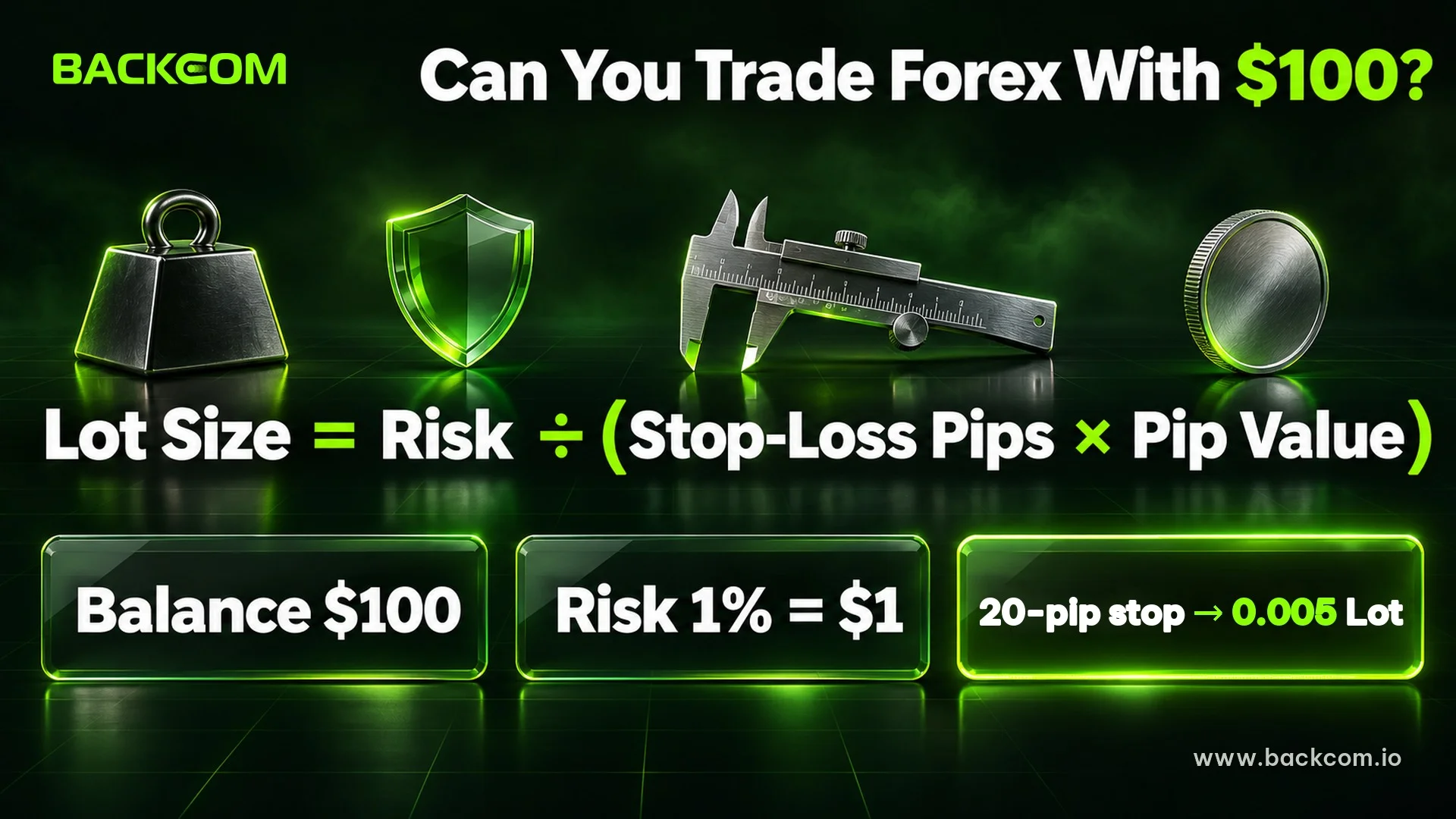
Lot size = Amount you accept to risk ÷ (Stop-loss pips × Value of 1 pip per lot)
With a $100 account and a 1% rule, you may lose $1 per trade. With a 20-pip stop, the matching size is 1 ÷ (20 × 10) = 0.005 lot, which is below the 0.01 minimum of a standard account.
Open 0.01 lot with a 20-pip stop and you lose 20 × $0.10 = $2, or 2% of the account. To stay at 1% you would need a 10-pip stop, which ordinary price noise can easily hit.
A trader with $100 usually ends up choosing one of three paths:
- Accept about 2% risk per trade and keep the number of trades very low.
- Use a cent account to split the position size.
- Treat the $100 as tuition, not as income.
The third sounds blunt but is the most realistic. A small balance lets you practise execution and emotional control at low cost. The goal is to protect the balance and build a routine, not to multiply it quickly.
Note: margin is not the obstacle at small sizes. At 1:500 leverage, 1 lot of EURUSD needs about 100,000 × 1.10 ÷ 500 = $220 of margin, so 0.01 lot needs only about $2.20, following the formula on the MetaTrader 5 forex margin help page. The real limit is that the minimum lot is too large for 1% of a small balance.
4. Is A Forex Cent Account Suitable For A Small Balance?
A forex cent account shows the balance in cents and allows much smaller position sizes than a standard account. Its purpose is to let you practise with real money while each trade costs very little.
Exness offers Standard Cent, and HFM offers a Cent account with a $0 minimum deposit, as noted in section 2. Contract sizes differ by broker, so read the account specifications before calculating lots instead of applying the standard-account formula.
A cent account fits when:
- You have no stable routine yet and want to test a strategy with real money.
- Your balance is under roughly $100–$200 and you want risk per trade near 1%.
- You are testing an EA or new strategy without committing a large balance.
There are three drawbacks:
- Costs can be higher: Exness lists Standard Cent spreads from 0.3 pip against 0.2 pip for Standard, in our 5 September 2026 comparison.
- Rebate and promotion terms can differ between account types, so check each broker before choosing.
- A large cent balance means nothing if you carry the same bad habits to a standard account.
Treat cent as a practice room, not a shortcut from a small balance to a large one. Once your routine is stable, moving to standard has real value.
5. Should You Start With $100, $500 Or $1,000?

The right starting balance depends more on your goal than on the absolute number. The table applies the 1% rule using the same EURUSD assumptions as section 3.
| Balance | 1% Risk | Lot At 20-Pip Stop | Lot At 50-Pip Stop |
|---|---|---|---|
| $100 | $1 | 0.005 (below 0.01) | 0.002 (below 0.01) |
| $500 | $5 | 0.025 | 0.010 |
| $1,000 | $10 | 0.050 | 0.020 |
Theoretical calculation as at 10/11/2026, assuming $10 per pip per standard lot and ignoring spread and swap. Real results depend on the pair, the price and the account type.
How to read it:
- $100: the 1% lot is below the standard minimum, so you need a cent account or must accept higher risk.
- $500: you can trade 0.01 lot with a 50-pip stop, or 0.02 lot with a 20-pip stop, and stay near 1% risk.
- $1,000: there is room to split orders and place stops by price structure instead of forcing a number.
You can use the position size calculator to turn balance, risk percentage and stop-loss pips into a lot size for your pair. For the units themselves, the guide to lot size in forex covers everything from standard to micro lots.
6. Which Risk Rules Help A Small Account Survive Longer?
A risk rule is the most you allow yourself to lose on one trade, usually as a percentage of the balance. With a small account it matters more than any indicator, because it sets how many mistakes you can afford.
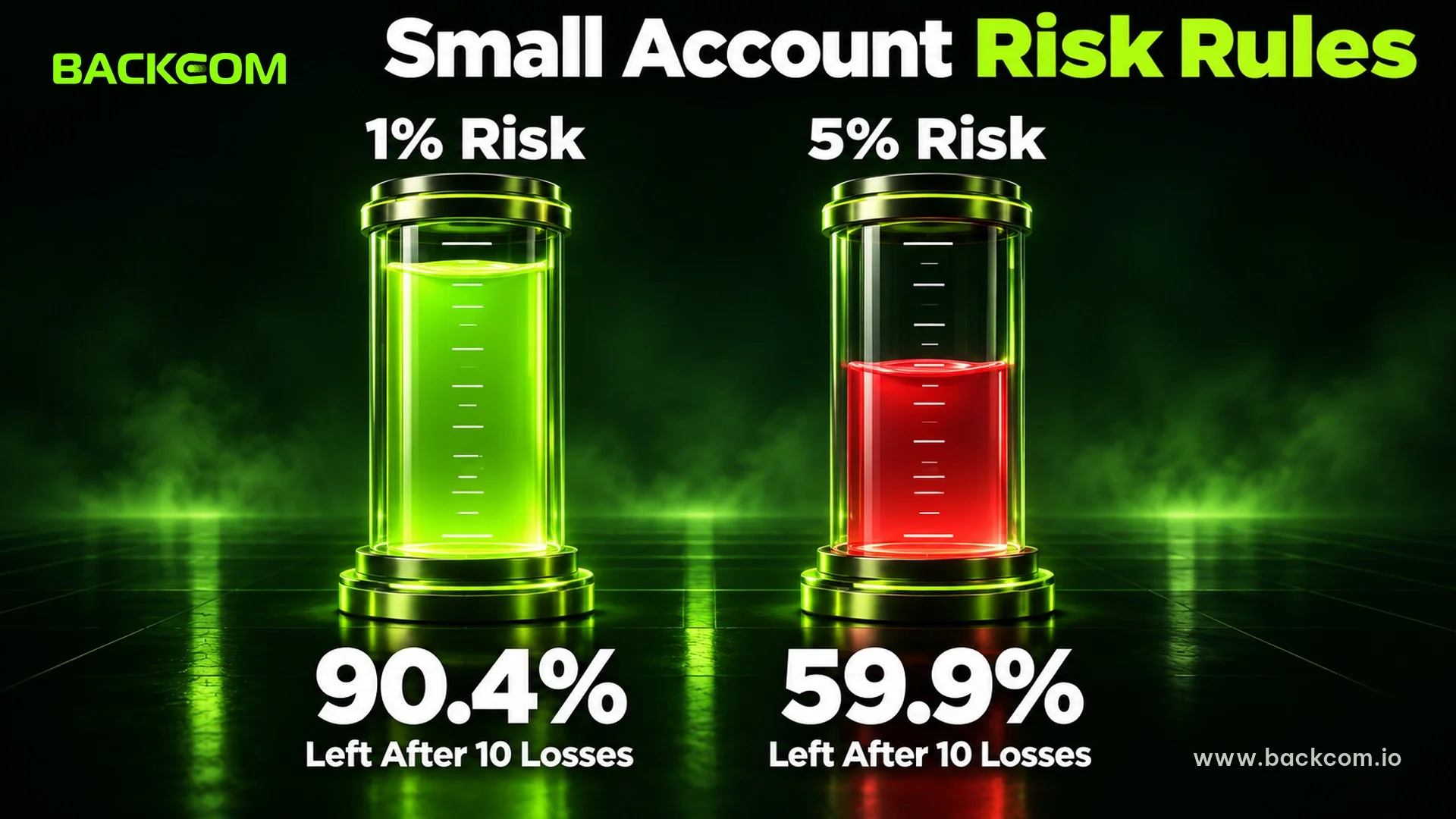
The table compares 1% and 5% risk per trade after ten losing trades in a row:
| Risk Per Trade | Balance After 10 Losses | Drawdown | Gain Needed To Recover |
|---|---|---|---|
| 1% | 90.4% | about 9.6% | about 10.6% |
| 5% | 59.9% | about 40.1% | about 67% |
Reference: compounding 0.99^10 and 0.95^10 as at 10/11/2026, ignoring spread and swap. A real losing streak can be shorter or longer.
The last row shows that losses and recoveries are not symmetrical. Losing 40% needs a 67% gain to get back to the start, which is why 5% per trade should never be treated as normal. Our article on drawdown and how to calculate it covers how losses compound.
Three habits keep the rule from staying on paper:
- Set the stop loss when you enter, and never move it further away.
- Cap total risk across open trades, for example at 3–5% of the balance.
- Stop trading for the day after a loss limit you set in advance.
Know also when a broker may close positions for you. ESMA measures, announced on 1 June 2018 and applying from 1 August 2018, require CFD providers serving retail clients to close positions when margin falls to 50% of the minimum, and cap leverage at 30:1 on major currency pairs. See the ESMA announcement. Outside the European Union, each broker entity sets its own terms.
7. Four Common Mistakes When You Trade Forex With A Small Balance
Most small accounts do not fail because the market is too hard. They fail because of the same few habits. These are the four seen most often.
1. Using maximum leverage to "speed up"
High leverage lets you open a large position on a small margin. A large position also makes every adverse pip expensive, and a small balance cannot absorb many of them.
2. Adding to positions to recover
After a loss, many traders raise the lot or open more trades in the same direction. That turns one losing trade into a chain, as our guide to pyramiding and averaging down explains.
3. Topping up the moment the balance runs low
Depositing again before finding the flaw in your routine only extends the loop. Pause, review your trading journal, then decide whether to add funds.
4. Ignoring trading costs
Spread and commission take a larger share when the balance is small and trades are short. The guide to what a forex spread is helps you measure the real cost of each trade.
Frequently Asked Questions (FAQ) About Forex Trading Capital
What Is The Minimum Amount Needed To Trade Forex?
There is no single figure. Each broker and account type sets its own minimum, for example XM Standard from $5, HFM Cent at $0 and Exness Pro from $200 in many regions, as last checked. Confirm the amount in the broker's client area, and remember that a minimum deposit is not the same as enough capital to manage risk.
Can You Trade Forex With $100?
Yes, but risk per trade often exceeds 1% on a standard account, because 0.01 lot with a 20-pip stop already loses about $2. A cent account lets you split the position size. Treat $100 as learning capital and keep the number of trades low.
When Should You Move From A Cent Account To A Standard Account?
There is no fixed threshold. What matters more is a stable routine, a trading journal and disciplined results over several months. Once 0.01 lot no longer exceeds 1–2% risk on your balance, moving to standard makes sense.
Should A Small Account Use High Leverage?
Do not use leverage as a reason to trade bigger. Leverage only reduces the margin held, while the loss is still measured on the full position. Pick the lot from the amount you accept to risk, then check margin as a secondary condition.
Conclusion: Size Your Capital By Risk, Not By The Minimum Deposit
The answer to how much money to trade forex has no universal form, but there is a way to find your own: work out what you accept to lose per trade, divide it by the stop-loss distance and check whether the result is above the minimum lot. If the numbers work, the balance is enough to start.
At $100, a cent account and low risk are the realistic choice. At $500–$1,000, a standard account with stops placed by price structure becomes workable. At every level, discipline decides how long you last.
Once you have a balance in mind, you can review account conditions and rebate terms on the partner brokers page. Backcom.io is an independent introducing broker (IB/affiliate) of the brokers listed; rebates are paid from the commission the broker pays Backcom.io — see the risk disclaimer.
Disclaimer: This content is compiled by Backcom.io for information only and is not investment advice, a trading recommendation or financial advice. Forex and CFDs are leveraged products and you can lose all of your capital. The numerical examples are for illustration only.
Was this article helpful?
Join The Backcom.io Community
Get the latest on trading rebates, trading tips, and broker deals — and connect with thousands of traders worldwide.

Backcom App
Track Your Rebates Every Day
Every rebate is visible by broker and by day. Manage your wallet and withdrawals in one place.
Open Backcom App