USDT Vs USDC: Differences, Risks And Which To Use For Trading

USDT and USDC are the two largest dollar stablecoins, and both aim to hold a value of one US dollar. They are not the same product, though. They have different issuers, different reserve reporting, different regulatory standing and a different record when things went wrong. In this article, Backcom.io compares USDT vs USDC on reserves, depeg risk, regulation and day-to-day trading use, so you can decide which coin fits which job.
1. What Is The Difference Between USDT Vs USDC (Tether Vs USD Coin)?
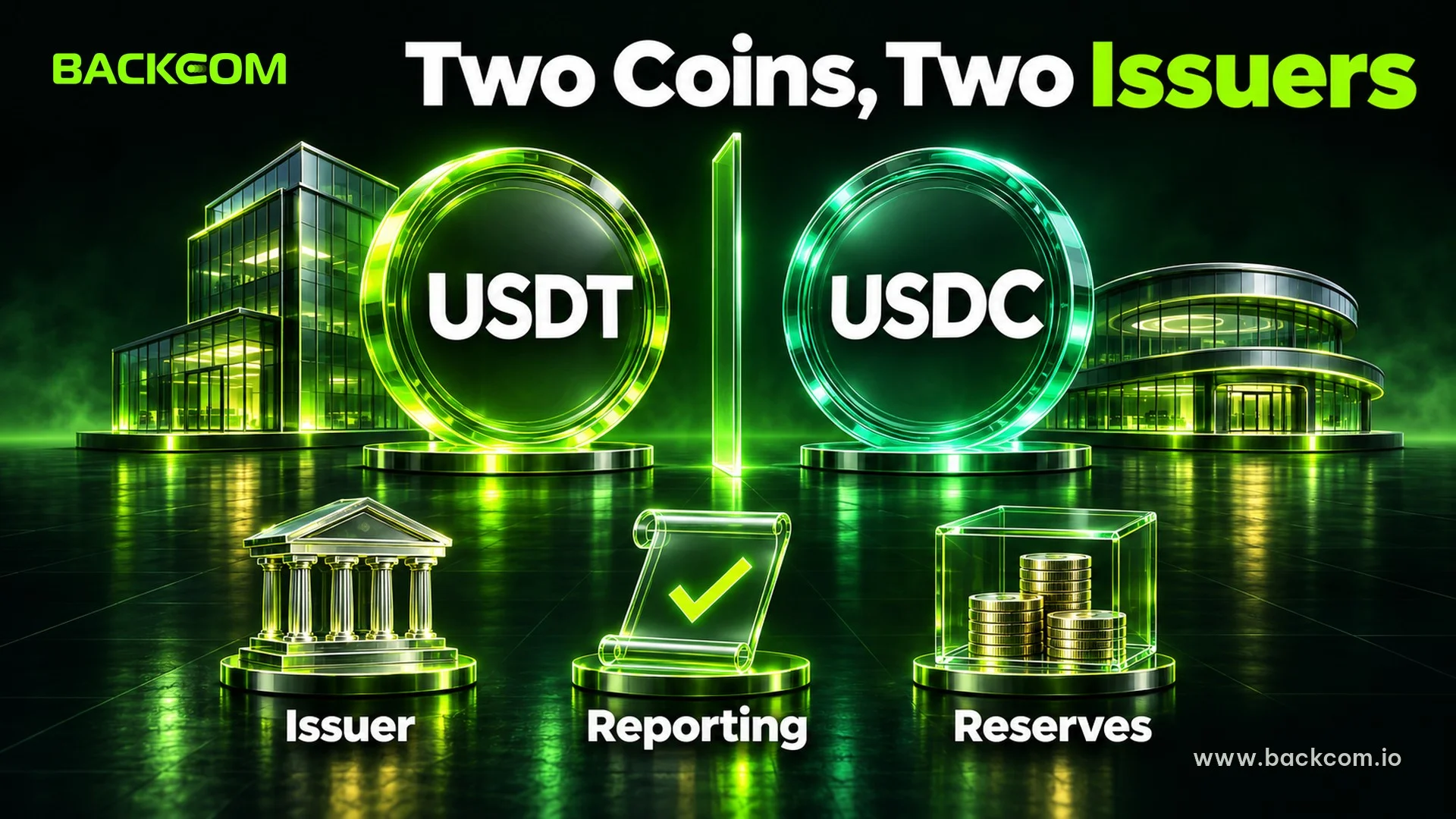
USDT is issued by Tether and USDC (USD Coin) is issued by Circle. Both are designed to be redeemable for one US dollar, but the companies behind them are run differently and report differently. Tether vs USD Coin is therefore mostly a question about who stands behind the coin and how much you can verify.
If you need the basics first, our guide to what a stablecoin is covers the different types. This article only compares these two.
| Item | USDT (Tether) | USDC (Circle) |
|---|---|---|
| Issuer | Tether | Circle |
| Peg target | 1 US dollar | 1 US dollar |
| Reserve reporting | Quarterly attestation by BDO | Monthly attestation by a Big Four firm, weekly holdings disclosure |
| Reserve mix | Mostly US Treasury bills, plus other assets including bitcoin | Cash and short-dated US Treasuries, mostly in a regulated money market fund |
| Size | About $183.5 billion in liabilities (mainly USDT issued) at 30 September 2026 | About $68.0 billion in circulation at 16 November 2026 |
Reference only, checked on 19/11/2026 against Tether's Q3 2026 attestation (30/09/2026) and Circle's USDC page (16/11/2026). Figures change often, so check the issuer pages before you rely on them.
Size matters in practice. USDT is the larger coin by a wide margin, while USDC is smaller but describes itself as issued by regulated affiliates of Circle. That difference shapes the rest of this comparison.
Two other differences are easy to miss:
- Who runs the coin: Circle is a company that describes USDC as issued by regulated affiliates, while Tether operates under its own structure and reporting schedule.
- How you get it: Most people never deal with either issuer directly. You buy the coin on an exchange or in a wallet, so the real counterparty risk also includes the platform you use, as our comparison of a centralized vs decentralized exchange explains.
Keep both points in mind when you compare the two coins, because the peg is only part of the picture.
2. Is USDC Safer Than USDT? Reserves, Audits And Transparency

Is USDC safer than USDT? No stablecoin is risk free, but the two differ in what you can see. Safety here means how clearly the issuer shows that every coin is backed by assets that can be sold quickly at full value.
On the Circle side, the company states that USDC is backed 100% by highly liquid cash and cash-equivalent assets and is always redeemable 1:1 for US dollars. The majority of the reserve sits in the Circle Reserve Fund, an SEC-registered government money market fund managed by BlackRock. The rest is held in cash at large banks. Circle publishes holdings weekly and says a Big Four accounting firm provides monthly assurance that reserves exceed the USDC in circulation.
On the Tether side, the reserve mix is broader. According to Cointelegraph's report on the Q3 2026 attestation, BDO attested that Tether held about $191.45 billion in assets against about $183.5 billion in liabilities at 30 September 2026. That leaves roughly $7.95 billion of excess reserves, or about 4.3% of the liabilities. The same report cites about $132.4 billion in direct and indirect US Treasury bill holdings and about $8.4 billion in bitcoin. Tether describes the coin as backed by its reserves on its transparency page.
What this means in practice:
- Reporting rhythm: USDC holdings are disclosed weekly and attested monthly, while USDT is attested quarterly.
- Asset quality: Cash and short-dated Treasuries are the easiest assets to sell at full value, while bitcoin can move sharply in price.
- Cushion: An excess reserve of 4.3% helps absorb a loss, but it is not a guarantee.
- Who can redeem: Circle says direct minting is not available to individuals, so most people buy USDC through an exchange or wallet rather than from Circle itself.
A more detailed and more frequent report is easier to check, but it does not remove the risk that a bank or a market fails.
3. What Is The USDT USDC Depeg Risk And Has It Happened?

Depeg risk is the chance that a stablecoin trades below one dollar. It can happen if buyers doubt the reserves, if the assets are stuck, or if the market panics. USDC's best-known slip below its peg came in March 2023 and is a clear example.
In March 2023, Circle disclosed that $3.3 billion of USDC reserves were stuck at Silicon Valley Bank, about 8% of the reserve at the time. USDC fell to a trough of about $0.86 before recovering after US authorities moved to protect depositors and Circle confirmed the funds were available. A Federal Reserve note from December 2025 describes the bank run as the trigger for that depeg and gives the 86 cent low.
A simple example shows what that looks like. Say you held $10,000 of USDC when the price touched $0.86. Your holding would show as $8,600, a paper loss of $1,400 that disappeared only because the peg later recovered. The numbers are illustrative.
The lesson is not that USDC is unsafe and USDT is safe, or the reverse. It is that:
- Reserves held at one bank are a risk, even when the coin is backed by cash.
- A depeg can come from the banking system, not only from the issuer.
- Prices recover only if confidence returns, and there is no promise that they will.
- A smaller depeg can still hurt a trader who uses the coin as margin or who must sell quickly.
For a broader view of how to avoid platform and token risk, see our checklist on how to avoid crypto exchange scams.
4. How Do Regulation And Freezes Affect Each Coin?
Regulation affects where you can use a coin. The clearest example is Europe. Under the EU's MiCA rules, stablecoins offered in the European Economic Area must meet authorisation requirements. In March 2025, Cointelegraph reported that Binance removed spot USDT pairs for EEA users and that Kraken moved USDT to sell-only mode there. Rules differ by country, so check which coins your own exchange offers for your region.
There is another point that applies to both coins: issuers can block tokens. Circle's USDC risk factors describe a blacklisting policy, and Tether publishes its own terms on its legal page. That is a compliance feature, but it also means that a stablecoin is not the same as cash in your hand. If an address is blocked, you may not be able to move the coins.
Practical steps:
- Check what your exchange lists in your region before you plan around one coin.
- Keep funds on a platform you trust, and review the steps in our exchange account security checklist.
- Do not assume both coins are available everywhere, because the answer can change with local rules.
5. USDC Vs USDT For Trading: Which Should You Use?

For trading, the better coin is the one with the best liquidity on your platform and the lowest total cost for your route. USDC vs USDT for trading is rarely about the dollar peg alone.
Points that often decide it:
- Pairs and liquidity: Check which pairs your platform offers in each coin, because liquidity differs by pair. Thin order books mean more slippage when you trade.
- Fees: Some platforms charge different fees on different pairs, so compare maker and taker fees for the pair you use.
- Network and withdrawal cost: The same coin can cost different amounts to move depending on the blockchain, which is covered in our guide to crypto withdrawal fees. Circle lists native USDC on 38 blockchains as of 16 September 2026, including Ethereum and Solana.
- Where you will spend it: If you plan to send coins to a broker, read our guide to depositing USDT to a forex broker first, because the accepted coin and network matter.
- Regional access: The rules in section 4 can limit which coin you can trade.
A short decision guide:
| If You Need | Often Fits Better | Why |
|---|---|---|
| Deepest book on your pair | Whichever has more liquidity there | Liquidity differs by pair and platform |
| Reporting you can check often | USDC | Weekly holdings, monthly attestation |
| Access in the European Economic Area | Check your platform first | Major exchanges restricted USDT there in 2025 |
| Low cost on a given pair | Whichever has the lower total cost | Fees and spreads differ by platform |
These are general patterns, not rankings, and they can differ on your platform and in your country. Many traders hold both coins and keep a small balance of each so they can use whichever pair is cheaper at the time. For the difference between spot and leveraged products, see spot vs futures trading.
Frequently Asked Questions (FAQ) About USDT And USDC
Is USDC Safer Than USDT?
It depends on what you mean by safe. USDC publishes holdings weekly, has monthly attestations and holds mostly cash and short-dated Treasuries, which makes it easier to check. Tether reported about $7.95 billion of excess reserves at 30 September 2026. Neither is guaranteed, and USDC traded well below its peg in March 2023, so spread your risk.
Can USDT Or USDC Lose Its Peg?
Yes. USDC fell to about $0.86 in March 2023 when $3.3 billion of its reserves were stuck at a failed bank, then recovered. Any stablecoin can trade below one dollar if the reserves are in doubt, assets are stuck or the market panics. Do not treat a stablecoin as a bank deposit.
Which Stablecoin Is Better For Beginners?
There is no single answer. Start with the coin your exchange supports in your country and that has the pair you need, then compare the fees. Keep the amount small until you understand the withdrawal network, and read our beginner guide to crypto if the terms are new.
Can Tether Or Circle Freeze My Coins?
Both issuers publish terms that allow them to block specific addresses, as Circle's risk factors and Tether's legal page describe. This shows that a stablecoin depends on its issuer. Use reputable platforms, and keep records of where your coins came from.
Conclusion: Choose The Stablecoin By Job, Not By Name
USDT and USDC both aim to be worth one dollar, but they differ in size, reporting and regulatory access. USDC gives you more frequent reporting and a simpler reserve, while USDT is the larger coin. Neither removes depeg risk, as the March 2023 episode showed. The practical approach is to check what your platform lists in your region, compare the total cost of your route, and avoid keeping more in any single stablecoin than you can afford to see trade below one dollar for a few days.
Disclaimer: This content is compiled by Backcom.io for information only and is not investment advice. Stablecoins can lose their peg and crypto trading carries a high risk of loss. Figures are as reported by the issuers and news sources named above, can change, and are illustrative in the examples.
Was this article helpful?
Join The Backcom.io Community
Get the latest on trading rebates, trading tips, and broker deals — and connect with thousands of traders worldwide.

Backcom App
Track Your Rebates Every Day
Every rebate is visible by broker and by day. Manage your wallet and withdrawals in one place.
Open Backcom App