Stablecoin Depeg Risk: Causes, Past Cases And How To Protect Funds

A stablecoin promises to be worth one dollar, and most days it keeps that promise so well that traders stop thinking about it. Stablecoin depeg risk is the chance that the promise breaks: the token trades below one dollar, sometimes for a few minutes and sometimes for good. In this article, Backcom.io explains what a depeg is, the four causes behind it, how USDC, UST, USDT and USDe each broke differently, and what you can realistically do to protect your funds.
1. What Is A Depeg In Crypto, And Is Every Dip A Failure?

So what is a depeg? It is a stablecoin trading away from the price it is designed to track, usually one US dollar. The word comes from "peg", the fixed target. If you are new to the basics, our guide to what a stablecoin is covers the main types first.
Not every dip is a failure. Three situations look similar on a price chart but mean very different things:
- A small, brief wobble: the price moves a fraction of a cent for minutes during heavy trading. This is normal market noise.
- A temporary depeg: the price falls several cents or more, then returns to one dollar once the cause is fixed, as USDC did in March 2023.
- A permanent depeg: the peg never comes back and holders lose most of their money, as with TerraUSD (UST) in May 2022.
The depth and the duration both matter. A token that drops to 0.87 for two days hurts a trader who needed to sell on Saturday. A token that never returns to 1.00 is a total loss for anyone still holding it.
Why Do Stablecoins Hold The Peg At All?
A fiat-backed stablecoin keeps its peg because an issuer promises to redeem each token for one dollar and holds assets to do so. If the market price falls below 1.00, large holders can in theory buy the token cheaply and redeem it at par, which pushes the price back up. That arbitrage only works when redemption is open, fast and trusted. Every depeg case below is, in some way, a failure of one of those three conditions.
2. What Causes Stablecoin Depeg Risk?

Stablecoin risks come from four places. Most real events combine more than one:
- Reserves: the assets and banks behind the coin.
- Design: how the coin keeps its peg in the first place.
- Venue: the exchange or pool where you trade it.
- Confidence: the trust of the people holding it.
Reserve And Banking Risk
A fiat-backed coin is only as safe as the assets and banks behind it. If part of the reserve is stuck, frozen or invested in assets that lose value, the market starts to doubt full redemption even before any money is actually lost. USDC in March 2023 is the textbook case, and the USDC depeg March 2023 section below shows how it unfolded.
Design Risk
Some stablecoins do not hold dollars at all. An algorithmic coin such as UST relied on a link to a second token and on new buyers arriving. A crypto-backed coin holds other crypto as collateral, and a synthetic coin such as USDe relies on hedged positions. Each design adds a failure mode that a plain cash-and-Treasury reserve does not have.
Venue And Liquidity Risk
The price you see is the price on one order book. If that order book is thin, or its price feed breaks, a stablecoin can look depegged on one exchange while staying near one dollar everywhere else. That is exactly what happened to USDe on 10 October 2025. For more on how thin books hurt fills, see what liquidity means in crypto.
Confidence Risk
A stablecoin is a promise, so a loss of trust can become a run. When many holders redeem or sell at once, the issuer must find cash quickly, which can force it to sell reserve assets at a discount. That is why a rumour can move a price before any fact changes.
3. How Did The USDC Depeg March 2023 Unfold?
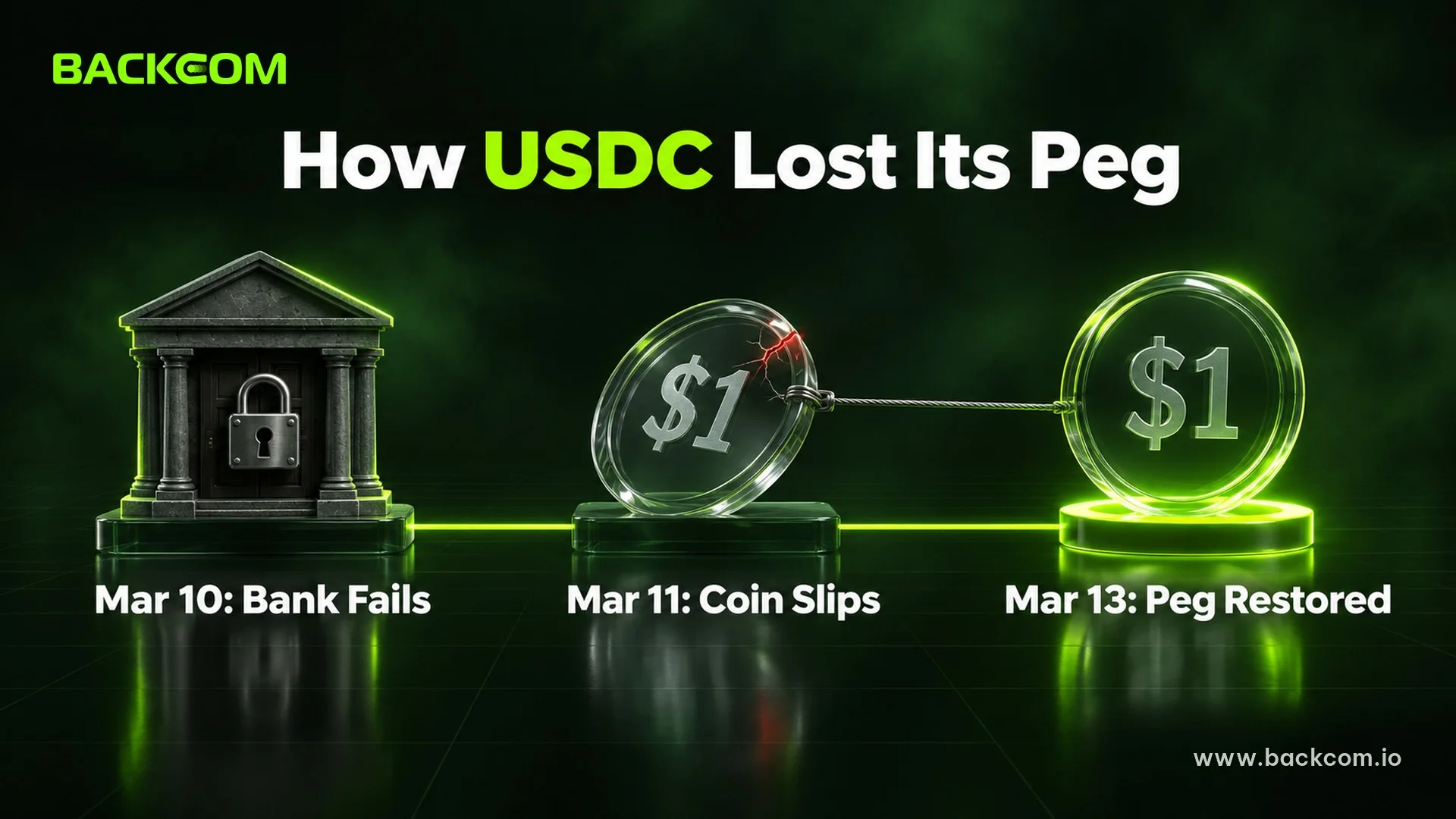
The USDC depeg of March 2023 was a banking-reserve event, not a collapse of the token's design. On 10 March 2023 Silicon Valley Bank (SVB) was placed into resolution. Over the next day Circle, the issuer of USDC, disclosed that USD 3.3 billion of its reserves, around 8% of roughly USD 40 billion, was held at SVB (reported by CNBC and Fortune).
How Far Did USDC Fall?
According to CNBC, citing CoinDesk data, USDC fell below 87 cents on Saturday 11 March. A Federal Reserve staff note on the episode puts the trough at about 86 cents. Other outlets quote 88 cents, so the exact low depends on the exchange and the minute you measure.
By Monday 13 March USDC had regained its peg and Circle had resumed redemptions, after US authorities said all SVB depositors would be made whole. Circle then planned to move its remaining SVB deposits to BNY Mellon. The key point is that the money was never gone, yet the price still lost 13 cents because nobody knew in time whether it would come back.
Why Did DAI Fall Too?
DAI is issued by MakerDAO and is over-collateralised, which sounds safe. But USDC made up over half of the assets backing DAI, partly through the Peg Stability Module that swaps USDC for DAI one to one, so the USDC drop pulled DAI down with it. According to The Block, Maker passed emergency changes that cut the daily mint limit of that module and raised swap fees. A coin can inherit the risk of the coin it is built on.
4. How Did UST, USDT And USDe Depeg Differently?
Each of the next three events failed for a different reason, which is why a single "safe" label does not exist. In short:
- UST broke because of its design.
- USDT was hit by market panic and answered it with redemptions.
- USDe was hit by a venue price problem, not by its collateral.
UST In May 2022: A Design Failure
TerraUSD was an algorithmic stablecoin with no fiat reserve. Its peg depended on swapping between UST and a sister token, LUNA. According to The Block's timeline, UST began losing its peg around 7 to 9 May 2022, and a "death spiral" followed in which both tokens fell together. UST lost over 90% within about a week and LUNA fell to near zero, wiping out more than USD 50 billion of market value in those two tokens according to press estimates. The Terra blockchain was also halted on 13 May.
UST was a permanent depeg because nothing real stood behind the dollar: only the expectation that new buyers would keep coming.
The USDT Depeg In May 2022: A Stress Test That Held
Tether's USDT slipped as UST collapsed. According to CNBC and Decrypt, it dipped to about 0.95 on 12 May 2022 (some outlets report 0.97) and recovered the same day. Fortune reported that about USD 10 billion of USDT was redeemed in the following days, and Tether's later assurance report showed a shift from commercial paper toward US Treasury bills.
This USDT depeg ended well, but it is not a guarantee. An assurance report is not a full audit, and some analysts kept questioning the quality of the reserve assets. Our comparison of USDT and USDC goes deeper on that difference.
USDe In October 2025: A Venue Failure
Ethena's USDe is a synthetic dollar. During the record liquidation day of 10 October 2025, it briefly traded as low as 0.65 on Binance, according to Crypto Briefing, while on DeFi pools such as Curve and Uniswap the deviation stayed under 0.3%. Ethena's founder said a single venue was out of line rather than the protocol's collateral, and The Block reported that Binance paid about USD 283 million in compensation for user losses. A 21Shares analysis asks why the token stayed stable onchain but not on that exchange.
The lesson is uncomfortable. Even when the coin is fine, the price on your screen can be wrong, and a forced sale or a liquidation cascade at that price can be real.
5. How Do These Stablecoin Risks Compare?
The table summarises the four cases using only the figures quoted above.
| Case | Main cause | Reported low | Outcome |
|---|---|---|---|
| USDC, March 2023 | USD 3.3 billion of reserves at a failed bank | About 0.86 to 0.88 | Peg restored in about 3 days |
| UST, May 2022 | Algorithmic design, death spiral | Fell over 90% in a week | Permanent loss |
| USDT, May 2022 | Market panic after UST | About 0.95 to 0.97 | Recovered the same day |
| USDe, October 2025 | Venue price feed issue | 0.65 on one exchange | Recovered, users reimbursed |
Figures are as reported by the cited sources as at 24 November 2026. Exact lows differ by data provider, and past events do not predict future ones.
The pattern is clear. A bigger drop does not always mean a worse coin: USDe's 0.65 was a venue problem, while UST's smaller early dip was a death spiral.
6. How Can You Protect Funds From A Stablecoin Depeg?

You cannot remove stablecoin risks, but you can limit how much one failure can cost you. Work through these five steps before holding or trading with any stablecoin:
- Read what backs it. Check whether the coin is backed by cash, Treasury bills, other crypto or an algorithm, and where the issuer says the reserves are held.
- Look for reserve reports and redemption terms. Regular attestations, a published redemption policy and clear fees show how the issuer behaves under stress. Our guide to proof of reserves explains what such reports can and cannot prove.
- Do not keep everything in one coin or one venue. About 8% of USDC's reserve, USD 3.3 billion, was stuck at one failed bank in March 2023, and holders of that one coin took the hit. Spreading funds limits that kind of single point of failure, though it also adds complexity.
- Avoid leverage on a stablecoin pair you do not understand. A depeg on one exchange can trigger forced closes at a price that never existed elsewhere. If you use leverage in crypto trading, size positions so a few cents of mispricing cannot liquidate you.
- Plan how you would exit. Know which assets you could swap into, what the fees would be and where liquidity is deepest. Moving stablecoins to fund a forex account has its own checks, listed in our guide to depositing USDT to a forex broker.
What Does The Law Say Now?
Rules are moving. The US GENIUS Act, signed in July 2025, requires covered payment stablecoin issuers to hold reserves of at least one dollar of cash or high-quality liquid assets per token, to publish a redemption policy and to release monthly reserve reports, according to summaries by The Block and Paul Hastings. Detailed rules are still being finalised by regulators, and regulation lowers some risks but does not remove venue, design or confidence risk. Rules and protections differ by country of residence, so check what applies to you.
Frequently Asked Questions (FAQ) About Stablecoin Depeg Risk
Can A Stablecoin Go To Zero?
Yes. TerraUSD fell more than 90% in about a week in May 2022, and its sister token LUNA fell to near zero. Fiat-backed coins with transparent reserves have so far recovered from their depegs, but that history is no guarantee.
Is USDT Or USDC Safer?
Neither is risk free. USDC depegged in March 2023 because of reserves held at one bank, and USDT dipped in May 2022 before recovering. Compare the reserve reports, redemption terms and where each coin trades before deciding, and do not rely on a single label.
What Should I Do If My Stablecoin Depegs?
Avoid panic selling at a distorted price without checking other venues first. Look at the issuer's official statements, compare prices on several exchanges and onchain pools, and review any leveraged positions that could be forced closed. Decide before a crisis how much you would be willing to hold.
Why Can A Stablecoin Depeg On One Exchange But Not Another?
Each exchange has its own order book and price feed. If liquidity is thin or an oracle fails, the quoted price can drift away from the real value, as USDe did on one exchange in October 2025 while staying close to 1.00 on DeFi pools.
Conclusion: Treat A Stablecoin As A Promise, Not As Cash
Stablecoin depeg risk is real but varied: a stuck reserve, a flawed design, a broken price feed or a simple loss of trust can each break the peg, and the damage ranges from a short scare to a total loss. The four cases above show that the cause matters more than the size of the drop.
Check what backs a coin, read the reserve and redemption terms, avoid concentrating funds in one coin or venue, and keep leverage away from pairs you do not understand. If you want a refresher, start with what a stablecoin is or the broader beginner guide to how crypto works.
Disclaimer: This content is compiled by Backcom.io for information only and is not investment advice. Stablecoins and crypto assets carry a high risk of loss, including the loss of your entire holding. Past events described above do not predict future results.
Was this article helpful?
Join The Backcom.io Community
Get the latest on trading rebates, trading tips, and broker deals — and connect with thousands of traders worldwide.

Backcom App
Track Your Rebates Every Day
Every rebate is visible by broker and by day. Manage your wallet and withdrawals in one place.
Open Backcom App