What Is Basis Trading In Crypto: Futures Premium, Funding And Risks


What is basis trading in crypto? It is a strategy that tries to earn the gap between a futures price and the spot price while hedging away most of the price move, usually by holding the asset and shorting the same amount in futures. In this article, Backcom.io explains the basis formula, a cash and carry example built on live BTC numbers, how perpetual funding fits in, and the risks that make the trade less safe than it looks.
What Is Basis Trading In Crypto?
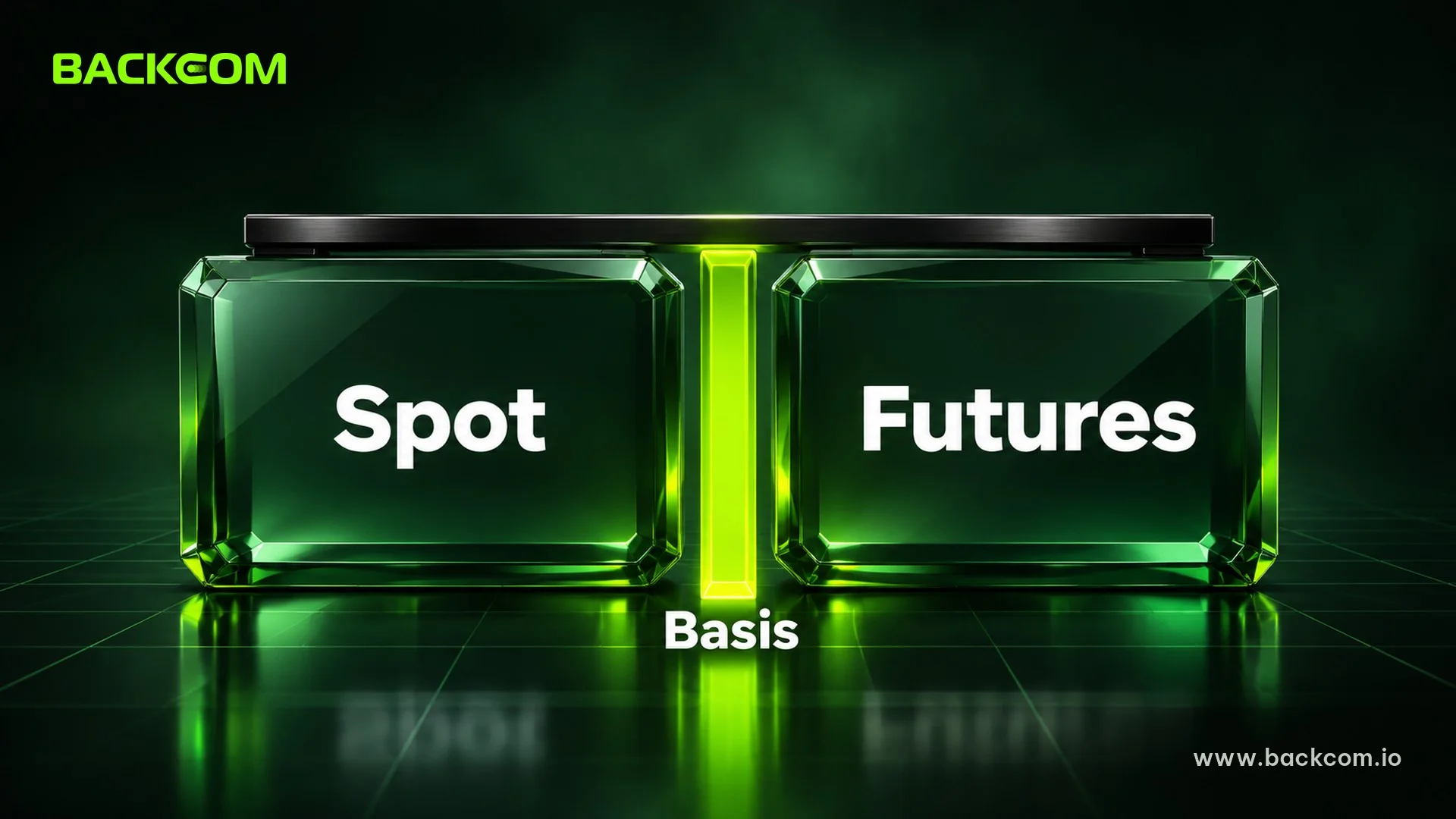
Basis trading in crypto means taking two opposite positions in the same asset, one in the spot market and one in a futures contract, so that the price direction cancels out and only the basis is left. The basis is the difference between the futures price and the spot (or index) price.
The idea is simple to state. If a futures contract trades above spot, you can buy spot and sell the futures. When the contract expires, its price must settle to the spot price, so the gap closes and you keep it, whether the coin went up or down in between.
Three things to hold on to before going further:
- The trade is hedged, not risk-free. It removes most price exposure but adds margin, cost and counterparty risk.
- The return is the gap, not a bet on direction. A bigger gap does not mean a safer trade.
- It needs size and discipline. The edge is small per trade, so fees and mistakes matter more than the idea itself.
If you are new to the contracts involved, start with what crypto is, spot vs futures trading in crypto and what perpetual futures are.
How Is The Crypto Futures Basis Calculated?
The crypto futures basis is the futures price minus the spot or index price, and most traders also express it as a percentage and as an annualised rate so contracts with different expiries can be compared.
Basis % = (Futures price − Spot price) ÷ Spot price
Annualised basis = Basis % × 365 ÷ Days to expiry
This is a simple (non-compounded) annualisation. Some venues and data providers use other conventions, so compare like with like. The sign of the result tells you which market you are in:
- Positive basis (contango): futures trade at a premium to spot, which is the usual state for dated crypto contracts.
- Negative basis (backwardation): futures trade at a discount to spot, often a sign of stress or heavy short demand.
Binance Academy describes contango as futures trading above spot and notes that the futures price tends to converge with spot as expiry approaches.
A Live BTC Example From 24 November 2026
Here is the basis on two Bitcoin delivery contracts, using the public Binance data feed at about 06:00 UTC on 24 November 2026:
| Contract | Futures mark price | Index price | Basis | Days to expiry | Annualised |
|---|---|---|---|---|---|
| BTCUSDT_261225 (USDⓈ-M quarterly) | 60,703.67 | 60,484.49 | +219.18 (+0.36%) | about 31 | about 4.3% |
| BTCUSD_270326 (COIN-M next quarter) | 61,342.70 | 60,414.18 | +928.52 (+1.54%) | about 122 | about 4.6% |
Data: Binance public API (premiumIndex and exchangeInfo), fetched 24 November 2026. Mark prices are exchange reference prices, not quotes you can necessarily trade at, and the two index values differ slightly between the two contract families. This is a snapshot, not a recommendation.
Notice that the longer contract carries a bigger raw gap but a similar annualised rate. That is why traders compare annualised numbers. For a broader view, a 6 January 2026 Kaiko market snapshot put BTC term-structure rates between about 4.7% and 6.3% a year depending on expiry and called the curve "relatively flat", which is one reading from one week.
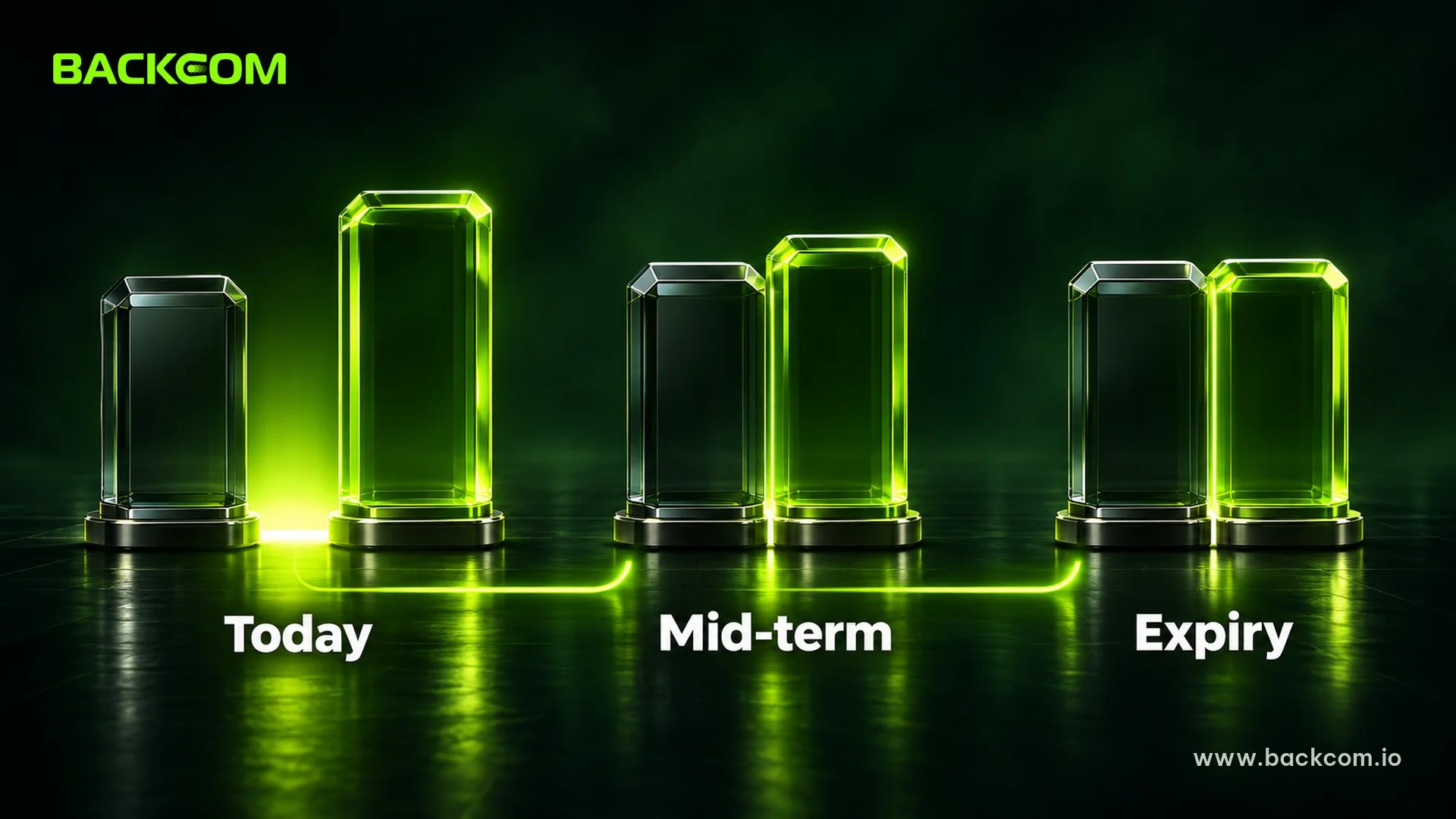
A futures premium vs spot exists mainly because of the cost of carry: holding a position until a later date has a financing cost, and the buyer of a dated future gets exposure without tying up the full amount today. Binance Academy says contango is often explained by this cost of carry.
In crypto the premium is also shaped by demand. When many traders want leveraged long exposure, they bid up futures, and the premium widens. When fear dominates, the premium shrinks or turns negative.
Why The Gap Closes At Expiry
A dated futures contract is settled to the underlying value on its expiry date, so the futures price and the spot price must meet. This convergence is what a basis trader relies on. It is also why the trade has a built-in end date, unlike perpetual contracts that never expire.
Dated Futures Vs Perpetuals
Perpetual futures have no expiry, so they use funding payments between longs and shorts to stay near the index price, a job that the premium or discount does on a dated contract. The table sets the two side by side:
| Feature | Dated (quarterly) futures | Perpetual futures |
|---|---|---|
| Expiry | Fixed date | None |
| How price is kept near spot | Convergence at expiry | Funding payments |
| Funding fees | None | Paid or received every funding interval |
| Basis visible as | Premium or discount to index | Funding rate plus a small mark-index gap |
| Main basis-trade use | Lock in a fixed gap to a known date | Collect (or pay) funding while hedged |
On the same snapshot, the BTCUSDT perpetual mark price (60,525.20) sat 0.06% below its index (60,559.72). The quarterly sat 0.36% above. The premium was in the dated contract, not the perpetual.
How Does Cash And Carry Crypto Trading Work?
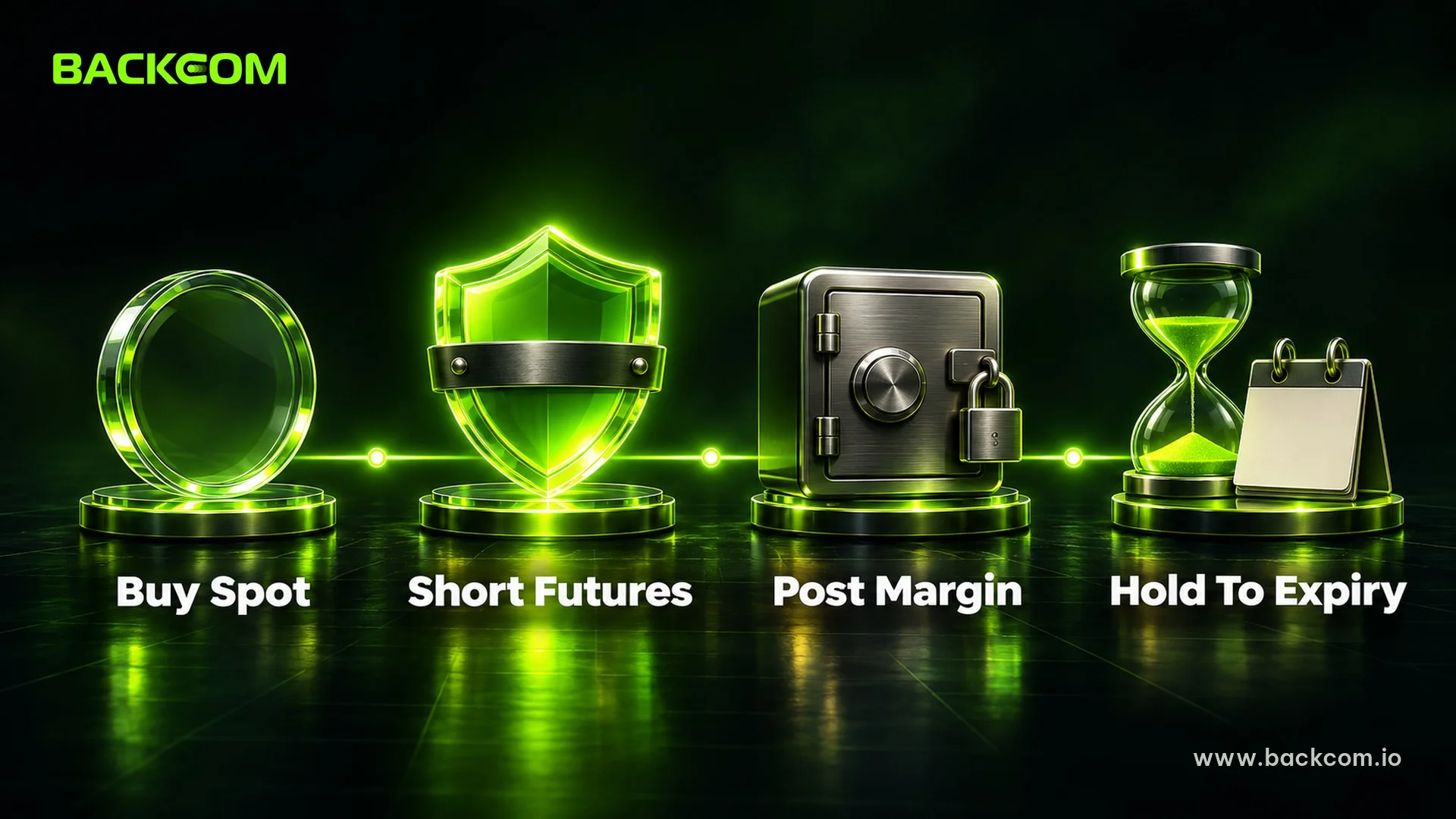
Cash and carry crypto trading is the classic basis trade: you buy the coin on the spot market (the cash leg), sell an equal notional of a dated future (the carry leg), and hold both until expiry. The profit comes from the futures premium converging to zero.
The steps look like this:
- Check the basis. Compare the annualised premium with your costs and your alternative uses of the same capital.
- Buy spot. Purchase the coin you will hold, for example BTC.
- Short the same notional in the dated future. Match the size so a price move on one leg offsets the other.
- Fund the margin. The short leg needs collateral, and that collateral is capital you cannot use elsewhere.
- Hold or unwind. You can wait for expiry, or close both legs earlier if the basis narrows enough.
A Worked Example With Real Basis And Hypothetical Costs
Take the BTCUSDT_261225 premium from the snapshot above (+0.3624%) and a hypothetical position of USD 100,000 on each leg. The costs and margin are assumptions for illustration, not quotes:
- Position size: USD 100,000 of BTC bought on spot and the same notional shorted in the quarterly.
- Costs: a combined 0.10% for fees and slippage across four executions (open and close of both legs).
- Margin: an extra USD 20,000 of collateral posted for the short leg.
| Item | Amount |
|---|---|
| Gross basis captured at expiry (0.3624% of 100,000) | USD 362.37 |
| Assumed total fees and slippage on four executions (0.10%) | −USD 100.00 |
| Net result before financing | USD 262.37 |
| Return on USD 100,000 spot capital, about 31 days | 0.26% (about 3.1% annualised) |
| Return if you also lock USD 20,000 as extra margin | 0.22% (about 2.6% annualised) |
The result is the same whether BTC ends at 40,000 or 90,000, because the long spot and the short future offset. But the gross figure is small, and one extra fee, one bad fill or a poorly sized margin can eat a large part of it. Use the guide on how to calculate crypto futures trading fees to test your own numbers.
Hypothetical sizing for illustration only. The gap you can lock depends on the price you actually get on both legs.
What Is A Basis Trade With Perpetuals And Funding?
A basis trade with perpetuals swaps the expiry date for funding. You hold spot and short the perpetual, and while funding is positive, longs pay shorts, so your short leg receives a payment every interval. There is no convergence date, so the income arrives as a stream.
Here is what that stream looked like on BTCUSDT over the last 30 days of Binance funding history (90 settlements from 25 October 08:00 UTC to 24 November 00:00 UTC):
| Measure | Value |
|---|---|
| Average rate per 8-hour settlement | 0.0059% |
| Sum over 90 settlements | 0.5339% of notional |
| Simple annualised equivalent | about 6.5% |
| Highest single rate | 0.0100% (seen in 27 of 90 settlements) |
| Lowest single rate | −0.0061% |
| Settlements with a negative rate | 7 of 90 |
Data: Binance public API (fundingRate), fetched 24 November 2026. Historical funding, not a forecast.
On a short perpetual position worth USD 100,000, 0.5339% is about USD 533.88 received over those 30 days before fees. That looks better than the quarterly example, but it is variable. Funding can drop to zero or turn negative, and then your short pays instead of earns. For the mechanics, read what the funding rate is and how it is calculated.
There is another difference. A quarterly basis is mostly known in advance. Funding is only known one interval at a time.
What Are The Main Basis Trade Risks?
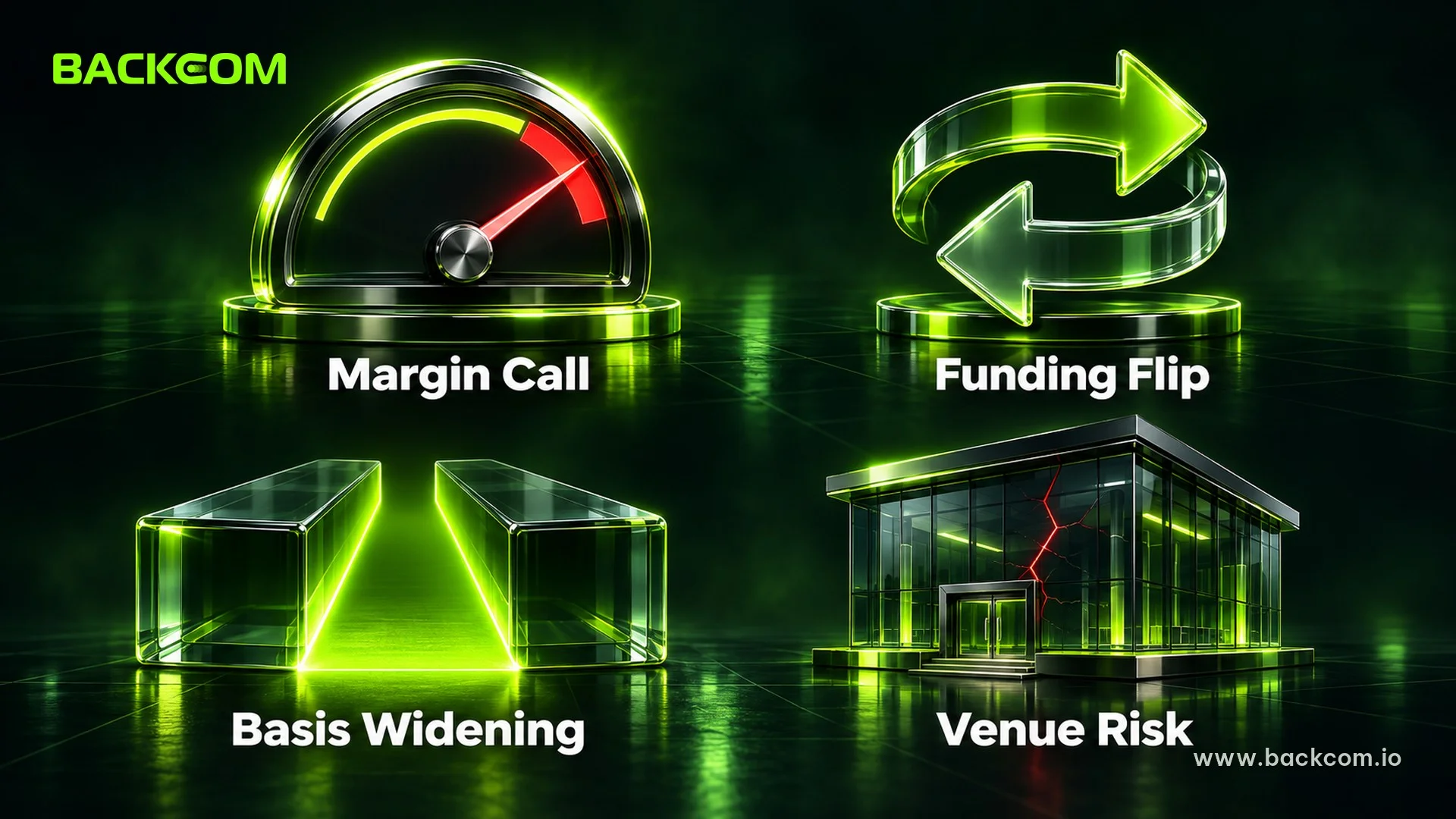
The main basis trade risks are margin calls on the short leg, funding turning against you, a basis that widens before it narrows, exchange risk, and costs that eat a thin return. The strategy is often called market-neutral, but neutral does not mean safe.
Margin Calls And Liquidation On The Short Leg
The spot leg and the futures leg are usually separate accounts or collateral pools. If BTC rises sharply, the short future loses cash immediately, while the matching gain sits unrealised in your spot holding. With USD 100,000 short and USD 20,000 of extra margin, a rise of around 20% would use up that margin on paper, and the exchange would liquidate before it hit zero.
OKX's explanation of expiry futures notes that when the maintenance margin ratio falls to 100% or below, liquidation is triggered with no grace period. A forced close of the short leaves you holding unhedged spot at a bad moment. Learn how to calculate liquidation price and compare cross margin vs isolated margin before you size the short.
Funding Flips And Basis Moves
On the perpetual version, funding is not guaranteed. In the 30-day sample above it was negative in 7 of 90 settlements, and a sustained flip would turn income into a cost. On the dated version, the basis can widen before it narrows. If you must close early, you pay the wider gap and show a loss, even though holding to expiry would have worked.
Exchange And Counterparty Risk
Both legs often sit on one venue, so a withdrawal freeze, outage or insolvency hits the whole trade. Fast cascades, where forced selling drives prices through levels, can also trigger liquidations faster than you can top up margin. See what a liquidation cascade is for how that unfolds.
Costs, Capital And Crowding
A gap of only 0.36% leaves little room for leakage. Three costs reduce it:
- Trading fees on four executions.
- Slippage when you enter or exit a large size.
- Idle capital locked in margin that could earn elsewhere.
Crowding adds to this. Kaiko's January snapshot also showed how crowded positioning can get, with perpetuals at 96.8% against 3.2% for dated futures of BTC futures open interest, which is one reason funding can swing quickly. Watching open interest in crypto futures helps you see when positioning is stretched.
Frequently Asked Questions (FAQ) About Basis Trading In Crypto
What Is Basis Trading In Crypto In Simple Terms?
It is holding the coin in the spot market and shorting the same amount in a futures contract so that the price move cancels out. What remains is the gap between the two prices, which narrows to zero at expiry on a dated contract. The profit is that gap, minus fees and other costs.
Is Crypto Basis Trading Risk-Free?
No. It reduces price risk, but it adds liquidation risk on the short leg, funding risk on perpetuals, exchange risk and execution costs. A sharp rally can force a liquidation before the hedge pays off, so position size and margin buffer matter more than the headline rate.
How Do You Calculate The Annualised Basis?
Divide the futures price minus the spot price by the spot price, then multiply by 365 and divide by the days to expiry. On 24 November 2026, a 0.36% premium with about 31 days left worked out to roughly 4.3% a year using the simple method. Different venues may use other conventions.
What Is The Difference Between The Basis And The Funding Rate?
The basis is the price gap on a dated futures contract and closes at expiry. The funding rate is a periodic payment on a perpetual contract that keeps it near spot. Both reflect demand for leveraged longs, but funding changes every interval, while a quarterly basis is largely set when you enter.
Why Does The Futures Price Converge To The Spot Price?
A dated future is settled to the value of the underlying asset at expiry, so at that moment the two prices have to match. Before then, the gap can move with demand and financing costs. That convergence is the mechanism a cash and carry trade relies on.
Conclusion: Basis Trading Is A Hedged Trade, Not A Free Lunch
Basis trading in crypto turns a futures premium into a possible return by pairing spot with an opposite futures position. The live numbers show why it needs care: a 0.36% gap over about 31 days is only around 4.3% a year before costs, and the perpetual version paid about 6.5% annualised in one 30-day window that could easily change.
If you study this strategy, check three things before you look at the headline rate:
- Margin buffer: how far the price can rise before the short leg is liquidated.
- Total cost: fees, slippage and the capital tied up in margin.
- Venue risk: where both legs are held and what happens if that venue fails.
Then read the related guides on funding, liquidation and open interest to see how the pieces fit.
Disclaimer: This content is compiled by Backcom.io for information only and is not investment advice. Futures trading and leverage carry a high risk of loss, past data is not a forecast, and exchange rules differ by platform and by the country where you live.
Was this article helpful?
Join The Backcom.io Community
Get the latest on trading rebates, trading tips, and broker deals — and connect with thousands of traders worldwide.

Backcom App
Track Your Rebates Every Day
Every rebate is visible by broker and by day. Manage your wallet and withdrawals in one place.
Open Backcom App