Crypto Options Vs Futures: Key Differences, Risk Profile And Costs


Both products let you bet on where a coin is heading without owning it, and both are sold with headline figures such as leverage or potential return. Yet crypto options vs futures is really a question about what you are obliged to do when the price moves against you. A futures position must be settled whatever happens; an options buyer can simply walk away. In this article, Backcom.io explains the key differences, the risk profile of each product, a worked example with hypothetical numbers and the costs people tend to overlook.
1. What Is The Core Difference Between Crypto Options And Futures?

The core difference is right versus obligation. With a futures contract, both buyer and seller must settle the contract regardless of how the underlying price moves. With an option, according to the Investor and Financial Education Council (IFEC), the buyer has the right, but not the obligation, to buy (a call) or sell (a put) the asset, and the seller must honour the buyer's decision.
Three terms make options easier to read:
- Strike price: the price at which the buyer may buy or sell at expiry.
- Expiry: the date the option stops being valid.
- Premium: the price the buyer pays the seller for the right.
Deribit's education page defines all three in the same way and notes that its options are European style, meaning they can only be exercised at expiry, and cash settled, meaning only the profit is paid.
Futures need none of these three terms to start. You open a long or short position, post margin and carry it until you close it, are liquidated, or the contract expires. If you are new to that side, our guide to spot versus futures trading covers the starting point.
Which Crypto Futures Do You Compare Against Options?
Most retail traders mean perpetual futures, which have no expiry date and use a funding payment to keep the contract price near spot. Our explainer on perpetual futures shows how that works, and the funding rate guide shows how the periodic payment is calculated. Dated futures expire like options do, but they still carry the obligation. This article compares options mainly with perpetual futures.
2. Difference Between Options And Futures Crypto Contracts: How Do They Compare Side By Side?
The table below summarises the difference between options and futures crypto products using the sources cited in this article.
| Feature | Crypto options (buyer) | Crypto futures |
|---|---|---|
| What you hold | A right, not an obligation | An obligation to settle |
| Upfront cost | Premium, paid in full | Margin, a fraction of position size |
| Margin | None for the buyer; sellers post margin | Required for both long and short |
| Maximum loss | The premium paid | Your margin, then liquidation; losses can grow quickly with leverage |
| Profit if price rises | Rises once price passes strike plus premium | Rises one-for-one with price on the position size |
| Time effect | Value decays towards expiry | Perpetuals: funding payments, no decay |
| Main extra input | Strike, expiry and volatility | Leverage and liquidation price |
Product terms differ by exchange. According to IFEC, a few exchanges use futures-style margining, where an option buyer posts margin instead of paying the full premium upfront. Contract sizes, settlement currency and expiry schedules also vary by venue, so read the specification of the exact contract before you trade it.
3. How Does Options Vs Perpetual Futures Risk Compare?
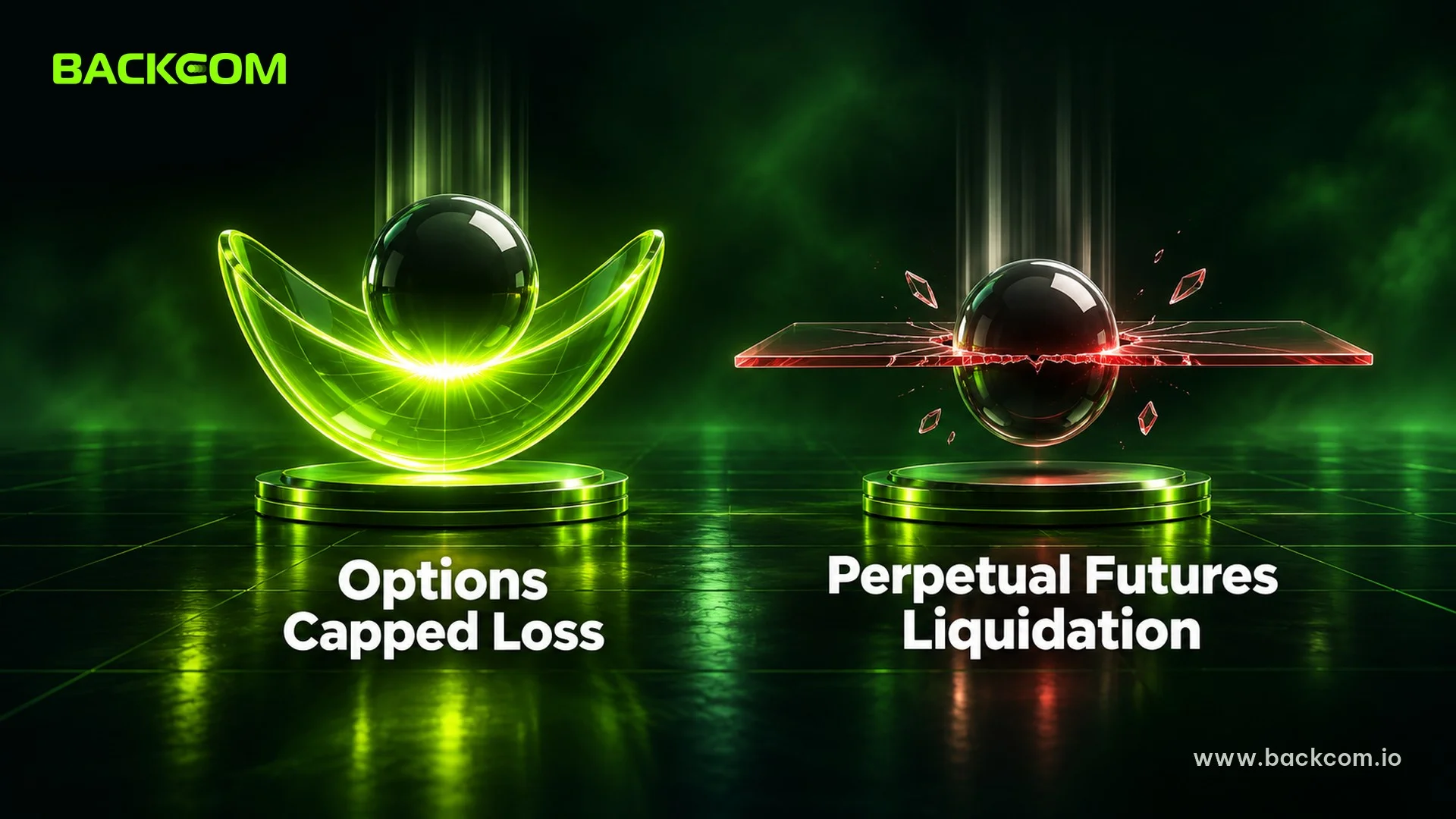
On options vs perpetual futures risk, a long option has a capped downside and an uncapped upside; a leveraged futures position has a downside that arrives faster than most beginners expect. Both statements are true at the same time, and neither makes one product safer in absolute terms.
Risk When You Buy An Option
The buyer's worst case is losing the premium. Binance's options PnL calculator FAQ states it directly: maximum loss for both calls and puts is the premium, and one of its examples shows a loss of 3,000 USDT equal to the premium paid. That loss can still be total. An option that expires out of the money is worth nothing, so a buyer who is right about the direction but wrong about the timing can lose the whole premium.
Risk When You Sell An Option
The seller's profit is capped at the premium collected, while the loss can be far larger. Deribit describes sellers as having limited profit and almost unlimited risk, and IFEC says the seller's loss can be far greater than the premium received. This is why sellers must post margin and why selling options is not a beginner strategy.
Risk With Futures
A futures position gains and loses in step with the full position size, not with the margin you posted. With leverage, a small price move can remove most of the margin, and the exchange will close the position at the liquidation price. Our guides on leverage, how to calculate liquidation price and initial versus maintenance margin show the arithmetic. IFEC describes futures risk as unlimited in principle; in practice an isolated-margin position is closed by liquidation, and the cross versus isolated margin setting decides how much of your account is exposed before that happens.
4. How Do Payoffs And Max Loss Options Vs Futures Differ In A Worked Example?
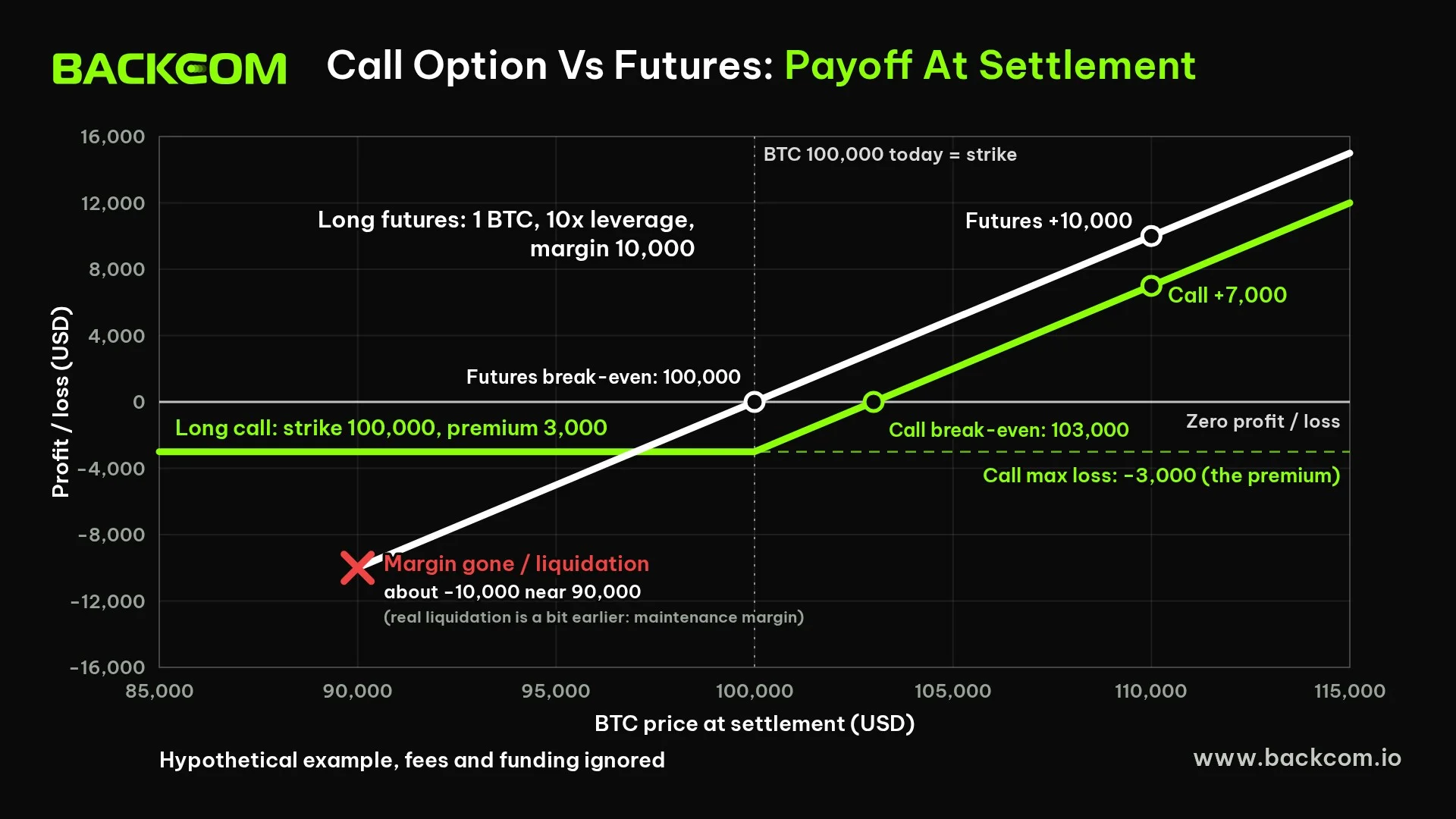
The example below uses hypothetical numbers to show the shape of each payoff and the max loss options vs futures produce, not a forecast or a recommendation. Assume Bitcoin trades at USD 100,000. Trader A buys one call option with a USD 100,000 strike for a USD 3,000 premium. Trader B opens a long futures position worth 1 BTC with 10x leverage, so the margin is USD 10,000. Fees and funding are ignored.
| BTC price at settlement | Call option result | Long futures result (10x) |
|---|---|---|
| USD 110,000 | +USD 7,000 (10,000 gain − 3,000 premium) | +USD 10,000 |
| USD 103,000 | USD 0 (break-even) | +USD 3,000 |
| USD 100,000 | −USD 3,000 | USD 0 |
| USD 90,000 | −USD 3,000 | About −USD 10,000: the position is liquidated shortly before USD 90,000, so the full margin is lost |
The formula for a call buyer is simple:
Call profit = max(Price at expiry − Strike, 0) − Premium
Three points stand out. First, the call needs the price to clear strike plus premium, USD 103,000, before it profits, while the futures position profits from the first dollar. Second, the call's loss stops at USD 3,000 however far the price falls. Third, with 10x leverage, a drop of roughly 10% removes the entire USD 10,000 margin, and in reality liquidation occurs slightly earlier because of maintenance margin. The option cost less to hold in a falling market because you paid for that protection in advance.
The same table also shows what you give up. If the price rises only slightly, the futures trader keeps more of the move because there is no premium to recover. Neither outcome is better in advance; each simply prices the risk differently.
5. What Do Options And Futures Really Cost?
Cost is where the two products look most different, and where the headline number misleads. An options buyer pays a visible premium, but futures traders pay through several smaller charges.
- Options premium: it contains intrinsic value, if any, plus time value. Time value shrinks as expiry approaches, a loss known as time decay.
- Bid-ask spread: options books can be thinner than perpetual futures books, so the gap between buy and sell prices can cost more, especially on far-from-the-money strikes.
- Trading fees: both products charge maker and taker fees, and exchanges calculate them differently. See maker versus taker fees for the logic, and check the fee schedule of the exact product.
- Funding payments: perpetual futures holders pay or receive funding while the position is open. Options have no funding.
- Liquidation losses: a futures trader forced out of a position by a spike pays the cost of the stop, not just fees.
Volatility changes the price of an option even when the coin does not move. When expected volatility rises, premiums rise; when it falls, premiums fall. A buyer can therefore be right on price and still lose to a drop in implied volatility.
6. When Do Traders Choose Options Instead Of Futures?
The choice depends on what you are trying to control: the cost of being wrong, or the efficiency of being right. This is a framework for thinking, not advice to use either product.
- Defined risk: a trader who wants a known maximum loss before entering may prefer buying an option, accepting the premium as the price.
- Simple directional exposure: a trader who wants one-for-one exposure and manages stops carefully may use futures, accepting liquidation risk.
- Holding through events: a long option can hold through a sudden gap without a forced close, though the premium is lost if the move does not materialise.
- Hedging: some holders of spot buy puts as protection, while others short futures to offset exposure. The two hedges behave differently and have different costs.
- Long-running views: options lose value with time, so a view that needs several months to play out can be expensive to express through short-dated options.
Order handling also differs by product. Our guide to crypto order types lists the common types, and options contracts may have wider spreads than perpetual futures.
7. What Should Beginners Check Before Trading Either One?
Work through this list before opening a first position:
- Read the contract specification. Confirm the underlying, contract size, expiry, settlement currency and whether the option is European or American style.
- Know your maximum loss before you click. For an option buyer, it is the premium. For futures, calculate the liquidation price first. The margin call guide explains the warning signs.
- Do not sell options without understanding the margin rules. Seller losses can exceed the premium received.
- Check the market depth. Look at the spread and traded volume, and read open interest to see how much activity sits behind a contract.
- Start small and use the practice or demo mode if your platform offers one, since options pricing is hard to judge from theory alone.
- Check the rules where you live. Derivatives are restricted or banned in some countries, and tax treatment differs by country of residence.
Frequently Asked Questions (FAQ) About Crypto Options Vs Futures
Are Crypto Options Safer Than Futures?
Not automatically. An option buyer's loss is capped at the premium, which is a clear advantage over a highly leveraged futures position. But the premium can be lost entirely, and option sellers face far larger risk than buyers. Safety depends on which side you take and how you size the trade.
Can You Lose More Than You Pay With Options?
If you buy an option, no: the maximum loss is the premium paid, according to Binance's PnL calculator documentation. If you sell an option, yes: the loss can be much greater than the premium received, which is why sellers must post margin.
Crypto options premium vs margin is price versus deposit. The premium is paid by the option buyer to the seller and is not returned if the option expires worthless. Margin is collateral held against a futures or sold-option position and is released when the position closes without loss.
Do Crypto Options Have Funding Rates Like Perpetual Futures?
No. Funding payments belong to perpetual futures. Options carry the cost of time decay and the bid-ask spread instead. An options buyer pays the premium once, while a perpetual holder can pay or receive funding at each interval.
Which Is Better For Beginners, Options Or Futures?
Neither is designed for beginners. Most newcomers should start by understanding spot trading, then leverage, then derivatives with small size. If you do try one, the product with the risk you can calculate before entry is the better starting point for you.
Conclusion: Choose The Risk You Can Measure
Crypto options vs futures comes down to a trade-off between paying a premium for a capped loss and carrying an obligation with leveraged exposure. The worked example shows how the same price move produces different results, and the cost section shows why the cheapest-looking product is not always the cheapest to hold. Before you trade either, read the contract specification, calculate your maximum loss and size the position so that a bad outcome stays survivable. For the next step, see our guide to spot versus futures trading or the beginner overview of what crypto is and how it works.
Disclaimer: This content is compiled by Backcom.io for information only and is not investment advice. Crypto derivatives, including options and futures, carry a high risk of loss, including the loss of your entire investment. The numbers in the worked example are hypothetical, and past events do not predict future results.
Was this article helpful?
Join The Backcom.io Community
Get the latest on trading rebates, trading tips, and broker deals — and connect with thousands of traders worldwide.

Backcom App
Track Your Rebates Every Day
Every rebate is visible by broker and by day. Manage your wallet and withdrawals in one place.
Open Backcom App