Initial Margin Vs Maintenance Margin In Crypto Futures: Differences And Examples

Initial margin vs maintenance margin is the difference between the money you must post to open a leveraged crypto futures position and the smaller amount you must keep to hold it open. Mix them up and a trade that looks safe can be liquidated sooner than you expect. In this article, Backcom.io explains both terms, the formulas, a worked BTC example at four leverage levels, and how margin ratio leads to liquidation.
1. Initial Margin Vs Maintenance Margin: What Is The Difference?
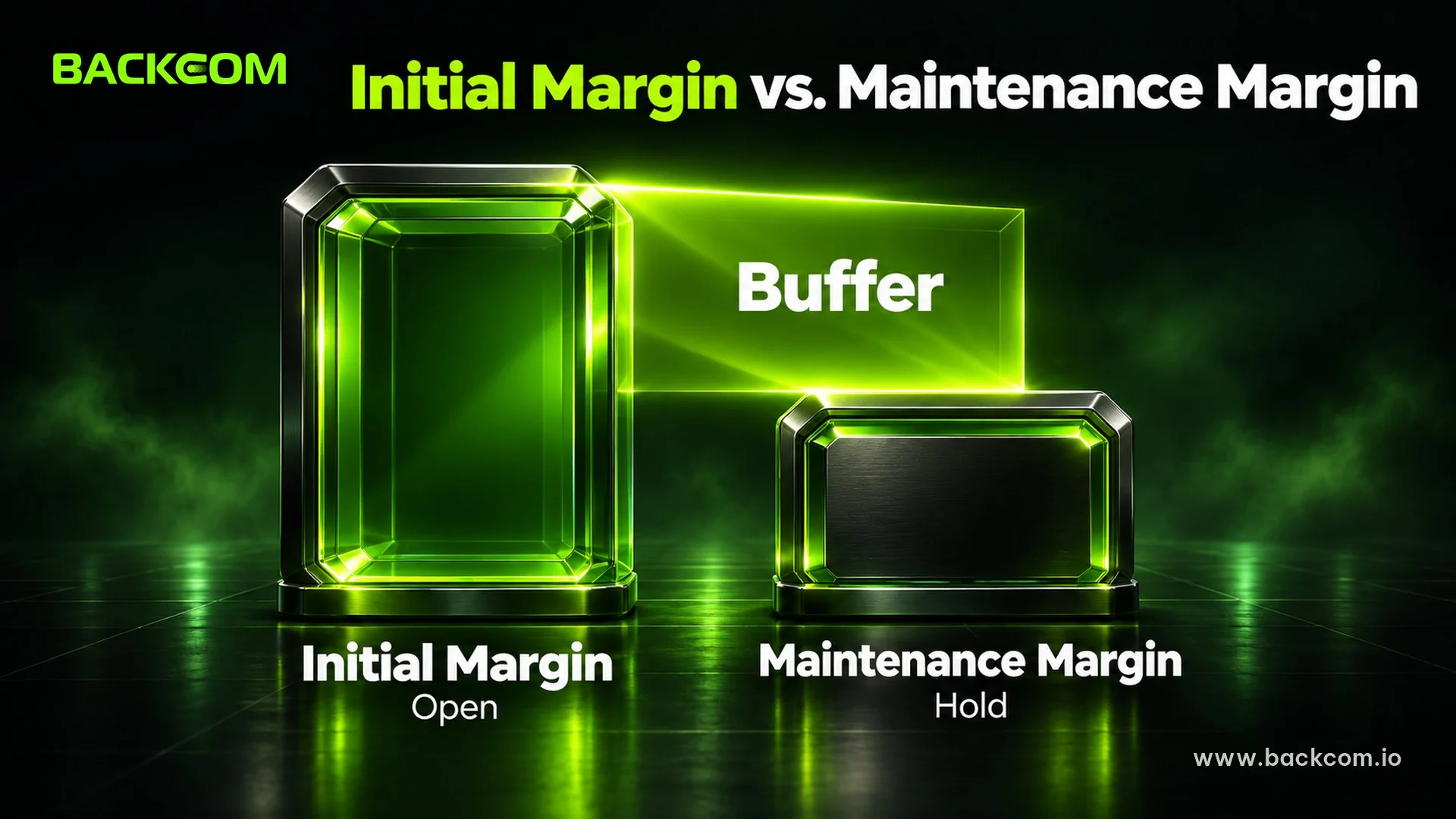
Initial margin is the collateral you commit to open a position. Maintenance margin is the minimum collateral you must keep in the account to hold it. Initial margin is a one-time entry requirement. Maintenance margin is a standing requirement that is checked continuously while the trade is open.
| Feature | Initial margin | Maintenance margin |
|---|---|---|
| Purpose | Opens the position | Keeps the position open |
| When it applies | At order entry | Every moment the position is open |
| Set by | Your chosen leverage | Exchange tier tables and position size |
| Typical size | Larger | Smaller (a fraction of initial margin) |
| If you fall short | Order rejected | Liquidation or a margin call |
Binance's USDⓈ-M support page, for example, says initial margin is determined by the leverage you select, and defines maintenance margin as the minimum amount of collateral a trader must maintain to keep an open leveraged position. It also warns that failing the maintenance requirement may result in liquidation. See the Binance Leverage and Margin FAQ (updated 27 March 2026).
The gap between the two is your buffer. It is the amount the market can move against you before the exchange steps in. If you are new to leverage itself, start with what leverage means in crypto trading.
2. How Is Initial Margin Calculated In Crypto Futures?
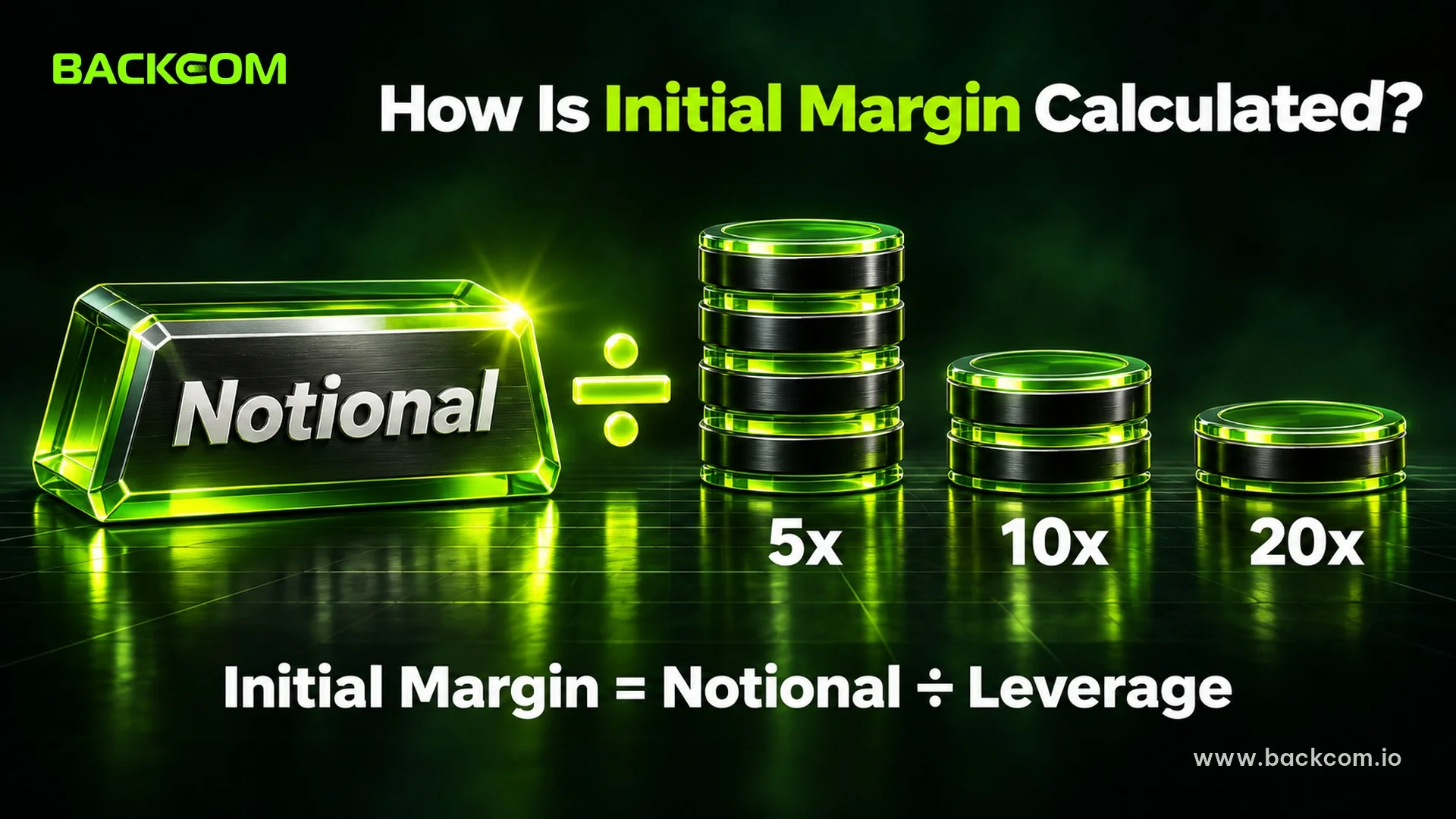
Initial margin in crypto futures equals the position's notional value divided by your leverage. A higher leverage means a smaller deposit for the same position. The formula is:
Initial Margin = Position Notional Value ÷ Leverage
Bybit's help centre uses the same logic: a 400,000 USDT position at 10x needs 40,000 USDT of initial margin. See Bybit's maintenance margin article for its tiered examples.
Initial Margin Crypto Futures Rate: 1 ÷ Leverage
Some exchanges quote the initial margin rate, which is simply 1 ÷ Leverage. At 10x it is 10%, at 20x it is 5%, and at 50x it is 2%. The rate tells you what share of the position you must fund yourself.
What Initial Margin Does Not Cover
Initial margin is not a fee and it is not spent. It stays in your account as collateral and moves with your profit or loss. Trading costs such as fees and funding are separate. For those, see how to calculate crypto futures trading fees and how funding fees work.
3. How Does The Maintenance Margin In Crypto Work?
Maintenance margin in crypto is calculated from the position size and a tiered rate, not from your leverage. Larger positions fall into higher tiers with higher rates. Binance states that the larger the position, the higher the maintenance margin rate, and publishes the formula:
Maintenance Margin = Notional Position Value × Maintenance Margin Rate − Maintenance Amount
Three inputs decide the result:
- Notional position value: quantity multiplied by the current price, so it changes as price moves.
- Maintenance margin rate: the tier rate for your position size on that contract.
- Maintenance amount: a fixed deduction attached to the tier.
The deduction keeps the total smooth when a position crosses from one tier into the next, so you are not charged the higher rate on the whole position at once.
Maintenance Margin Crypto Tiers: A Margin Requirement Formula Example
Bybit's help centre gives an example of the same structure. A 400,000 USDT position in a tier with a 3.5% rate and a 3,000 USDT deduction needs:
400,000 × 3.5% − 3,000 = 11,000 USDT
That is an effective rate of 2.75% on the whole position, lower than the headline 3.5%. The exact tiers differ by exchange, contract and time, so always read the live table for your symbol before sizing a trade.
Which Price Is Used?
Exchanges usually measure margin against the mark price, a fair-value reference, not the last traded price. Bybit's margin calculation update notes that from 2 September 2025 its maintenance margin calculation uses the mark price, while initial margin in isolated mode continues to use the entry price. This stops one thin print from triggering a liquidation.
4. How Do You Calculate Initial And Maintenance Margin For A BTC Trade?
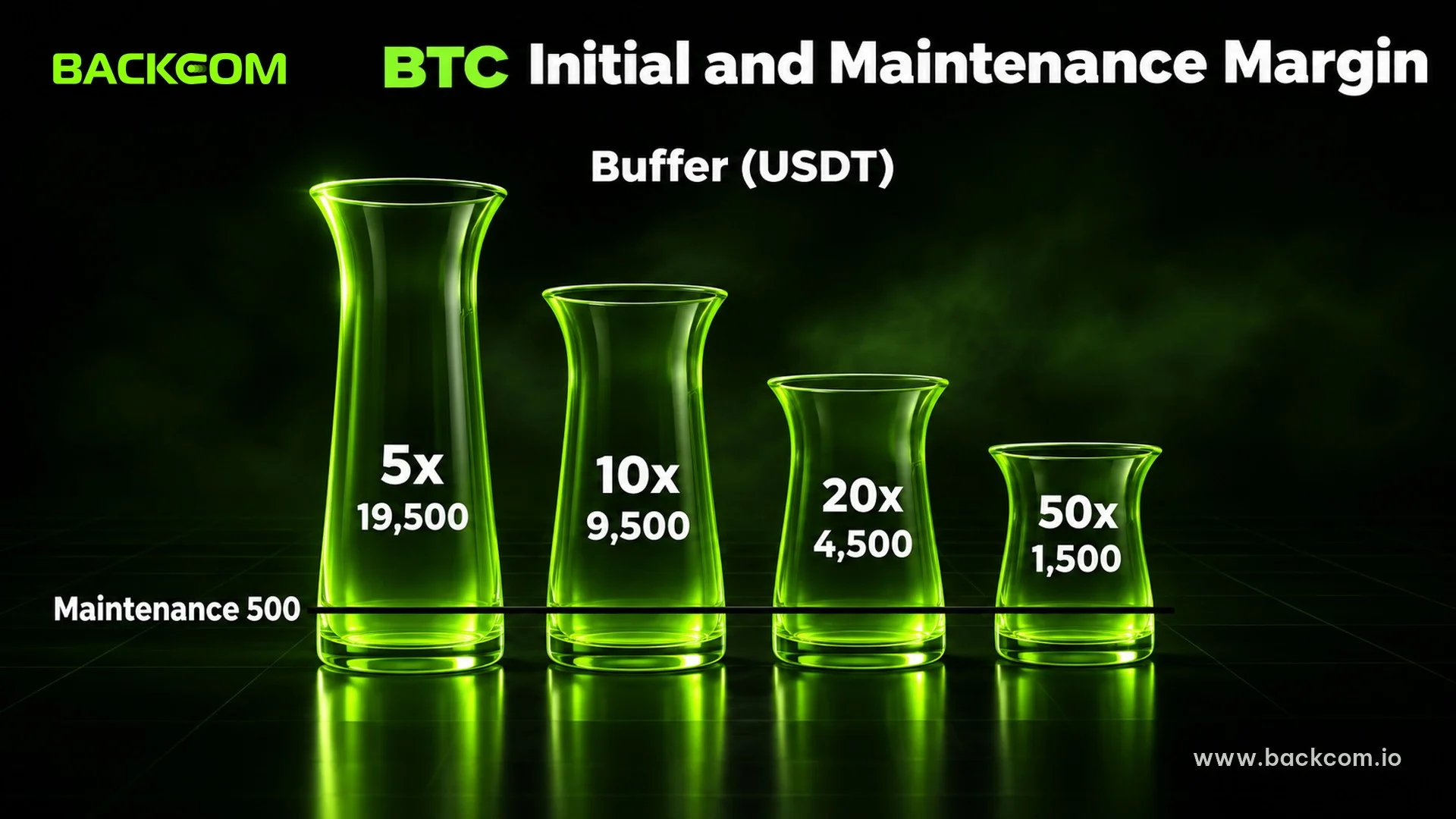
You calculate both numbers from the same position, then compare them. The example below is hypothetical, with a flat 0.5% maintenance margin rate and no deduction, to keep the arithmetic clear. Real exchange tiers differ.
Take a long of 1 BTC at 100,000 USDT, so the notional value is 100,000 USDT. Maintenance margin is 100,000 × 0.5% = 500 USDT at every leverage level. To keep the arithmetic simple, the example holds it fixed at 500. In a real market it would drift with the mark price, so live liquidation levels sit slightly away from these round numbers.
| Leverage | Initial margin | Maintenance margin | Buffer (initial − maintenance) | Liquidation price (long) |
|---|---|---|---|---|
| 5x | 20,000 | 500 | 19,500 | 80,500 |
| 10x | 10,000 | 500 | 9,500 | 90,500 |
| 20x | 5,000 | 500 | 4,500 | 95,500 |
| 50x | 2,000 | 500 | 1,500 | 98,500 |
Illustrative figures for an isolated long, ignoring fees and funding. Not any exchange's live margin table.
Look at the buffer column. Maintenance margin stays the same, but the buffer shrinks as leverage rises. At 50x, a move of about 1.5% against you is enough to erase it. At 10x it takes about 9.5%. For a deeper version of this maths, follow the liquidation price examples with BTC.
Why The Liquidation Price Sits Where It Does
Liquidation is triggered when your margin balance (collateral plus unrealised profit or loss) falls to the maintenance margin. For the 10x long: 10,000 + PnL = 500, so PnL = −9,500, and price is 100,000 − 9,500 = 90,500. Real engines also account for fees and close the position before margin hits zero, so actual levels are slightly less generous.
5. How Do Margin Ratio And Liquidation Connect?
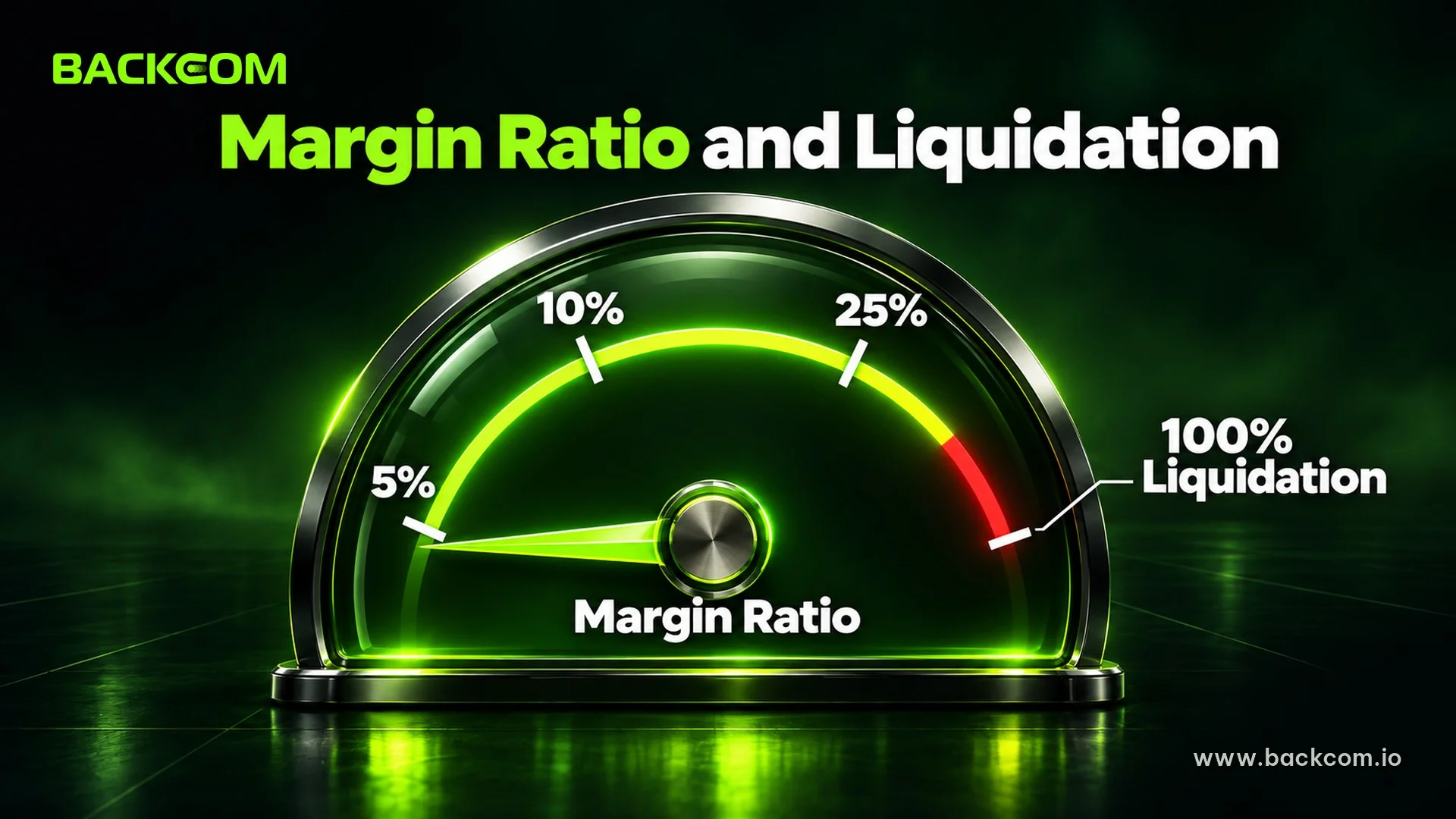
Margin ratio and liquidation are linked directly: the margin ratio measures how much of your margin balance the maintenance requirement is using. When it reaches 100%, the position is liquidated. Exchanges define and label the ratio differently, so check your platform, but the logic is consistent:
Margin Ratio ≈ Maintenance Margin ÷ Margin Balance
Margin Ratio Liquidation Example For A 10x Long
Using the 10x long from section 4, the margin balance starts at 10,000 and maintenance margin is 500. Here is how the ratio moves as price falls:
| BTC price | Unrealised PnL | Margin balance | Margin ratio |
|---|---|---|---|
| 100,000 | 0 | 10,000 | 5% |
| 95,000 | −5,000 | 5,000 | 10% |
| 92,000 | −8,000 | 2,000 | 25% |
| 90,500 | −9,500 | 500 | 100% |
The ratio does not climb in a straight line in practice. It accelerates, because each loss lowers the denominator. That is why the final stretch feels so much faster than the first. Three habits help you read it:
- Watch the ratio, not only the price. A 5% reading at entry and a 25% reading after an 8% fall describe very different risk.
- Know your platform's label. Some show a percentage, others show a margin level or a distance to liquidation.
- Expect volatility to jump the queue. In a fast wick, the ratio can move from 25% to 100% before you can react.
When many accounts hit this zone together, the result can be a liquidation cascade.
What Happens After The Warning
Many platforms send a warning when the ratio gets high, then close part or all of the position at the liquidation point. Our guide to a crypto margin call lists the warning signs. If the position is closed at a price worse than the bankruptcy price, an insurance fund may cover the shortfall.
6. How Do Margin Modes Change Initial And Maintenance Margin?
Margin mode decides which funds back the position. It does not change the formulas, but it changes how close you are to liquidation.
- Isolated margin: only the margin assigned to that position is at risk. Maintenance margin is checked against that amount alone.
- Cross margin: the whole account balance backs the position, so the buffer is larger, but a loss can drain everything.
Adding margin to an isolated position moves the liquidation level. In the 10x example, adding 2,000 USDT gives a margin balance of 12,000, so liquidation moves from 90,500 to 88,500 (12,000 − 11,500 = 500). Compare the trade-offs in cross margin vs isolated margin.
Position size matters too. If your notional value grows, you may move into a higher tier, and maintenance margin rises faster than the position itself. Some traders are caught out when they add to a winner and discover their buffer is thinner than before.
7. How Can You Use This To Manage Risk?
The practical rule is to decide your buffer before you choose your leverage. A short checklist:
- Set the stop first. Choose where the trade is wrong, then work backwards to size and leverage.
- Keep liquidation well beyond the stop. If liquidation is close to your stop, a wick can end the trade before your order fills.
- Check the live tier table. Look up the maintenance margin rate for your size and contract.
- Leave spare margin. Extra collateral widens the buffer without changing position size.
- Re-check after adding to a position. A larger notional can change the tier.
Several mistakes come up again and again:
- Treating initial margin as the amount you can afford to lose. The exchange acts at the maintenance level, long before your deposit is gone.
- Ignoring fees and funding. They reduce margin balance and bring liquidation closer than a simple formula shows.
- Comparing leverage settings across exchanges. Tier tables differ, so 20x on one platform is not the same risk as 20x on another.
- Copying the hypothetical 0.5% rate. It is a teaching number, not a live rate.
A small example shows why the last point matters. If the maintenance rate in the BTC example were 1% instead of 0.5%, maintenance margin would double to 1,000 USDT and the 10x long would be liquidated near 91,000 instead of 90,500. The position, leverage and entry are unchanged, yet the buffer is 500 USDT smaller.
Use the position size calculator guide to size from your stop, and read how to place a stop loss for placement mistakes. The futures leverage calculator guide shows how to combine margin, size and liquidation in one worksheet. For the exchange's own formula, see Bybit's liquidation price article.
Frequently Asked Questions (FAQ) About Initial And Maintenance Margin
Is Maintenance Margin Always Lower Than Initial Margin?
At normal leverage, yes. Initial margin is based on your leverage choice, while maintenance margin is based on tier rates and position size. At very high leverage the two get close, which leaves almost no buffer. Always read your exchange's live margin table.
Does Higher Leverage Change Maintenance Margin?
Not directly. Maintenance margin follows position size and tier rates. Higher leverage lowers your initial margin, so the buffer between the two shrinks and liquidation moves closer to your entry price.
What Happens If My Margin Balance Falls Below Maintenance Margin?
The exchange may liquidate part or all of your position, usually at the mark price. Binance advises reducing positions or adding margin before collateral falls below the maintenance margin. Rules and partial liquidation steps differ by platform.
Can I Avoid Liquidation By Adding Margin?
Often yes, if you add margin in time. In isolated mode, extra margin widens the buffer and moves the liquidation price away. In cross mode, a deposit raises the whole account balance. It does not protect you if price gaps through the level first.
Conclusion: Treat Maintenance Margin As Your Real Limit
Initial margin vs maintenance margin comes down to entry versus survival. Initial margin gets you in, maintenance margin decides when you are forced out, and the buffer between them is set by leverage. In the 1 BTC example, the same 500 USDT requirement left a 19,500 buffer at 5x but only 1,500 at 50x.
Before opening a futures trade, check the live tier table, calculate your liquidation price, and keep it well outside your stop. For a next step, read how a margin call works in practice.
Disclaimer: This content is compiled by Backcom.io for information only and is not investment advice. Crypto futures carry a high risk of loss, and liquidation can wipe out your margin. The figures above are illustrative and do not predict future results.
Was this article helpful?
Join The Backcom.io Community
Get the latest on trading rebates, trading tips, and broker deals — and connect with thousands of traders worldwide.

Backcom App
Track Your Rebates Every Day
Every rebate is visible by broker and by day. Manage your wallet and withdrawals in one place.
Open Backcom App