Crypto Futures Leverage Calculator: Margin, Position Size And Liquidation Examples


A crypto futures leverage calculator turns three inputs, your margin, your leverage and the entry price, into the numbers that decide the trade: position size, locked margin and the price where the exchange closes the position for you. The arithmetic is simple enough to check by hand. In this article, Backcom.io walks through the four formulas behind every calculator and shows where leverage quietly changes your risk. The Bitcoin example uses real Binance price data.
What Is A Crypto Futures Leverage Calculator?
A crypto futures leverage calculator converts margin and leverage into a position size, and a position size back into the margin an exchange will lock. A leverage calculator for crypto predicts nothing. It runs the same sums the exchange runs when you press Buy or Sell, so you see the cost before the order exists.
Inputs And Outputs Of A Leverage Calculator Crypto Traders Use
Any leverage calculator crypto traders open takes some mix of these inputs and returns some mix of these outputs:
- Inputs: margin you allocate, leverage multiple, entry price, direction (long or short), and sometimes a stop price and account balance.
- Outputs: notional value, position size in coins, initial margin, an approximate liquidation price and the profit or loss at a target price.
Five terms appear in every tool, so it helps to fix them first:
| Term | Meaning | Example |
|---|---|---|
| Notional value | Full value of the position: quantity × price | 0.1587 BTC × 63,000 ≈ 10,000 USDT |
| Initial margin | Collateral locked to open the position | 1,000 USDT |
| Leverage | Notional value ÷ margin on that position | 10x |
| Maintenance margin | Minimum collateral needed to keep it open | 0.4% of notional (assumed) |
| Liquidation price | Price where margin falls to the maintenance level | 56,952 USDT for a long |
Reference figures for illustration only. Real maintenance rates depend on the exchange and the position tier.
If leverage itself is still new to you, start with our primer on what leverage in crypto trading is and how risky it is, then come back for the numbers.
Initial Margin Crypto Futures Formula: How To Calculate It
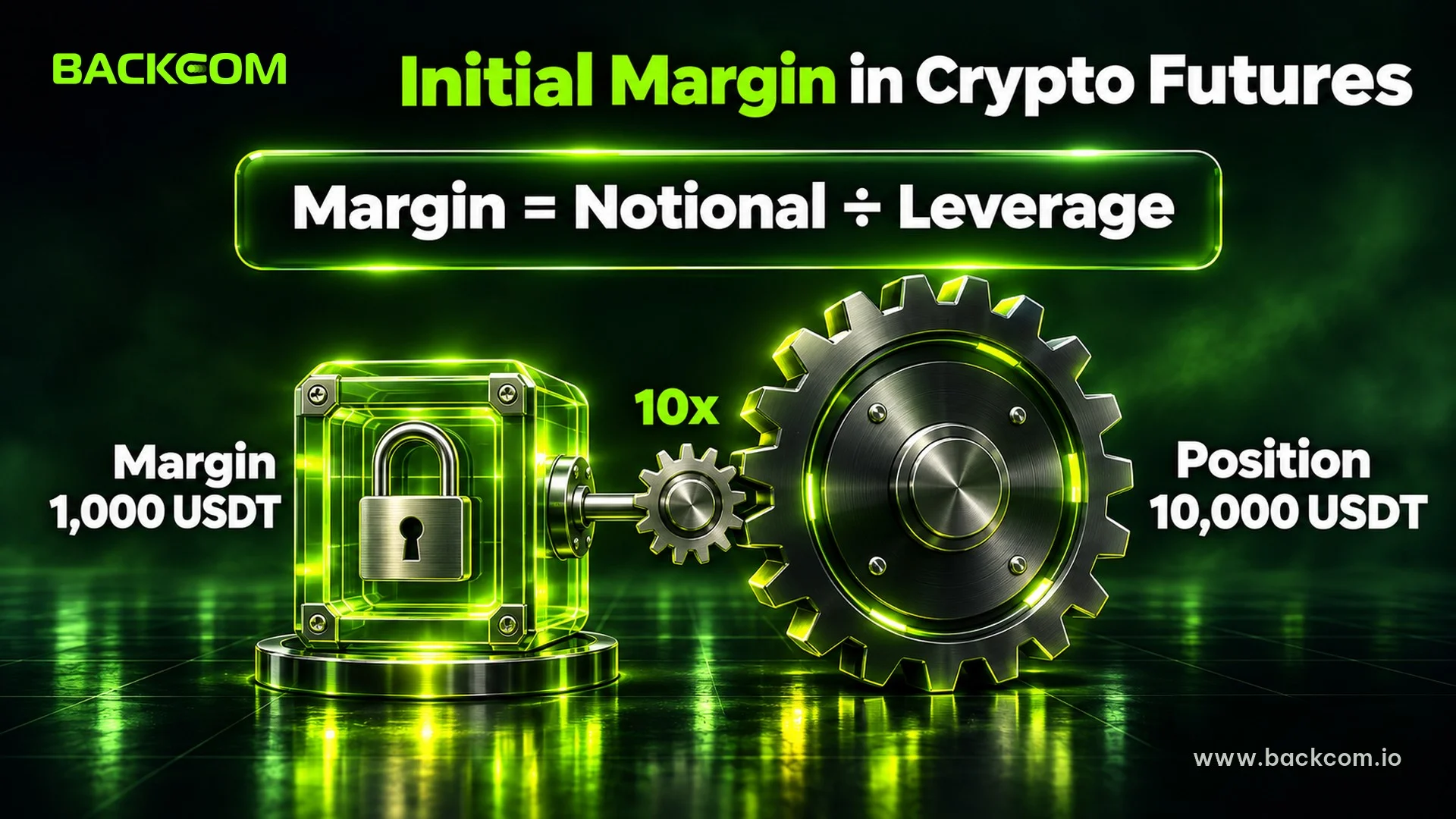
The initial margin crypto futures exchanges lock is the collateral taken when you open a position, and it equals the notional value divided by the leverage. According to the Binance USDⓈ-M Futures margin FAQ, the initial margin is determined by the leverage you select, and position sizes are calculated on the contract's notional value. These are the four formulas every calculator uses:
Notional value = Quantity × Entry price
Initial margin = Notional value ÷ Leverage
Quantity = (Margin × Leverage) ÷ Entry price
Approximate long liquidation price = Entry price × (1 − 1 ÷ Leverage + Maintenance margin rate)
The last formula is the isolated-margin shortcut we derive in our guide to how to calculate liquidation price. It uses the first maintenance tier only and leaves out fees and funding. For a short, flip the signs.
Worked Example: 1,000 USDT At 10x On Bitcoin
Binance's BTCUSDT daily candle closed at 63,068.22 on 18 November 2026. We round the entry to 63,000 so the sums stay readable. Suppose you allocate 1,000 USDT of isolated margin and choose 10x:
- Notional value: 1,000 × 10 = 10,000 USDT.
- Position size: 10,000 ÷ 63,000 = 0.1587 BTC.
- Initial margin check: 10,000 ÷ 10 = 1,000 USDT, which matches the margin you allocated.
- Liquidation price (long): 63,000 × (1 − 0.1 + 0.004) = 56,952 USDT, a drop of about 9.6%.
- Profit or loss per 1% move: 1% of 10,000 = 100 USDT, which is 10% of your margin.
That last line is the heart of leverage. A 1% price move changes your margin by 1% × leverage, in either direction.
Source for prices: Binance BTCUSDT daily candles, retrieved 19 November 2026. The 0.4% maintenance rate is an assumption, not a quoted tier. Past prices are not a forecast.
How Does A Futures Margin Calculator Change With Leverage?
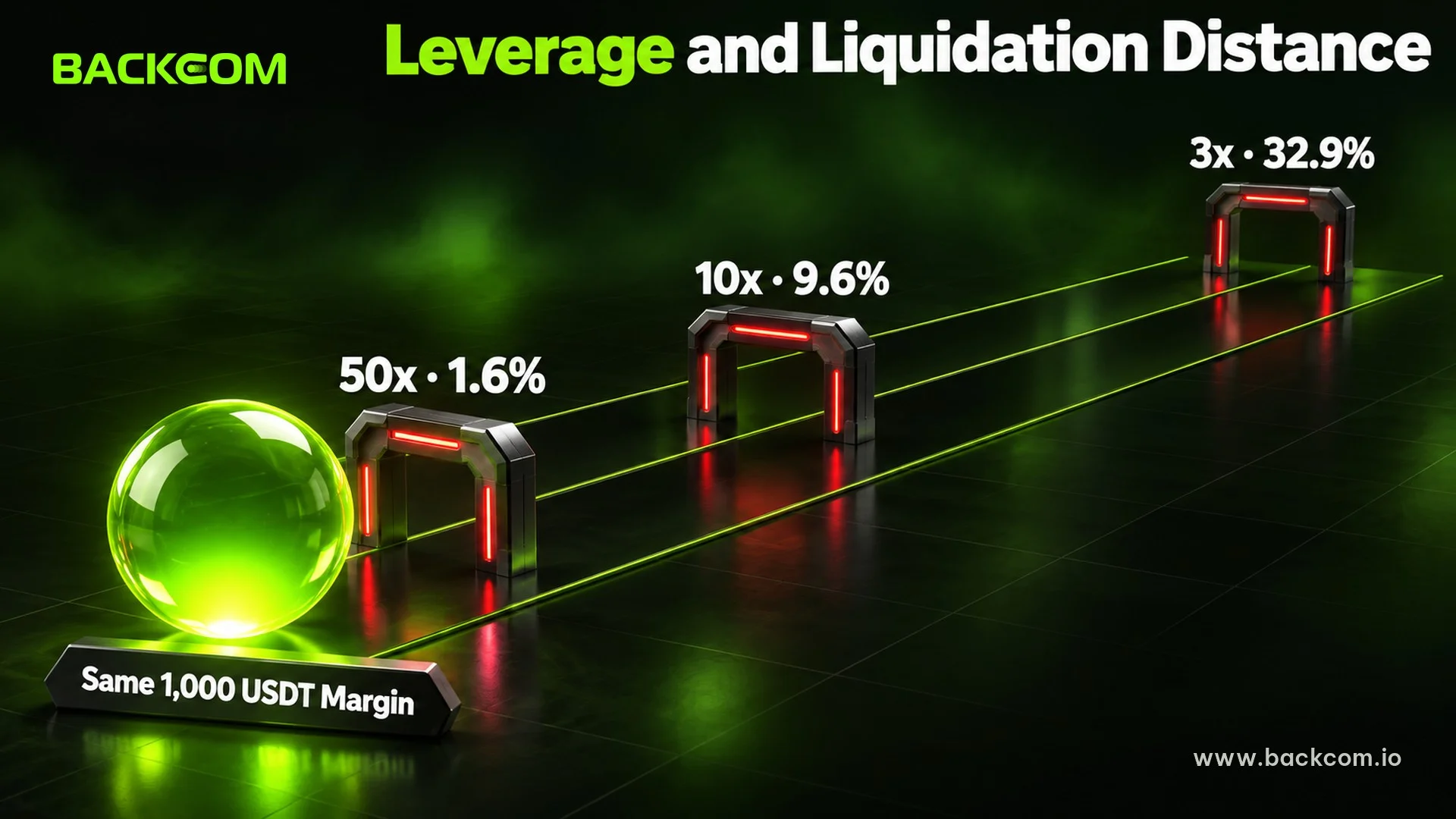
A futures margin calculator shows that higher leverage does not change what you can lose on the position; it lets the same margin control a bigger notional value and moves the liquidation price closer. Keep the 1,000 USDT margin and the 63,000 entry, and change only the leverage:
| Leverage | Notional value | Position size | Long liquidation price | Distance from entry |
|---|---|---|---|---|
| 3x | 3,000 USDT | 0.0476 BTC | 42,252 | 32.9% |
| 5x | 5,000 USDT | 0.0794 BTC | 50,652 | 19.6% |
| 10x | 10,000 USDT | 0.1587 BTC | 56,952 | 9.6% |
| 20x | 20,000 USDT | 0.3175 BTC | 60,102 | 4.6% |
| 50x | 50,000 USDT | 0.7937 BTC | 61,992 | 1.6% |
Reference calculation at an entry of 63,000 USDT with an assumed 0.4% maintenance rate. Exchange tiers, fees and funding will move the real figures.
Two patterns stand out. First, the margin never changes, so the amount you can lose in the position stays the same while the room for the price to move shrinks from 32.9% to 1.6%. Second, the distance to liquidation is roughly 1 ÷ leverage minus the maintenance rate, which is why 50x leaves almost no breathing room.
Exchanges also cap leverage by position size. Binance states that the maximum leverage depends on the notional value of your position, so larger positions allow lower leverage. A calculator that ignores position size can therefore show a leverage level you cannot actually select.
How To Work Out Position Size With Leverage From Your Risk
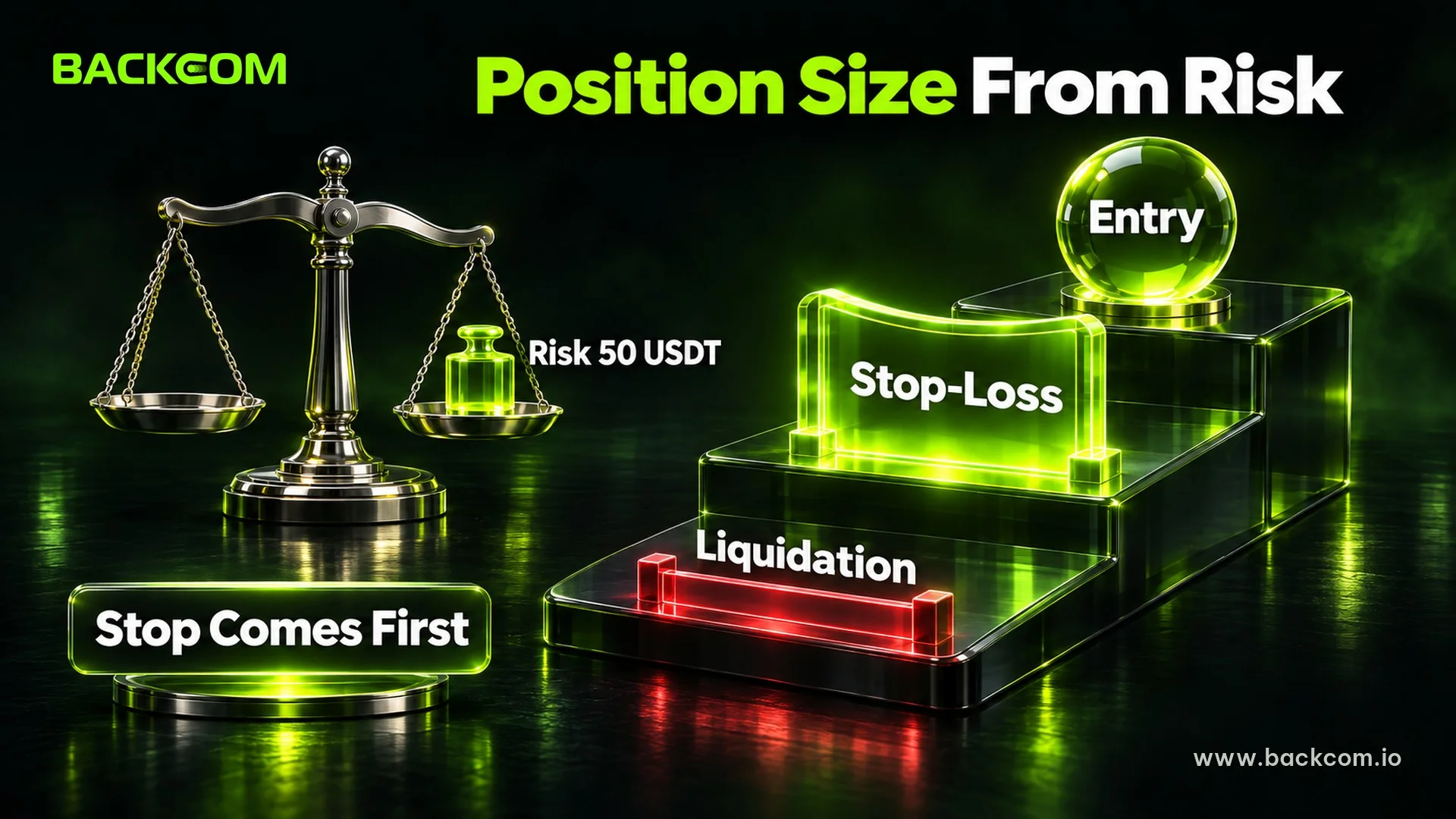
Position size with leverage should start from the loss you accept, not from the leverage you like. Leverage then only decides how much margin you lock for that size. The method has four steps:
- Decide the risk in money, for example 1% of the account.
- Set the stop-loss price from the chart, not from the margin.
- Divide the risk by the stop distance to get the quantity.
- Choose the leverage last, and check the margin it requires.
Quantity = Risk in USDT ÷ (Entry price − Stop price)
Here is a worked case. The account holds 5,000 USDT, you risk 1% (50 USDT), you enter a long at 63,000 and set the stop 2% below at 61,740:
- Stop distance: 63,000 − 61,740 = 1,260 USDT per BTC.
- Quantity: 50 ÷ 1,260 = 0.0397 BTC.
- Notional value: about 2,500 USDT (the 50 USDT risk divided by the 2% stop distance).
- Leverage on the whole account: 2,500 ÷ 5,000 = 0.5x.
At 10x this position locks 250 USDT of margin; at 5x it locks 500 USDT. Either way, if the stop is hit you lose about 50 USDT. Assuming a 0.05% taker fee on each side, the round trip adds about 2.50 USDT (1.25 on entry and 1.25 on exit), so the real loss is closer to 52.50. Our guide to calculating crypto futures trading fees covers that layer in detail.
Check The Stop Against The Liquidation Price
A stop-loss only protects you if it sits between the entry and the liquidation price. For this long, the 10x liquidation price is 56,952, far below the 61,740 stop, so the stop triggers first. At 50x, the liquidation price is 61,992, which is above the stop. The exchange would close the position before your stop ever fires.
The break-even point follows from the distance formula. The stop is 2% away, so liquidation sits beyond it only while 1 ÷ leverage minus 0.4% stays above 2%. That holds up to about 41x, and a sensible buffer means choosing a leverage well under that. For the full sizing method, see our crypto position size calculator guide, and for stop placement read crypto stop loss explained.
What Recent Bitcoin Prices Show About Leverage Levels
A calculator is abstract until you hold it against a real price path. We take the Binance BTCUSDT daily candles from 16 to 18 November 2026. The high on 16 November was 65,696.16 and the low on 18 November was 62,062.97, a fall of 5.53% in three days.
Imagine a long opened at that 16 November high, chosen with hindsight to show the harsh case:
| Leverage | Liquidation price (assumed 0.4% rate) | Lowest price reached | Outcome |
|---|---|---|---|
| 10x | 59,389 | 62,062.97 | Survives; unrealised loss about 55% of margin at the low |
| 20x | 62,674 | 62,062.97 | Liquidated; the low is below the liquidation price |
Source: Binance BTCUSDT daily candles retrieved 19 November 2026. These are spot candle prices, not the mark price exchanges use for liquidation, so this is an illustration and not a record of any real account.
The same market move wiped out the 20x position and left the 10x position alive but badly hurt. Neither outcome needed a crash, only a dip of about 5.5%. That is why leverage above 10x should be a deliberate choice with a narrow margin for error.
Four Calculator Mistakes That Make Leverage Look Safer Than It Is
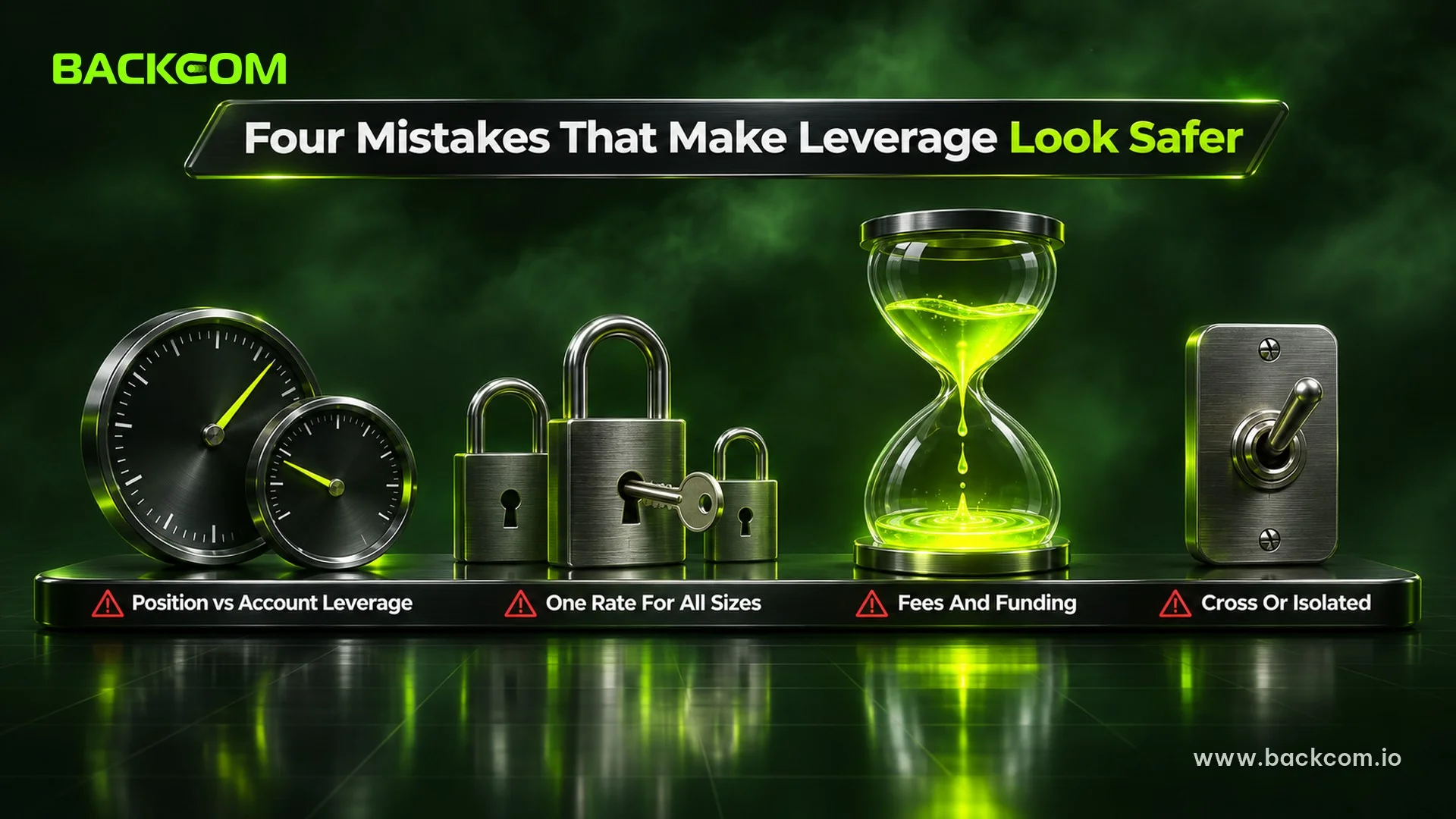
Most losses blamed on "bad luck" come from calculator inputs that did not match what the exchange does. Watch for these four:
- Mixing position leverage with account leverage. A 10x position on a 31,500 USDT notional uses 3,150 USDT of margin, but against a 5,000 USDT account it is 6.3x exposure. Each 1% price move changes the account by 6.3%.
- Using one maintenance rate for every size. Maintenance margin is the notional value times a rate minus a fixed amount, and the rate steps up with position size. Large positions liquidate sooner than the shortcut formula says.
- Ignoring fees and funding. Perpetual contracts settle a funding payment at regular intervals, every 8 hours by default on Binance and as often as every hour on some contracts, as the Binance funding rate FAQ explains. Our explainer on the funding rate shows how a long hold can erode margin even if the price barely moves.
- Forgetting how the margin mode works. Under cross margin the whole wallet backs the position, so the liquidation price sits much further away but you can lose far more than you set aside. Compare both modes in cross margin vs isolated margin.
If the exchange warns that your margin ratio is rising, that is the margin call stage, which we describe in crypto margin call explained. You can also run your own sizing sums with the free position size calculator.
Frequently Asked Questions (FAQ) About Crypto Futures Leverage Calculators
What Is The Formula For A Crypto Futures Leverage Calculator?
The core formula is initial margin = notional value ÷ leverage, where notional value is quantity times entry price. Rearranged, quantity equals margin times leverage divided by price. A liquidation estimate then adds the maintenance margin rate. These sums use only division and multiplication, so you can verify any online tool with a phone calculator.
Does Higher Leverage Mean Paying More Margin?
No. Higher leverage means less margin for the same position. A 10,000 USDT position needs 2,000 USDT at 5x but only 200 USDT at 50x. The catch is the liquidation distance, which shrinks as leverage rises, so a smaller margin buys a much thinner safety cushion.
How Much Leverage Should I Use In Crypto Futures?
There is no universal number, and this is not advice. A practical rule is to set your stop first, then pick a leverage whose liquidation price sits well beyond it. In our example the stop sat 2% from entry, which made anything above roughly 41x unworkable and left 10x or lower with a clear buffer.
Is The Liquidation Price From A Calculator Exact?
No, it is an estimate. The exchange uses the mark price, its own maintenance tiers, fees and any margin you add later. Treat a calculator result as a rough guide and read the figure on your order ticket before you confirm. If the two differ, trust the exchange's number.
Conclusion
A crypto futures leverage calculator is only four formulas: notional value, initial margin, quantity and an approximate liquidation price. The numbers that matter most are not the largest leverage the platform offers but the distance to liquidation, the stop placed before it and the leverage across the whole account. Work out the position from the loss you accept, then pick the lowest leverage that supports it, and check the result against your exchange's own order ticket.
Disclaimer: This content is compiled by Backcom.io for information only and is not investment advice. Leveraged crypto futures can lose more than you expect and may result in the loss of your entire margin. All examples use assumed or past prices and do not predict future results.
Was this article helpful?
Join The Backcom.io Community
Get the latest on trading rebates, trading tips, and broker deals — and connect with thousands of traders worldwide.

Backcom App
Track Your Rebates Every Day
Every rebate is visible by broker and by day. Manage your wallet and withdrawals in one place.
Open Backcom App