Funding Rate Arbitrage Crypto: How The Strategy Works, Costs And Risks

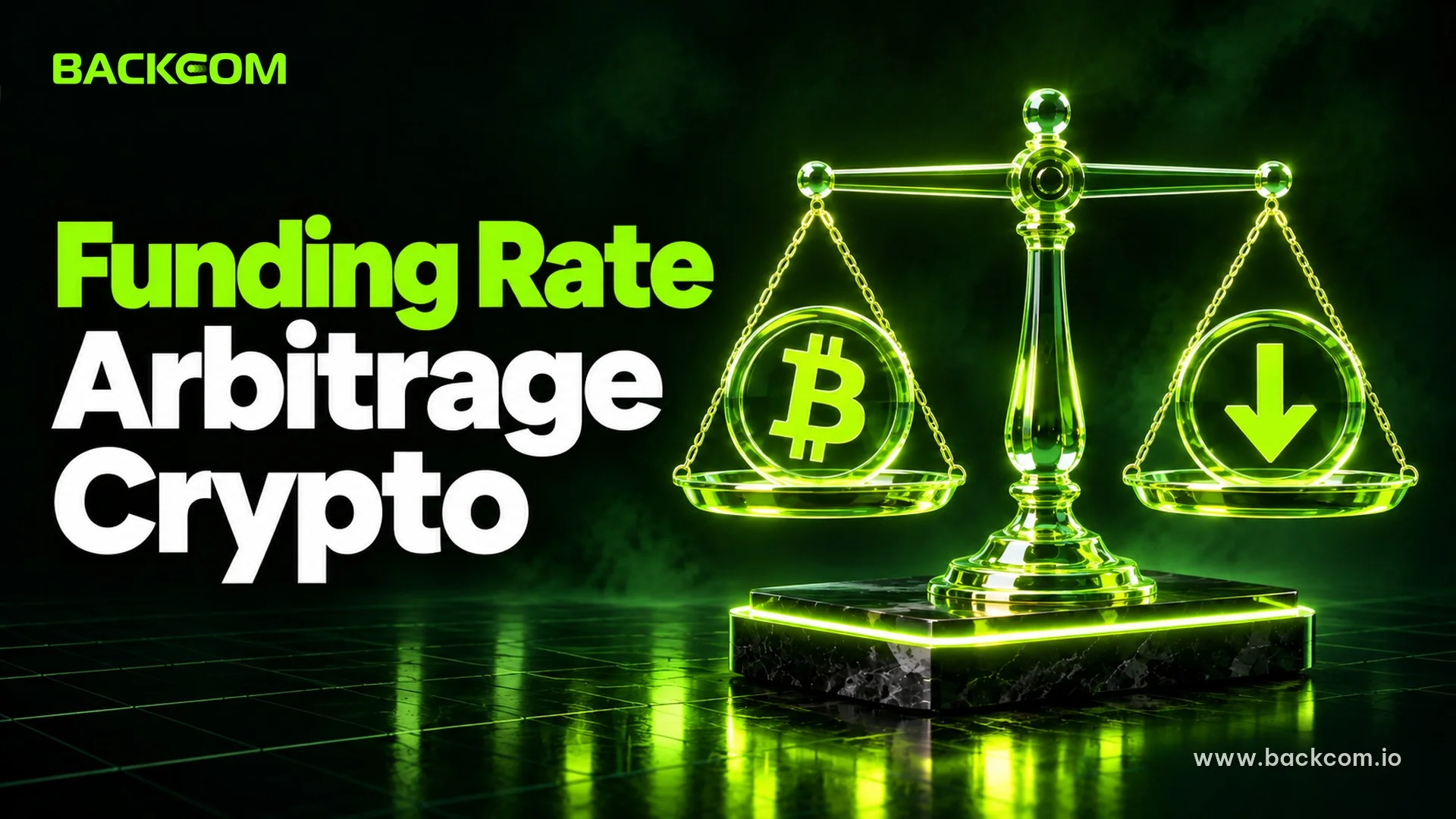
Funding rate arbitrage crypto strategies are often described as a way to earn steady income with no view on price. The idea is real, but the label "arbitrage" hides costs, margin requirements and a few ways the trade can turn against you. Funding rate arbitrage in crypto means holding spot and an opposite perpetual futures position of equal size, so price moves cancel and the periodic funding payment becomes the result. In this article, Backcom.io explains how the strategy works, walks through a hypothetical example with costs, and lists the risks that decide whether it pays.
1. What Is Funding Rate Arbitrage In Crypto?
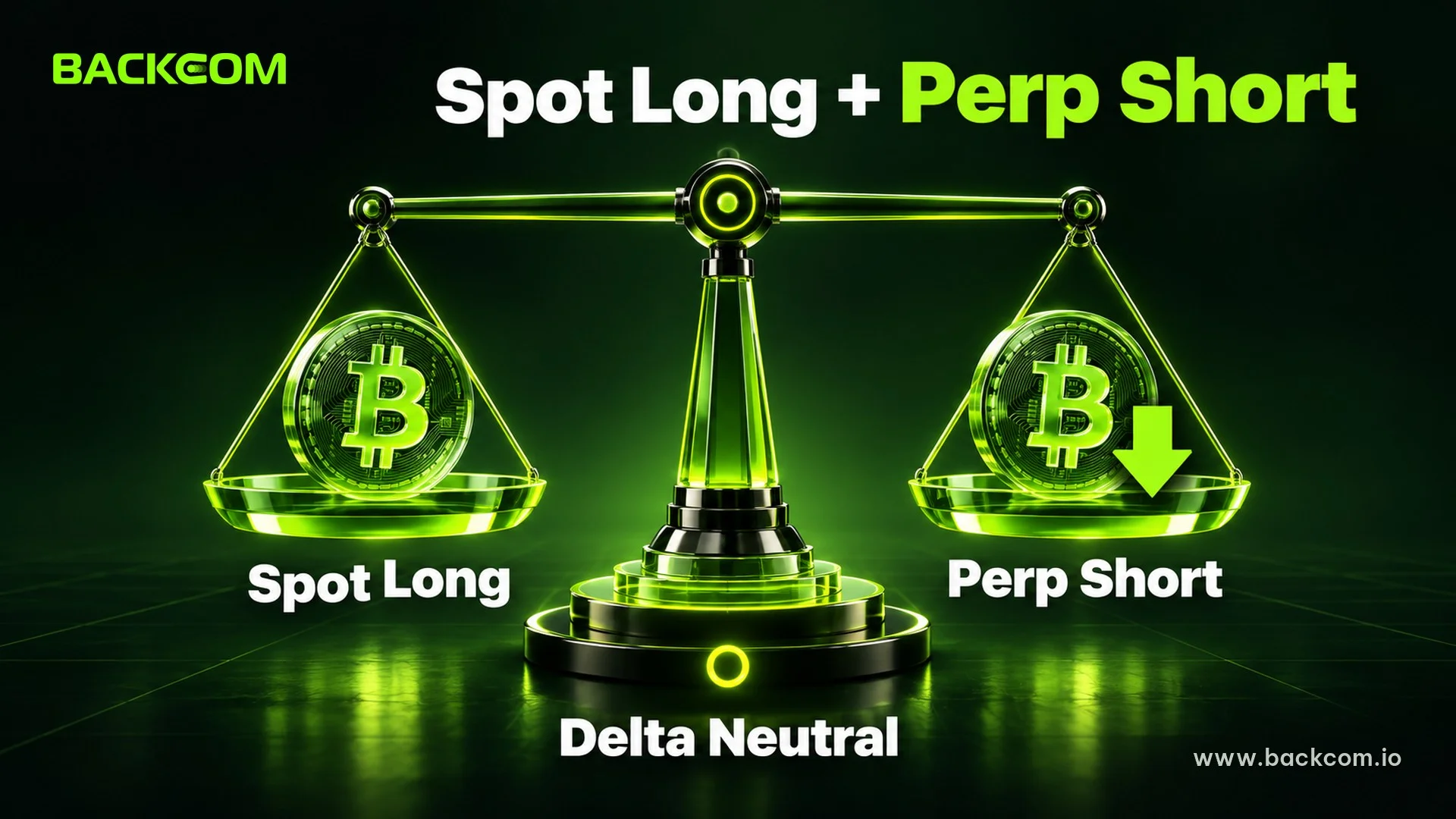
Funding rate arbitrage is a delta-neutral strategy that collects funding payments instead of betting on direction. Perpetual futures have no expiry date, so exchanges use a periodic payment between traders to keep the contract price close to spot. When the funding rate is positive, long holders pay short holders. According to the Binance Futures funding rate FAQ, the exchange does not charge a fee on these payments; they pass directly between traders on opposite sides.
The strategy uses that flow. A trader buys the coin on the spot market and opens a short perpetual position of the same notional value. If the price rises, the spot gain offsets the short loss; if it falls, the reverse happens. Kraken's funding rate arbitrage guide describes the same structure: price moves roughly cancel, and the funding payment is the profit or loss that remains.
Two related terms are worth separating:
- Funding rate: the periodic payment between longs and shorts. Our funding rate guide explains how it is calculated.
- Delta neutral: a position whose value does not change much when the price moves, because the two legs offset each other.
The same idea is called cash and carry in traditional futures markets: buy the asset in the spot market and sell it in the futures market at the same time. OKX's funding rate arbitrage article describes cash and carry in these terms. With perpetual futures the "carry" is the funding payment instead of the gap to an expiry date.
If you are new to the contract itself, start with our explainer on perpetual futures.
2. How Does The Delta Neutral Funding Strategy Work Step By Step?
The strategy has four steps, and the last one never ends while the trade is open. The numbering below follows the order a trader would use.
- Find a persistently positive funding rate. Positive funding means shorts are being paid. A rate that is positive for one interval and negative for the next is a poor candidate.
- Buy the coin on spot. This is the long leg and it needs the full notional value in cash or stablecoins.
- Open a short perpetual position of equal notional value. This is the hedge. It also needs margin, which is a second pool of capital.
- Collect funding and keep the hedge balanced. Funding is paid at each interval for as long as you hold the short at the settlement time, and you must watch margin and re-balance when prices move.
According to Binance, positions are settled by default every 8 hours at 00:00, 08:00 and 16:00 UTC. Kraken notes that some regions use hourly intervals instead. Binance also states that you pay or receive funding only if you hold a position at the settlement time; closing before then means no payment either way.
Funding Amount = Nominal Value Of Position × Funding Rate
That formula comes from Binance's documentation. The nominal value is the mark price multiplied by the contract size, so the payment grows with the position even when the margin you posted stays the same.
3. How Is The Funding Rate Calculated And Why Does It Turn Positive?
The funding rate has two parts: an interest rate component and a premium component. Binance sets the interest rate at 0.03% per day by default, or 0.01% per 8-hour interval. The premium index measures how far the perpetual price sits above or below the index price, sampled every five seconds and averaged over the interval.
When the perpetual trades well above spot, which usually happens when many traders are buying with leverage, the premium is positive and the funding rate rises. Binance states that while the premium stays within a narrow band around zero, the funding rate sits at the 0.01% interest component. That value is the base case for the examples below.
Caps also matter. Binance lists a cap and floor tied to the maintenance margin ratio for its major contracts and a cap of 2% for other USD-margined perpetuals, and it has moved some contracts that hit the limit to shorter settlement intervals. Rules differ by exchange and change over time, so always read the current contract page. Our guide to open interest shows one way to judge how crowded a side has become.
4. How Much Can Funding Rate Arbitrage Crypto Trades Earn After Costs?
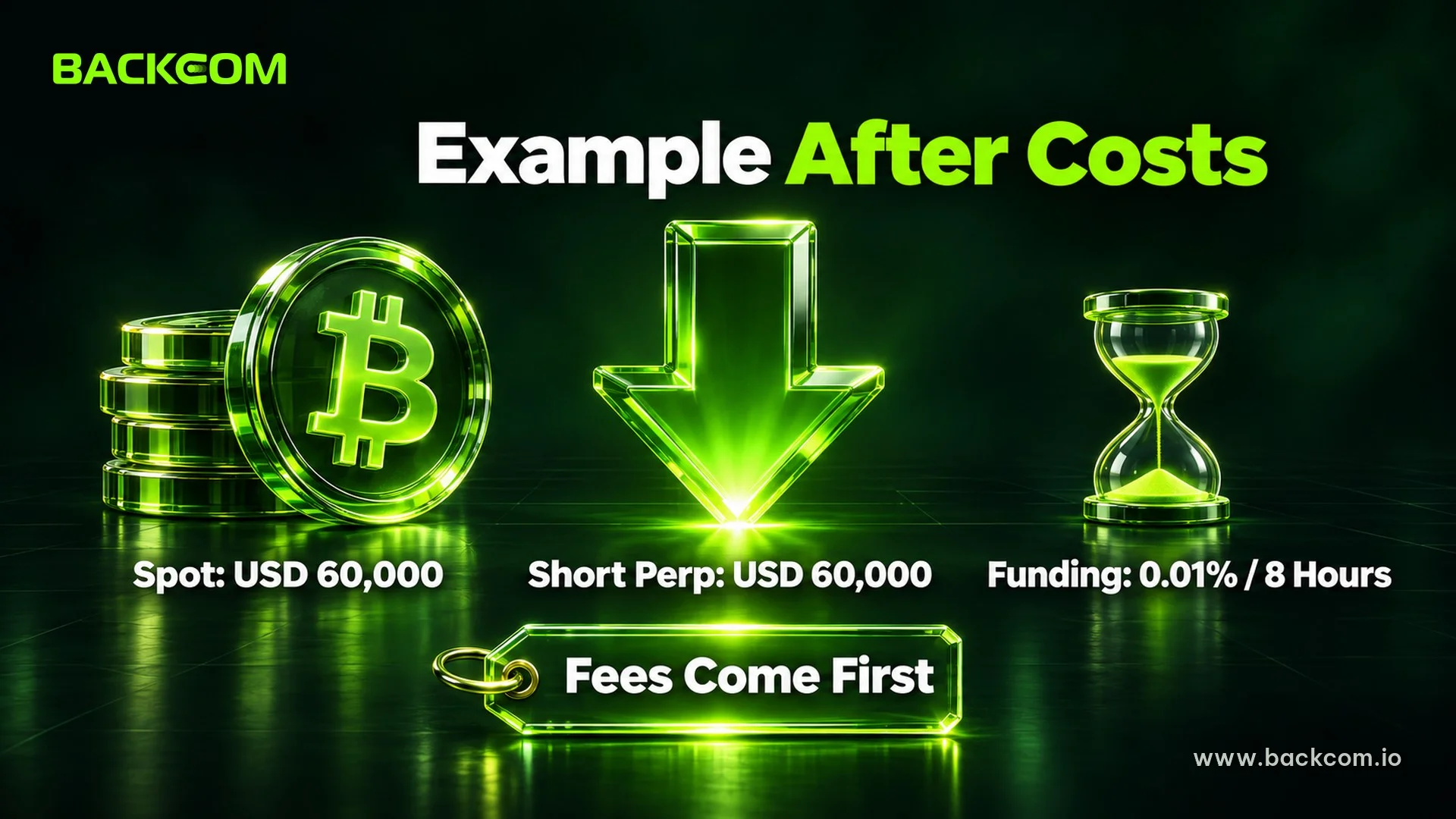
The example below uses hypothetical numbers. It shows the structure of the calculation, not a forecast and not a recommendation. Assume Bitcoin trades at USD 60,000 and a trader holds 1 BTC on spot against a short perpetual of the same size.
| Item | Amount |
|---|---|
| Spot position (1 BTC) | USD 60,000 |
| Short perpetual notional | USD 60,000 |
| Margin posted at 3x leverage | USD 20,000 |
| Total capital tied up | USD 80,000 |
| Funding rate | 0.01% per 8 hours |
| Funding collected per day (3 payments) | USD 18 |
| Round-trip fees, both legs (0.04% of notional) | USD 24 |
At 0.01% per interval the trade earns USD 18 a day before costs, so it needs about 1.3 days of funding just to cover the USD 24 of round-trip fees. Kraken's own worked example uses the same 0.04% fee assumption. It shows that at 0.05% per interval the strategy covers costs with room to spare, while at 0.01% per interval the daily funding does not cover costs for a short holding period.
Return on capital looks lower than the headline rate suggests:
Daily return on capital = USD 18 ÷ USD 80,000 = 0.0225%
Over a year that is roughly 8% before fees and slippage, assuming the rate never changes, which it will. Kraken's example turns 0.15% per day into about 55% a year on notional, but that figure assumes a rate that stays high and ignores the margin pool. Annualised numbers are arithmetic, not promises. See our guide on how to calculate crypto futures trading fees to build your own version with the fee schedule of your exchange.
5. Which Funding Arbitrage Fees And Margin Costs Eat Into The Income?
Costs are the reason many positive-funding trades lose money. The main ones are:
- Trading fees on both legs: you pay on the spot buy, the perpetual short and again when you close each. Our explanation of maker versus taker fees shows why order type changes this cost.
- Slippage and spread: two orders must fill at nearly the same time, and a thin book can move the price between them.
- Opportunity cost of margin: Kraken points out that the margin held for the short perpetual could be used elsewhere.
- Withdrawal and transfer fees: moving funds between wallets or exchanges adds a cost that a quick calculation often leaves out.
- Funding when it turns against you: a negative payment is a cost, not just a missed gain.
If the trade is held for a short time at a low funding rate, costs can exceed income. Kraken makes the same point: at low funding rates these holding costs can exceed the funding collected.
6. What Is The Negative Funding Rate Risk For This Strategy?
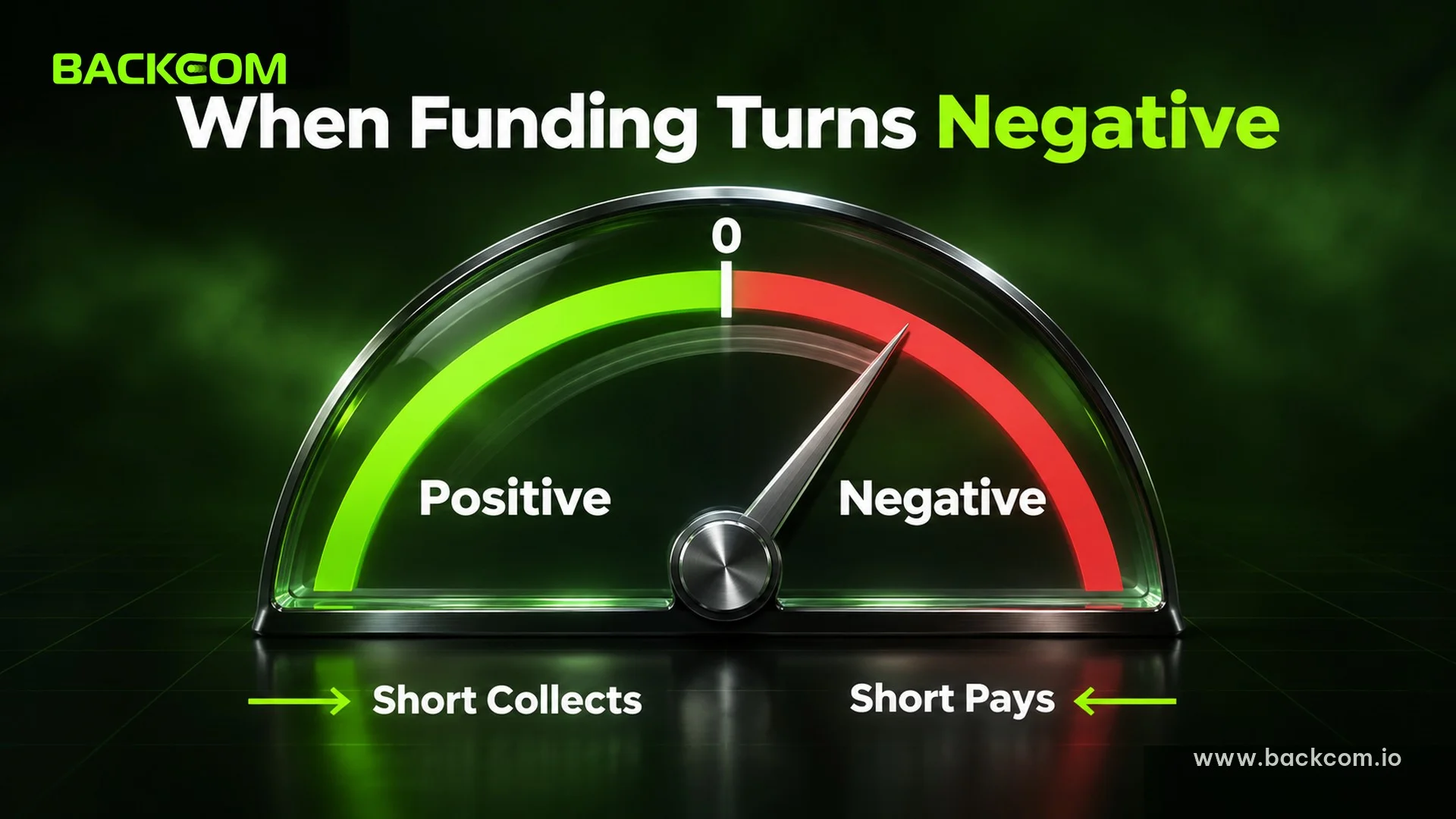
Negative funding rate risk means the short leg starts paying instead of collecting. When the rate turns negative, shorts pay longs. A spot-long, perpetual-short position then loses money on funding while the hedge still ties up margin.
A trader can exit, or reverse the trade by going long the perpetual and short spot. The reverse needs a way to borrow and sell the coin, which many spot venues do not offer to retail users, and borrowing carries its own interest. Kraken notes that the strategy is least viable when the market is strongly directional, because funding trends can shift quickly during those moves.
Funding often changes sign when the market mood changes, so the rate you saw at entry is a snapshot. Treat any funding history as context rather than a promise about the next payment, and decide in advance at what rate you will close the trade.
7. What Other Risks Can Break The Hedge?
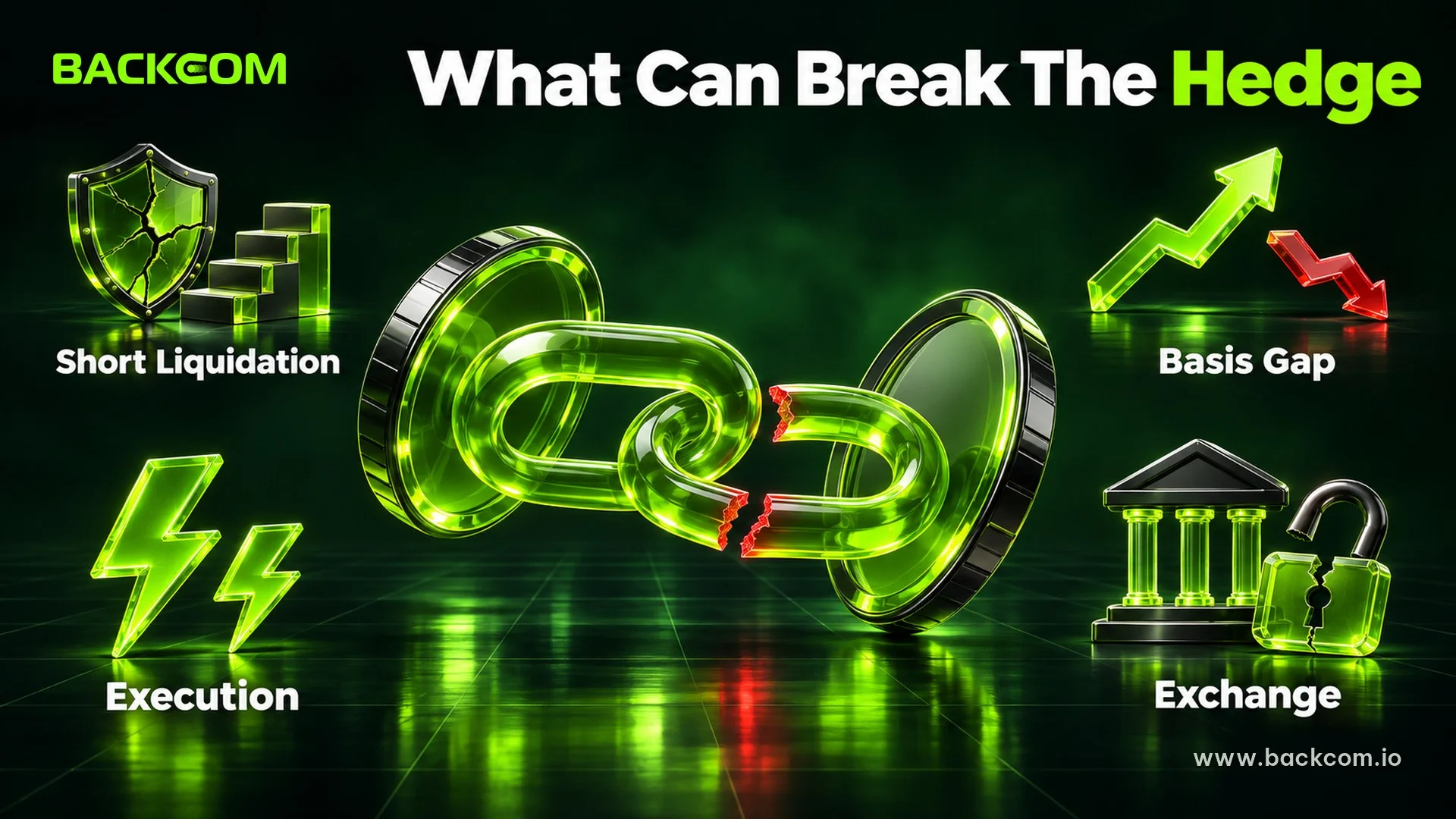
A delta-neutral position is neutral only while both legs stay open and correctly sized. Four risks deserve attention.
Liquidation Of The Short Leg
The short perpetual is margined, the spot coin is not. If the price rallies sharply, the short loses value quickly while the gain sits in spot, which cannot be used to top up margin unless you move funds. At 3x isolated leverage, a rise of roughly 30% would put the short close to liquidation in the example above. Our guides on how to calculate liquidation price and cross versus isolated margin show how to size a buffer. A margin call is the warning stage before that point.
Basis Risk
Spot and perpetual prices can move apart. Kraken notes that basis can widen during high volatility or forced selling. The related idea of the futures premium is covered in our article on what basis trading is in crypto.
Execution Risk
If one leg fills and the other does not, you hold a directional position for a short time. Partial fills and delays are the usual cause.
Exchange And Counterparty Risk
Both legs usually sit on the same exchange. A withdrawal freeze, an outage or an insolvency affects the whole trade at once. Kraken's own disclaimer warns that crypto products and services may not be covered by investor-compensation or deposit-protection schemes, so check what protection, if any, applies to the platform you use. Stablecoin collateral adds a further layer; see our article on what a stablecoin is.
8. What Should You Check Before Trying It?
Work through this list before putting money in:
- Read the contract page. Confirm the funding interval, caps, fee tiers and how funding is taken from your balance. Binance states that funding comes from the available futures balance first and then from position margin, which can move your liquidation price.
- Calculate break-even. Divide round-trip fees by the funding you expect per day. If that number is large, the trade needs luck.
- Size the margin buffer. Use less leverage on the short and hold spare funds to add margin.
- Set an exit rule. Decide the funding level, or the number of negative payments, at which you close both legs.
- Practise small. Use the smallest size or a demo environment, since fills and fees are hard to judge on paper.
- Check the rules where you live. Derivatives are restricted in some countries, and tax treatment differs by country of residence.
Frequently Asked Questions (FAQ) About Funding Rate Arbitrage
Is Funding Rate Arbitrage Risk-Free?
No. The structure removes most price risk, but margin, funding reversals, costs and exchange risk remain. Some educational pages use phrases such as "risk-free", yet even Kraken states the trade is not risk-free. Treat that wording as marketing, not as a guarantee.
How Much Money Do You Need For A Delta Neutral Funding Strategy?
You need capital for both legs: the full spot value plus margin on the perpetual. In the example, USD 80,000 supported a USD 60,000 position at 3x leverage. Smaller sizes work mechanically, but fixed costs and minimum order sizes weigh more heavily on small accounts.
What Happens If The Funding Rate Turns Negative?
The short perpetual starts paying funding to longs. You can close the trade, accept the cost for a while, or reverse the position if you can short spot. Whichever you choose, the payment is real money, so plan the exit before you enter.
Does Funding Arbitrage Work On Every Coin?
No. It needs liquid spot and perpetual markets for the same coin. Illiquid coins have wide spreads, higher slippage and more volatile funding, and they are harder to hedge cleanly.
Is Funding Rate Arbitrage Legal Everywhere?
Not necessarily. Rules on crypto derivatives and on the use of foreign platforms vary by country, and some places restrict them entirely. Check the rules for your country of residence before trading.
Conclusion: Funding Income Is Real, But So Are The Costs
Funding rate arbitrage crypto strategies turn the funding mechanism into income by pairing spot with an opposite perpetual position. The worked example shows why the headline rate misleads: fees, margin and a rate that can change sign decide whether the trade pays. Before you try it, read the contract rules, calculate break-even, and size the margin so that a sharp rally does not close the hedge for you. To go deeper, read our guides on spot versus futures trading and what leverage is in crypto trading.
Disclaimer: This content is compiled by Backcom.io for information only and is not investment advice. Crypto derivatives carry a high risk of loss, including the loss of your entire investment. The numbers in the worked example are hypothetical, and past funding rates do not predict future results.
Was this article helpful?
Join The Backcom.io Community
Get the latest on trading rebates, trading tips, and broker deals — and connect with thousands of traders worldwide.

Backcom App
Track Your Rebates Every Day
Every rebate is visible by broker and by day. Manage your wallet and withdrawals in one place.
Open Backcom App