How To Read A Crypto Order Book: Bids, Asks, Depth And Spread

A crypto order book is the live list of buy and sell orders waiting at every price on an exchange. Every trade you make either joins that list or eats from it. If you learn how to read a crypto order book, you can judge trading costs, thin markets and misleading price levels before you click buy or sell. In this article, Backcom.io explains bids, asks, the spread and depth, with a real BTCUSDT snapshot, a worked market-order example and the limits of the data.
1. What Is A Crypto Order Book And What Does It Show?

A crypto order book is a real-time table of resting limit orders, split into buyers on one side and sellers on the other. Each row shows a price and the quantity waiting there. Nothing in the table has traded yet. Trades happen only when an incoming order meets an order already in the book.
Binance Academy describes the layout in plain terms: buy orders (bids) are listed from the highest to the lowest price, and sell orders (asks) from the lowest to the highest price. See its explainer on what an order book is and how it works for the standard layout.
Why The Order Book Matters To You
The book tells you three practical things before you trade:
- The real entry price: the best bid and best ask, not the last traded price.
- The cost of crossing the market: how far apart the two sides are.
- How much size you can trade without moving price: how thick the book is near the market.
It also explains why a market order can fill worse than the price on your screen. Our guide to what slippage is in crypto trading covers that cost in detail.
2. How To Read A Crypto Order Book: What Do Bids, Asks And The Spread Mean?
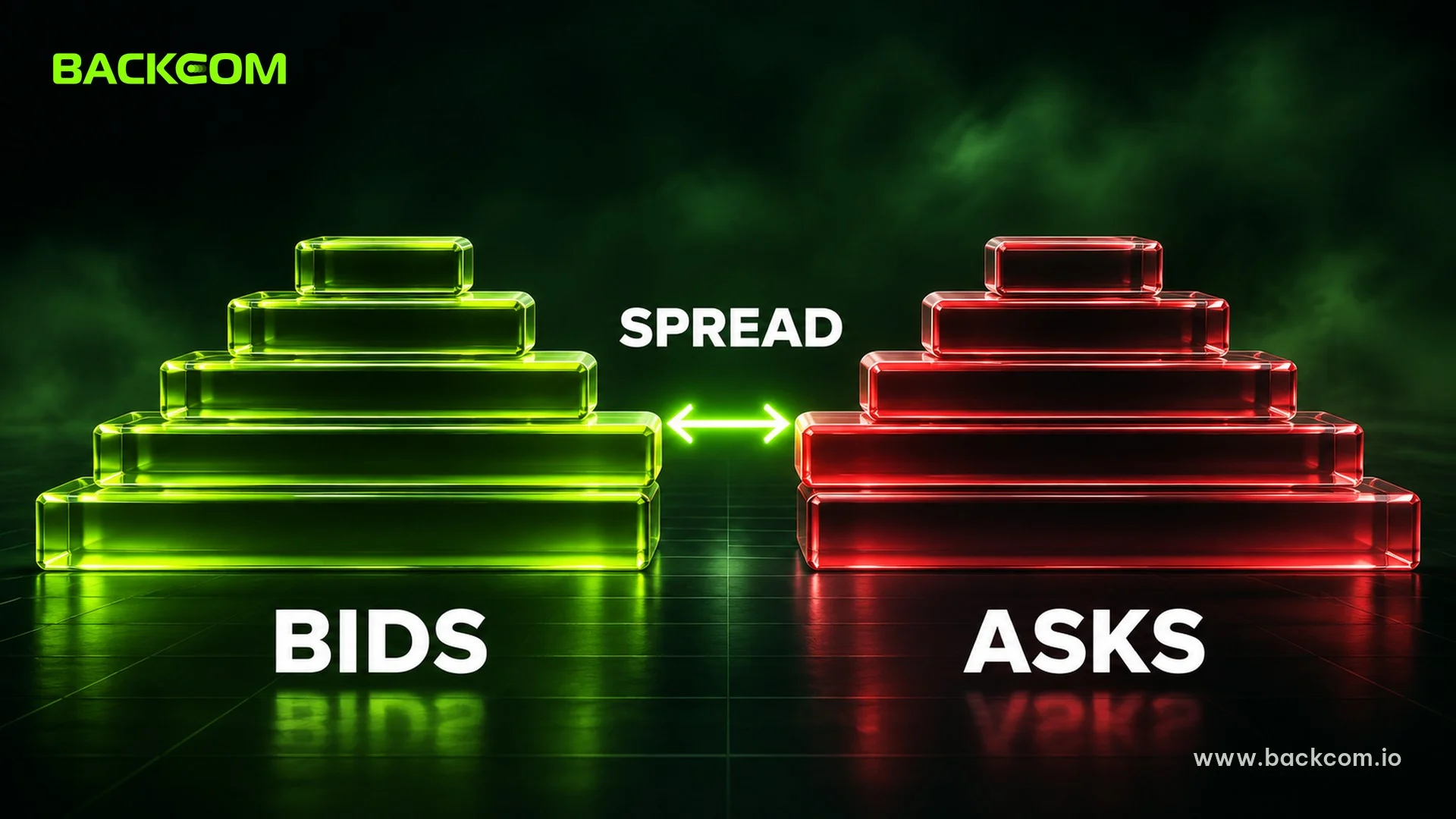
Bids are orders to buy, asks are orders to sell, and the spread is the gap between the highest bid and the lowest ask. Binance Academy defines the spread as the difference between the highest price a buyer will pay and the lowest price a seller will accept, and calls it a hidden cost in every trade. Our short guide to what bid and ask mean goes through the basics.
A Bid And Ask Order Book In A Real BTCUSDT Snapshot
A real snapshot makes this easier to see. The table below shows the top five levels of the BTCUSDT order book on Binance Spot, taken from the public depth endpoint on 26 November 2026 (update ID 103750421991).
| Side | Price (USDT) | Size (BTC) |
|---|---|---|
| Ask 5 | 60,595.41 | 0.20980 |
| Ask 4 | 60,595.40 | 0.00018 |
| Ask 3 | 60,595.14 | 0.01894 |
| Ask 2 | 60,595.13 | 0.00235 |
| Ask 1 (best ask) | 60,594.17 | 5.78768 |
| Bid 1 (best bid) | 60,594.16 | 0.62589 |
| Bid 2 | 60,594.15 | 0.00063 |
| Bid 3 | 60,594.01 | 0.00027 |
| Bid 4 | 60,594.00 | 0.01200 |
| Bid 5 | 60,593.40 | 0.00010 |
Reference snapshot from the Binance Spot public API (top five of ten levels per side shown), taken on 26 November 2026. The book changes many times per second, so treat these figures as an illustration, not a quote.
Reading The Spread In This Snapshot
The best bid is 60,594.16 and the best ask is 60,594.17, so the spread is 0.01 USDT. That is about 0.00002% of the price. A spread this tight is typical for the most traded pairs, and it is a sign of deep liquidity. Binance Academy notes that the larger the order book on both sides, the smaller the spread tends to be.
On a thinly traded token the same gap can be far wider as a share of price, and the spread then becomes a large part of your cost. Compare it with the exchange fees in our guide to maker and taker fees, because the spread is a cost on top of them.
3. How Do You Read Depth: Size, Levels And The Depth Chart?
Depth means how much quantity is waiting at and near the market price. A book can show a tiny spread and still be thin if each level holds only a few cents' worth of coins. Reading depth means looking at size per level and at how far price must move to consume a given amount.
Order Book Depth Crypto Traders Can Measure
Two numbers are enough for a first check: the total size within a set distance of the price (for example the first 20 levels) and the price distance needed to absorb your order. The Binance guide to bid-ask spread and slippage links both to cost: thin depth means a wider spread and more slippage.
How The Market Depth Chart Shows Cumulative Size
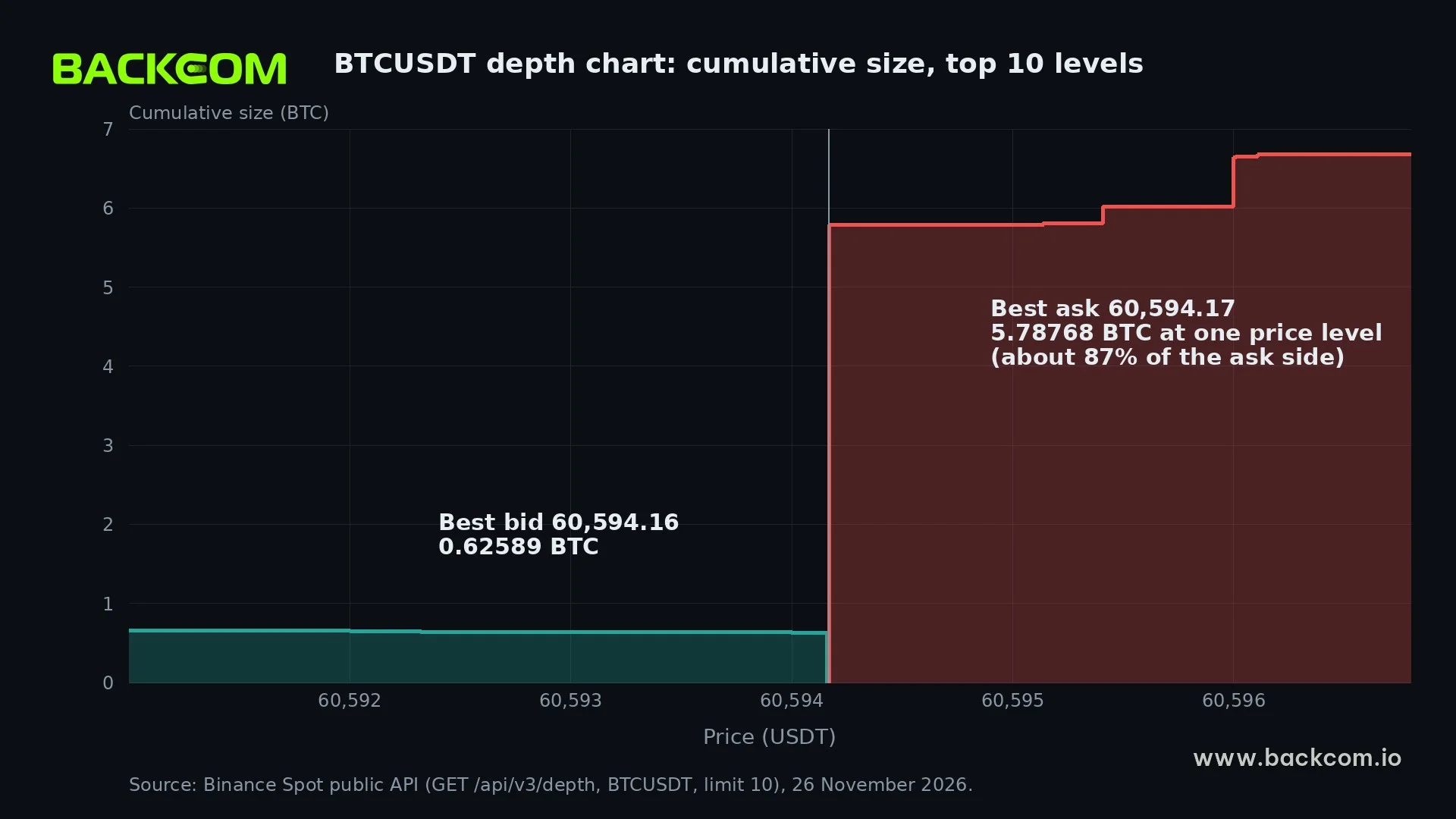
Binance Academy explains the market depth chart as a picture of the same data. The x-axis shows price, the y-axis shows the cumulative volume of orders at each price, bids are drawn in green and asks in red. A steep line means a lot of size sits close to the market. A flat line means a thin book.
What The Top Ten Levels Tell You (And What They Do Not)
In the snapshot, the ten bid levels add up to 0.65968 BTC and the ten ask levels to 6.67525 BTC. That is a bid share of only about 9% of the visible size. It looks like heavy sell pressure, but two details change the story:
- One price level dominates each side. The best ask alone holds 5.78768 BTC, about 87% of the visible ask size. The best bid holds 0.62589 BTC, about 95% of the visible bid size. The API shows one total per price, so that may be one large order or several orders at the same price.
- The window is tiny. Ten bid levels span 2.71 USDT and ten ask levels span 2.07 USDT. That is less than 0.005% of the price.
So a ten-level view of a busy pair tells you about the next few seconds, not about the next move. The Binance Spot API documentation says the depth endpoint returns 100 levels by default and up to 7,500, with a higher request weight for larger requests. Most trading interfaces let you choose how many levels to display, and you should widen the view before drawing any conclusion.
4. What Does A Market Order Do To The Order Book?
A market order takes liquidity from the opposite side of the book, starting at the best price and moving outwards until the full size is filled. A limit order that does not cross the spread instead joins the book and waits. This is the single most useful idea for reading the screen, and it is the basis of the order types in our guide to crypto order types.
Here is a worked example on the snapshot above.
Average fill price = Total cost of all filled levels ÷ Total quantity filled
- Buy 6 BTC at market. The order takes 5.78768 BTC at 60,594.17, then the remaining 0.21232 BTC from the next four levels. Total cost is about 363,565.28 USDT.
- Average price. Dividing 363,565.28 by 6 gives about 60,594.21 USDT, only 0.04 USDT above the best ask.
- Sell 0.65 BTC at market. The order takes 0.62589 BTC at 60,594.16 and the rest from lower levels. The average fill is about 60,594.12 USDT, 0.04 USDT below the best bid.
These figures use the snapshot only. Real fills depend on how the book changes between the moment you see it and the moment your order reaches the exchange.
The lesson is not that slippage is always tiny. It is that BTCUSDT on a large exchange is deep, so a 6 BTC order barely moves it. Run the same maths on a thin pair and the average price can land several percent away from the best quote. A post-only order avoids crossing the spread at all, because it is rejected instead of taking liquidity. A reduce-only order is another order type that only reduces an existing position.
5. How Do You Spot Walls, Imbalance And Thin Books?

You spot these three patterns by comparing size across levels and between the two sides. Each one is a reading of the current book, not a forecast.
Buy Walls And Sell Walls
A wall is an unusually large order at one price. Traders watch walls because a big resting bid may absorb selling at that level, and a big resting ask may absorb buying. Binance Academy describes buy walls and sell walls in exactly this way, as levels that may stop price moving past them.
Look at three things before you give a wall any weight:
- Size relative to its neighbours: a wall is only meaningful when it is far larger than the surrounding levels.
- Distance from the market: a wall far from the price may never be tested.
- Persistence: does it stay while price approaches it, or does it vanish?
Order Book Imbalance
Order book imbalance compares the total size on the bid side with the ask side over a chosen number of levels. A simple version is:
Bid share = Total bid size ÷ (Total bid size + Total ask size)
A bid share above 50% means more visible buy size, and below 50% means more visible sell size. In the snapshot it is about 9%. Remember that the figure depends on how many levels you include and on single large price levels, such as the 5.78768 BTC ask above.
Thin Books
A thin book has small size at each level and wide gaps between prices. The warning signs are a wide spread, big jumps between neighbouring prices and a depth chart that is nearly flat. In these conditions, market orders slip more, and stop orders can fill far from their trigger. Our guide to a liquidation heatmap shows another way thin liquidity matters, because forced closings hit the book hard when depth is poor.
6. Why Can't You Fully Trust The Order Book?
You cannot fully trust the order book because it shows intentions, not trades, and intentions can change in a fraction of a second. Binance Academy warns that orders can be placed and removed easily, and that buy walls and sell walls are sometimes used to create false impressions of supply and demand. Such orders may be cancelled quickly once the desired price movement occurs.
The main limits are:
- Orders can be cancelled instantly. A wall that looks solid can disappear as price approaches.
- The book is per exchange. The BTCUSDT book on one exchange is not the whole market. Other venues, and the futures market, have separate books.
- Not everything is displayed. Where an exchange offers order types that hide part of the size, you only see the visible part.
- Snapshots go stale. By the time you read a level, the book has updated many times.
- Spot and futures differ. Futures prices are also influenced by funding and open interest, which the book does not show. Our explainer on open interest in crypto futures covers that missing context.
The practical rule is to treat the order book as one input. Combine it with price action, volume and your own risk limits. Binance Academy itself says the order book should be used together with other tools.
7. How Can You Use The Order Book In A Simple Routine?
A sensible routine uses the order book to check cost and risk before you place an order, not to predict direction. These steps work on any exchange:
- Read the spread. Compare best bid and best ask, and note the gap as a percentage of price.
- Widen the view. Show at least the top 20 to 50 levels, or open the depth chart.
- Estimate your fill. Add up the levels your order would consume and calculate the average price with the formula above.
- Choose the order type. If the fill looks poor, use a limit order or split the order into smaller pieces.
- Re-check just before sending. The book may have moved while you were calculating.
Frequently Asked Questions (FAQ) About Reading A Crypto Order Book
What Is The Difference Between An Order Book And A Depth Chart?
The order book is the table of prices and sizes. The depth chart is a graph of the same data with price on the x-axis and cumulative size on the y-axis. The table is better for exact numbers at the top of the book. The chart is better for seeing walls, gaps and the overall shape of liquidity at a glance.
Does A Bigger Bid Side Mean Price Will Go Up?
No. A larger bid side only means more visible buy size at that moment. Orders can be cancelled, and one large order can distort the total. Market buy orders and sell orders keep arriving, so imbalance describes the current queue, not where price must go next.
Why Does My Market Order Fill At A Different Price?
A market order walks through the book from the best price outward, so a larger order fills at several prices and the average moves away from the quote you saw. The book can also change between your click and the fill. Splitting the order or using a limit order reduces the effect.
Are Buy Walls And Sell Walls Reliable Signals?
Not on their own. A wall can hold price, but it can also be cancelled or moved before price arrives. Check whether it persists, how large it is next to nearby levels and whether trades actually happen against it before giving it weight.
How Many Levels Of The Order Book Should I Look At?
For a quick cost check, the top 10 to 20 levels are enough. To judge liquidity or a large order, look at 50 levels or more, or use the depth chart. On a liquid pair such as BTCUSDT, ten levels may cover only a few dollars, as the snapshot above shows.
Conclusion: Use The Order Book To Measure Cost, Not To Guess Direction
Reading a crypto order book comes down to a short list: find the best bid and ask, measure the spread, check how much size sits near the market, and work out the average price your order would get. Walls and imbalance are useful context, but they can be cancelled in an instant, so they never replace risk limits. Start by checking the spread and your estimated fill on every order, then build further from our guide to crypto order types.
Disclaimer: This content is compiled by Backcom.io for information only and is not investment advice. Crypto trading carries a high risk of loss, and rules differ by country, so check what applies where you live before you trade. Figures from the snapshot are illustrative and change continuously.
Was this article helpful?
Join The Backcom.io Community
Get the latest on trading rebates, trading tips, and broker deals — and connect with thousands of traders worldwide.

Backcom App
Track Your Rebates Every Day
Every rebate is visible by broker and by day. Manage your wallet and withdrawals in one place.
Open Backcom App