Is Forex Gambling? 5 Differences And The Real Risks

The question is forex gambling comes up in almost every beginner group, usually right after a first account loses a third of its balance in a single week. The short answer is that the currency market is not a game of chance, but the way many people trade forex looks so much like betting that regulators' own figures show most retail accounts lose money.
So asking whether forex is gambling is not enough. You need to separate two layers: the nature of the market, and the behaviour of the person sitting in front of the screen. Each layer has at least one real difference from gambling, and at least one risk that traders tend to overlook.
In this article, Backcom.io walks through 5 differences between forex and gambling, explains why most traders lose money in forex, separates market risk from broker fraud, and ends with three things to do before real money goes into an account.
1. Forex Vs Gambling: How Do The Products Differ?
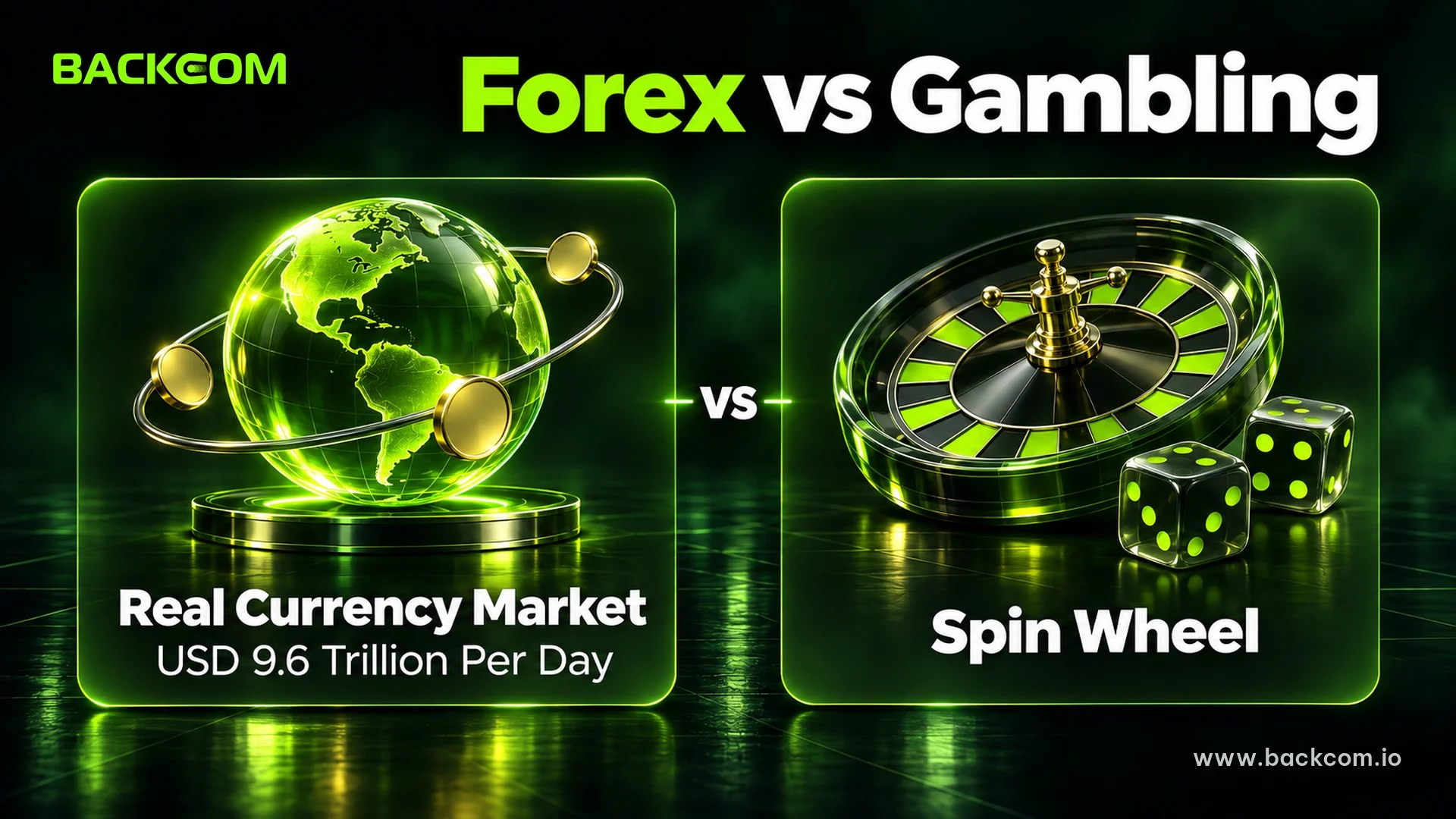
Forex is the market where currencies are exchanged, and its prices reflect real supply and demand from banks, companies, funds and central banks. Gambling is staking money on a random outcome designed by the organiser, who keeps a fixed advantage over time. The two differ at the source of the result.
According to the Bank for International Settlements (BIS) triennial survey, over-the-counter foreign exchange trading reached about USD 9.6 trillion per day in April 2025, with the US dollar on one side of 89.2% of trades. That volume comes from trade payments, currency hedging and investment, not from a wheel programmed in advance.
That said, the difference only holds for the currency market as a whole. Most retail traders do not buy and sell physical currency. They trade contracts for difference (CFDs) or margin contracts through a broker. These are contracts between the trader and the broker that follow market prices but carry their own terms on spread, swap, leverage and automatic closing.
The point to grasp is that the price is real, while your position is a financial product with fees and leveraged risk. If the basics are still unclear, read Forex Trading For Beginners: What Is Forex first, because every comparison below builds on it.
For the source, see the BIS survey of foreign exchange turnover in April 2025.
2. Who Controls The Risk On Each Trade?
Control over risk is the most practical difference between the two. At a gambling table, the stake and the odds are set by the house, and the player only chooses whether to bet. In forex, the trader chooses the position size, the entry, the stop loss and the profit target on every trade.
A trader can control the following:
- Position size: on the same account, a 0.01 lot trade and a 1 lot trade carry risks a hundred times apart.
- Stop loss: the maximum amount you accept losing is fixed before the trade opens.
- Reward to risk: a trade targeting twice its risk only needs to win more than one in three trades to break even before costs.
- Trading frequency: fewer trades mean lower total costs.
The most common guideline is to risk about 1% of the account per trade, explained in Forex Money Management: The 1% Rule And Lot Size. On a USD 1,000 account, 1% risk means each trade loses about USD 10 at most, so a losing streak cannot wipe out the balance quickly.
However, this control cuts both ways. It lets a trader survive, but it also lets a trader stake far too much. That is why forex is not automatically gambling, and not automatically safe either.
3. How Do Trading Costs Change The Expected Result?
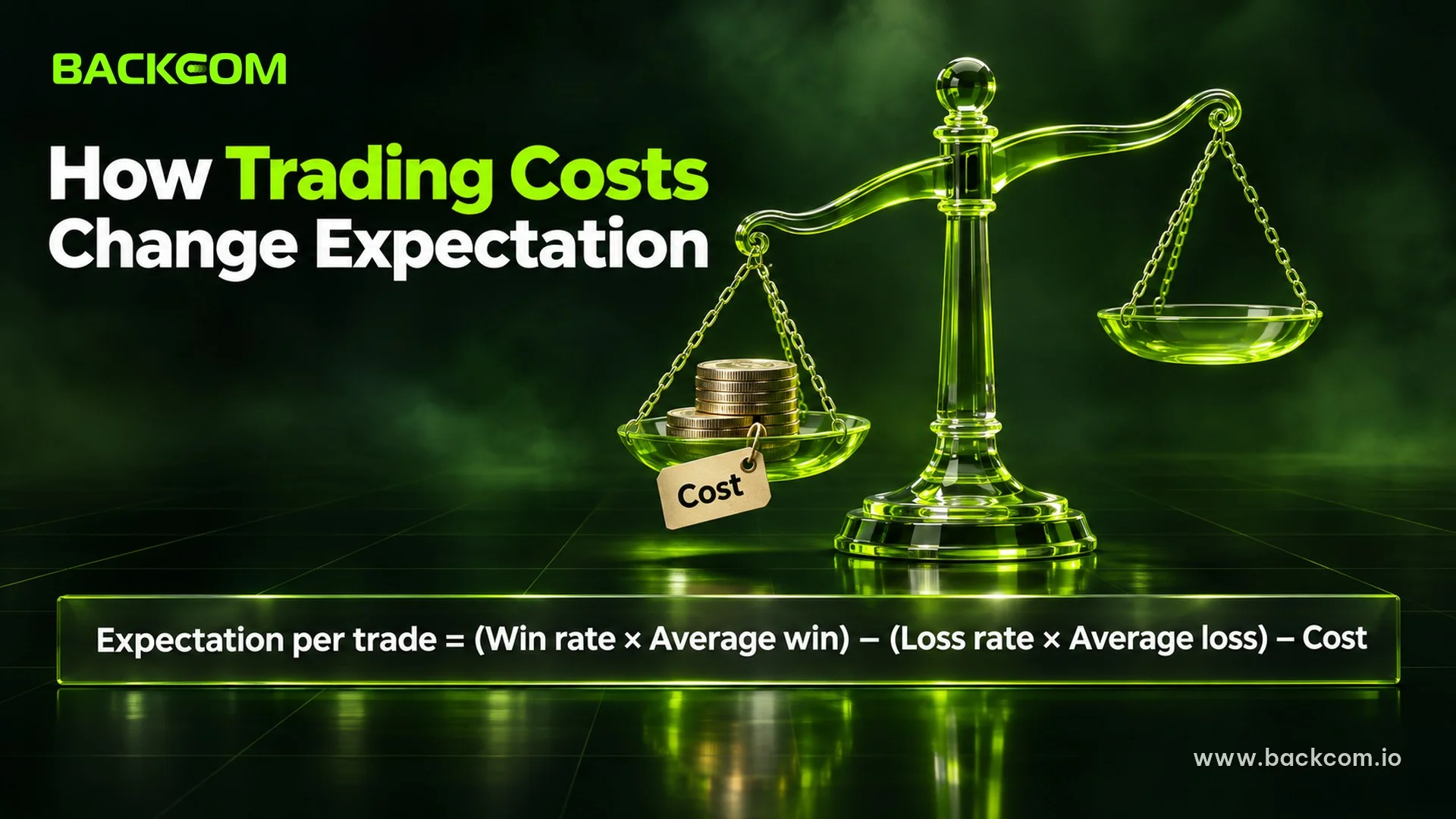
Trading costs are what a trader pays the broker on each trade: spread, commission and overnight swap. This is where forex resembles gambling most closely. Win or lose, the cost is still deducted, so the expectation of a trader without a real edge turns negative over time.
You can write the expectation per trade as a simple formula:
Expectation per trade = (Win rate × Average win) − (Loss rate × Average loss) − Cost
Suppose a trader wins exactly 50% of trades, wins USD 10 on each winner, loses USD 10 on each loser, and pays USD 0.70 per trade. The expectation is negative USD 0.70 per trade, and after 100 trades the account is down about USD 70 even though wins and losses are balanced. This is a worked illustration, not data from any particular broker.
The same arithmetic explains why scalping or opening too many trades is expensive: costs add up faster than the edge the trader believes they have. To compare brokers on equal terms, use the method in How To Compare Forex Broker Costs.
Real data is clearer than theory. In a 2026 release, the Australian Securities and Investments Commission (ASIC) reported that in the 2024 financial year 68% of retail CFD clients lost money, with total losses above A$458 million, of which A$73 million was fees. This covers one market and one year, so it cannot be copied across every broker, but it shows the baseline for retail traders.
For the source, see ASIC media release 26-004MR on the CFD sector.
This is the main reason many traders lose. They do not lose because the market is built to make them lose, but because costs, leverage and behaviour add up to a negative expectation they never calculated.
4. How Do Regulators View Retail Forex?
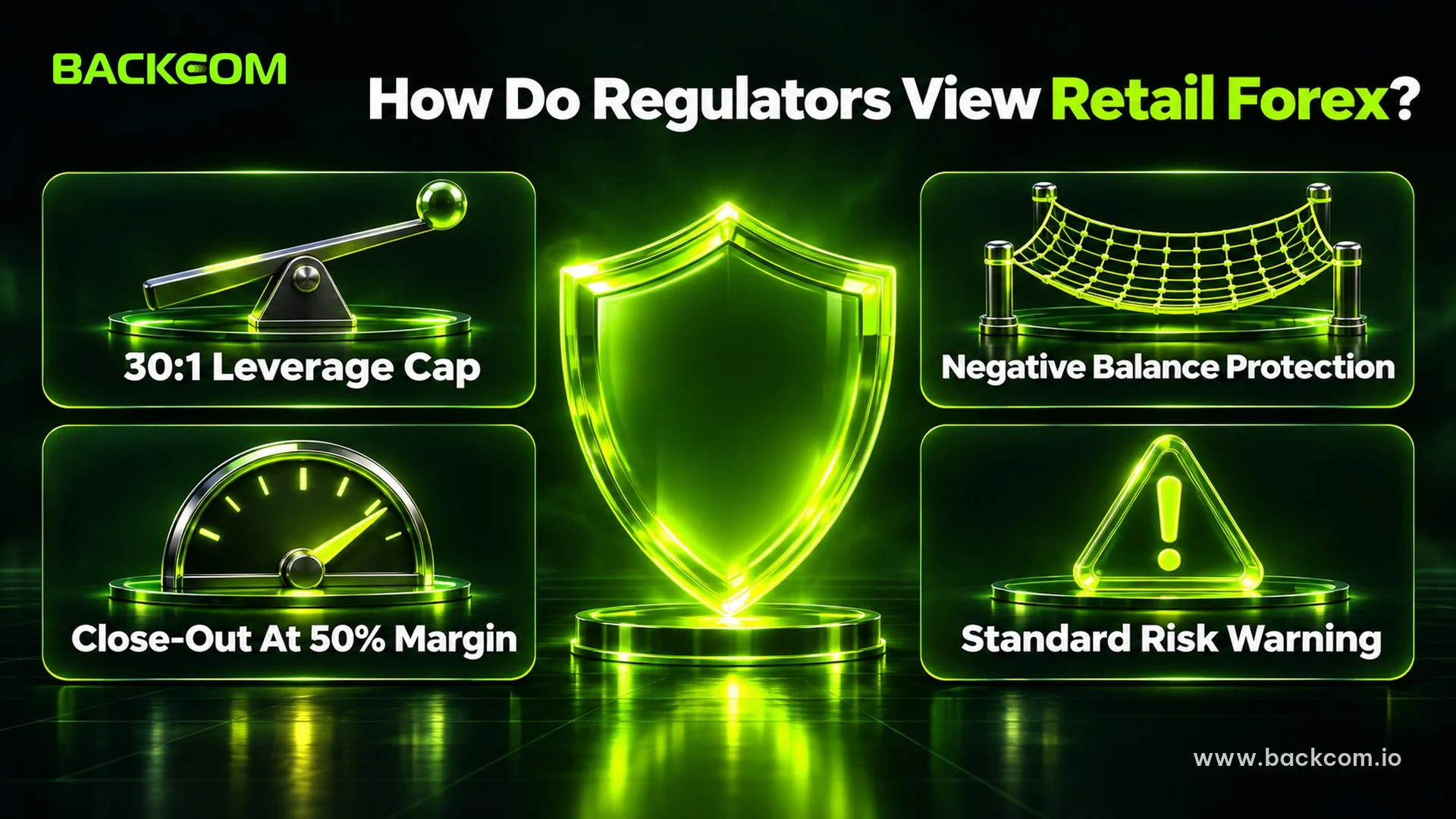
Regulators do not treat retail CFDs as a safe product. They allow the product to exist, but set limits so that a retail account cannot lose more than the money deposited. This is a difference in the protection framework, and it is also a reminder of the level of risk.
In 2018 the European Securities and Markets Authority (ESMA) adopted product intervention measures for retail CFDs:
- Leverage limits: at most 30:1 for major currency pairs, lower for more volatile assets.
- Negative balance protection: a retail client cannot lose more than the funds in their CFD account.
- Close-out at 50% of minimum margin: the provider must close positions when equity falls to that level.
- Standardised risk warning: the provider must publish the share of retail accounts that lose money.
The fact that regulators had to force these limits shows they view high-leverage products as a hazard for newcomers.
For the source, see the ESMA statement of 1 June 2018 on CFD product intervention measures.
Legal status is a separate question that depends on where you live. Rules, licensing and taxes differ by country of residence, so you should check the rules that apply to you and the broker's licence before depositing money.
5. Is Trading Forex Like Gambling? When Behaviour Crosses The Line
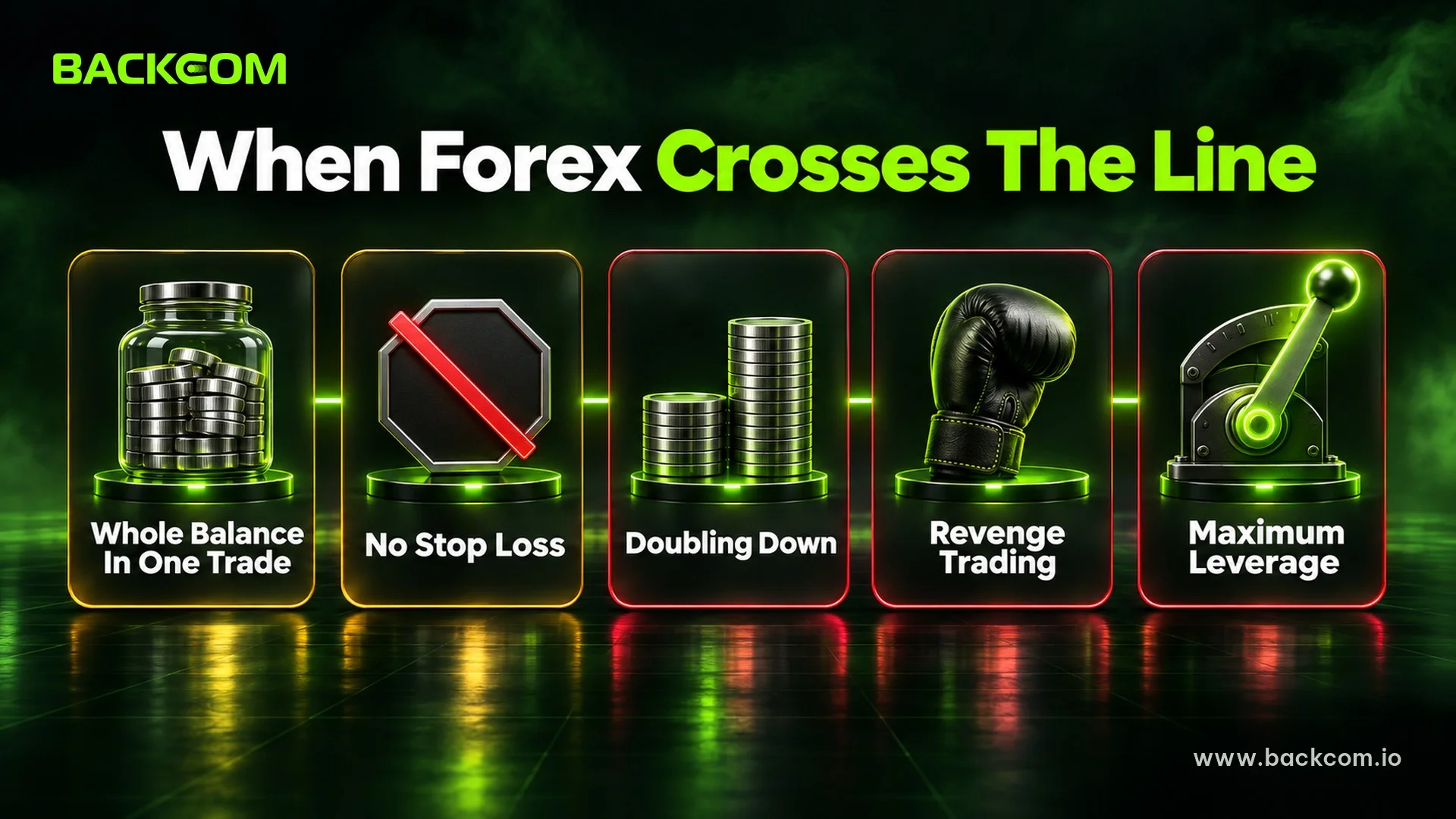
Trading forex like gambling means opening trades with no risk plan, no testable reason to enter, and accepting the outcome like a coin toss. The product is still forex, but the behaviour has become betting.
Common warning signs include:
- Putting the whole balance into one trade: one wrong call wipes out most of the account.
- No stop loss: hoping price comes back instead of taking a small loss.
- Doubling down after each loss: raising the size to win it back, often called martingale.
- Revenge trading: opening trade after trade straight after a loss, driven by emotion.
- Maximum leverage: a small move is enough to trigger a margin call.
Each sign makes the negative expectation from section 3 worse. Before increasing size, make sure you understand what leverage is in forex and how a margin call differs from a stop out.
The most important point is that feeling right after a win does not prove skill. A short winning streak on a large size can still be luck, and that feeling is exactly what makes many people raise their stakes when the odds are against them.
6. Is Forex A Scam? Market Risk Versus Fraudulent Brokers
Is forex a scam is really two questions in one: the risk of losing money to the market, and the risk of losing money to a broker or an impersonator. The currency market is not a scam, but many scams dress up as forex, and the two need to be told apart.
Market risk is when you place the trades, price moves against you, and the account loses while the broker still pays out when you withdraw. Fraud risk is when the broker has no credible licence, blocks withdrawals, or a stranger messages you promising guaranteed signals.
A few signs help separate them:
- A promise of fixed returns: no leveraged trade can guarantee a profit.
- A request to deposit into a personal account: a legitimate broker does not take funds through an employee's account.
- A licence you cannot verify: the entity name and licence number do not match the regulator's register.
- Pressure to deposit more to unlock withdrawals: this is a familiar scam script.
A fuller list is in Signs Of A Forex Broker Scam And How To Avoid It. A licensed broker can still be a place where you lose money through your own decisions, which is why the two ideas must stay separate.
7. Three Things To Do Before You Put Real Money Into Forex
Preparing before live trading is the most practical way to reduce the gambling element in your behaviour. The three steps below do not guarantee profit, but they show what risk you are accepting.
- Set a loss you can afford: use only money whose complete loss would not affect your living costs, and keep risk per trade around 1% of the account.
- Test your plan on a demo account or with small size: keep a journal of at least a few dozen trades, include costs, and only then consider raising size.
- Measure the broker's real cost: compare spread, commission, swap and any rebate instead of one advertised number.
On the third step, a rebate reduces part of the cost but does not turn a losing strategy into a winning one. You can read how it works in Is Forex Cashback Legit? Real Risks and compare broker terms on the partner broker page.
Backcom.io is an independent introducing broker (IB/affiliate) of the brokers listed on its pages; rebates are paid from the commission the broker pays Backcom.io, as explained in the risk disclaimer.
Frequently Asked Questions (FAQ) About Forex And Gambling
Is Forex Gambling?
No, but it can become gambling depending on how you trade. Forex is a market where prices come from real supply and demand and the trader decides the risk on each trade, while gambling has a random outcome designed by the house. Even so, staking the whole balance, skipping stop losses and doubling down make behaviour resemble betting, and ASIC data shows 68% of retail CFD clients lost money in the 2024 financial year.
Is Trading Forex Like Gambling If You Use High Leverage?
High leverage pushes behaviour closer to gambling, but it does not turn the product into gambling by itself. Leverage magnifies both gains and losses, so a small move can trigger a margin call. This is why ESMA caps leverage at 30:1 on major currency pairs for retail clients in Europe.
Why Do Most Traders Lose Money In Forex?
The cause is usually a mix of three things: trading costs that make the expectation negative, leverage that makes losses arrive faster, and emotional habits such as skipping stop losses or raising size to recover. Why most traders lose money in forex is therefore rarely a single reason, and the way to lose less is to deal with each factor.
Is Forex A Scam?
The currency market is not a scam, but fake brokers and signal groups exist. Check the licence on the regulator's own website, never deposit into a personal account, and doubt any promise of fixed returns. See section 6 of this article for more signs.
Conclusion: Forex Is Not Gambling, But Traders Can Turn It Into Gambling
Is forex gambling is a question that needs a two-layer answer. As a product, forex has real prices, risk that the trader sets, and a framework set by regulators. As behaviour, costs, leverage and emotion can push a trader into a negative expectation that looks like a bet.
Traders should look at three things together: risk per trade, total trading costs and the reliability of the broker. Doing all three does not guarantee profit, but it helps separate market risk from risk you create yourself.
If you are starting from zero, go back to Forex Trading For Beginners: What Is Forex and then use Forex Money Management: The 1% Rule And Lot Size to set your risk before depositing.
Disclaimer: This content is compiled by Backcom.io for information only and is not investment advice, a trading recommendation or legal advice. Trading leveraged forex and CFDs carries a risk of losing all your capital. Figures from BIS, ASIC and ESMA are given as at each regulator's publication date and may change.
Was this article helpful?
Join The Backcom.io Community
Get the latest on trading rebates, trading tips, and broker deals — and connect with thousands of traders worldwide.

Backcom App
Track Your Rebates Every Day
Every rebate is visible by broker and by day. Manage your wallet and withdrawals in one place.
Open Backcom App