Auto Deleveraging Crypto Futures (ADL): What It Is And How It Works

Auto deleveraging (ADL) is the last safety step a crypto futures exchange uses when a liquidated trader's losses are too big for the exchange's reserve fund to cover. Instead of letting the loss spill onto everyone, the exchange forcibly closes part of a profitable opposite position, and that winner may be you. Searches for auto deleveraging crypto usually come from traders who have just seen an ADL warning light on a profitable position. In this article, Backcom.io explains what ADL is, when it triggers, how traders are ranked for it, and what you can do to lower the odds of being picked.
1. What Is Auto Deleveraging In Crypto Futures?
Auto deleveraging in crypto futures is a forced reduction of a profitable position, applied only after normal liquidation has failed to contain a loss. The exchange closes the winning trader's position against the bankrupt trader's position so that the books still balance.
If you are new to the basics, start with our beginner guide to how crypto works. Binance describes it as "the final step in the liquidation process" that happens "only if the Futures Insurance Funds are unable to accept a bankrupt futures position" (Binance ADL FAQ). OKX calls it "the final liquidation process" used to protect its security funds when a fund cannot take over more bankrupt positions (OKX ADL help page).
Auto Deleveraging Crypto Meaning In Plain Words
Three facts set the idea apart from ordinary liquidation:
- It hits winners, not losers. The trader who is auto-deleveraged was on the right side of the move.
- It is a last resort. It comes after liquidation and after the insurance fund has been used.
- It happens with no fee. Both Binance and OKX state that no trading fee is charged on a position closed this way.
ADL In Crypto Futures And Perpetual Contracts
ADL in crypto futures matters most for contracts such as perpetual futures, where leverage lets a small price move erase a margin balance quickly.
2. Why Do Exchanges Need ADL?
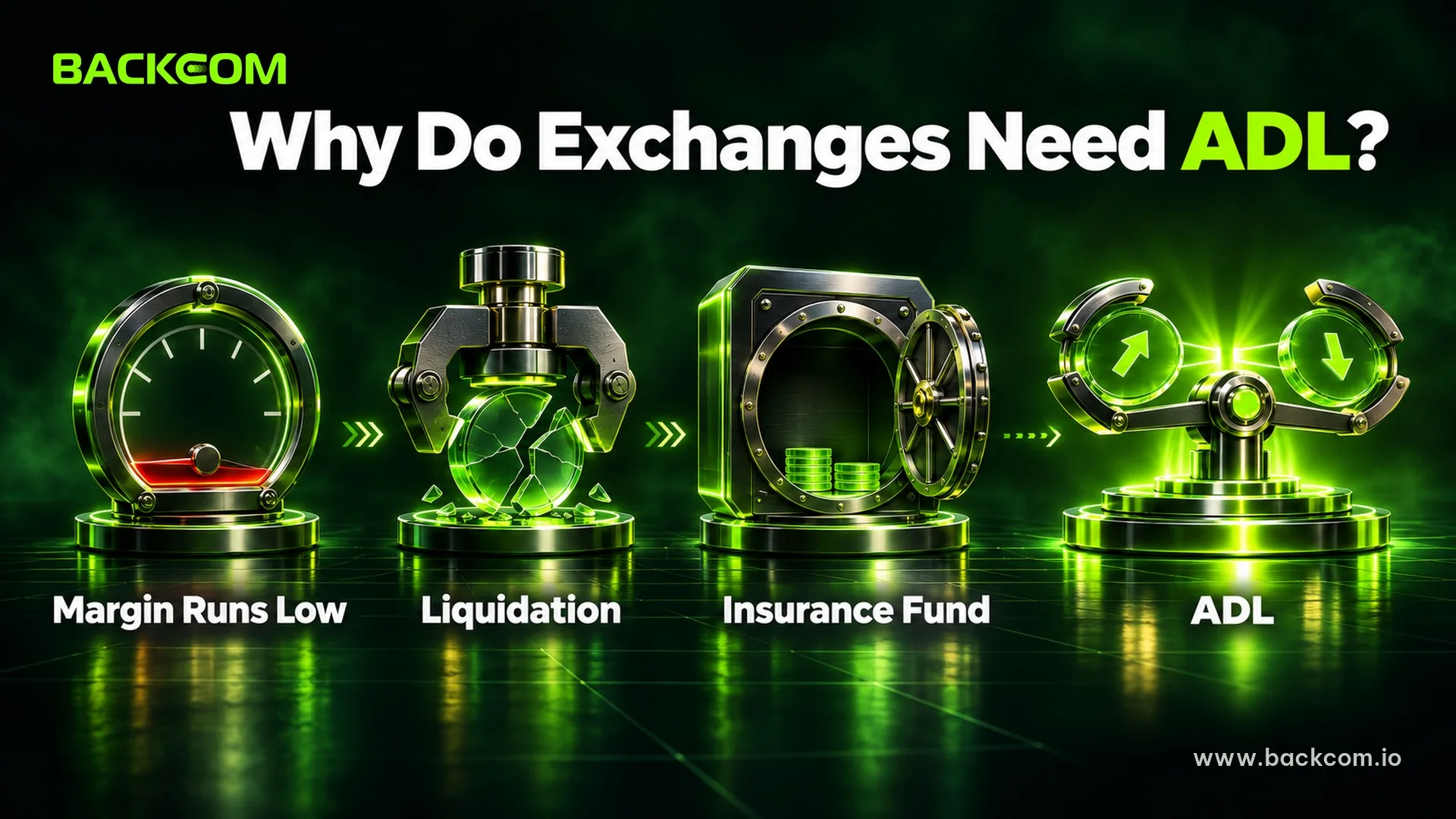
Exchanges need ADL because a futures contract has two sides, and every profit is another trader's loss. If one side goes bankrupt and nobody pays the shortfall, the other side's profit is not backed by real money.
Here is how the chain normally works, step by step:
- Margin runs low. Price moves against a leveraged position until its margin barely covers the loss.
- Liquidation starts. The exchange closes the position at the liquidation price, a little before the margin is gone. Our guide to calculating liquidation price shows the maths.
- The insurance fund takes over the bankrupt position. It is the first cushion for the loss. The insurance fund explainer covers this part.
- ADL steps in. If the fund cannot absorb the loss, the exchange selects profitable opposite positions and closes them.
Funding payments are a separate cost; see what the funding rate is. Binance adds a caution: because of crypto volatility and high leverage, "it is not possible to completely avoid ADL liquidations." So ADL is rare, but it is a designed part of the system and not a bug.
3. When Does ADL Trigger?
ADL triggers when the reserve fund can no longer absorb bankrupt positions. The exact test belongs to each exchange, and the wording differs.
| Exchange | Documented trigger | Source |
|---|---|---|
| Binance | The Futures Insurance Funds are unable to accept a bankrupt position | Binance ADL FAQ |
| OKX | The value of the applicable security fund drops significantly below a preset threshold; ADL stops when it recovers above the threshold plus a buffer | OKX ADL help page |
Reference points as at 21 November 2026. The Binance page was last updated on 13 January 2026 and the OKX page on 11 August 2026. Rules can change, so check the current page before you rely on any detail.
Insurance Fund Vs ADL
The insurance fund vs ADL difference is simple: the fund is the first cushion and ADL is the second. The fund is a reserve the exchange keeps to take over bankrupt positions, while ADL uses the profitable positions of other traders. In short, ADL is the point where users' positions take the hit.
Binance notes that coin-margined contracts are more likely to be auto-deleveraged than USD-margined contracts, because contracts sharing the same collateral coin share one smaller fund. So the contract you trade changes your exposure.
4. How Does The ADL Ranking Decide Who Gets Closed?
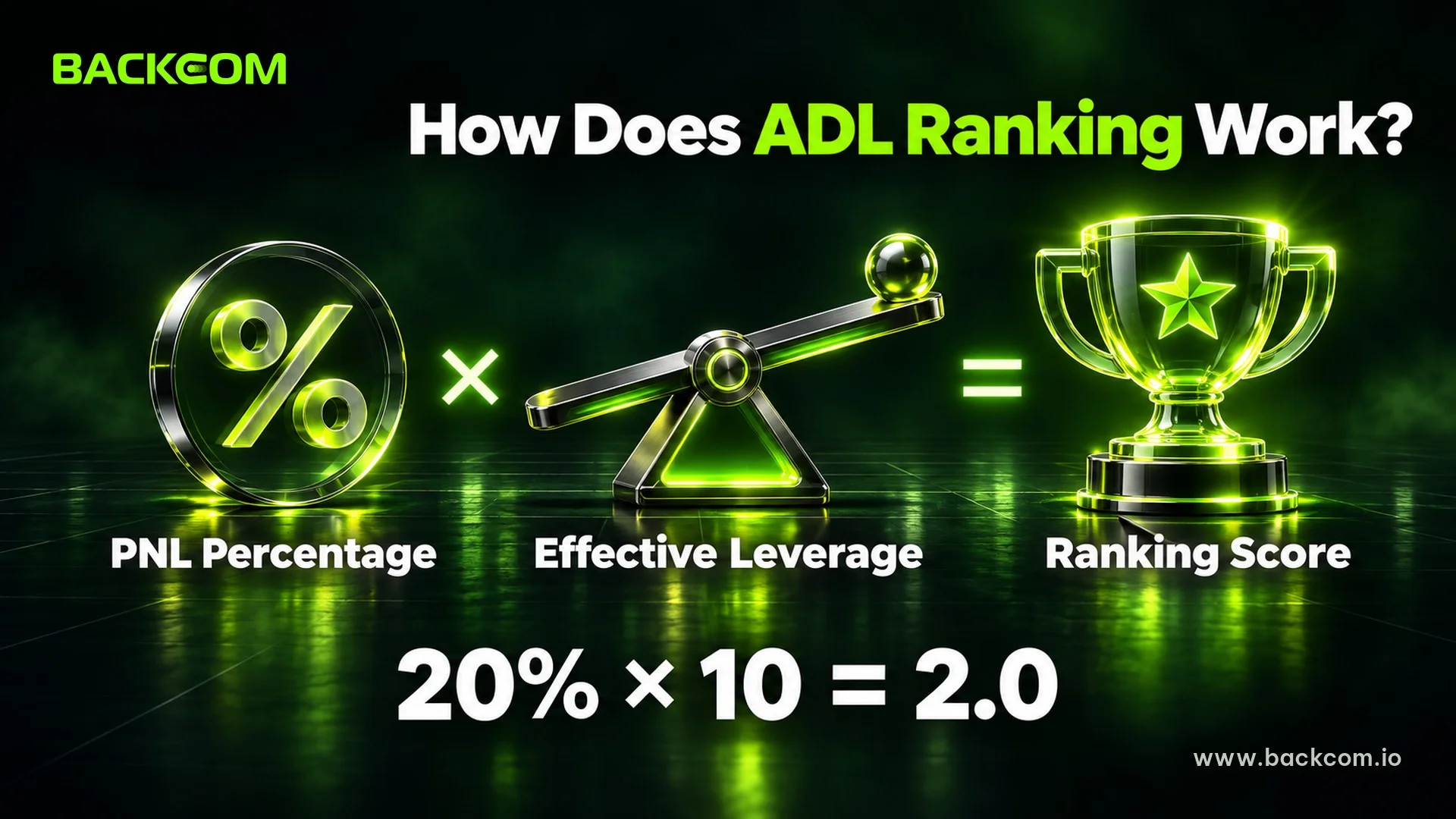
The ADL ranking puts the most profitable and most leveraged positions first in the queue. The rule is that "positions that are more profitable and more highly leveraged will be queued for ADL liquidation first," according to Binance.
ADL Ranking Position Formula
Binance publishes its ranking formula. It uses two inputs:
- PNL percentage: unrealized profit divided by the absolute position notional.
- Effective leverage: absolute position notional divided by account balance plus unrealized profit.
For a profitable position, the score is simple:
Ranking score = PNL percentage × Effective leverage
A higher score means a higher place in the queue. Binance also publishes a quantile, which is your rank divided by the total user count. Its page does not spell out how that maps to the indicator on screen. OKX ranks on a similar "leverage PnL%" basis, with its own variation based on the account's maintenance margin ratio.
A Worked Example
Here is an illustrative example with round numbers, not real market data. Three traders hold profitable positions on the same side:
| Trader | PNL percentage | Effective leverage | Ranking score | Queue place |
|---|---|---|---|---|
| A | 20% | 10 | 2.0 | First |
| B | 20% | 3 | 0.6 | Second |
| C | 5% | 10 | 0.5 | Third |
Trader A and trader B earn the same percentage, but A uses more than three times the leverage, so A is ahead in the queue. Trader C has the same leverage as A and a much smaller profit, which puts C last. The lesson is that profit and leverage both push you up the queue, so a big winner on high leverage is the most exposed.
5. What Price Is Used When A Position Is Auto-Deleveraged?
The price used is often not the price on your chart. Binance says the profitable position "will be closed at the Bankruptcy Price of the liquidated order for the losing trader." The bankruptcy price is the level where the liquidated trader's margin balance equals zero, and Binance warns it "may be out of the contract's market price range."
A simple example shows the idea. A trader opens a long on BTC at 100,000 with 10x leverage and isolated margin. A 10% fall wipes out the initial margin, so the bankruptcy price is about 90,000 before fees. Liquidation starts slightly above that level, because the exchange tries to close the position before the margin is gone.
OKX describes a slightly different rule. In normal conditions, deleveraged positions are closed at the mark price at the time of matching. If the fund is nearly depleted, they "could be closed at bankruptcy price."
For you, this means two things. First, you cannot choose the exit price. Second, the trade may be closed at a price that is worse for your plan than staying in the market, because the position you intended to hold is simply gone.
6. What Does The ADL Indicator Show On Your Screen?
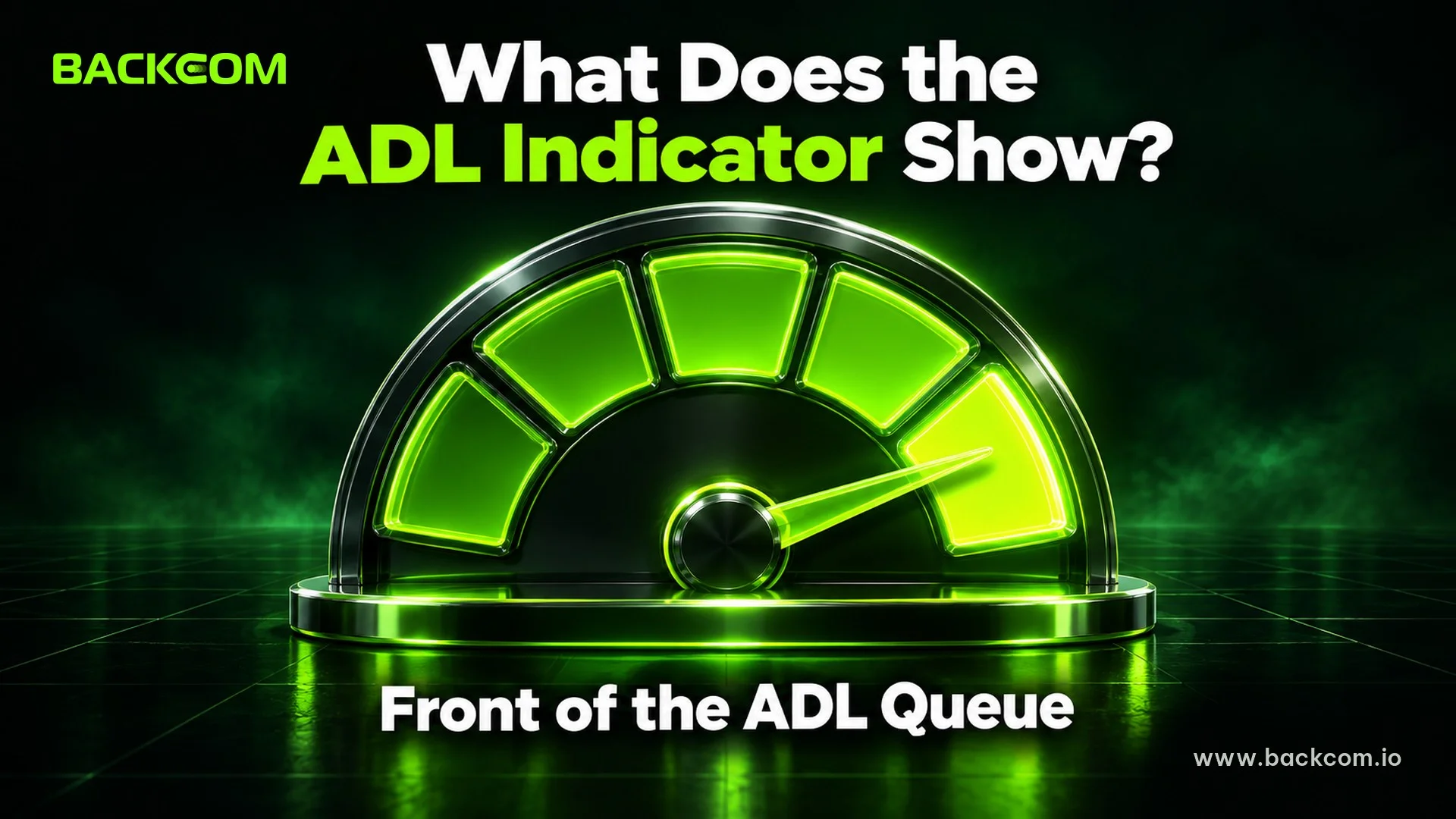
The ADL indicator is a small gauge on the position panel that shows how close your position is to the front of the queue. Binance says each position includes "an indicator of the likelihood that the position will be subject to ADL liquidation."
OKX shows the ADL indicator as a warning light with 1 to 5 bars. In its words, "five lights indicate your position is ranked at the front of the ADL queue." The layout and number of bars differ by exchange, so every platform, including Bybit, should be checked on its own help page.
Use the gauge this way:
- Check it after a big move. A position that has become highly profitable can climb the queue fast.
- Treat a full gauge as a warning. It does not mean ADL will happen, only that your position would be among the first picked if it did.
- Do not rely on an alert. OKX points to its indicator light, the security fund balance and its ADL API channel, says it sends no other warning before ADL, and emails affected users afterwards.
7. How To Lower The Risk Of Being Auto-Deleveraged
You cannot remove ADL risk, but you can lower it. These five steps follow what the exchanges' own pages say, plus the maths of the ranking formula.
- Use lower leverage. Effective leverage is half of the ranking formula, so a smaller multiplier moves you down the queue. See our guide to leverage in crypto trading.
- Add margin to a winning position. OKX lists adding margin to lower the account's effective leverage as a way to reduce ADL risk.
- Take partial profit. A smaller position lowers your effective leverage, and with it your score. Closing part of the trade also locks in a profit that ADL cannot touch.
- Prefer liquid contracts. OKX suggests trading major coins and contracts with deeper liquidity, where large liquidations are less likely to overwhelm a fund.
- Consider a hedged structure. Both Binance and OKX state that hedged positions can rank lower: Binance for accounts that activate Delta Neutral Account and meet its threshold, and OKX for the hedged portion in a delta-neutral strategy.
Margin mode also matters. In an isolated position, a loss is limited to the margin you assigned, and the difference between the modes is covered in cross margin vs isolated margin.
8. ADL Vs Liquidation Vs Margin Call: What Is The Difference?
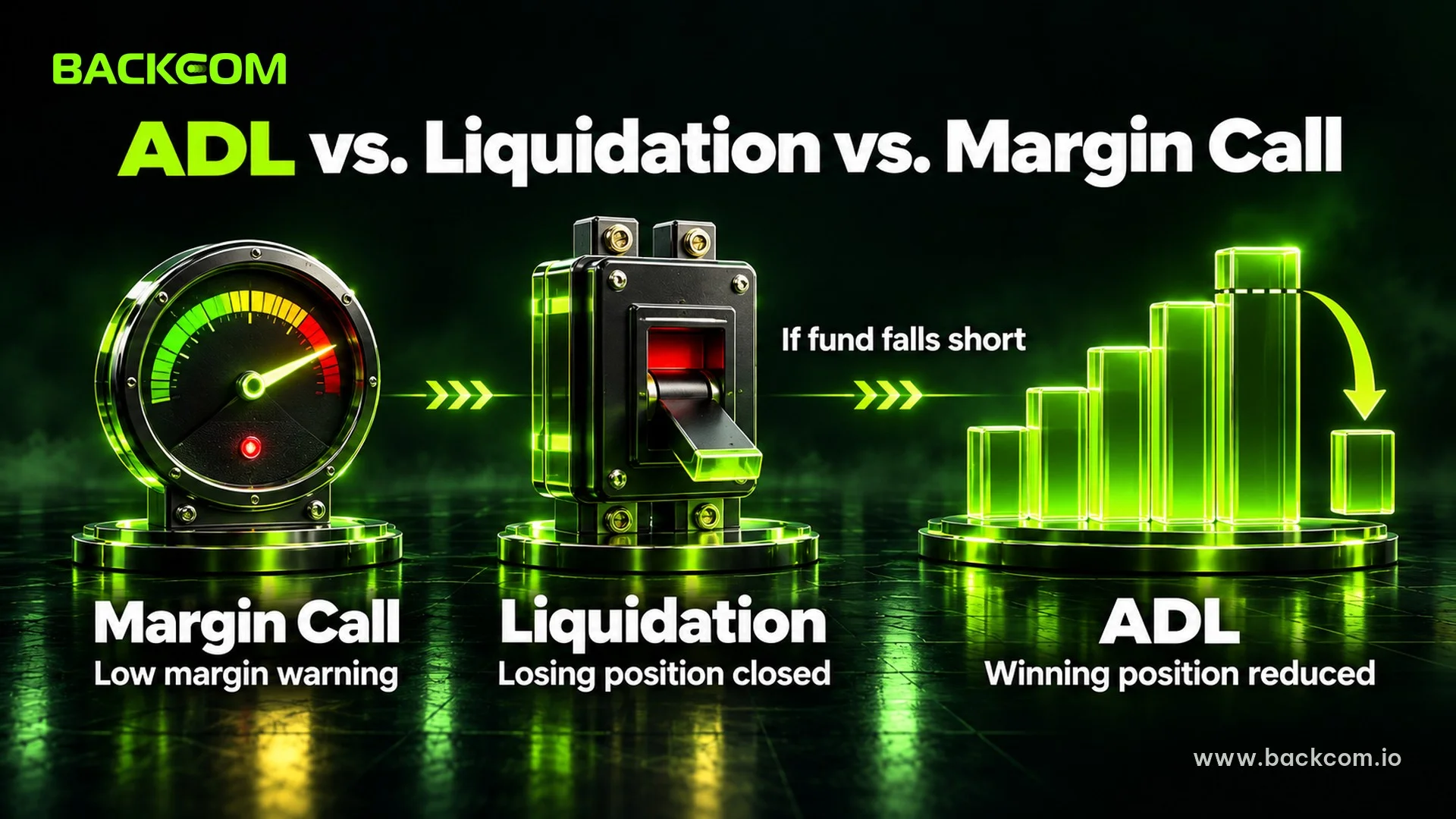
ADL, liquidation and margin calls describe different stages of the same risk chain. Liquidation hits the losing trader, ADL hits the winning trader, and a margin call is only a warning.
| Term | Who is affected | What happens | When |
|---|---|---|---|
| Margin call | Trader with falling margin | Warning to add funds | Before liquidation |
| Liquidation | Trader whose margin is nearly gone | Position is closed by the exchange | When margin falls to the maintenance level |
| ADL | Profitable opposite traders | Part of a winning position is closed | After liquidation, when the fund cannot cover the loss |
A stop loss does not stop ADL, since ADL closes winners. It can still help you manage your own downside; see the guide to crypto stop loss orders and the explainer on a crypto margin call.
Frequently Asked Questions (FAQ) About Auto-Deleveraging
How Often Does Auto-Deleveraging Happen?
It is rare, because it only starts when the insurance fund cannot absorb a bankrupt position. It tends to appear in violent moves where many leveraged positions fail together. Binance states plainly that it is not possible to completely avoid ADL, so treat it as a tail risk rather than a daily event.
Is ADL The Same As Liquidation?
No. Liquidation closes the position of a trader who is running out of margin. ADL closes the position of a trader who is winning, after liquidation and the insurance fund were not enough. One is a punishment for being under-margined, the other is a side effect of someone else's loss.
Do I Pay A Fee If My Position Is Auto-Deleveraged?
No trading fee is charged. Both Binance and OKX say this on their ADL pages. You still lose the position, so check how your exchange treats any funding payments and the final profit calculation.
Can I Check My ADL Risk Before It Happens?
Yes, through the ADL indicator on your position panel. A higher score means a higher place in the queue. The gauge does not predict whether ADL will happen. It tells you where you would stand if it did.
Does Using Less Leverage Remove The Risk Completely?
No. Lower leverage lowers your place in the queue, but it does not take you out of it. If the fund is depleted and your position is profitable, it can still be selected. Combine lower leverage with sensible position sizing, such as the approach in our position size calculator guide.
Conclusion: ADL Is The Price Of Leveraged Markets
Auto-deleveraging is the final backstop when liquidation and the insurance fund are not enough. It closes profitable positions at a price you do not choose, and the ranking favours big profits on high leverage. You cannot switch it off, but you can lower the odds by using less leverage, adding margin, taking partial profit and watching the indicator after large moves. Read your own exchange's ADL page before you size a position, because triggers, prices and indicators differ from one platform to another.
Disclaimer: This content is compiled by Backcom.io for information only and is not investment advice. Crypto futures carry a high risk of loss, and leveraged positions can be liquidated or auto-deleveraged. Rules differ by country and by exchange, so check the product terms and your local regulations before you trade.
Was this article helpful?
Join The Backcom.io Community
Get the latest on trading rebates, trading tips, and broker deals — and connect with thousands of traders worldwide.

Backcom App
Track Your Rebates Every Day
Every rebate is visible by broker and by day. Manage your wallet and withdrawals in one place.
Open Backcom App